Oracle

Oracles are essential infrastructure components that feed real-time, off-chain data (such as price feeds, weather, or sports results) into blockchain smart contracts. Without decentralized oracles like Chainlink and Pyth, DeFi could not function. In 2026, oracles have evolved to support verifiable randomness and cross-chain data synchronization. This tag covers the technical evolution of data availability, tamper-proof price feeds, and the critical role oracles play in ensuring the deterministic execution of complex decentralized applications.

5122 Articles
Created: 2026/02/02 18:52
Updated: 2026/02/02 18:52
The Top 5 Crypto Coins That Could Explode by 2026

The Top 5 Crypto Coins That Could Explode by 2026

The crypto market never sleeps, and the next bull run might already be warming up. Here are five digital assets with real potential to shape the future and maybe your portfolio. Imagine this: Back in 2011, you skipped Bitcoin, and in 2016, you laughed at Ethereum. Fast forward, those “fads” turned into empires. Now 2026 could be the same kind of turning point, if you’re paying attention. Here are five crypto projects worth keeping an eye on for the next big wave. 5. Ethereum (ETH) Ethereum has had its share of growing pains: High gas fees, network congestion, and countless “Ethereum killers” trying to take its crown. Yet, it’s still here, still leading, and still evolving. With Ethereum 2.0 upgrades fully underway and Layer 2 solutions like Arbitrum and Optimism scaling the ecosystem, ETH could remain the backbone of decentralized finance, gaming, and NFT’s well into 2026. If you believe in Web3, Ethereum is still the safest bet outside of Bitcoin. 4. Solana (SOL) After the 2022 crash, many people wrote Solana off as a failed experiment. But the truth is, Solana’s speed and ultra-low fees have attracted developers back in droves. Its ecosystem is thriving with DeFi projects, NFT marketplaces, and even serious moves into payments. If Solana can maintain stability and avoid the outages that haunted it in the past, it has all the ingredients to be a major contender against Ethereum by 2026. 3. Chainlink Chainlink doesn’t always get the hype it deserves, but it quietly powers much of the crypto world. As the leading decentralized oracle network, Chainlink connects smart contracts to real-world data, think stock prices, weather reports, or sports scores.Why does this matter? Because without data feeds, most DeFi apps can’t function. With the rise of tokenized real-world assets, Chainlink could become more essential than ever by 2026. 2. Polkadot (DOT) One of the biggest problems in crypto today is fragmentation. Different blockchains can’t easily talk to each other. That’s where Polkadot comes in. Founded by Ethereum co-founder Gavin Wood, Polkadot’s mission is to connect blockchains into one seamless ecosystem. By 2026, as adoption grows, interoperability will be a huge deal, and DOT could be a key player in making it possible.

  1. Bitcoin (BTC) — The Digital Gold Standard Of course, no top-five list is complete without Bitcoin. While Bitcoin may not be as “exciting” as newer projects, it remains the most trusted, battle-tested, and widely adopted cryptocurrency. With institutional adoption growing and more countries exploring Bitcoin as legal tender, BTC will likely remain the anchor of the entire crypto market. And as history shows, when Bitcoin moves, the whole market follows. Final Thoughts Nobody has a crystal ball, and the crypto world is unpredictable. But what we can do is look at fundamentals, adoption, and long-term vision. Ethereum, Solana, Chainlink, Polkadot, and Bitcoin all check those boxes in their own way. If you’re serious about crypto, tracking your moves is just as important as making them. Stay smart, stay safe, and never invest what you can’t afford to lose. If you want to invest in the crypto market and track your trades safely, click the link below and get a free $15 bonus when you sign up to TradingView. Join TradingView — Daily Crypto Invest Disclaimer: “This is an affiliate link, which means I may earn a small commission at no extra cost to you.”
The Top 5 Crypto Coins That Could Explode by 2026 was originally published in Coinmonks on Medium, where people are continuing the conversation by highlighting and responding to this story

Author: Medium
Several multinational companies have established new regional headquarters in the UAE this year, including PayPal and Bitcoin.com.

Several multinational companies have established new regional headquarters in the UAE this year, including PayPal and Bitcoin.com.

PANews reported on September 2nd that Techinasia reported that by 2025, several multinational corporations had established new regional headquarters in the United Arab Emirates, further solidifying the country's position as a global business hub. In April of this year, PayPal opened its first Middle East and Africa regional headquarters in Dubai, covering over 80 markets. Nasdaq-listed telecommunications company Veon relocated its global headquarters to Dubai, and private equity firm Partner Group established a regional office in Abu Dhabi in June. Bitcoin information platform Bitcoin.com moved into the Dubai Multi Commodities Centre (DMCC) cryptocurrency hub, and Fortress Investment Group announced plans to establish an Abu Dhabi office in May. In addition, technology and financial giants such as Meta, Google, Oracle, Microsoft, Amazon, Cisco, Visa and Mastercard have also established regional bases in the UAE.

Author: PANews
Urgent: Bunni DEX Hack Reveals Critical DeFi Security Flaws

Urgent: Bunni DEX Hack Reveals Critical DeFi Security Flaws

BitcoinWorld Urgent: Bunni DEX Hack Reveals Critical DeFi Security Flaws The cryptocurrency world is once again facing a stark reminder of its inherent risks, as news breaks about a significant security incident. The Bunni DEX hack has reportedly led to the loss of approximately $2.3 million across two major blockchain networks: UniChain and Ethereum. This alarming event serves as a critical wake-up call for everyone involved in decentralized finance (DeFi), emphasizing the constant need for vigilance and robust security measures. What Exactly Happened in the Bunni DEX Hack? According to initial reports from blockchain security firm BlockSecFalcon, the decentralized exchange (DEX) Bunni DEX experienced an apparent security breach. The firm quickly identified the compromise, which resulted in a substantial financial loss. While full details are still emerging, the hack’s impact spread across both UniChain and the widely used Ethereum network. Bunni DEX operates as a platform where users can trade cryptocurrencies directly with each other, without the need for a central intermediary. These platforms rely heavily on smart contracts to facilitate transactions, and any vulnerability in these contracts can be exploited by malicious actors. The exact method used in this particular Bunni DEX hack is currently under investigation, but such incidents often stem from complex exploits of smart contract code. Why Are DeFi Platforms Vulnerable to Attacks Like the Bunni DEX Hack? Decentralized finance, while offering unprecedented opportunities for financial freedom, also presents unique security challenges. The open-source nature of many DeFi protocols means their code is publicly viewable, which can be a double-edged sword. On one hand, it allows for community audits; on the other, it gives attackers ample time to scrutinize for weaknesses. Common vulnerabilities that lead to events like the Bunni DEX hack include: Smart Contract Bugs: Errors or oversights in the code can be exploited to drain funds. Flash Loan Attacks: These involve borrowing large amounts of assets, manipulating market prices, and repaying the loan within a single transaction, often exploiting price oracles. Front-Running: Attackers can see pending transactions and place their own orders to profit from the price movement. Private Key Compromises: Although less common for protocol-level hacks, compromised administrative keys can grant access to funds. These sophisticated attack vectors require deep technical knowledge to prevent, making robust security audits an absolute necessity for any DeFi project. Protecting Your Digital Assets: Lessons from the Bunni DEX Hack For users and project developers alike, the Bunni DEX hack underscores the critical importance of security. While developers must prioritize rigorous code audits and implement multi-layered security protocols, users also have a role to play in safeguarding their investments. Here are some actionable insights: Due Diligence: Always research a DeFi project thoroughly before investing. Look for audited smart contracts, experienced teams, and clear communication channels. Diversification: Avoid putting all your funds into a single project, no matter how promising it seems. Wallet Security: Use hardware wallets for significant holdings and be wary of connecting your wallet to unfamiliar or suspicious dApps. Stay Informed: Follow reputable blockchain security firms and news outlets for updates on potential vulnerabilities and hacks. The DeFi space is constantly evolving, and so are the methods used by attackers. Continuous education and adaptation are key to navigating this dynamic environment safely. The community’s collective effort in identifying and mitigating risks is vital for the long-term health and growth of decentralized finance. The incident involving the Bunni DEX hack serves as a potent reminder that even established platforms can fall victim to sophisticated attacks. As the industry matures, the focus on security infrastructure, rapid response protocols, and transparent communication will become paramount. This event should prompt both users and developers to re-evaluate their security postures and work towards a more resilient and secure DeFi ecosystem for everyone. Frequently Asked Questions (FAQs) What is Bunni DEX? Bunni DEX is a decentralized exchange that allows users to trade cryptocurrencies directly with each other without the need for a centralized intermediary, relying on smart contracts for transaction execution. How much money was lost in the Bunni DEX hack? Approximately $2.3 million in digital assets was reportedly stolen during the Bunni DEX hack, impacting both the UniChain and Ethereum networks. Are my funds safe on other decentralized exchanges (DEXs)? While the Bunni DEX hack highlights risks, many DEXs employ robust security measures, including regular audits. However, no platform is entirely risk-free. Always conduct your own research and exercise caution. What steps can I take to protect my cryptocurrency assets from hacks? To protect your assets, use hardware wallets, diversify your investments, research projects thoroughly (checking for audits), and be extremely careful about which dApps you connect your wallet to. Stay informed about security best practices. If you found this article insightful, please consider sharing it with your network to help raise awareness about crucial DeFi security issues. Your share can help others stay informed and vigilant in the evolving crypto landscape! To learn more about the latest crypto market trends, explore our article on key developments shaping Ethereum price action. This post Urgent: Bunni DEX Hack Reveals Critical DeFi Security Flaws first appeared on BitcoinWorld and is written by Editorial Team

Author: Coinstats
Cardano ETF Rumors Build as DOT and LINK Rally With Altcoin Buzz

Cardano ETF Rumors Build as DOT and LINK Rally With Altcoin Buzz

The post Cardano ETF Rumors Build as DOT and LINK Rally With Altcoin Buzz appeared on BitcoinEthereumNews.com. Crypto News Cardano ETF rumors are gaining traction in August 2025, boosting ADA’s price outlook. Polkadot and Chainlink also rally as traders prepare for altseason. The rumors regarding a Cardano (ADA) ETF have reached serious traction in August 2025 attracting new excitement to the market. The catalyst was Grayscale filing an updated S-1 filing with the US Securities and Exchange Commission (SEC) in order to advance its Cardano ETF filing. The proposal outlines that the ETF would be traded on NYSE Arca where it would directly hold ADA but have Coinbase Custody acting as security. That setup eliminates exposure to leverage, or derivatives, which is safer to the traditional investors. Polymarket data show that the probability of an SEC approval of a Cardano ETF has now increased to approximately 87% the previous month-of-time probability of about 63-75%. Such an increase of probability has increased confidence in ADA. The coin has already overcome the resistance of $0.85 on the charts and analysts have a belief that it can move beyond 1.00 should support be maintained. Others even have an eye on a 40-55% price increase in the event that the ETF is cleared. In addition to the ETF buzz, the continued activity of Cardano such as smart contract upgrades, developer tools, and the Midnight privacy protocol have provided investors with grounds to remain optimistic. The only catch is timing. The SEC has already pushed its final decision date of August 27 to October 26 because of its analysis of nearly 100 crypto ETF applications. However, as analysts note, Cardano is among the companies that are on top when regulatory clarity comes. Polkadot (DOT) Polkadot has been trading in the range of $3.80-$4.20 up until August. It is now trading near 3.85 which is a little lower than the position it was…

Author: BitcoinEthereumNews
Cardano ETF Rumors Build — DOT and LINK Rally With Altcoin Buzz

Cardano ETF Rumors Build — DOT and LINK Rally With Altcoin Buzz

The rumors regarding a Cardano (ADA) ETF have reached serious traction in August 2025 attracting new excitement to the market. […] The post Cardano ETF Rumors Build — DOT and LINK Rally With Altcoin Buzz appeared first on Coindoo.

Author: Coindoo
Experts Pick 3 Cryptos To Hold Instead Of Ripple (XRP) For Big 2025 Gains: Chainlink, VeChain And Layer Brett

Experts Pick 3 Cryptos To Hold Instead Of Ripple (XRP) For Big 2025 Gains: Chainlink, VeChain And Layer Brett

The post Experts Pick 3 Cryptos To Hold Instead Of Ripple (XRP) For Big 2025 Gains: Chainlink, VeChain And Layer Brett appeared on BitcoinEthereumNews.com. The market is changing, and there is speculation as investors look beyond Ripple (XRP) for bigger opportunities in 2025. While established players like Chainlink and VeChain continue to build solid foundations, a new meme token is coming: Layer Brett.  This Ethereum Layer 2 memecoin is already drawing attention for its blend of meme culture and real utility, with its presale live at just $0.0053. Analysts are starting to believe it could be one of the next 100x altcoins heading into the crypto bull run of 2025. Layer Brett: Breaking Chains On Layer 2 Unlike the original Brett token stuck on Base, Layer Brett has moved to Ethereum Layer 2, bringing lightning-fast transactions and gas fees slashed to pennies. Ethereum Layer 1 remains secure but often congested, with transaction costs spiking above $10. Layer Brett solves that problem, offering scalability and performance that older meme tokens lacked. This is more than just a speculative meme token. With its ERC-20 design, $LBRETT combines viral appeal with real infrastructure advantages.  Compared to Ripple (XRP), which has faced regulatory battles, or projects like Chainlink and VeChain, which grow steadily but at slower rates, Layer Brett has the flexibility to expand quickly in the booming Layer 2 sector, projected to handle trillions annually. The advantage of staking and low-cap potential For early buyers, the big draw isn’t just the low entry price; it’s the staking rewards. By purchasing $LBRETT during the crypto presale, investors can immediately stake tokens via MetaMask or Trust Wallet for high APYs powered by Layer 2 efficiency.  In contrast, holding LINK or VET long-term often means waiting on ecosystem adoption for significant returns. Key benefits include: Layer 2 Speed: Transactions processed in seconds with minimal fees. Presale Access: $LBRETT available at $0.0053 for early backers. Staking Rewards: Early adopters can secure…

Author: BitcoinEthereumNews
Cardano eyes Q4 push – But without Chainlink, can momentum last?

Cardano eyes Q4 push – But without Chainlink, can momentum last?

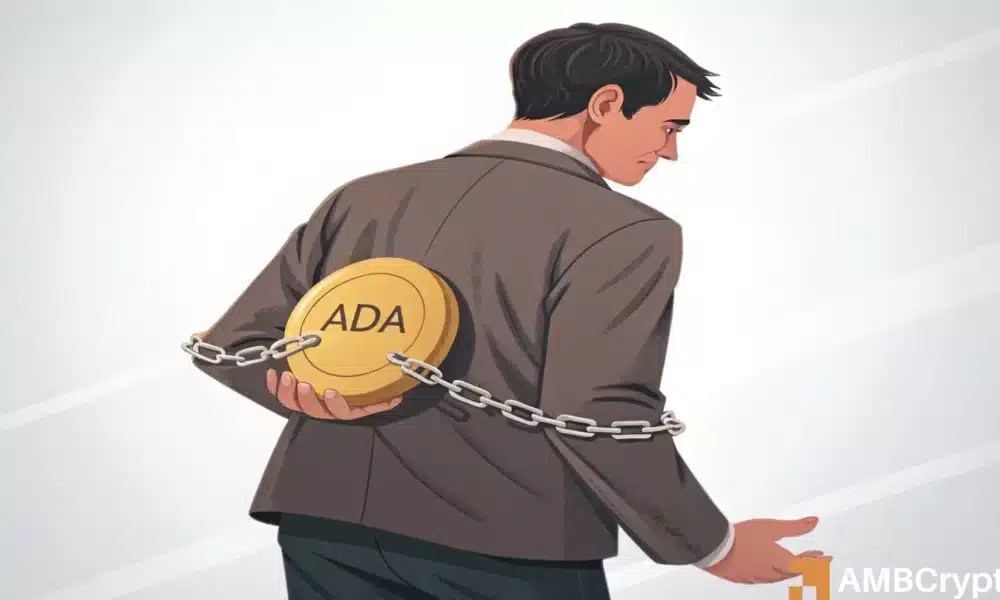
The post Cardano eyes Q4 push – But without Chainlink, can momentum last? appeared on BitcoinEthereumNews.com. Key Takeaways Cardano gained 40% in Q3, but weak on-chain activity and delayed Chainlink integration kept DeFi growth on hold. Cardano’s [ADA] price action shows three consecutive monthly gains. In fact, since Q3 began, ADA has rallied 40% off its $0.57 base, hinting at a potential double-digit leg in September. Yet, this price resilience isn’t translating into on-chain dominance.  On-chain slump despite price rally Reinforcing this, key metrics like Daily Active Addresses have dropped nearly 100% over the past three months, while Total Value Locked (TVL) has fallen to half of its $721 million peak seen during the election run. Source: DeFilLama That kind of divergence usually screams potential manipulation. That explains why Cardano’s stuck in a tight range across multiple timeframes. Even with steady MoM inflows, it can’t crack key psychological resistance, with underlying positioning feeding a volatility loop. On top of that, derivatives positioning added volatility. On the 18th of August, ADA hit $0.96 while Open Interest (OI) climbed to $1.87 billion. Lacking follow-through, the token fell back to $0.80, with OI easing to $1.54 billion by press time. Why Chainlink integration matters for Cardano  Cardano runs on a unique setup. Unlike Ethereum [ETH], Cardano is built on a unique architecture with its own programming language (Plutus) and consensus protocol (Ouroboros), which makes plugging into stuff like Chainlink messy. Since Chainlink [LINK] is built for EVM chains, integrating it on Cardano means extra dev glue, custom adapters, and higher costs.  Cardano’s Charles Hoskinson noted, “Chainlink gave us an absurd number (price) for integration,” adding that Sergey Nazarov “knows he’s sitting on a golden egg.” Source: Artemis Terminal The result? Slower on-chain activity and fewer DeFi projects going live, because accessing reliable oracle data (a key piece for smart contracts) is harder and pricier to access, something Chainlink could…

Author: BitcoinEthereumNews
5 Altcoins to Watch in September as the Market Dips

5 Altcoins to Watch in September as the Market Dips

The post 5 Altcoins to Watch in September as the Market Dips appeared on BitcoinEthereumNews.com. Sei (SEI) is in the spotlight with its new “parallelized EVM” and a recent spot ETF filing by 21Shares Cardano and Chainlink are making major moves in real-world adoption, including a US government contract Newcomers WLFI and Pyth Network are gaining traction with a high-profile launch and a new data deal September has kicked off with a market-wide pullback, but smart money knows that dips are for buying strength. While the broader market is weak, a handful of altcoins have major, distinct catalysts that could allow them to outperform.  Here are five projects – Sei, Cardano, Chainlink, WLFI, and Pyth that traders are watching for a potential September rebound. Sei (SEI): The “Parallelized EVM” and an ETF Filing Sei is positioning itself as one of the fastest L1s, and two major catalysts are putting it in the institutional spotlight. What is the big tech upgrade? Sei just launched its mainnet beta v2, which introduced the first “parallelized EVM.” This is a major technical upgrade designed to process transactions much faster, with the team claiming it will eventually handle 100,000 complex transactions per second. Is there institutional interest? Yes. 21Shares just filed for a spot Sei ETF with the SEC. An ETF filing is a massive signal of mainstream interest and a potential catalyst for a major price re-rating. With Sei trading at $0.2785 and holding a $1.67 billion market cap, investors see the current pullback as an appealing entry point. Related: Weekly Token Unlocks: ARB, APT, SEI Prices Rally Despite $120 Million in New Supply Cardano (ADA) & Chainlink (LINK): The Real-World Adoption Plays While other projects focus on speculation, Cardano and Chainlink are making serious moves into real-world and government infrastructure. What’s the catalyst for Cardano? Founder Charles Hoskinson is pushing for deeper DeFi integration, teasing potential collaborations with…

Author: BitcoinEthereumNews
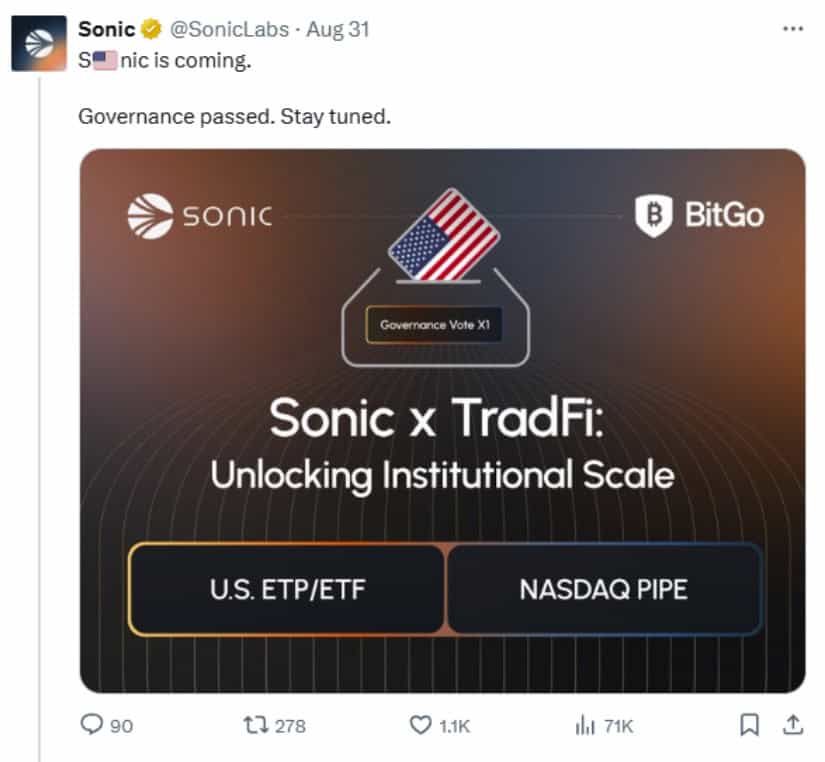
Sonic Labs Secures Community Approval for Historic $200M Traditional Finance Expansion

Sonic Labs Secures Community Approval for Historic $200M Traditional Finance Expansion

The vote, conducted from August 20-31, concluded with 99.99% approval from token holders, representing nearly 860 million S tokens—well above the required 700 million token threshold.

Author: Brave Newcoin
Five sectors Warren Buffett continues to avoid in 2025

Five sectors Warren Buffett continues to avoid in 2025

Legendary investor Warren Buffett’s iconic warning from his 1983 shareholder letter – likening major reinvestment in weak industries to “struggling in quicksand” – remains a cornerstone of Berkshire Hathaway’s capital discipline.In 2025, as speculative fervor returns to global markets, Buffett’s refusal to chase structurally flawed sectors offers a sobering counterweight.His approach favors durable moats, consistent cash generation, and industry structures that reward restraint as much as selection. Here are five sectors he continues to sidestep – and why.Airlines: high altitude, low returnsBuffett’s brief flirtation with airline stocks in the late 2010s ended abruptly during the COVID-19 crisis, and his skepticism hasn’t softened.Airline stocks remain plagued by overcapacity, volatile fuel costs, and limited pricing power. Even in 2025, with travel rebounding and carriers touting efficiency gains, Buffett sees the industry’s economics as fundamentally broken.Fixed costs are high, competition is fierce, and margin are razor-thin. “Problem isn’t management,” he once said. “It’s the industry.” For Berkshire, the skies are still off-limits.Biotech and pharma: complexity without clarityDespite their potential for innovation, biotech and pharmaceutical stocks rarely meet Buffett’s criteria for predictability and durable advantage.Drug pipelines are expensive and uncertain, regulatory hurdles are steep, and cash flows are often binary – hinging on approvals or patent cliffs.In 2025, with AI-driven drug discovery and gene therapies gaining traction, the “Oracle of Omaha” remains unconvinced.He prefers businesses with clear earnings visibility and long-term pricing power – not moonshots with scientific risk and opaque economics.Electric vehicles: hype over moatBuffett’s avoidance of EV manufacturers, including Tesla Inc, reflects his discomfort with sectors driven by innovation cycles rather than structural advantage.EV stocks face brutal competition, high R&D costs, and uncertain profitability. While Berkshire has exposure to battery tech and charging infrastructure through its energy holdings, it steers clear of the automakers themselves.In Buffett’s view, the race to scale in EVs resembles a capital-intensive sprint with no guaranteed winner –  a classic quicksand scenario.Early-stage tech: growth without guardrailsBuffett has long resisted investing in early-stage tech startups, citing their lack of durable moats and unpredictable business models.In 2025, with venture capital pouring into AI, fintech, and the metaverse, Berkshire remains on the sidelines.While Apple remains a core holding, it’s the exception – not the rule. Buffett favours companies with entrenched customer bases and pricing power, not those burning cash in pursuit of scale. “We don’t do hope-based investing,” he’s said.Commoditized manufacturing and low-margin retailWarren Buffett’s original investment in Berkshire Hathaway’s textile business –  and his eventual exit – taught him a lasting lesson: commoditized sectors with weak pricing power and constant reinvestment needs rarely compound capital.In 2025, that logic still applies to low-margin retail and basic manufacturing. These industries face relentless competition, shrinking margins, and little room for differentiation.Buffett’s playbook favors businesses that can raise prices without losing customers – not those that fight for survival on volume alone.The post Five sectors Warren Buffett continues to avoid in 2025 appeared first on Invezz

Author: Coinstats