Liquidation

Liquidation occurs when a trader’s collateral is no longer sufficient to cover their leveraged position’s losses, triggering an automated forced closure by the exchange's liquidation engine. It is a critical risk-management mechanism that ensures the solvency of lending protocols and derivative platforms. In 2026, the focus has moved toward MEV-resistant liquidation models that protect users from predatory "cascades." This tag provides essential information on maintenance margins, health factors, and how to avoid liquidation in high-volatility environments.

14430 Articles
Created: 2026/02/02 18:52
Updated: 2026/02/02 18:52
Mega Matrix announces plans for Ethena reserve strategy

Mega Matrix announces plans for Ethena reserve strategy

The post Mega Matrix announces plans for Ethena reserve strategy appeared on BitcoinEthereumNews.com. Mega Matrix Inc. announced a new facility to buy stablecoin governance tokens, starting with Ethena (ENA). The company announced a $2B universal shelf registration, allowing the company to list a wide range of equity and debt in the next two years.  Mega Matrix Inc. filed for a $2B facility on its latest S-3 form. The universal shelf registration will allow Mega Matrix to tap a wide range of equity and debt instruments within a three-year time frame.  The company’s digital asset treasury (DAT) approach aims to tap tokens that are used for issuing, backing, and governance of special stablecoins. Stablecoin issuers are a relatively risky type of crypto project, which nevertheless tap the overall market performance.  The first token to be added to the treasury will be Ethena (ENA), the issuer of USDe and sUSDe. While most treasury companies are still focused on Ethereum, Mega Matrix goes directly to Ethena as a way to tap both ETH earnings and the protocol’s native yield.  Mega Matrix move shows confidence in Ethena Following the news, Mega Matrix MPU shares traded around $1.83, down from their August peak of $3.66. MPU rallied as of August 23, when the first version of the S-3 filing emerged, and the market had already discounted the news of a treasury.  ENA still traded around $0.70, close to the higher range for the past three months. The Ethena project benefitted from the August ETH rally, as it expanded USDe stablecoin issuance to 12.5B tokens, an all-time peak.  While just months ago, Ethena was seen as too risky, the ETH bull market boosted the protocol, turning it into one of the key providers of liquidity. Ethena has also been stress-tested by ETH downturns and liquidations, managing its USDe asset without price shocks.  Ethena’s USDe increased its supply to a…

Author: BitcoinEthereumNews
Cardano and XRP Rumors Spark Talk of Alliance, But Another Meme Coin Grabs This Week’s Headlines

Cardano and XRP Rumors Spark Talk of Alliance, But Another Meme Coin Grabs This Week’s Headlines

Cardano–XRP alliance rumors spark buzz, but Layer Brett steals headlines with $2.5M raised, $0.0053 presale price, and 1,040% staking rewards fueling 100x hype.

Author: Blockchainreporter
Top Crypto to Buy for September, ETH for Steady Gains or a DeFi Crypto Poised for 60x Upside

Top Crypto to Buy for September, ETH for Steady Gains or a DeFi Crypto Poised for 60x Upside

Ethereum (ETH) has earned its place as one of the strongest names in the digital asset space. Its network stability, vast ecosystem of decentralized applications, and strong institutional adoption make it an obvious choice for those who want steady, reliable exposure to the market. For many, ETH is the “blue chip” of crypto investing, offering [...] The post Top Crypto to Buy for September, ETH for Steady Gains or a DeFi Crypto Poised for 60x Upside appeared first on Blockonomi.

Author: Blockonomi
RedStone to Acquire Credora, Debuts First Oracle-Powered DeFi Risk Ratings

RedStone to Acquire Credora, Debuts First Oracle-Powered DeFi Risk Ratings

RedStone, one of DeFi’s fastest-growing oracle networks, said it will acquire Credora, an on-chain credit-rating platform backed by Coinbase Ventures, S&P and HashKey, in a deal subject to approval. In a press release shared with CryptoNews the firms said the combined product will operate as “Credora by RedStone” and, according to the companies, will introduce the industry’s first oracle-powered risk-rating framework for assets and yield strategies across decentralized finance. The integration aims to give protocols and allocators a single pipe for real-time prices and real-time risk. Company data cited by RedStone indicates DeFi strategies carrying a rating—such as Morpho Vaults—have grown as much as 25%faster than unrated peers, suggesting measurable user demand for standardized risk signals. Deal Details and Product Scope Credora’s ratings methodology is built for crypto markets, assessing collateral composition, liquidity, volatility, governance parameters and market structure. RedStone said it will feed those risk metrics alongside its price oracles, creating a unified interface for protocols to query both price and risk in one call. RedStone explains its feeds have recorded no historical mispricing events, positioning data integrity as a selling point for institutions evaluating on-chain exposure. “This acquisition allows RedStone to expand services for DeFi protocols and users. Today, Credora is the leading DeFi ratings provider, widely used in Morpho and poised to expand across the broader lending ecosystem,” Marcin Kazmierczak, RedStone co-founder, told me. “Ratings are a natural extension of our services: we gather and deliver data on-chain, and transparent ratings transform it into actionable intelligence.” Why It Matters for DeFi DeFi lacks a common language for risk. Traditional ratings firms built models around corporate and sovereign debt; those frameworks often miss crypto-native dynamics like composability, cross-chain bridges and programmatic liquidations. The companies say “Credora by RedStone” is designed for these mechanics, with a Consensus Ratings Protocolintended to update as collateral mixes and liquidity conditions shift. By surfacing standardized scores next to live pricing, lending markets could tune parameters dynamically—for example, adjusting loan-to-value caps, interest bands or reserve factors as underlying risks change—rather than relying on static assumptions or informal heuristics. Institutional Angle Institutional interest in on-chain assets is widening—from stablecoins and tokenized bonds to private credit and reinsurance structures—raising the bar on risk transparency. The firms position the tie-up as a step toward a crypto-native analogue of S&P or Moody’s, with transparency and on-chain verifiability as core design principles. “We’ve always believed that risk transparency is the cornerstone of sustainable DeFi,” Darshan Vaidya, Credora’s founder, said. “Joining forces with RedStone allows us to scale this mission globally for institutions and individuals alike.” Next Steps and Launch Timeline The transition to Credora by RedStone is under way. The companies plan to re-launch public ratings and ship API integrations so risk scores can propagate through RedStone’s feeds to protocols already using its oracles. Credora co-founders Darshan Vaidya and Matt Ficke will join RedStone as strategic advisors to support integration and adoption. If completed, the deal would give on-chain markets a dual lens—price and risk—baked into the data layer, with the goal of making risk management a default feature of DeFi infrastructure rather than an afterthought

Author: CryptoNews
Corporate BTC treasuries are a threat to market stability

Corporate BTC treasuries are a threat to market stability

The post Corporate BTC treasuries are a threat to market stability appeared on BitcoinEthereumNews.com. Disclosure: The views and opinions expressed here belong solely to the author and do not represent the views and opinions of crypto.news’ editorial. Comparing this year’s Bitcoin (BTC) chart to the U.S. dollar’s DXY index makes for a stark contrast. While Bitcoin has soared to new heights, breaching the $120,000 threshold, the DXY has had a rough year — down nearly 10% this year to date — and is predicted to keep falling in the foreseeable future. In this environment, it’s perhaps unsurprising that more and more companies are turning to Bitcoin as an alternative asset to prop up their treasuries. But this seemingly innocuous trend could quickly turn into a threat not only to Bitcoin itself, but to the wider financial market. Summary Bitcoin’s narrative flipped. Once battling regulators, BTC is now embraced by states, institutions, and treasuries, while the SEC softens its stance. Strategy’s playbook is unique. Michael Saylor’s first-mover advantage, low entry price, and favorable debt terms mean he can weather downturns others cannot. If multiple leveraged firms panic-sell, Bitcoin’s entanglement with ETFs, pensions, and governments could amplify market shocks. The lesson: Saylor’s success is not a blueprint. Companies should strengthen fundamentals instead of betting their balance sheets on volatile assets. Only a year ago, $100,000 for Bitcoin was still a distant dream, while crypto was battling U.S. regulators and struggling to recover its image after the disastrous collapse of 2022. But what a difference a year makes. Fast forward to today, and the SEC has dropped or settled the majority of its lawsuits against crypto firms and has signalled a far more accommodating stance. Meanwhile, Bitcoin is increasingly being adopted as a reserve asset by a number of U.S. states and several emerging market governments. The attitude towards Bitcoin has completely changed. Not only that, but…

Author: BitcoinEthereumNews
Bitcoin, ETH, XRP, SOL’s Max Pain Price Ahead of Options Expiry, Key Jobs Data

Bitcoin, ETH, XRP, SOL’s Max Pain Price Ahead of Options Expiry, Key Jobs Data

The post Bitcoin, ETH, XRP, SOL’s Max Pain Price Ahead of Options Expiry, Key Jobs Data appeared on BitcoinEthereumNews.com. Bitcoin, Ethereum, and other altcoins are facing pullbacks amid continued profit booking in the broader crypto market. Traders are bracing for further selloffs ahead of $4.5 billion in crypto options expiry and key U.S. jobs data this week. BTC, ETH, XRP, and SOL prices slip amid liquidations of $115 million in long positions by traders. In addition, rising long-term Treasury yields and gold prices due to fiscal concerns increased selling pressure on Bitcoin price. $3.28 Billion in Bitcoin Options Expiry According to Deribit, more than 29K BTC options with a notional value of $3.28 billion are set to expire on Friday. The put-call ratio is 1.39, which is extremely high and indicates bearish sentiment among traders. Moreover, the max pain price is at $112,000. Derbit revealed that puts have clustered around $105K-110K strike price, with most traders betting on a Bitcoin price fall below $105,000. Bitcoin Max Pain Price. Source: Deribit Analyst Caleb Franzen revealed that Bitcoin broke below its daily Ichimoku cloud for the first time since February 2025, potentially flipping it into resistance. Historical seasonality patterns are playing a key role in bearish sentiment for Bitcoin, with bearish crossover on the weekly MACD.   Bitcoin Breaks Below Daily Ichimoku Cloud. Source: Caleb Franzen $1.28 Billion in Ethereum Options Expiry Over 293K ETH options with a notional value of $1.28 billion are set to expire on Deribit, with a put-call ratio of 0.78. This indicates mixed sentiment among traders due to a neutral put-call ratio. Moreover, the max pain price is at $4,400, higher than the current market price of $4,385 at the time of writing. This signals. Options traders are watching three key levels of $4,500, $4,700, and $5,000. Bitcoin Max Pain Price. Source: Deribit “Flows lean more balanced, but calls build up above $4.5K, leaving upside optionality,” said…

Author: BitcoinEthereumNews
WLFI Crashes Below $0.20, Is $0.10 Next?

WLFI Crashes Below $0.20, Is $0.10 Next?

The post WLFI Crashes Below $0.20, Is $0.10 Next? appeared on BitcoinEthereumNews.com. Key Insights: WLFI breaks $0.20 support, with traders eyeing $0.15 and $0.10 as potential downside levels. Long trader 0x1527 faces $2.2M losses, while short trader 0x92bb gains $1.8M profits. WLFI price drops 22% in 24 hours, trading volume surges to nearly $1 billion daily. WLFI Crashes Below $0.20, Is $0.10 Next? World Liberty Financial ($WLFI) has dropped below $0.20, a price level that had acted as support in recent sessions. The token quickly moved lower, trading around $0.182 after the breakdown. Price charts suggest the token could pause near $0.19 before pushing lower. The next support levels are seen at $0.15 and $0.10. Ali, Commented,  “Unless buyers manage to reclaim $0.20, lower levels remain in play,”. Source: Ali Martinez/X Heavy Losses for Long Positions Wallet 0x1527 is holding a large long position on WLFI. The entry was more than 34.52 million tokens, valued at about $6.56 million with an average price of $0.25449. With WLFI now near $0.19, the position is showing an unrealized loss of about $2.22 million. Funding costs add further strain, totaling more than $17,000. The liquidation level is far below at $0.00059, so the trade is not at risk of immediate closure. Still, the account remains heavily underwater. “The trader is not near liquidation but is carrying large losses,” one tracker noted. Short Positions See Strong Profits While long holders are in the red, short positions have gained. Wallet 0x92bb is reported to be up more than $1.8 million on a short trade against WLFI. The move below $0.19 created sharp differences in outcomes for traders on opposite sides of the market. The contrasting results between the two wallets underline how fast market conditions have shifted after the breakdown of $0.20. Price and Volume Activity At the latest update, WLFI was priced at $0.1764, down 22%…

Author: BitcoinEthereumNews
Corporate Bitcoin treasuries are a threat to market stability | Opinion

Corporate Bitcoin treasuries are a threat to market stability | Opinion

Whether Bitcoin advocates like it or not, BTC is becoming increasingly entangled with traditional finance.

Author: Crypto.news
Cardano’s Hoskinson calls for ‘vote of no confidence’ amid $600M ADA scandal

Cardano’s Hoskinson calls for ‘vote of no confidence’ amid $600M ADA scandal

The post Cardano’s Hoskinson calls for ‘vote of no confidence’ amid $600M ADA scandal appeared on BitcoinEthereumNews.com. Journalist Posted: September 4, 2025 Key Takeaways  Charles Hoskinson called for the dissolution of the Cardano Foundation. Will ADA sentiment suffer amid the chaos?  The Cardano[ADA] community may face division after ADA’s $600 million theft allegation took another twist.  In a recent X (formerly Twitter) space, the chain’s founder, Charles Hoskinson, expressed frustration with the Cardano Foundation (CF) for ‘ruining the integrity’ of the ecosystem.  He added, “At some point, we, as the ecosystem, have to hold them (CF) accountable. An info action with a vote of no confidence, maybe a class action suit with the Swiss government to get them to vacate the board.” Hoskinson said that the CF’s funds can be donated to the Cardano treasury or another organization that can support the ecosystem.  Will the stand-off affect ADA? So, why is the update crucial for the community and ADA? Well, Hoskinson and early insiders were blamed for the misappropriation of over 300 million ADA tokens (worth over $600M based on ADA prices at the time the story hit headlines).  According to Hoskinson, the allegations were being spread by Cardano Foundation employees and affected the ‘integrity’ of the ecosystem.  In response, he instructed an independent audit to verify the claims. The report, released recently, exonerated him and insiders, stating that,  “The investigation determined that each of the allegations related to the topics of investigation does not have any basis.”  Source: ADA redemption report The report added that some of the unredeemed ADA from early investors were directed to a trust fund (Intersect) that helped oversee Cardano’s roadmap. Intersect had two founding members: Input Output and EMURGO, but both contributed capital to fund the project’s roadmap.  This could help clear the allegations that Hoskinson and other insiders stole $600 million.  However, his hard stance on the Cardano Foundation for…

Author: BitcoinEthereumNews
What Is DeFi? Inside MakerDAO, DAI, and the Future of Finance

What Is DeFi? Inside MakerDAO, DAI, and the Future of Finance

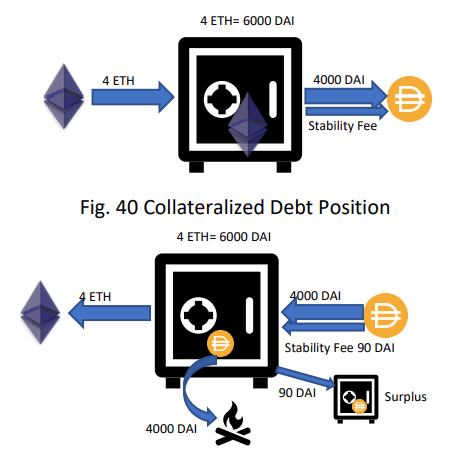
Decentralized Finance (DeFi) is transforming financial intermediation by replacing banks with smart contracts. Platforms like MakerDAO issue DAI, a stablecoin pegged to the US dollar, through overcollateralized crypto loans, governed by MKR token holders. This ecosystem enables lending, savings, and passive income without intermediaries, but also raises challenges for regulation, taxation, and financial stability. MakerDAO’s mechanisms—collateralized debt positions, governance votes, auctions, and external actors like oracles and keepers—keep the system running. Together with platforms like Uniswap, DeFi illustrates both the promise of financial innovation and the complexity of decentralized governance.

Author: Hackernoon