Liquidation

Liquidation occurs when a trader’s collateral is no longer sufficient to cover their leveraged position’s losses, triggering an automated forced closure by the exchange's liquidation engine. It is a critical risk-management mechanism that ensures the solvency of lending protocols and derivative platforms. In 2026, the focus has moved toward MEV-resistant liquidation models that protect users from predatory "cascades." This tag provides essential information on maintenance margins, health factors, and how to avoid liquidation in high-volatility environments.

15192 Articles
Created: 2026/02/02 18:52
Updated: 2026/02/02 18:52
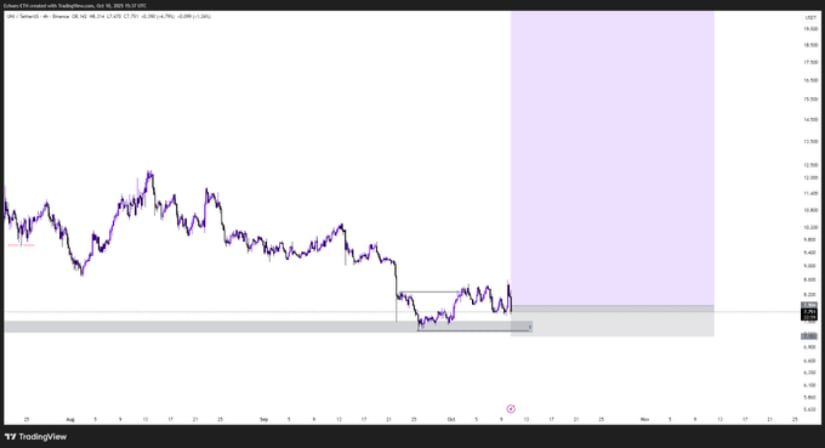
Uniswap (UNI) Holds Key Support Zone as Traders Anticipate Trend Shift

Uniswap (UNI) Holds Key Support Zone as Traders Anticipate Trend Shift

TLDR Uniswap forms higher lows at key support zone, signaling potential recovery. UNI price drops 27.8% in 24 hours but remains resilient with strong liquidity. Open interest for UNI drops to $168M, clearing overleveraged positions. UNI holds $3.52B market cap, showing ongoing DeFi ecosystem strength. Uniswap (UNI) has recently shown signs of stabilization after a [...] The post Uniswap (UNI) Holds Key Support Zone as Traders Anticipate Trend Shift appeared first on CoinCentral.

Author: Coincentral
Here’s where Analysts Expect SOL Price To Be Trading In 2026

Here’s where Analysts Expect SOL Price To Be Trading In 2026

The post Here’s where Analysts Expect SOL Price To Be Trading In 2026 appeared on BitcoinEthereumNews.com. Crypto News Solana is currently trading at $184, gradually recovering from the market crash that caused its price to drop to $144 at its lowest point. The Trump tariff war against China triggered a massive crypto sell-off, resulting in over $30 billion in liquidation losses, with SOL accounting for a $2 billion share. As repositioning begins in earnest, Different Solana price predictions are erupting from different crypto analysts and market watchers. Simultaneously, whispers continue to transmit across trading circles and communities about some investors who were able to hedge against the crash by investing in a PayFi solution, Remittix (RTX). Solana Price Prediction: What Investors Should Expect In 2026 Over the past few months, Solana’s price has been bouncing off trendlines and testing yearly resistance. Analysts believe this momentum is driven by growing confidence in its ecosystem, characterised by increasing developer activity, an expanding NFT market, institutional interest and DeFi growth. In his Solana price prediction, Ali Martinez reported that $SOL appears to be breaking out of a cup-and-handle pattern. If confirmed, the pattern points to $1,300. Source: Ali_chart via X.   While the cup-and-handle setup is valid, the real fireworks will start when SOL clears that $250 neckline. Then $1,300 is just the first stop on the chart. While the Solana price prediction of $1,300 is valid, remember that the token depends heavily on the market momentum. If the trade wars that occurred yesterday resurface, SOL will also drop. Rather than allowing their investments to be swayed by trade news, savvy investors believe that investing in Remittix is a wiser decision. Remittix (RTX), the Better Investment Pick Unlike Solana’s modest predictions, Remittix (RTX) emerges onto the scene promising a 100x return. Remittix has a clear mission of revolutionising the global crypto-to-fiat remittance market. It facilitates crypto-to-fiat transactions across more than…

Author: BitcoinEthereumNews
Ethena Labs founder: USDDe's anchoring to USDT is reasonable, and the minting and redemption functions did not stop during the market turmoil

Ethena Labs founder: USDDe's anchoring to USDT is reasonable, and the minting and redemption functions did not stop during the market turmoil

PANews reported on October 12th that the founder of Ethena Labs stated in a post on the X platform: "Oracles attempt to identify two distinct scenarios: a temporary price dislocation in the secondary market and a permanent impairment of collateral. The latter has never occurred with USDe and is much less likely for most assets, including USDe." While the DeFi currency market has been criticized for USDe's peg to USDT, it believes this practice is reasonable because it avoids liquidations caused by temporary price imbalances. Ethena provides on-demand proof of reserves to a small number of entities, some of which are also oracle providers, including Chaos Labs and Chainlink. Ethena's minting and redemption functions did not go down during the market turmoil this week. Major liquidity venues through on-chain venues such as Curve, Uniswap, and Fluid experienced price dislocations. More than $9 billion of on-demand stablecoin collateral was available for immediate redemption, but actual usage was only a small portion.

Author: PANews
Solana Price Prediction: Here’s where Analysts Expect SOL Price To Be Trading In 2026

Solana Price Prediction: Here’s where Analysts Expect SOL Price To Be Trading In 2026

The Trump tariff war against China triggered a massive crypto sell-off, resulting in over $30 billion in liquidation losses, with […] The post Solana Price Prediction: Here’s where Analysts Expect SOL Price To Be Trading In 2026 appeared first on Coindoo.

Author: Coindoo
Over 1,000 Hyperliquid Traders Lose Entire Deposits in Market Crash

Over 1,000 Hyperliquid Traders Lose Entire Deposits in Market Crash

Lookonchain analysts reported large-scale liquidations on decentralised platform Hyperliquid. According to their data, during the market crash on the night of 11 October, more than 1,000 wallets were completely zeroed out – users lost all their funds. Experts told that more than 6,300 addresses are in losses, and the total amount of losses exceeds $1.23bn. […] Сообщение Over 1,000 Hyperliquid Traders Lose Entire Deposits in Market Crash появились сначала на INCRYPTED.

Author: Incrypted
Mutuum Finance crosses $17.1m funding milestone

Mutuum Finance crosses $17.1m funding milestone

The post Mutuum Finance crosses $17.1m funding milestone appeared on BitcoinEthereumNews.com. Disclosure: This article does not represent investment advice. The content and materials featured on this page are for educational purposes only. Mutuum Finance raises $17.1m as its DeFi presale gains momentum ahead of next price increase. Summary Mutuum Finance raises $17.1m as structured presale model drives DeFi momentum. With the money raised, Mutuum’s transparent presale model could position it as one of 2025’s leading DeFi project. Over 16,800 investors have joined Mutuum Finance, backing its $17m DeFi presale success story. While many crypto presales in 2025 have struggled to maintain momentum after their early hype phases, Mutuum Finance (MUTM) is charting a different path. The Ethereum-based DeFi protocol has paired a transparent pricing structure with active development and broad investor participation, pushing it to one of the largest early-stage funding totals of the year.  With more than $17.1 million raised and the next price increase approaching, analysts are increasingly calling it one of the standout presales heading toward launch. Structured presale model drives consistent growth Mutuum Finance is an Ethereum-based decentralized lending and borrowing protocol focused on building efficient on-chain markets. Its ecosystem is built on real utility rather than speculation. Users can supply assets to earn yield, borrow against collateral under structured risk parameters, and participate in a revenue-sharing model that continuously drives demand for the MUTM token. The presale uses a fixed-price, staged structure that has underpinned its steady rise. Each stage offers a fixed number of tokens at a set price. Once the allocation sells out, the next stage begins at roughly 20% higher, giving early participants meaningful appreciation while keeping pricing clear for newcomers. Phase 1 launched at $0.01, offering one of the lowest entry points of the year. After five fully completed stages, the token price has climbed to $0.035 in Phase 6, representing a…

Author: BitcoinEthereumNews
AAVE Faces 64% Price Drop Amid Historic Stress Test on DeFi Protocol

AAVE Faces 64% Price Drop Amid Historic Stress Test on DeFi Protocol

TLDR AAVE’s price dropped 64% during a flash crash before recovering 140%. Aave processed a record $180M in liquidations without human intervention. AAVE’s trading volume surged to over 570,000 units amid volatility. The Aave protocol demonstrated its resilience under intense market pressure. Aave (AAVE), the leading decentralized lending protocol, faced a dramatic 64% price drop [...] The post AAVE Faces 64% Price Drop Amid Historic Stress Test on DeFi Protocol appeared first on CoinCentral.

Author: Coincentral
Bitcoin’s Bull Run Isn’t Over Yet, Crypto Expert Claims

Bitcoin’s Bull Run Isn’t Over Yet, Crypto Expert Claims

The post Bitcoin’s Bull Run Isn’t Over Yet, Crypto Expert Claims appeared on BitcoinEthereumNews.com. Bitcoin Bitcoin’s recent selloff has reignited debate over whether the current bull cycle has reached its end – but according to cryptocurrency analyst Joao Wedson, the long-term structure of the market remains fully intact. Wedson argues that Bitcoin continues to follow its four-year cycle, a pattern that has historically governed its major peaks and corrections. He pointed to his team’s Recurrence Fractal Cycle model, which has tracked Bitcoin’s behavior with high accuracy since 2015. “Many are claiming the cycle is broken because of global liquidity shifts,” Wedson said, “but the data still points to a continuation rather than a collapse.” Backing his argument, Wedson referenced the Max Intersect SMA Model, a metric his team developed to identify Bitcoin’s cycle tops. The model, he noted, has successfully predicted every all-time high since Bitcoin’s early trading history. “It’s remarkable how closely it has aligned with previous peaks. The real question is whether it will capture this one too,” he added. Wedson compared the current market environment to 2021, when a wave of deleveraging briefly rattled prices before a swift rebound carried Bitcoin to record highs. He believes the same dynamic could be unfolding again – that large liquidations may simply reset the market rather than end it. On-chain data, Wedson said, continues to suggest resilience. Indicators such as mining fees, transaction activity, and address growth remain at historically low but stable levels, typically seen near major accumulation phases. He also highlighted that the total crypto market capitalization remains smaller than Nvidia’s valuation, underscoring the sector’s room for expansion. “The market doesn’t end with one major liquidation,” Wedson concluded. “Historically, those moments mark bottoms, not tops. With Bitcoin dominance rising again, this cycle may still have weeks – or even months – left before peaking.” The information provided in this article is for…

Author: BitcoinEthereumNews
Trump-tarieven crypto zetten retail op zoek naar ‘één oorzaak’

Trump-tarieven crypto zetten retail op zoek naar ‘één oorzaak’

Snelle crypto updates? Connect op Instagram! Check onze Instagram   De cryptomarkt crashte na de aankondiging van 100% importtarieven in de VS richting China. Retailhandelaren zochten daarbij opvallend snel naar één duidelijke trigger, terwijl data laat zien dat hefboom en sentiment minstens zo’n grote rol speelden. Wat er gebeurde en waarom het breder is dan tarieven De reactie was scherp. In 24 uur verloor Bitcoin meer dan 10%. Een groot futures-paar schoot zelfs kortstondig omlaag tot $102.000 in de slipstream van het tariefnieuws. Tegelijkertijd lag de markt vol met hefboom: circa $16,7 miljard aan longposities ging in de versnipperaar, tegenover zo’n $2,5 miljard aan shorts, een verhouding van bijna 7 op 1. Zulke liquidatiestromen versterken neerwaartse bewegingen en drukken extra op het vertrouwen. Ten tijde van publicatie handelde Bitcoin rond $109.910, zo’n 10% lager ten opzichte van een week eerder. The biggest crypto crash in history Here’s what happened: The crypto market suffered one of the worst crashes in its history on October 10, 2025 After President Trump announced 100% tariffs on all Chinese imports. More than $9.5 billion in liquidations happened in 24 hours… pic.twitter.com/ihul5l8plG — StarPlatinum (@StarPlatinumSOL) October 11, 2025 Particuliere traders grijpen vaak naar één “singular event” om de hele daling aan op te hangen. Na een plotselinge verkoopgolf ontstaat snel een collectieve verklaring, vaak op basis van het meest zichtbare nieuws. De huidige tariefkoppen bieden daarvoor munitie, maar ze verklaren niet de volledige omvang van de beweging. De hefboombalans en het risico in de markt waren vooraf al scheef, wat de klap vergrootte. Blik vooruit: VS–China als kortetermijnkompas Op korte termijn sturen de ontwikkelingen tussen de VS en China het retailgedrag. Haperende gesprekken en verhoogde spanningen kunnen de pessimistische scenario’s aanwakkeren en meer roep om “Bitcoin onder $100.000” op de tijdlijn zetten. Komen er juist signalen van ontspanning of vooruitgang, dan kan het sentiment herstellen en verdwijnt de drang om één schuldige aan te wijzen naar de achtergrond. Intussen sloeg het marktsentiment duidelijk om. De Crypto Fear & Greed Index, een maatstaf voor de stemming in de markt, zakte naar 27 (“Fear”). Dat is 37 punten lager dan een dag eerder en de laagste stand in bijna een half jaar. De sprong in sentiment onderstreept hoe nieuws en hefboom elkaar versterken. Op het moment van schrijven is de indicator zelfs nog lager gezakt, en staat nu op 24 punten. nog 4 punten naar beneden en we zitten in het ‘extreme fear’ level. (function(){var iframeId="fgg-embed-aa53a322-b103-4751-aae6-f0bb2e113eec";function resize(evt){if(!evt.data||!evt.data.fggEmbed) return;var p=evt.data.fggEmbed;if(p.id!==iframeId) return;var iframe=document.getElementById(iframeId);if(iframe){iframe.style.height=Math.max(120,Math.ceil(Number(p.height)||0))+"px";}}window.addEventListener("message",resize,false);})(); Slotbeeld De daling is niet tot één krantenkop te reduceren. Tarieven vormden een vonk, maar de brandstof lag in hefboom, positionering en een publiek dat houvast zoekt. Voor traders draait het de komende dagen om de draad tussen Washington en Peking én om discipline in risicobeheer. Koop je crypto via Best Wallet Best wallet is een topklasse crypto wallet waarmee je anoniem crypto kan kopen. Met meer dan 60 chains gesupport kan je al je main crypto coins aanschaffen via Best Wallet. Best wallet - betrouwbare en anonieme wallet Best wallet - betrouwbare en anonieme wallet Meer dan 60 chains beschikbaar voor alle crypto Vroege toegang tot nieuwe projecten Hoge staking belongingen Lage transactiekosten Best wallet review Koop nu via Best Wallet Let op: cryptocurrency is een zeer volatiele en ongereguleerde investering. Doe je eigen onderzoek. Het bericht Trump-tarieven crypto zetten retail op zoek naar ‘één oorzaak’ is geschreven door Sebastiaan Krijnen en verscheen als eerst op Bitcoinmagazine.nl.

Author: Coinstats
Exchange monopoly, Wall Street harvesting, and the desperate situation of retail investors

Exchange monopoly, Wall Street harvesting, and the desperate situation of retail investors

Written by Haotian To be honest, the black swan event of October 11th made me, an originally optimistic industry observer, feel a sense of despair. I originally understood the current "Three Kingdoms" situation in the crypto industry, thinking that it was a fight between the gods and retail investors would get some meat. However, after experiencing this bloodbath and unraveling the underlying logic, I found that this was not the case. To put it bluntly, we originally thought that the technical community was innovating, exchanges were generating traffic, and Wall Street was allocating funds. The three parties were each doing their own thing. As long as we retail investors seize the opportunity, follow the wave of technological innovation, take advantage of hot spots, and rush in when funds enter the market, we can always get a share of the profits. However, after experiencing the bloodbath on October 11, I suddenly realized that these three parties might not be competing in an orderly manner at all, but were instead harvesting all the liquidity in the market? The first force: exchanges monopolize traffic and are vampires that control traffic and liquidity pools. To be honest, I used to think that exchanges just wanted to expand their platforms, increase traffic, expand their ecosystems, and make a lot of money. However, the USDe's cross-margin liquidation incident exposed the powerlessness of retail investors under the rules of the exchange platform. The leverage level increased by the platform to improve the product and service experience and the unclear risk control capabilities are actually traps for retail investors. Various rebate programs, Alpha and MEME launch pads, various revolving loans, and highly leveraged contract trading methods are constantly emerging. While these seemingly offer retail investors numerous profit opportunities, if exchanges can no longer withstand the risk of on-chain DeFi cascading liquidations, retail investors will also be dragged down. Life is like that. What's particularly frightening is that the top 10 exchanges generated $21.6 trillion in trading volume in Q2, yet overall market liquidity is declining. Where did the money go? Besides transaction fees, there's also various liquidations. Who's draining the liquidity? The second force: Wall Street capital, entering the market under the guise of compliance I was particularly looking forward to Wall Street entering the market, thinking that institutional funds could bring greater stability to the market. After all, institutions are long-term players and can bring incremental injections into the market. We will then reap the industry dividends of the integration of Crypto and TradFi. However, before this recent plunge, there were reports of whales profiting from precise short selling. Several wallets, suspected to be Wall Street structures, initiated massive airdrop positions before the crash, generating hundreds of millions in profits. Similar reports abound, resembling insider information. However, in these moments of panic, it makes one wonder: how do institutions consistently gain the advantage of "front-loading" before black swan events? These TradFi institutions, under the guise of compliance and capital, are actually entering the market. What are they actually doing? Using stablecoin public chains to tie up the DeFi ecosystem, using ETF channels to control capital flows, and using various financial tools to gradually erode the market's voice? On the surface, they claim to be doing this for industry development, but what is the reality? There are too many conspiracy theories about the Trump family's wealth to elaborate on. The third force: technology natives + retail developers, cannon fodder caught in the middle. I think this is where most of the retail investors, developers, and so-called builders in the market are truly desperate. Since last year, it has been said that many altcoins have been brought down, but this time it directly broke through to zero, forcing people to see the facts clearly: the liquidity of many altcoins is almost exhausted. The problem is, infra technical debt is piling up, application rollouts are failing to meet expectations, and developers are toiling away on building, only to find the market isn't buying it. Therefore, I can't see how the altcoin market will rebound. I don't understand how these altcoin projects will seize liquidity from exchanges, or how they will compete with Wall Street institutions in their ability to manipulate prices. If the market doesn't buy into the narrative, if the market is left with only so-called meme gambling, then the altcoin market will be a complete liquidation and reshuffle. Developers will flee, and there will be a structured reshuffle of market participants. Will the market return to nothingness? Oh, it's too difficult! so..... If the crypto industry's "Three Kingdoms" situation continues, with exchanges monopolizing the market, Wall Street profiting, and retail investors and technical analysts being domineering, this will be a disaster for the cyclical nature of crypto trading. In the long run, the market will only leave a few short-term winners and all long-term losers.

Author: PANews