Liquidation

Liquidation occurs when a trader’s collateral is no longer sufficient to cover their leveraged position’s losses, triggering an automated forced closure by the exchange's liquidation engine. It is a critical risk-management mechanism that ensures the solvency of lending protocols and derivative platforms. In 2026, the focus has moved toward MEV-resistant liquidation models that protect users from predatory "cascades." This tag provides essential information on maintenance margins, health factors, and how to avoid liquidation in high-volatility environments.

14708 Articles
Created: 2026/02/02 18:52
Updated: 2026/02/02 18:52
XRP Holders Can Mint Stablecoins via Enosys Loans on Flare

XRP Holders Can Mint Stablecoins via Enosys Loans on Flare

The post XRP Holders Can Mint Stablecoins via Enosys Loans on Flare appeared on BitcoinEthereumNews.com. Enosys introduces the first-ever XRP-backed stablecoin loan protocol on Flare, using the Liquity V2 model. XRP holders can mint overcollateralized stablecoins without selling their assets. Plans include supporting staked XRP (stXRP) for additional DeFi benefits. Enosys has launched Enosys Loans, a collateralized debt position (CDP) protocol that lets XRP holders mint an overcollateralized stablecoin without selling their assets. It’s the first XRP-backed stablecoin loan service live on Flare The product uses FXRP, a wrapped version of XRP, as the initial collateral with plans to support staked XRP (stXRP) in the future. This development marks the first time a decentralized stablecoin is fully backed by XRP. In other words, the launch expands XRP’s role from payments into yield-generating decentralized finance (DeFi) activities. Related: XRP Staking and DeFi Yield Features Now Being Offered via Flare Network and Uphold Liquity V2 Fork Brings Proven DeFi Design Enosys Loans is built as a fork of Liquity V2, one of DeFi’s most tested CDP protocols. Liquity has maintained billions in collateral and a stable $1 peg through volatile market conditions since 2021.  The Flare deployment keeps key Liquity features, such as its stability pool, which covers outstanding debt during liquidations. At the same time, it adds upgrades like user-set borrowing rates, protocol-incentivized liquidity, and improved capital efficiency. Borrowers can set their own annual percentage rate (APR), but lower rates come with a risk. If the stablecoin dips below its peg, the lowest-rate loans are the first to be redeemed. Flare Oracles for Pricing The platform integrates with the Flare Time Series Oracle (FTSO) for decentralized collateral pricing.  The FTSO aggregates independent price feeds, ensuring accurate and tamper-resistant data to determine the value of the collateral and help the stablecoin maintain its $1 value. Expanding XRP DeFi Reach Beyond FXRP, Enosys plans to add stXRP, allowing…

Author: BitcoinEthereumNews
Michael Saylor Says Bitcoin May Go ‘Boring’ as Institutional Money Kills Volatility

Michael Saylor Says Bitcoin May Go ‘Boring’ as Institutional Money Kills Volatility

Strategy’s Michael Saylor warned that the growing institutional adoption of Bitcoin could transform the asset from an adrenaline-fueled investment into a “boring” store of value as mega institutions demand lower volatility before entering the market. Speaking on the Coin Stories podcast, Saylor described this transition as a natural growing stage where early volatility exists in the asset to accommodate large-scale institutional capital. The prediction comes as Bitcoin has consolidated around $115,500 after hitting an all-time high of $124,100 in August. Saylor attributed current selling pressure to crypto OGs diversifying holdings rather than losing confidence, comparing the situation to startup employees selling stock options to fund life expenses despite believing in the company’s future.Saylor speaking on the Coin Stories podcast | Source: YouTube From Bitcoin Buying Spree to Strategic Restraint According to a report from Cryptonews, corporate Bitcoin treasuries reached a record 1.011 million BTC worth over $118 billion, representing approximately 5% of the circulating supply. However, accumulation patterns have shifted dramatically from the aggressive buying sprees that characterized 2024. MicroStrategy’s monthly purchases collapsed from 134,000 BTC in November 2024 to just 3,700 BTC in August 2025, while the company’s market premium over net asset value fell from 3.89x to 1.44x. Despite Strategy’s reduced accumulation, other companies stepped up purchases, cutting Strategy’s dominance in corporate holdings from 76% to 64% while maintaining overall growth momentum. Public companies added 415,000 BTC to treasuries in 2025, already surpassing the 325,000 BTC acquired throughout 2024.Source: Bitcoin Treasuries 28 new Bitcoin treasury firms launched in July and August alone, adding 140,000 BTC to aggregate corporate holdings. However, firms now buy smaller amounts per transaction amid macro uncertainty and stricter risk management requirements from shareholders. Similarly, a recent report showed that a quarter of public Bitcoin treasury companies now trade below their net asset value, with the average NAV multiple declining from 3.76 in April to 2.8 currently. Companies like NAKA trade at just 0.7x NAV after losing 96% of market value from peak, while others, including Twenty One, Semler Scientific, and The Smarter Web Company, also trade below their Bitcoin holdings’ worth. The Million-Dollar Bitcoin Credit Revolution During the podcast, Saylor outlined his vision for revolutionizing credit markets through Bitcoin-backed financial instruments, addressing what he sees as fundamental weaknesses in traditional fixed-income markets. He described current credit environments as “yield starved” with Swiss banks offering negative 50 basis points and European corporate bonds yielding just 2.5% while monetary inflation exceeds these returns. Strategy has launched four different Bitcoin-backed preferred stock instruments designed to capture various market segments. Strike offers 8% dividends with conversion rights to common stock, while Strife provides 10% perpetual yields with senior liquidation preferences. Stride removes penalty clauses for 12.7% effective yields, targeting investors with higher risk tolerance and Bitcoin conviction. The newest instrument, Stretch, represents an innovation in creating what Saylor called a “treasury preferred” with monthly variable dividends designed to minimize duration risk and volatility. Using AI assistance, Strategy also developed this first-of-its-kind structure to compete with money market instruments while maintaining Bitcoin backing and 10% target yields. These instruments allow Strategy to fund dividend payments through equity capital raises rather than Bitcoin sales. The company raises approximately $20 billion annually in equity markets, using roughly $600 million for dividend payments while deploying the remainder for additional Bitcoin purchases. This structure enables leverage expansion without credit risk while maintaining Bitcoin accumulation. When Digital Gold Rush Meets Wall Street Reality Saylor emphasized that Bitcoin’s institutional maturation process requires patience as market participants adapt to revolutionary financial technology. He compared the current environment to the early petroleum industry in 1870, when investors struggled to comprehend the scope of applications for crude oil derivatives before kerosene, gasoline, and petrochemicals transformed multiple industries. The executive projected that 2025-2035 will represent a “digital gold rush” period with extensive business model experimentation, product creation, and fortune building. Strategy aims to become the first investment-grade Bitcoin treasury company, pursuing credit ratings for all instruments through extensive agency education processes. Market dynamics continue to evolve as traditional financial metrics prove inadequate for evaluating Bitcoin treasury companies, a point also noted by a recent Sentora research. Saylor noted that many institutional investors still require basic education on Bitcoin, and also questioned whether the asset faces regulatory bans despite recent policy clarifications. Corporate concentration risks are also emerging as public companies control a significant Bitcoin supply. Analysts warn that heavy treasury control could reduce liquidity and increase volatility if major holders change strategies. However, retail participation remains strong, with approximately 75% of Bitcoin ETF shares held by non-institutional investors, and retail flows providing critical support during periods of institutional demand slowdowns. The transition toward institutional dominance may indeed make Bitcoin “boring” compared to its volatile past, but Saylor views this evolution as necessary for achieving his vision of Bitcoin as the world’s primary digital capital and settlement layer for global finance

Author: CryptoNews
XRP Steadies at $3 Amid Ripple’s DBS-Franklin Tokenized Finance Push

XRP Steadies at $3 Amid Ripple’s DBS-Franklin Tokenized Finance Push

The post XRP Steadies at $3 Amid Ripple’s DBS-Franklin Tokenized Finance Push appeared on BitcoinEthereumNews.com. XRP’s Neutral Funding Signals Calm Before the Next Breakout According to market analyst Tom Tucker, XRP is showing remarkable balance in derivatives markets, with funding rates holding steady at 0.02%.  This level is considered neutral, indicating neither aggressive long positioning nor panic-driven shorting. For traders, such equilibrium in funding is a signal worth watching, especially as XRP consolidates around the critical $3 support zone. Tucker pointed out, “No overheated longs, no panic shorts, just steady spot demand building at the $3 support zone. Neutral funding at key highs often sets the stage for the next leg up.” Source: Tom Tucker Notably, funding rates in perpetual futures reveal market balance because spikes signal overheated longs or shorts and heighten liquidation risks, while neutral funding shows futures traders moving in step with genuine spot demand. This explains why Tucker highlights XRP’s healthy setup, noting the absence of reckless leverage and the steady spot demand consolidating at $3, a structure that often precedes the next major rally with a 35% upside on the table.  Therefore, the $3 level has emerged as both a psychological and technical stronghold for XRP. Repeated tests after the recent rally have seen buyers step in with conviction, reinforcing $3 as a solid support zone and lowering the risk of a sharp pullback in the near term. Ripple’s Strategic Alliance Targets the Next Evolution in Tokenized Finance Ripple president Monica Long stressed that tokenization’s real potential goes far beyond digitizing assets. While blockchain has enabled tokenized equities, bonds, and real-world assets, the industry still lacks the building blocks for mass adoption.  “For tokenized finance to deliver on its promise, we need liquid secondary markets, real utility like collateralization, and stablecoins such as RLUSD,” Long said. This vision is at the core of Ripple’s new partnership with DBS Bank and…

Author: BitcoinEthereumNews
Solana Price Forecast After Spot ETFs Approval and the Top Crypto to Buy Now

Solana Price Forecast After Spot ETFs Approval and the Top Crypto to Buy Now

Solana (SOL) price is set to get a serious uplift in Q4 after spot ETFs are approved, with the majority of analysts predicting a sharp rally now that institutional capital will start flowing in. But while SOL will benefit from the momentum, chatter among investors is shifting to newer cryptos with bigger upside potential. One […]

Author: Cryptopolitan
Dogecoin and XRP Ride ETF Speculation; Zexpire’s $ZX Token Adds Fresh Angle to Prediction Markets

Dogecoin and XRP Ride ETF Speculation; Zexpire’s $ZX Token Adds Fresh Angle to Prediction Markets

Dogecoin and XRP surge amid ETF speculation, capturing investor interest, while Zexpire’s $ZX token introduces a novel twist to blockchain-based prediction markets.

Author: Cryptodaily
DOGE May Regain Hype, but Traders Look Toward MUTM Just Crossing $16M as the Top Crypto for 700% ROI

DOGE May Regain Hype, but Traders Look Toward MUTM Just Crossing $16M as the Top Crypto for 700% ROI

Mutuum Finance raises $16M+ in presale, offering overcollateralized lending, P2P markets & Chainlink oracles, targeting 700% ROI for early buyers.

Author: Blockchainreporter
Bitcoin Price Targets Include a Return to Take $110,000 Liquidity

Bitcoin Price Targets Include a Return to Take $110,000 Liquidity

The post Bitcoin Price Targets Include a Return to Take $110,000 Liquidity appeared on BitcoinEthereumNews.com. Key points: Bitcoin fails to close above $117,200, opening the door to support retests. A giant $4.9 trillion options expiry event adds further friction for Bitcoin bulls on Friday. Order-book liquidity shows bids massing at $110,000 and above, creating a “magnet” for price. Bitcoin (BTC) missed a key daily close into Friday as traders expected short-term BTC price losses. BTC/USD one-hour chart. Source: Cointelegraph/TradingView Bitcoin adds headwinds after daily close miss Data from Cointelegraph Markets Pro and TradingView showed that BTC/USD narrowly avoided a daily close above $117,200. This had been one of the key lines in the sand on short timeframes — a reclaim would allow price to revisit $120,000, analysis said. #BTC Bitcoin is on the cusp of printing a Daily Close inside the Range to kickstart the reclaim process Bitcoin is one Daily Close above ~$117.2k away from preparing for a revisit of ~$120k+$BTC #Crypto #Bitcoin https://t.co/AMROY2kutn pic.twitter.com/EFi4CJTpOB — Rekt Capital (@rektcapital) September 18, 2025 “Once we gain this level the way to $120K is open in my opinion,” popular trader Crypto Caesar wrote Thursday in part of an X post on the topic alongside an explanatory chart.  “However: Last time we rejected this level and came all the way back to the light blue zone.” BTC/USDT one-day chart. Source: Crypto Caesar/X Crypto investor and entrepreneur Ted Pillows predicted downward BTC price pressure continuing through the week’s options expiry event. “$BTC failed to reclaim the $117,200 level again. Today, $4.9 trillion in US stock futures and options will expire,” he told X followers.  “Historically, this has resulted in downside volatility and consolidation in the stock market. And because the crypto market follows US stocks, volatility will shift into Bitcoin and alts too. Be prepared.” BTC/USDT one-day chart. Source: Ted PIllows/X Trader bids create $113,000 BTC price “magnet”…

Author: BitcoinEthereumNews
Which Top Cryptos Stand to Gain from the SEC’s New ETF Listing Guidelines?

Which Top Cryptos Stand to Gain from the SEC’s New ETF Listing Guidelines?

The post Which Top Cryptos Stand to Gain from the SEC’s New ETF Listing Guidelines? appeared first on Coinpedia Fintech News The U.S. Securities and Exchange Commission is reviewing new generic listing standards that could change how crypto ETFs launch. At present, each ETF application takes months of scrutiny, often without approval.  A generic standard would allow issuers to bring new ETFs to market under predefined rules. As a result, approval time may shorten to as …

Author: CoinPedia
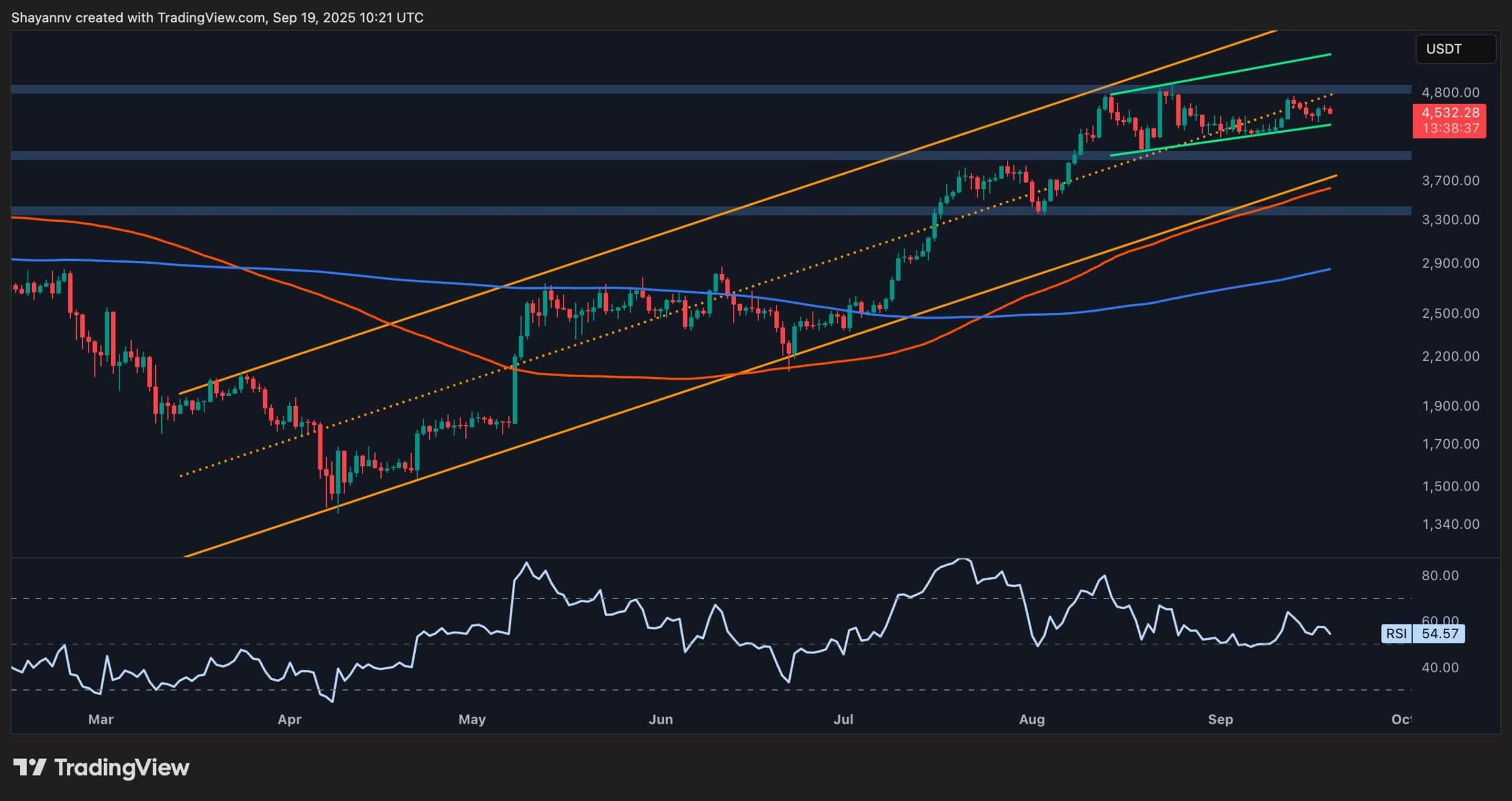
Ethereum Price Analysis: Will ETH Crash to $4K or Rocket to $5K Next?

Ethereum Price Analysis: Will ETH Crash to $4K or Rocket to $5K Next?

Ethereum’s price has been consolidating for over a month now and is yet to push through the key $5,000 mark. This consolidation has come following a significant rally since April, pushing the asset past multiple resistance levels, and will likely continue if the market is able to break through the $4,800 level in the coming […]

Author: CryptoPotato
HBAR Slides 3% as Selling Pressure Intensifies, Finds Support at $0.24

HBAR Slides 3% as Selling Pressure Intensifies, Finds Support at $0.24

The post HBAR Slides 3% as Selling Pressure Intensifies, Finds Support at $0.24 appeared on BitcoinEthereumNews.com. HBAR faced steady downward pressure over the past 23 hours, sliding from $0.25 to $0.24—a 3.38% decline. The token initially attempted to build momentum on September 18, reaching $0.25 by 20:00, but sellers quickly overwhelmed demand near that resistance level. Trading activity spiked at 19:00 with volumes topping 55.91 million, underscoring the intensity of selling. By late evening, HBAR broke below key support zones at $0.25 and $0.24, testing the lower boundary before finding temporary stability. The retracement highlights fragile sentiment in the short term, with bears maintaining control as buyers failed to defend critical thresholds. The inability to reclaim lost ground indicates that market participants remain cautious, though consolidation near $0.24 suggests some stabilization. If the level continues to hold, traders may view it as a base for potential sideways movement before a clearer directional trend emerges. Broader market factors continue to shape HBAR’s outlook. While its energy-efficient Hashgraph technology is often cited as a competitive advantage over traditional blockchains, trading volumes still lag peers like Solana. Still, institutional endorsements from Google, IBM, and Boeing offer a degree of legitimacy that could appeal to investors seeking utility-driven blockchain projects. Its low-cost, high-speed transactions keep HBAR positioned as a contender in the evolving digital asset landscape. In the final hour of the observed session, HBAR showed signs of stabilization, hovering tightly around $0.24. The token formed a minor ascending triangle pattern, testing support multiple times while nudging slightly upward. Though modest, this recovery on volume of 2.08 million indicates buyers are tentatively stepping back in. Whether that consolidation evolves into sustained upside momentum remains contingent on overcoming immediate resistance near $0.24. HBAR/USD (TradingView) Technical Indicators Assessment HBAR breached multiple support levels including $0.25 and $0.24 throughout the bearish phase. Volume surge of 55.91 million during the 19:00 hour signalled intensified…

Author: BitcoinEthereumNews