Liquidation

Liquidation occurs when a trader’s collateral is no longer sufficient to cover their leveraged position’s losses, triggering an automated forced closure by the exchange's liquidation engine. It is a critical risk-management mechanism that ensures the solvency of lending protocols and derivative platforms. In 2026, the focus has moved toward MEV-resistant liquidation models that protect users from predatory "cascades." This tag provides essential information on maintenance margins, health factors, and how to avoid liquidation in high-volatility environments.

15229 Articles
Created: 2026/02/02 18:52
Updated: 2026/02/02 18:52
Bitcoin Lost $12B in Futures, Now the Market’s Bracing for What Comes Next

Bitcoin Lost $12B in Futures, Now the Market’s Bracing for What Comes Next

The post Bitcoin Lost $12B in Futures, Now the Market’s Bracing for What Comes Next appeared on BitcoinEthereumNews.com. TLDR: Bitcoin’s open interest plunged $12B in a week, marking one of the largest futures contractions this year. Funding rates briefly turned negative during Friday’s sell-off before stabilizing in modestly positive territory. Bitcoin’s leverage ratio dropped to levels unseen since 2022, showing mass deleveraging across exchanges. Stablecoin supply ratio fell to April lows, signaling increased buying power waiting to re-enter the market. The crypto market lately faced one of its sharpest pullbacks in recent memory.  Bitcoin’s price correction wiped billions from leveraged positions and sent traders scrambling to reduce risk. It’s the kind of reset that shakes confidence in the short term but may set the stage for future recovery.  Market watchers are now debating whether this shakeout marks the end of overheated speculation or the start of a new accumulation phase. Data shared by CryptoQuant shows Bitcoin’s open interest plunged by $12 billion in a week, sliding from $47 billion to $35 billion. The sudden decline points to widespread liquidation of leveraged bets after prices hit recent highs.  Analysts say this is one of the steepest drops in open interest seen in months, signaling deep stress in derivatives markets. According to on-chain analyst EgyHash on CryptoQuant, the event “reset leveraged positioning across the board.” He added that such cleanouts often clear the way for healthier market structures and eventual uptrends once volatility cools. Bitcoin’s Biggest Reset: Pain Today, Gain Tomorrow? “The recent capitulation has effectively reset leveraged positioning across the board. Historically, such large-scale deleveraging events have often preceded significant uptrends in the long term.” – By @EgyHashX pic.twitter.com/foCGdwOniE — CryptoQuant.com (@cryptoquant_com) October 13, 2025 Bitcoin Leverage and Funding Rates Show Market Reset Funding rates, which track the cost of holding leveraged futures, briefly flipped negative during Friday’s sell-off. That move suggested traders were paying a premium to short…

Author: BitcoinEthereumNews
Best Cryptos to Buy at a Discount as Market Records the Largest Single-Day Liquidation in History

Best Cryptos to Buy at a Discount as Market Records the Largest Single-Day Liquidation in History

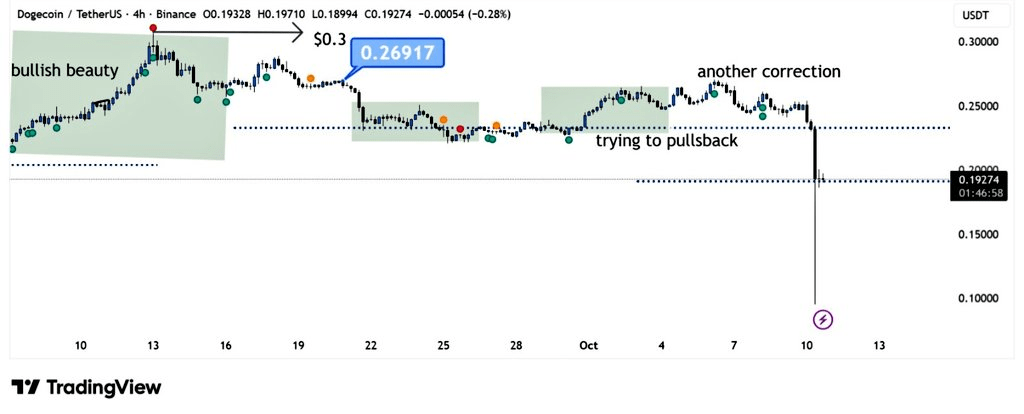
The post Best Cryptos to Buy at a Discount as Market Records the Largest Single-Day Liquidation in History appeared on BitcoinEthereumNews.com. The crypto market has just witnessed its biggest liquidation event in history, liquidating more than $19 billion worth of leveraged positions in just 24 hours. Over 1.6 million traders were affected as Bitcoin, Ethereum, and Solana tanked to multi-week lows. Longs covered almost $16.75 billion, shorts $2.47 billion, and the biggest single liquidation, an Ethereum-USDT position via Hyperliquid worth $203 million, shows the extent of the rout.  Bitcoin dropped to near $101,000 but stabilized near $112,000, while Ethereum decreased 13% to $3,814, and BTC and ETH alone covered nearly $10 billion worth of liquidated positions. Solana, XRP, and Cardano also dropped 15-20%, prompting a liquidation of billions of longs. Risk appetite vanished across the market as a rush to exit saw a level of volatility befitting one of the most dramatic events in crypto history. Amid this chaos, opportunity emerges for those who can spot quality undervalued assets. While established cryptocurrencies like Dogecoin (DOGE) remain prominent, attention is shifting to Mutuum Finance (MUTM), currently in Phase 6 of its presale, with over 65% already sold out. With a token price of $0.035, raised over $17.25 million, and more than 16,910 holders, MUTM is performing well. Its innovative DeFi ecosystem, structured presale, and community-driven roadmap position it as a standout investment for traders seeking upside in the wake of this historic market crash. Dogecoin Holds onto Key Thresholds Despite Meme Psychology Dogecoin (DOGE) witnessed its meme-led liquidity retreat, underscoring volatile characteristics of social-led assets. Significant levels to focus on are still $0.28 for a breakout and $0.17–$0.19 as support.  Traders are watching for the next moves, keeping in mind that meme coins primarily operate based on sentiment and must never become core positions. Though DOGE’s social engines can resuscitate fast advances, investors are gradually looking towards projects having better-defined fundamentals and…

Author: BitcoinEthereumNews
Amid $30B in Crypto Liquidations, Mandala Chain Presale Stands Strong — Traders Call It a “Safe Haven” for 2025 ROI

Amid $30B in Crypto Liquidations, Mandala Chain Presale Stands Strong — Traders Call It a “Safe Haven” for 2025 ROI

The presale of the Mandala Chain became a fortress in the middle of a fierce liquidation of 19 billion dollars in crypto on October 10, 2025, wiping out 1.6 million traders. Bitcoin dropped below 102k, and altcoins such as Solana dropped by 15 percent, but the Mandala Chain $KPG token gave traders a safe haven [...] The post Amid $30B in Crypto Liquidations, Mandala Chain Presale Stands Strong — Traders Call It a “Safe Haven” for 2025 ROI appeared first on Blockonomi.

Author: Blockonomi
Bitcoin koers terug boven $116.000 – maar onzekerheid blijft

Bitcoin koers terug boven $116.000 – maar onzekerheid blijft

Connect met Like-minded Crypto Enthusiasts! Connect op Discord! Check onze Discord De koers van Bitcoin is na de zware crash van vrijdag weer opgeklommen tot boven de 116.000 dollar. Daarmee herstelde de munt zich alweer redelijk ten opzichte van de dieptepunten van rond de 102.000 dollar. Toch heerst er verdeeldheid onder handelaren: staat de bullmarkt voor een nieuwe opleving of is dit het begin van een langdurige correctie. Waarom daalde de Bitcoin koers? De crash, veroorzaakt door nieuwe Amerikaanse tarieven in de handelsoorlog met China, leidde tot de grootste liquidatiegolf in de geschiedenis van crypto. Meer dan 20 miljard dollar aan posities verdampte in enkele uren. Ook aandelen en goud reageerden heftig. Opvallend genoeg zette goud daarna direct een nieuw record neer van 4.078 dollar per ounce. Volatiele uren voor de cryptomarkt. Bron: Adam Kobeissi Reset voor de markt Volgens analisten heeft de markt een grote hefboomreset ondergaan. Derivatenplatform Glassnode ziet dat financieringskosten voor handelaren zijn gedaald tot niveaus die sinds de bearmarkt van 2022 niet meer zijn gezien. “Speculatief overschot is hard uit het systeem geperst,” zegt medeoprichter Rafael Schultze-Kraft. 3/ We saw the largest open interest wipe-out in history. For #BTC alone, over $10B in open interest was erased across all major exchanges. pic.twitter.com/Fvuvzf96Nc — Rafael (@n3ocortex) October 12, 2025 Toch blijft de nervositeit groot. Analisten wijzen op cruciale steunzones rond 112.000 dollar en 108.000 dollar. Een doorbraak omlaag kan een nieuwe bearmarkt bevestigen, waarschuwen handelaren. Optimisten houden juist 120.000 dollar als doel in de gaten. Welke crypto nu kopen?Lees onze uitgebreide gids en leer welke crypto nu kopen verstandig kan zijn! Welke crypto nu kopen? De rentes zijn officieel omlaag voor het eerst sinds 2024, heeft Fed-voorzitter Jerome Powell vorige week aangekondigd, en dus lijkt de markt klaar om te gaan stijgen. Eén vraag komt telkens terug: welke crypto moet je nu kopen? In dit artikel bespreken we de munten die in 2025 écht het verschil kunnen… Continue reading Bitcoin koers terug boven $116.000 – maar onzekerheid blijft document.addEventListener('DOMContentLoaded', function() { var screenWidth = window.innerWidth; var excerpts = document.querySelectorAll('.lees-ook-description'); excerpts.forEach(function(description) { var excerpt = description.getAttribute('data-description'); var wordLimit = screenWidth wordLimit) { var trimmedDescription = excerpt.split(' ').slice(0, wordLimit).join(' ') + '...'; description.textContent = trimmedDescription; } }); }); Het macro-economische plaatje Intussen kijkt de markt ook naar macro-economische signalen. Door de aanhoudende sluiting van de Amerikaanse overheid worden belangrijke inflatiecijfers mogelijk niet gepubliceerd. De aandacht richt zich daarom op Fed-voorzitter Jerome Powell, die deze week een toespraak geeft over het economisch beleid. Beleggers hopen op aanwijzingen voor renteverlagingen later deze maand. Naast korte termijnschokken speelt een bredere trend. Zowel goud als Bitcoin profiteren van zorgen over geldontwaarding, een beweging die door analisten de “debasement trade” wordt genoemd. Volgens beleggingshuis Mosaic Asset Company is de stijging van edelmetalen en crypto een reactie op oplopende staatsschulden en groeiende geldhoeveelheden wereldwijd. Financial markets are evolving: The -$19.5 billion crypto liquidation and -$2.5 trillion equity market crash on October 10th have highlighted a crucial point. Markets in 2025 have evolved to their most reactionary form in history. When you couple this with record levels of… — The Kobeissi Letter (@KobeissiLetter) October 12, 2025 Analisten van The Kobeissi Letter vinden het vooral een bijzondere markt waar we ons in begeven. Headlines in het nieuws kunnen biljoenen dollars aan kapitaal liquideren. Volgens hen is het in deze tijd heel veel waard als je rustig kunt blijven, terwijl de rest van de markt juist in pure paniek handelt. “Wij zijn klaar voor een nieuwe grote week,” zo sluiten ze hun publicatie op zondagavond af. Wat denk jij? Gaan we deze week weer flink schommelen met de Bitcoin koers? Crypto marktinzichten 10xResearch - insights in de cryptomarkt Jarenlange expertise in markt onderzoek en technische insights Data gebaseerd op meer dan 50 trading algoritmes Meest recente en accurate marktanalyses 10xResearch review Registreer op 10xResearch Het bericht Bitcoin koers terug boven $116.000 – maar onzekerheid blijft is geschreven door Thom Derks en verscheen als eerst op Bitcoinmagazine.nl.

Author: Coinstats
Analysts See 2020 Parallels in Crypto’s $19B Market Washout

Analysts See 2020 Parallels in Crypto’s $19B Market Washout

Analysts are comparing Friday’s crash to the March 2020 meltdown that preceded crypto’s historic bull run.

Author: CryptoPotato
As 1.6M Traders Get Liquidated, Top Funds Rotate into Mandala Chain’s AI-Powered Sovereign Blockchain

As 1.6M Traders Get Liquidated, Top Funds Rotate into Mandala Chain’s AI-Powered Sovereign Blockchain

The presale of Mandala Chain in $KPG is on an unparalleled roll. More than 1.6 million traders are in the liquidation process as the market goes through a huge plunge. A flash crash erased $19 billion and dropped BTC to a 102K low. Top funds are now frantically pouring billions of dollars into the Mandala […] The post As 1.6M Traders Get Liquidated, Top Funds Rotate into Mandala Chain’s AI-Powered Sovereign Blockchain appeared first on Live Bitcoin News.

Author: LiveBitcoinNews
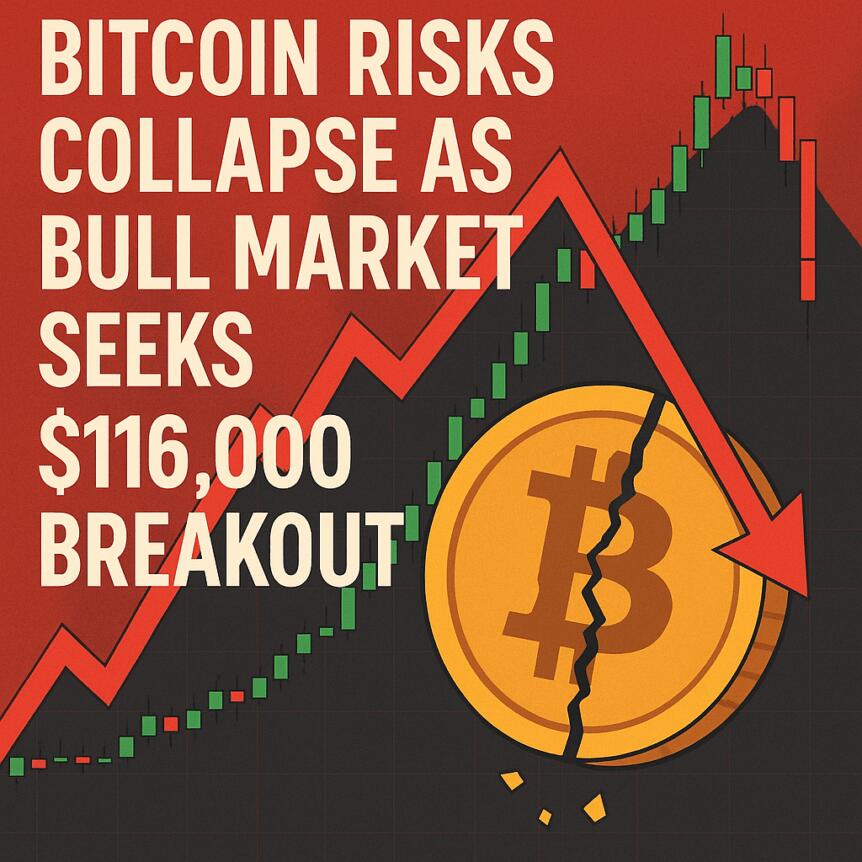
Bitcoin Risks Collapse as Bull Market Seeks $116,000 Breakout

Bitcoin Risks Collapse as Bull Market Seeks $116,000 Breakout

Bitcoin’s recent rebound has sparked renewed debate among traders and analysts about the sustainability of the current bull market. As BTC inches back from its recent lows, the market faces critical levels and uncertain macroeconomic influences, including potential shifts in US monetary policy and inflation dynamics. This week could prove pivotal in determining whether the [...]

Author: Crypto Breaking News
Why does DeFi's next milestone depend on AI?

Why does DeFi's next milestone depend on AI?

Original title: DeFi's next milestone: What it'll take for agentic finance to work Original author: @Lemniscap Original translation: Ismay, BlockBeats Editor's Note: When the world of DeFi becomes so complex that even professional users find it difficult to control, how can we return the initiative to ordinary people? This research article from Lemniscap systematically examines the rise and current challenges of "intelligent agent finance." From &milo and Meridian to SendAI and The Hive, these early products demonstrate how AI can become a new interface for on-chain interactions, but they also expose significant gaps in execution reliability, permission security, and verification mechanisms. The author argues that the key to DeFi's next phase lies not in smarter models but in a more trustworthy underlying structure—one that ensures that every action taken by agents is verifiable, traceable, and trustworthy. This is not only a turning point in technological evolution, but also an experiment in the reconstruction of trust. As the article states: The next milestone for DeFi is not greater scale, but trust in automation. By 2025, DeFi will look nothing like its early days. The data speaks for itself: Institutional funds inflows exceeded $10 billion in a single quarter, and the number of active protocols across dozens of chains exceeded 3,000. The total locked-in value of DeFi protocols across the entire network reached $160 billion in 2025, a year-on-year increase of 41%. The cumulative trading volume of DEXs and Perps is measured in trillions. As DeFi grows in scale, the possibilities for doing more and more are expanding, but the complexity is also skyrocketing. Most people simply can't keep up with everything happening on-chain. If we want more people to seize these new opportunities, we must build tools that make it easier for users to make the right decisions—and that's where the future is headed. At the same time, AI has become increasingly integrated into daily life, and people are starting to develop new habits around automation. This trend has given rise to "agentic finance," where intelligent agents handle the navigation and execution of financial operations. Even simple browser-based proxies like Comet demonstrate the rapid evolution of these tools. When you perform a DeFi operation through a browser proxy (as in the example shared by SendAI founder Yash), you can see the potential of intelligent agent finance. The vision is straightforward: instead of searching through dashboards or long posts on X, you can simply tell the AI what you want to achieve, and it will automatically help you complete the next steps. Two categories of intelligent agents are emerging: One type is Copilots, which guide users to make decisions in the entire DeFi world; the other type is Quant Agents, which are more inclined to professional automated strategy execution, equivalent to "Autopilots". Both are still in their early stages and have flaws, but together they point in a new direction—a radically different, AI-driven way of interacting with DeFi. Intelligent Agent as Co-Pilot Think of these intelligent agents as your personal assistant. No longer needing to scroll through charts or jump between protocols, you can simply ask natural language questions like, "What are the hottest tokens right now?" or "Where can I find the best returns?" and the agent will answer directly and recommend next steps—like a knowledgeable friend always on hand. Take &milo as an example. Its co-pilot mode can assist you in making investment decisions, rebalancing assets, and gaining portfolio insights - allowing you to stay in control while eliminating tedious operations. Using natural language interpretation and intelligent prompts, &milo helps users understand their positions and compare profit opportunities without having to search for data in various dashboards. It demonstrates the evolution of co-pilot agents from simple chat assistants to full-fledged DeFi guides. To see how these agents perform in practice, we tried out several recently released products to see firsthand how well they handle real-world DeFi tasks. The results showed that these agents still have limitations. For example, they successfully identified popular tokens but were unable to execute buy operations. Two transactions also failed with the system indicating "insufficient balance" even though there was actually enough SOL in the account to cover the transaction fee. A similar platform, The Hive, takes a different approach. It organizes multiple DeFi agents into a "swarm," capable of collaboratively completing complex tasks such as cross-chain transactions, yield strategies, and liquidation defenses, all coordinated through a simple chat interface. This network of specialized agents can complete multi-step on-chain operations using natural language commands. We tested the same buy command using The Hive. The system did recognize the popular token WEED, but returned the wrong contract address when executing the purchase. Overall, Milo demonstrates how portfolio management tools can be integrated into a seamless process, while The Hive explores how to enable multiple specialized agents to work together. As the capabilities of intelligent agents increase, they will begin to develop a clearer division of labor. For example, Meridian focuses on the other end of the user spectrum—helping beginners take their first steps into DeFi. Its mobile-first design, coupled with clear prompts, makes basic operations like swapping tokens, staking, or checking returns easier to use. Meridian performs smoothly and quickly on these core tasks, and more importantly, it is very clear about its own boundaries. When users ask it to perform an operation beyond its scope, it will explain the reason instead of blindly trying. This honesty makes it a reliable starting point for novices to explore the world of on-chain. Meridian founder Benedict explained: Meridian allows users to securely research and operate using natural language. We have made the broker's research functionality available to the public for free at meridian.app. Users who register for the Meridian mobile app can use the broker's swap, multi-swap, and portfolio purchase features. Currently in closed beta, interested users can contact @bqbrady on Twitter to request a trial. Through our testing, we found that most of the AI agents currently focused on DeFi navigation are still in the role of "teachers" or "assistants", mainly helping users complete the most basic operations (such as currency exchange). Further improvements are still needed before they can reliably handle more complex processes such as providing liquidity and managing leveraged positions. As Rishin Sharma, Head of AI at the Solana Foundation, noted: "Large language models (LLMs) are prone to hallucinations when handling a wide range of tasks and struggle to execute deterministic operations. Function call mechanisms like MCP may be more suitable for translating 'action plans' into actual execution. While LLMs perform well at the conception and guidance levels, they still struggle with precise execution. To make intelligent agent finance truly reliable, we must go beyond LLMs and develop specific function call mechanisms, clear execution policies, verifiability, and a secure permission system. In other words, the execution layer of today's intelligent agents is still underdeveloped—the AI 'brain' is smart enough, but it lacks a 'body' that can act reliably." As an intelligent agent for "autonomous driving" If "co-pilot" agents are more like mentors, then "quantitative" agents are more like autopilot systems. They not only build strategies but also execute them—monitoring the market in real time, testing trades, and acting automatically at machine speed, putting complex DeFi strategies into "full autopilot" mode. A prime example emerging is SendAI. It's not a quantitative agent per se, but rather a toolkit that enables others to create such agents. Its "Agent Kit," designed for Solana, supports over 60 autonomous operations, including token swaps, new asset issuance, and loan management, and can directly interact with mainstream protocols like Jupiter, Metaplex, and Raydium. In other words, it provides developers with a "rail system" that allows them to connect decision models directly to the chain for execution. SendAI founder Yash clearly outlined their vision: “We believe that every AI agent will have its own wallet in the future. SendAI is building the tools and economic layer needed to enable these agents to perform any action on Solana. We are building a platform that makes these agents contextually aware and supports long-running, persistent, and asynchronous execution of complex tasks.” Meanwhile, other teams are working to make this capability more accessible. Lomen curates strategies and enables users to deploy them with one click, lowering the barrier to entry for users to enjoy quantitative automation without writing code. For advanced traders who prefer a more customized system, Unblinked offers an AI-powered strategy experimentation environment. It's like Cursor for trading: users can sketch out their strategy ideas, run and optimize them in a secure sandbox environment, and then decide whether to invest real money. Some platforms choose to call multiple agents to collaborate to complete tasks at the same time. For example, Almanak combines "programming agents" with "backtesting agents": users describe strategies in natural language, AI automatically generates production-level code, and backtests with more than 10,000 Monte Carlo simulations, ultimately generating a "ready-to-play" strategy. Finally, there are teams focused on real-time market advantage. Giza's ARMA agents proactively allocate funds across lending protocols to maximize stablecoin returns. Rather than keeping funds stuck in a single pool, ARMA continuously monitors interest rates, liquidity, and gas costs, dynamically moving assets. Its flagship agent manages over $17 million and boasts a claimed yield 83% higher than static holdings. Overall, these quantitative agents significantly reduce time costs and allow ordinary users to access complex strategies that were once the domain of professional quantitative teams. However, at the same time, they also reveal the fragility of automation: when data is delayed, protocols are suspended, or the market fluctuates violently, the agents may still "stumble." In other words, they do make you faster, but they're far from invincible. Their problem Spend some time with current intelligent agents and you’ll notice some familiar issues: they sometimes suggest actions that no longer exist, like a long-closed liquidity pool; the data they rely on often lags behind the actual on-chain state; and if a multi-step plan goes awry, they don’t self-adjust, but instead try the same action over and over again. Permission management is also clunky—users must either grant full access to their entire wallet or manually approve every minor action. Testing is similarly superficial, with simulations struggling to replicate the "real-world chaos" of sudden on-chain liquidity changes or governance parameter adjustments. One of the most serious problems is that these proxies operate almost like black boxes. Users have no way of knowing which inputs it read, how it weighed its options, whether it checked the real-time status, or why it chose to execute a particular transaction. Without a signature-verified operational record, it is impossible to verify the consistency between the "promised result" and the "actual execution." Users can only use and "supervise" the automation process at the same time - which is not only inefficient but also makes performance difficult to evaluate. Without a mechanism to validate decisions and prove that actions adhere to established strategies, users will never be able to distinguish between a reliable system and beautifully packaged marketing. For larger-scale capital, DeFi platforms must shift from "trust us" to "please verify." This is also a critical turning point in building an "auditable, governable, and trustworthy" intelligent agent financial infrastructure. Infrastructure gap The core problem is that current systems lack the fundamental tools to ensure agents remain trustworthy, consistent, and secure at scale. To address this, we need infrastructure that can verify agent behavior, confirm execution results, and enforce consistent rules across all environments. Only then will people feel comfortable entrusting them with their money. However, most users don’t really care about the agent’s “thought process”; they just want to confirm that the output is correct, verified, and within the security boundary. When it comes to building trust, “verifiable reliability” is more important than “visibility.” This is where Verifiable Reliability comes in. Proxies don’t have to record every internal operation, but they should operate under clear policies and sanity checks: set spending limits, execution time windows, confirmation nodes before key operations, etc. Under the hood, these rules can be enforced by a Trusted Execution Environment (TEE) or similar system—proving that the agent adheres to the boundaries without revealing all the details. The result: outputs that can be audited when needed, and operations that ordinary users can immediately trust. This layer of verification doesn't have to be a one-size-fits-all approach. Everyday scenarios can employ lightweight security measures and standardized metrics, while high-risk or institutional scenarios may require stronger proofs and formal verification. The key is that each layer of infrastructure should provide measurable reliability commensurate with its risk level. Make the protocol agent-ready The next step to be filled is to make the protocol "agent-friendly". Most current DeFi protocols are not designed for smart agents. They need to provide more stable and secure execution interfaces that allow for previewing operations, safe retries, and consistent execution based on consistent data structures. Permissions should also be limited rather than fully empowered, allowing agents to operate within clear boundaries rather than control the entire wallet. Without these foundations, even the most intelligent agent framework will be tripped up by a fragile underlying infrastructure. Once these foundations are in place, users no longer need to manually monitor automation processes; development teams can reduce troubleshooting time and focus on innovation; and execution results from different service providers can be compared thanks to shared benchmarks—no longer just hype. Parts that must be changed The solution is actually quite simple: make the agent verifiable and the protocol agent-ready. Add a policy layer between the agent and the wallet, and require that all execution processes be traceable and verifiable, rather than operating in a black box. For example, Termina's SVM engine is built on this principle—it provides a true Solana runtime environment for AI agents, enabling them to model, make decisions, and learn based on on-chain data. At the same time, the protocol should provide a "dry-run" interface with clear error codes, a safe retry mechanism, consistent core data structures (positions, fees, and health), and session-based permission control. When these features are implemented, users will be freed from the burden of “minding” agents; teams will be able to reduce system failures; and institutional investors will finally have the safety rails and verifiable proofs they need. Realistic timeline Over the next six months, the fastest-growing improvements are expected to be in "co-pilot" agents, as improved data pipelines will increase their reliability in everyday use cases. Within a year, as testing standards are strengthened, agents will be able to coordinate execution across protocols, with humans only needing to approve key steps. Longer term, as the infrastructure matures, smart agents may gradually blur into the default interaction layer of DeFi—no longer a separate “tool,” but the primary way people interact with the financial system on a daily basis. Conclusion Agentic Finance is lowering the barrier to entry, making automation no longer just a tool for experts. However, to truly operate at scale, it requires a better foundation: real-time data, more secure permission mechanisms, stronger testing systems, and more transparent execution results. Smarter AI alone won’t solve these problems. Real progress will come from improving the underlying structures. The next milestone for DeFi isn't just growth in scale, but trust in automation. This day will only come when AI agents stop being mere "conceptual demos" and become truly reliable executors.

Author: PANews
MARA Buys 400 Bitcoin as BTC Rebounds Above $114K

MARA Buys 400 Bitcoin as BTC Rebounds Above $114K

        Highlights:  MARA Holdings acquired 400 Bitcoin worth $46.29 million, pushing total holdings beyond 53,000 BTC. Bitcoin rebounded over $114,000 after $19 billion in liquidations during market turmoil. Bitcoin dominance surged past 60% as Saylor and Tether CEO signaled more accumulation.  MARA Holdings, a publicly listed Bitcoin mining firm, has acquired 400 Bitcoin worth $46.29 million from institutional crypto liquidity provider FalconX earlier today, a well-known digital asset trading platform. This move aligns with the company’s ongoing strategy to strengthen and grow its Bitcoin treasury. Marathon Digital Boosts Bitcoin Holdings Past 53,000 The recent purchase was made through MARA’s wallet address “3MYao.” With this, the company’s total Bitcoin holdings have crossed 53,000 BTC. It remains the second-largest corporate Bitcoin holder after Strategy, which holds 640,031 BTC, according to Bitcoin Treasuries Net data. Meanwhile, the company has also made deals with artificial intelligence and high-performance computing firms, which show plans to expand beyond Bitcoin mining.  MARA Holdings, which holds 52,850 $BTC($6.12B), bought another 400 $BTC($46.31M) through #FalconX 2 hours ago.https://t.co/pz4qGMyLze pic.twitter.com/2R42GgwLn4 — Lookonchain (@lookonchain) October 13, 2025  The acquisition happened as Bitcoin rebounded to $114,477, marking a 3.4% increase in the last 24 hours, according to CoinMarketCap. This recovery followed the largest liquidation event in crypto history on Friday.  More than $19 billion worth of crypto positions were liquidated after President Donald Trump announced plans for “massive” tariffs on China. The news caused Bitcoin to drop sharply from above $121,000 to below $106,000 before bouncing back. Markets calmed over the weekend after Trump eased his tone. He said on Truth Social that the U.S. wants to help China, not harm it, and called President Xi “highly respected.” In a recent X post, Peter Brandt stated that the Bitcoin bull market “remains strong and active.” This signals that the upward momentum in Bitcoin continues despite market fluctuations. The chart he shared confirmed that the leading cryptocurrency is still trending upward, even after facing recent challenges. Brandt said Ethereum is “ready to rock and roll.” He believes it may rise soon. His chart shows Ethereum is resting now and could break higher. For XRP, Brandt said the small drop is normal. He had already listed XRP as a possible winner. He also saw a descending triangle forming on its chart.  A few final posts for the weekend, then I will leave you youngsters with your dreams$XRP – just a minor reaction in bigger theme of things$BTC – bull still alive and well$XLM – a bull waking from a nap$ETH – ready to rock and rollIf I change my mind I won't let you know pic.twitter.com/rL1nVETYSn — Peter Brandt (@PeterLBrandt) October 11, 2025  Bitcoin Dominance Surges as Saylor and Tether CEO Hint at More Accumulation Michael Saylor also fueled fresh speculation about another Bitcoin purchase after the recent market crash. He shared a chart of MicroStrategy’s Bitcoin holdings with the caption, “Don’t Stop ₿elievin’.” The chart showed that the company holds 640,031 BTC, bought at an average price of $73,983 per coin, hinting that more accumulation could follow.  Don’t Stop ₿elievin’ pic.twitter.com/LUMroqLSCl — Michael Saylor (@saylor) October 12, 2025  Tether CEO Paolo Ardoino made another positive comment about the market. Replying to a past quote, he said, “Bitcoin and Gold will outlast any other currency.” His words showed Tether’s strong belief in long-term value assets. Ardoino added that the company will keep putting money into Bitcoin and Gold. Meanwhile, Bitcoin’s dominance in the market has grown stronger. According to TradingView data, BTC dominance has crossed the 60% resistance level for the first time in months. This shows that money is moving from altcoins into Bitcoin. Analyst CryptoPulse noted that a retest near 62% could confirm the start of a Bitcoin-led recovery phase.   BTC Dominance Breaks Key Level After months of decline, Bitcoin Dominance has finally broken above its last swing high at ~60.6%, marking a clear shift in market structure.  This move signals capital rotation back into BTC as traders seek safety amid recent volatility.… pic.twitter.com/C6kVDInYpn — CryptoPulse (@CryptoPulse_CRU) October 12, 2025     eToro Platform    Best Crypto Exchange   Over 90 top cryptos to trade Regulated by top-tier entities User-friendly trading app 30+ million users    9.9   Visit eToro eToro is a multi-asset investment platform. The value of your investments may go up or down. Your capital is at risk. Don’t invest unless you’re prepared to lose all the money you invest. This is a high-risk investment, and you should not expect to be protected if something goes wrong. 

Author: Coinstats
Has there been the biggest crash ever in the crypto market?

Has there been the biggest crash ever in the crypto market?

A historical record has indeed been set, but not on the spot market for direct token trading.

Author: The Cryptonomist