Liquidation

Liquidation occurs when a trader’s collateral is no longer sufficient to cover their leveraged position’s losses, triggering an automated forced closure by the exchange's liquidation engine. It is a critical risk-management mechanism that ensures the solvency of lending protocols and derivative platforms. In 2026, the focus has moved toward MEV-resistant liquidation models that protect users from predatory "cascades." This tag provides essential information on maintenance margins, health factors, and how to avoid liquidation in high-volatility environments.

15393 Articles
Created: 2026/02/02 18:52
Updated: 2026/02/02 18:52
Bitcoin Just Broke Up with Nasdaq — And No One Saw It Coming

Bitcoin Just Broke Up with Nasdaq — And No One Saw It Coming

The post Bitcoin Just Broke Up with Nasdaq — And No One Saw It Coming appeared on BitcoinEthereumNews.com. Amid a week where major assets, including Gold and the Nasdaq 100, posted gains, Bitcoin lagged significantly. The recent Bitcoin decoupling suggests the asset is neither a risk-on nor a safe-haven asset. According to Coingecko, Bitcoin’s price has declined by approximately 2.09% over the past seven days. This occurred while safe-haven gold surged 4.85% and the risk-on Nasdaq 100 Index climbed 1.34%. Sponsored Sponsored What Caused the BTC-Nasdaq Decoupling? For much of the year, Bitcoin has maintained a high correlation with the Nasdaq 100, generally rising and falling in tandem. This relationship held early last week. The mood was positive through Tuesday after Federal Reserve Chair Jerome Powell hinted at a potential interest rate cut at the October FOMC meeting and a possible end to Quantitative Tightening (QT). These statements led to minor gains for both the Nasdaq and Bitcoin. However, the correlation began to break sharply starting at 9 am UTC on October 15. From that point, the Nasdaq 100 finished the week up 0.44%, while Bitcoin plunged 3.71%. Leverage Washout Cited as Primary Cause On-chain analysts point to the massive crypto crash on October 10—an event that saw over $19 billion in liquidations and injected fear into the market—as the likely culprit. TeddyVision, an analyst at CryptoQuant, highlighted two distinct trends between August 1 and mid-October. Analyzing the 30-day Simple Moving Average (SMA) of stablecoin net inflows to exchanges, he found that USDC inflows to spot exchanges (typically used for spot buying) declined. Meanwhile, USDT inflows to derivatives exchanges (often used for collateral) increased. This suggests that capital used for actual asset purchases decreased. Meanwhile, liquidity supporting leveraged derivatives, such as futures and perpetual contracts, surged. Sponsored Sponsored The Role of Synthetic Demand According to this analysis, it might not have been organic spot demand which have driven…

Author: BitcoinEthereumNews
Bitcoin falls below $110,000, will the market turn bearish?

Bitcoin falls below $110,000, will the market turn bearish?

Written by: 1912212.eth, Foresight News After the October 11th crash, widespread market concerns about a potential second dip surfaced, and just days later, another plunge struck. Bitcoin, which rebounded from $116,000 on October 17th, experienced four consecutive daily declines. At around 4:00 PM today, it dipped to around $104,500, within striking distance of the October 11th crash low of $102,000. Ether (ETH) was also not immune, plummeting to $3,706, and Sol (SOL) to around $175. A host of altcoins saw widespread declines. Coinglass data shows that over the past 24 hours, open interest across the entire network has reached $1.189 billion, with $935 million in long positions liquidated. The largest single liquidation occurred on Hyperliquid's ETH-USD exchange, valued at $20.4274 million. Alternative data shows that the market panic index has fallen to 22, indicating extreme panic. US BTC and ETH spot ETFs both saw significant net outflows Since the crash, US BTC spot ETFs have shown significant net outflows. Between October 10 and 16, only October 14th saw a net inflow of $102.58 million, while the rest of the period saw net outflows. On October 1st, net outflows exceeded $536 million, a new low since August. The outlook for Ethereum spot ETFs is also not optimistic, with large net outflows occurring since October 9. On October 13, the net outflow exceeded $428 million, setting a new record for net outflows since September this year. The crash has left market confidence fragile DeFiance Capital, which had prospered in the previous cycle by betting on multiple DeFi projects, suffered losses in this crash. On October 14th, its founder, Arthur, posted on social media, "We're fine. The fund experienced some losses, but they weren't among our top five biggest profit and loss days. I'm just extremely angry and disappointed. This crash has set the entire crypto space back significantly, especially for the altcoin market, as most price discovery occurs on offshore CEXs." He even pessimistically believes that the crash marks the end of the encryption era. The previously popular trend of treasury DATs has also died down. Tom Lee, chairman of BitMine, the largest Ethereum holding company, said the bubble may have burst. Previously, on September 9, 2025, Nasdaq-listed QMMM Holdings announced plans to invest $100 million in a cryptocurrency reserve, leading to a 9.6-fold increase in its stock price within three weeks. At the end of September, the U.S. Securities and Exchange Commission (SEC) suspended trading of the company, effective September 29, based on allegations that the company was manipulating its stock price through social media platforms. The suspension remains in effect. Caixin visited its Hong Kong headquarters on October 16th and found the office deserted. Upon contacting staff at another nearby company, they stated that the company had relocated in September and were unaware of the relocation. Changpeng Zhao commented on this, saying, “All crypto treasury (DAT) companies should use third-party crypto custodians and have their accounts audited by investors.” Small US banks collapse as market sells first Two regional U.S. banks, Zions Bancorp and Western Alliance Bancorp, disclosed losses Thursday from fraud involving distressed commercial mortgage investment funds. While the losses were relatively small compared to other recent credit defaults, amounting to only tens of millions of dollars, the market reaction was dramatic. Germany's DAX index fell 2.13%, Britain's FTSE 100 index fell 1.6%, Nikkei 225 index fell 1.44%, Australia's S&P/ASX 200 index fell 0.81%, and all three major U.S. stock index futures fell. Panic spread quickly, dragging down the entire banking sector, with the total market value of 74 large US banks wiping out more than $100 billion in one day. This "sell now, see later" mentality quickly spread. JPMorgan analysts Anthony Elian and Michael Pietrini wrote in a report that they also questioned "why all these credit 'isolation' events seem to have occurred in such a short period of time." However, the sell-off did not spare large bank stocks, with shares of Citigroup and Bank of America both falling by more than 3%. The 2023 US banking crisis also triggered a sharp correction in the crypto market. Will the market turn bearish in the future? Chris Burniske, partner at Placeholder VC, wrote, “It increasingly feels like last Friday’s plunge has caused the crypto market to stagnate in the short term. After such a crash, it’s difficult to quickly form sustained buying. This cycle has been disappointing for most people, which may limit their actions because everyone is looking forward to a market recovery or previous historical highs. It’s easy to get caught up in the details of the chart, but if you look at the monthly charts of BTC and ETH, it shows that we are still in the high range (although there are cracks), if you are considering taking profits. MSTR is falling, gold is warning, as are credit markets, and stocks will be the last to react. We can always get a weak rebound, but I've already taken action (remember, cashing out is never all or nothing). I'll watch how BTC reacts to $100,000, but I might become interested again if it reaches $75,000 or lower. This bull market is different from the last, and the next bear market won't be either." Arete Capital partner McKenna said the market is in the process of forming a bottom, which takes 40-60 days to establish. All price action within this interval is a volatile washout. "In mid-November, we should begin to expect constructive results and a positive December and first quarter of 2026." glassnode tweeted that Bitcoin is currently in a key support range, with the price below the 200-day moving average ($107,400) and just above the 365-day moving average ($99,900). At the same time, there is also pressure from the 111-day moving average ($114,700) above it. If the 365-day moving average can be held, the trend may stabilize; if it falls below this level, there may be a risk of a deeper correction. Weiss Crypto suggests that around October 17th, the market may begin to rebound from its lows. By December of this year, the price of Bitcoin could reach a new high of nearly $135,000.

Author: PANews
The Funding: Crypto VCs unpack the largest liquidation event in history — and what’s next

The Funding: Crypto VCs unpack the largest liquidation event in history — and what’s next

I asked crypto VCs what triggered the cascade, what fixes are needed to prevent a repeat, and what comes next.

Author: Coinstats
Trump Confirms Meeting With Xi Jinping on Oct 31, Markets Rally in Response

Trump Confirms Meeting With Xi Jinping on Oct 31, Markets Rally in Response

The post Trump Confirms Meeting With Xi Jinping on Oct 31, Markets Rally in Response appeared on BitcoinEthereumNews.com. United States President Donald Trump confirmed on Sunday that he is meeting with China’s President Xi Jinping at the Asia-Pacific Economic Cooperation (APEC) summit in Seoul, Korea, slated to begin on October 31. “We’re going to meet in a couple of weeks. We’re going to meet in South Korea, with president Xi and other people, too,” Trump told Maria Bartiromo of Fox News, following a de-escalation of trade tensions between China and the US. Trump said on Sunday: “[Xi Jinping] is a very strong leader, a very amazing man. You can look at what he’s done, where he is in his life. It is an amazing story. It’s a story for a great movie. I think we’re gonna be fine with China, but we have to have a fair deal. It’s going to be fair.” Donald Trump talks to Maria Bartiromo about the upcoming meeting with Xi Jinping and settling trade disputes between the two countries. Source: Fox News Trump previously said there was “no reason” to meet Xi Jinping at the APEC summit in South Korea, followed by an announcement of additional trade tariffs on China, which sent crypto markets into a downward spiral, wiping away 99% of value on some altcoins. The social media posts from Trump ignited a cascade of nearly $20 billion in liquidations in the crypto derivatives market — the worst crypto liquidation event in history — which was exacerbated by a perfect storm of leverage, thin liquidity, and excessive risk. Related: Trump confirms US is in a trade war with China Crypto market reacts to de-escalation of trade tensions The price of Bitcoin (BTC) rose by about 2% on Sunday, following Trump’s comments, and BTC wasn’t alone in seeing modest gains. Crypto rallied across the board, with Ether (ETH) and BNB (BNB) each recording…

Author: BitcoinEthereumNews
Worldcoin Price Eyes Recovery Toward $1.45 as Sellers Lose Momentum

Worldcoin Price Eyes Recovery Toward $1.45 as Sellers Lose Momentum

The post Worldcoin Price Eyes Recovery Toward $1.45 as Sellers Lose Momentum appeared on BitcoinEthereumNews.com. Worldcoin Crypto is showing early signs of stabilization following weeks of aggressive downside pressure. The sharp selloff that pushed the token below the $1.00 threshold has begun to subside, with recent price action suggesting that market participants are reassessing short-term positioning. The market’s current tone reflects reduced volatility and cautious accumulation, a structure often seen near the end of a corrective phase. Leverage Reset Reflects Post-Liquidation Equilibrium On the lower timeframes, WLD has been consolidating after the dramatic decline that triggered widespread liquidations. Aggregated open interest dropped sharply from over 300 million to approximately 111 million, according to derivatives data. This steep contraction represents a classic deleveraging phase, clearing out speculative positions and resetting market exposure to more sustainable levels. Source: Open Interest Such conditions typically precede steadier price action, as reduced leverage lessens the probability of erratic swings. With open interest remaining flat at low levels, the crypto now reflects spot-driven dynamics rather than overextended futures positions. If this stability continues, it could provide a stronger foundation for gradual recovery, as traders focus on real market demand rather than leveraged momentum. Market Data Confirms Cooling Volatility Additionally, Data from BraveNewCoin indicates that Worldcoin currently trades at $0.88, reflecting a 1.14% intraday decline, with a market capitalization of $1.95 billion and 24-hour trading volume of $82.6 million. The circulating supply stands at 2.21 billion tokens, placing the token at rank 68 globally. Despite the muted performance, the consistency in liquidity suggests that selling pressure has eased considerably following prior volatility. Source: BraveNewCoin This environment marks a shift from the earlier panic-driven movements. The absence of rapid price swings and steady on-chain volume readings implies that both buyers and sellers are waiting for a clear directional signal before committing to larger positions. Technical Indicators Suggest Bottom Formation Near $0.90 At the…

Author: BitcoinEthereumNews
XRP Holders Urged to Secure Assets as Analyst Issues Critical Warning

XRP Holders Urged to Secure Assets as Analyst Issues Critical Warning

Versan Aljarrah warns XRP holders to prioritize self-custody immediately. XRP rebound possible as MVRV ratio signals oversold market conditions. Rising XRP wallet numbers highlight growing investor confidence and security focus. The XRP community is once again on alert after financial strategist and Black Swan Capitalist founder Versan Aljarrah issued a stern caution to investors. According to him, the time for relying on third-party custody solutions has passed, emphasizing that self-custody is now essential for survival in the volatile crypto landscape. Aljarrah explained that users who depend on custodial wallets place their future in the hands of others, as such services control the private keys to the funds. He encouraged investors to shift to self-custody wallets, where holders have complete authority over their digital assets. He added that he personally uses eight cold wallets secured across multiple layers to ensure maximum safety. Also Read: Ripple CTO Clears Misconception About XRP Ledger’s Unique Node List Expert Emphasizes Control Amid Growing Market Uncertainty Crypto markets have faced heightened instability, following a record sell-off earlier in October that saw more than $19 million erased in liquidations. The strategist’s remarks come at a time when investor confidence remains fragile, particularly as digital asset values continue to swing sharply. Cold wallets, which keep private keys offline, have become the preferred choice for many long-term investors. These wallets, including hardware and paper options, offer protection against online threats that have recently become more sophisticated. Aljarrah’s advice reflects growing concerns over centralized exchanges, which have previously suffered from breaches and insolvencies. Indicators Point to a Potential XRP Rebound Data from on-chain analytics firm Santiment suggests a possible recovery for XRP. The firm reported that XRP’s MVRV ratio, a key indicator of trader profitability, has fallen to -15.3 percent. Historically, such negative values often precede rebounds, as they indicate traders are holding assets at a loss, signaling potential buying opportunities. Significantly, the number of wallets holding at least 10,000 XRP has reached an all-time high of more than 317,500. This growing participation among mid and large holders indicates sustained interest and confidence in XRP’s long-term prospects despite short-term market turbulence. Security and Control Remain the Core of Crypto Ownership Aljarrah’s call reinforces a broader sentiment within the cryptocurrency community that security and control are paramount. As digital assets become increasingly integrated into global finance, investors are reminded that safeguarding access to their holdings is crucial. Managing one’s own private keys, according to experts, remains the foundation of true financial independence in the crypto space. Also Read: Aster (ASTER) Price Prediction 2025–2030: Can ASTER Hit $1.35 Soon? The post XRP Holders Urged to Secure Assets as Analyst Issues Critical Warning appeared first on 36Crypto.

Author: Coinstats
‘Protect Your XRP’: Analyst Issues Warning to Crypto Community

‘Protect Your XRP’: Analyst Issues Warning to Crypto Community

The post ‘Protect Your XRP’: Analyst Issues Warning to Crypto Community appeared on BitcoinEthereumNews.com. Financial strategist and founder of Black Swan Capitalist, Versan Aljarrah, has a warning for the XRP community, urging them to protect their crypto assets. Crypto remains in the spotlight following a record sell-off earlier in October, which resulted in over $19 million wiped out in liquidations. According to Aljarrah, self-custody at this point in time is not optional but rather survival, noting that in the crypto ecosystem, control over assets remains everything. In a self-custody wallet, the user has possession of the private keys and thus total control over the funds. This is not so for custodial wallets, as a third party (a cryptocurrency exchange or a managed wallet service) has control of the private keys, implying they are in control of the funds stored in the wallet. Self-custody isn’t optional, it’s survival. In this ecosystem, control over your assets is everything. If you’re not protecting your XRP, you’re leaving your future in someone else’s hands. I personally use 8+ cold wallets spread across layers of security. — Black Swan Capitalist (@VersanAljarrah) October 18, 2025 The Black Swan Capitalist founder asks holders to protect their XRP, saying “If you’re not protecting your XRP, you’re leaving your future in someone else’s hands,” adding that he personally uses eight cold wallets spread across layers of security. Cold wallets keep your private keys offline and out of reach of online threats and include paper and hardware wallets. Indicator signals XRP rebound ahead At the time of writing, XRP was trading up 1.64% in the last 24 hours to $2.40. The MVRV metric, which indicates big pain from crypto traders, signals that an XRP rebound might be imminent. According to on-chain analytics platform Santiment, XRP’s MVRV (mean value to realized value) has entered into negative range as average trader returns in the last 30…

Author: BitcoinEthereumNews
Astra Nova Targeted in Market Maker Account Breach

Astra Nova Targeted in Market Maker Account Breach

The post Astra Nova Targeted in Market Maker Account Breach appeared on BitcoinEthereumNews.com. Key Points: Hacked market maker account led to a huge sell-off of RVV tokens. RVV price plummets by over 69%. Community doubts arise, questioning insider involvement. Astra Nova’s third-party market maker account was breached, resulting in a substantial sell-off of RVV tokens on October 19, leading to a significant drop in RVV’s value. The incident raises concerns over security practices in the cryptocurrency sector, with implications for market trust and the stability of Astra Nova’s operations. Massive RVV Token Sell-Off Causes 69% Price Plunge Following the breach, Astra Nova’s team quickly notified exchange partners to halt further damage. They reaffirmed the security of the project’s smart contracts and infrastructure. There is a commitment to transparency as the incident is examined. On-chain data indicates approximately 890 million RVV tokens were offloaded, equivalent to around 8.6% of the total supply. This resulted in a $10.3M loss, highlighting the severe effect on token valuation. The price fell from $0.26 to approximately $0.0103. Community backlash followed, with well-known blockchain analyst EmberCN expressing skepticism over typical hacker behavior, suggesting potential insider activity. “Which hacker would convert stolen assets into USDT and hold onto them? And even transfer them directly to a CEX? USDT can be frozen, and going straight to a CEX—where are there hackers this foolish?” — EmberCN, Blockchain Analyst The company’s official statement offered a bounty for funds returned, amplifying doubts about internal involvement. Insider Speculation Intensifies in Astra Nova Breach Fallout Did you know? In crypto history, similar breaches of market maker accounts, like the Mango Markets incident, frequently lead to immediate asset liquidation and long recovery phases, mirroring Astra Nova’s current challenges. According to CoinMarketCap, Astra Nova’s RVV token fell to $0.01 with a market cap of $11.59 million. Trading volume skyrocketed 378.14% to $136.32 million, reflecting sharp investor reactions amid…

Author: BitcoinEthereumNews
In the past 24 hours, the total contract liquidation of the entire network was US$238 million, mainly due to the collapse of long orders.

In the past 24 hours, the total contract liquidation of the entire network was US$238 million, mainly due to the collapse of long orders.

PANews reported on October 19th that Coinglass data showed that over the past 24 hours, the cryptocurrency market saw $238 million in liquidated contracts across the network, including $145 million in long positions and $92.4854 million in short positions. The total liquidation amount for BTC was $64.4223 million, and the total liquidation amount for ETH was $69.7147 million.

Author: PANews
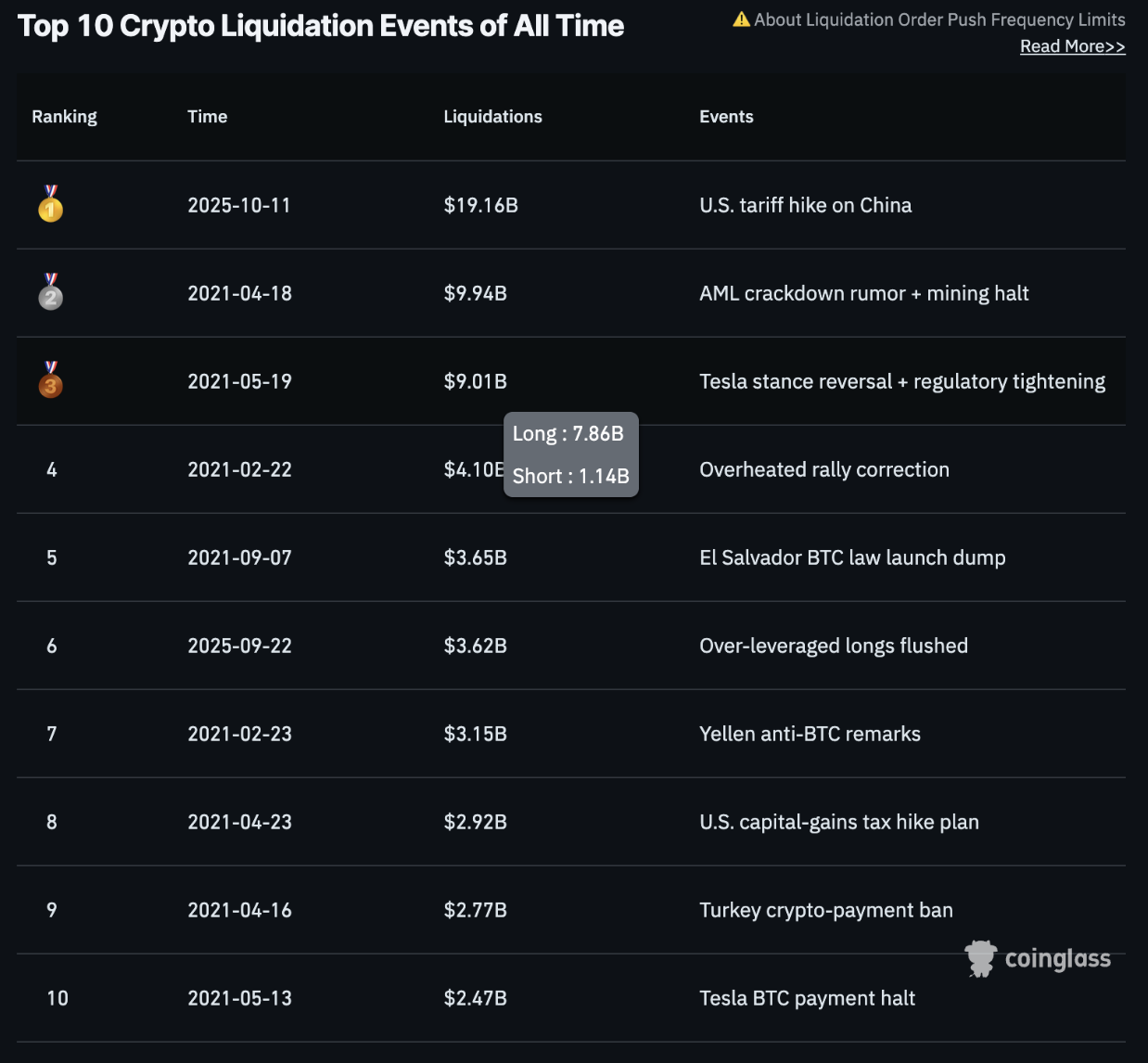
10 Biggest Crypto Liquidations in History — And What Caused Them

10 Biggest Crypto Liquidations in History — And What Caused Them

Crypto’s biggest crashes often stem from global economic or political factors and rarely from internal failures. 2021 and 2025 saw the biggest Liquidation in history, wiping out billions of dollars. On October 10, 2025, the market witnessed the largest liquidation event in crypto history, as more than $19.16 billion in leveraged positions were wiped out [...]]]>

Author: Crypto News Flash