Lending

Lending protocols form the backbone of the decentralized money market, allowing users to lend or borrow digital assets without intermediaries. Using smart contracts, platforms like Aave and Morpho automate interest rates based on supply and demand while requiring over-collateralization for security. The 2026 lending landscape features advanced permissionless vaults and institutional-grade credit lines. This tag covers the evolution of capital efficiency, liquidations, and the integration of diverse collateral types, including LSTs and tokenized RWAs.

14070 Articles
Created: 2026/02/02 18:52
Updated: 2026/02/02 18:52
Forget Shiba Inu (SHIB), Smart Investors Are Buying This $0.035 DeFi Altcoin for Its Utility

Forget Shiba Inu (SHIB), Smart Investors Are Buying This $0.035 DeFi Altcoin for Its Utility

The post Forget Shiba Inu (SHIB), Smart Investors Are Buying This $0.035 DeFi Altcoin for Its Utility appeared on BitcoinEthereumNews.com. As the cryptocurrency environment soars, interest is diversifying throughout different segments, ranging from popular tokens like Shiba Inu (SHIB) to emerging decentralized finance solutions. One of the projects that is attracting increasing interest is Mutuum Finance (MUTM), which is renowned for its widening ecosystem and focus on lending and utility-driven innovation.  Mutuum Finance (MUTM) is priced at $0.035 in presale phase 6. Investors in the project are projecting a minimum of 400% ROI when MUTM is listed in the market. Mutuum Finance has surpassed a total of $14.9 million and more than 15700 token buyers. Mutuum Finance is positioning itself in the broader DeFi market as a platform with actual real-world applications. Mutuum Finance (MUTM) Presale Phase 6 Milestone The Mutuum Finance (MUTM) 2025 presale has been a historic success, an unprecedented achievement in the project’s journey to transform the decentralized finance (DeFi) market. The token, now in Stage 6 and valued at $0.035, is reflective of growing investor confidence and strong market anticipation. Mutuum Finance seeks to define the future of decentralized finance through an innovative platform, long-term utility, and futuristic solutions for both retail and institutional users. The presale has already attracted over 15,700 token holders and secured over $14.9 million in funding, positioning the project for a robust launch and widespread adoption. With its ambitious roadmap, innovative smart contract ecosystem, emphasis on security and scalability, Mutuum Finance is paving the way for a revolutionary DeFi experience in 2025 and beyond. $100K Worth of Tokens to Be Won Mutuum Finance (MUTM) is also running a $100,000 giveaway. There are 10 winners of a Mutuum Finance gift of $10,000. The giveaway is a sign that the project really cares for a loyal and a long-term community. And another step towards transparency and security, Mutuum Finance (MUTM) has initiated an…

Author: BitcoinEthereumNews
SEC Receives Application for Staked INJ ETF Approval

SEC Receives Application for Staked INJ ETF Approval

The post SEC Receives Application for Staked INJ ETF Approval appeared on BitcoinEthereumNews.com. Key Points: The U.S. SEC evaluates Canary Capital’s proposed Staked INJ ETF. First ETF combining Injective Protocol with staking rewards. SEC’s review period signals regulatory openness to staking-based ETFs. The U.S. Securities and Exchange Commission (SEC) has received an application from Canary Capital for the Canary Staked INJ ETF, intending to provide regulated staking exposure to INJ tokens. Approval could position this ETF as a pioneering financial instrument, integrating staking returns into traditional investing, potentially influencing liquidity and value dynamics in the Injective Protocol’s ecosystem. Canary Capital’s Staked INJ ETF: A Regulatory Milestone Canary Capital, led by Steven McClurg, submitted a proposal for a Staked INJ ETF via Cboe’s platform, aiming to integrate Injective Protocol and staking rewards within an ETF structure. While this represents a milestone, official statements from Injective Labs are pending. If approved, the ETF would offer investors access to Injective Protocol without technical hurdles, potentially boosting its ecosystem. This innovation follows the SEC’s recent clarifications on staking activities. Market analysts anticipate heightened interest, although institutional sentiment varies. Investors and developers are closely monitoring the SEC’s position, which may shape future regulatory frameworks for crypto ETFs. Injective Protocol: Expert Views and Market Data Did you know? Canary Capital’s application is part of broader efforts to offer a diversified range of ETFs, including those involving major Layer-1 networks. According to CoinMarketCap, the current market cap for Injective (INJ) stands at $1.29 billion, with a price of $12.91. Despite a recent decline in trading volume and price, INJ gained 21.03% over the past two months, reflecting interest amidst evolving market conditions. Injective(INJ), daily chart, screenshot on CoinMarketCap at 06:35 UTC on August 26, 2025. Source: CoinMarketCap Coincu’s research team highlights that this ETF approach might lead to increased liquidity, aligning with past trends where ETF approvals positively influenced market…

Author: BitcoinEthereumNews
MAGACOIN Finance, Ethereum and Dogecoin Named Best Altcoins With 25x Potential in 2025

MAGACOIN Finance, Ethereum and Dogecoin Named Best Altcoins With 25x Potential in 2025

The post MAGACOIN Finance, Ethereum and Dogecoin Named Best Altcoins With 25x Potential in 2025 appeared on BitcoinEthereumNews.com. Disclaimer: This content is a sponsored article. Bitcoinsistemi.com is not responsible for any damages or negativities that may arise from the above information or any product or service mentioned in the article. Bitcoinsistemi.com advises readers to do individual research about the company mentioned in the article and reminds them that all responsibility belongs to the individual. Anyone who has followed crypto for a while knows it never stays still for long. Prices rise, fall, and reset — and smart investors keep an eye on what’s likely to do well in the next cycle. Lately, analysts have been highlighting MAGACOIN FINANCE, Ethereum, and Dogecoin as three of the Best Altcoins to Buy Now. Each brings something different to the table: Ethereum’s utility, Dogecoin’s community power, and MAGACOIN’s fresh momentum. Together, they show how both established coins and new projects can capture attention when the market heats up. Analysts See a Big Opportunity Ahead Crypto analysts are bursting with excitement as MAGACOIN FINANCE gets placed in the same conversation as Ethereum and Dogecoin. Predictions are that Ethereum and Dogecoin could deliver gains to their holders, but the real opportunity lies in the 25x gain analysts have forecasted for investors who buy MAGACOIN FINANCE. While Ethereum continues to strengthen its ecosystem and Dogecoin retains its meme-driven momentum, MAGACOIN FINANCE is being recognized as a rising star with breakout potential. The reason is clear. The project is an outlier, backed by a strong community and analyst coverage. Investors are closely watching this trio as they could dominate the upcoming bull run, blending blue-chip reliability with fresh upside opportunities. With momentum building, traders are preparing for the kind of explosive returns that haven’t been seen since the early 2021 cycle. Why Ethereum and Dogecoin still matter Ethereum has been around long enough to prove itself.…

Author: BitcoinEthereumNews
PBOC sets USD/CNY reference rate at 7.1188 vs. 7.1161 previous

PBOC sets USD/CNY reference rate at 7.1188 vs. 7.1161 previous

The post PBOC sets USD/CNY reference rate at 7.1188 vs. 7.1161 previous appeared on BitcoinEthereumNews.com. On Monday, the People’s Bank of China (PBOC) set the USD/CNY central rate for the trading session ahead at 7.1188 as compared to the previous day’s fix of 7.1161 and 7.1670 Reuters estimate. PBOC FAQs The primary monetary policy objectives of the People’s Bank of China (PBoC) are to safeguard price stability, including exchange rate stability, and promote economic growth. China’s central bank also aims to implement financial reforms, such as opening and developing the financial market. The PBoC is owned by the state of the People’s Republic of China (PRC), so it is not considered an autonomous institution. The Chinese Communist Party (CCP) Committee Secretary, nominated by the Chairman of the State Council, has a key influence on the PBoC’s management and direction, not the governor. However, Mr. Pan Gongsheng currently holds both of these posts. Unlike the Western economies, the PBoC uses a broader set of monetary policy instruments to achieve its objectives. The primary tools include a seven-day Reverse Repo Rate (RRR), Medium-term Lending Facility (MLF), foreign exchange interventions and Reserve Requirement Ratio (RRR). However, The Loan Prime Rate (LPR) is China’s benchmark interest rate. Changes to the LPR directly influence the rates that need to be paid in the market for loans and mortgages and the interest paid on savings. By changing the LPR, China’s central bank can also influence the exchange rates of the Chinese Renminbi. Yes, China has 19 private banks – a small fraction of the financial system. The largest private banks are digital lenders WeBank and MYbank, which are backed by tech giants Tencent and Ant Group, per The Straits Times. In 2014, China allowed domestic lenders fully capitalized by private funds to operate in the state-dominated financial sector. Source: https://www.fxstreet.com/news/pboc-sets-usd-cny-reference-rate-at-71188-vs-71161-previous-202508260119

Author: BitcoinEthereumNews
Whales Loading Arctic Pablo 200% Bonus, 25x ROI As SHIB Burns And BONK Rallies—Best New Meme Coins For Exponential Returns

Whales Loading Arctic Pablo 200% Bonus, 25x ROI As SHIB Burns And BONK Rallies—Best New Meme Coins For Exponential Returns

The post Whales Loading Arctic Pablo 200% Bonus, 25x ROI As SHIB Burns And BONK Rallies—Best New Meme Coins For Exponential Returns appeared on BitcoinEthereumNews.com. What happens when a presale project unlocks triple rewards, projects a staggering five-digit ROI, and positions itself as the most thrilling meme-driven adventure in crypto? That’s exactly what’s unfolding with Arctic Pablo Coin (APC), a token that has captured the imagination of investors by combining mythical storytelling with serious wealth-generation potential. While Shiba Inu (SHIB) battles its way through massive token burns without a clear price breakout, and Bonk (BONK) rides whale accumulation in the Solana ecosystem, Arctic Pablo Coin has launched Stage 38 of its presale with a 200% bonus for investors using the “CEX200” code. This stage marks a tipping point—whales are circling, and the presale has already raised over $3.62 million. At just $0.00092 per token, APC offers a projected 10,761.57% ROI if it reaches analysts’ predicted $0.1 price. For those seeking the best new meme coins for exponential returns, APC is not just another token—it’s an expedition into undiscovered wealth. This article will cover the updates on Arctic Pablo Coin (APC), Shiba Inu (SHIB), and Bonk (BONK), with a focus on how APC is rewriting the playbook for meme coin presales. Arctic Pablo Coin Presale Unlocks Triple Tokens and 10,761% ROI Potential Could a single presale stage change everything for investors? Arctic Pablo Coin (APC) says yes, with its Stage 38 “CEXPedition PREP” launch that has stunned the market. This meme coin presale is live at just $0.00092, and thanks to the exclusive CEX200 code, every purchase is instantly tripled. For early participants, this means three times the tokens without three times the cost. The result? A presale environment unlike anything the meme coin space has seen in 2025. An investment example shows the raw potential: a $8,000 purchase today delivers 8,695,652 APC tokens at the presale price. Apply the 200% bonus, and that figure jumps…

Author: BitcoinEthereumNews
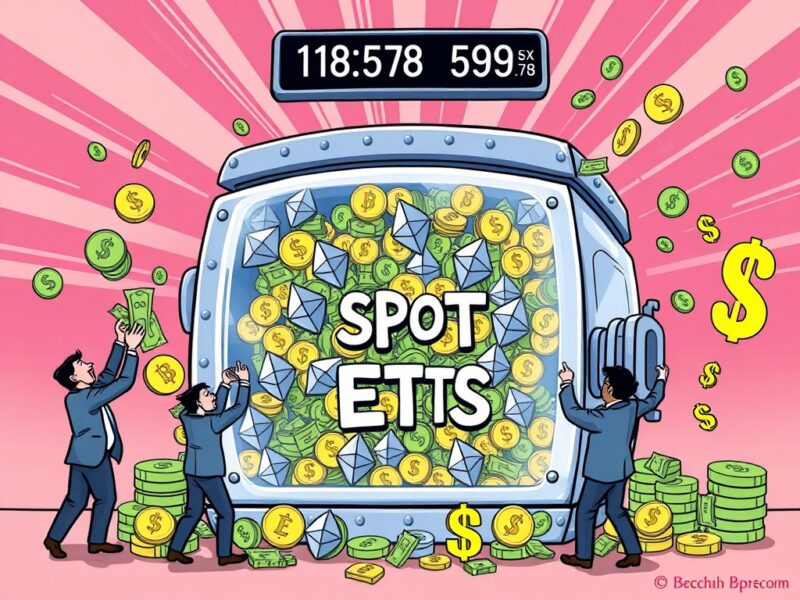
Spot ETH ETFs See Remarkable $440M Inflow Surge

Spot ETH ETFs See Remarkable $440M Inflow Surge

BitcoinWorld Spot ETH ETFs See Remarkable $440M Inflow Surge The world of digital assets is buzzing with exciting news! Spot ETH ETFs have just recorded a remarkable $440 million in net inflows on August 25, marking the third consecutive day of positive momentum. This significant influx signals growing investor confidence and a vibrant market for Ethereum-backed investment products, capturing the attention of investors globally. What’s Driving This Remarkable Surge in Spot ETH ETFs? According to Farside Investors, this impressive figure of $440 million (equivalent to 618.2 billion Korean Won) underscores a sustained interest in Ethereum exchange-traded funds. It’s not just a one-off event; these consistent inflows point to a deeper trend in institutional adoption and investor appetite for regulated crypto exposure. We are seeing a clear shift in how traditional finance approaches digital assets. Several key players led the charge in these inflows. BlackRock’s ETHA fund saw a substantial $315 million, demonstrating its strong market presence. Following closely, Fidelity’s FETH also attracted significant capital with $87.4 million, while Grayscale’s ETH added $53.3 million to the total. These figures highlight a broad-based positive sentiment across major issuers, showcasing robust demand for Spot ETH ETFs. Why Are Investors Pouring Capital into Spot ETH ETFs? The consistent flow into Spot ETH ETFs can be attributed to several factors. Investors are increasingly seeking regulated avenues to gain exposure to Ethereum, the second-largest cryptocurrency by market capitalization. The perceived security and ease of access offered by ETFs make them an attractive option compared to direct crypto purchases, simplifying the investment process for many. Moreover, the growing utility of the Ethereum blockchain, from decentralized finance (DeFi) to NFTs and enterprise solutions, enhances its appeal. As the ecosystem matures, more traditional investors recognize Ethereum’s long-term potential. Regulatory clarity, albeit gradual, also plays a crucial role in boosting institutional confidence, paving the way for more mainstream adoption. Increased Accessibility: ETFs simplify investment in Ethereum for traditional portfolios, removing complexities. Institutional Confidence: Major financial institutions are actively participating, lending credibility to the asset class. Ethereum’s Ecosystem Growth: Expanding use cases and technological advancements drive fundamental value. Regulatory Progress: A clearer regulatory landscape reduces investment risk and fosters trust. What Do These Spot ETH ETF Inflows Mean for the Broader Market? These substantial inflows into Spot ETH ETFs are more than just numbers; they send a powerful signal to the entire cryptocurrency market. They suggest a growing acceptance of digital assets within mainstream finance. This trend could lead to increased liquidity and potentially more stable price action for Ethereum itself, as more capital flows into the ecosystem through regulated products. Furthermore, the success of Spot ETH ETFs might pave the way for other crypto-backed ETFs. It demonstrates a clear demand for diversified crypto investment vehicles, potentially encouraging regulators and financial institutions to explore similar products for other prominent digital assets. This could accelerate the integration of cryptocurrencies into traditional investment portfolios globally, transforming the investment landscape. Looking Ahead: The Future of Spot ETH ETFs The consistent positive inflows are a strong indicator of sustained interest in Spot ETH ETFs. While market sentiment can always shift, the current trajectory suggests a promising future for these investment vehicles. Investors should, however, remain mindful of market volatility and conduct their own research, as with any investment, to make informed decisions. The long-term implications for Ethereum are significant. As more capital is locked into ETFs, it could further strengthen Ethereum’s position as a foundational asset in the digital economy. This institutional embrace is a testament to Ethereum’s enduring innovation and its potential to reshape various industries, from finance to entertainment. In conclusion, the recent $440 million net inflows into Spot ETH ETFs over three consecutive days are a powerful testament to the growing institutional and retail interest in Ethereum. This trend highlights increasing market maturity, regulatory comfort, and the undeniable appeal of digital assets as a legitimate asset class. It’s an exciting time to watch how these developments continue to shape the future of finance, bringing new opportunities and stability to the crypto world. Frequently Asked Questions (FAQs) 1. What are Spot ETH ETFs? Spot ETH ETFs are exchange-traded funds that directly hold Ethereum (ETH) as their underlying asset. They allow investors to gain exposure to ETH’s price movements without directly owning or managing the cryptocurrency. 2. Which funds led the recent inflows into Spot ETH ETFs? BlackRock’s ETHA led the inflows with $315 million, followed by Fidelity’s FETH with $87.4 million, and Grayscale’s ETH with $53.3 million. 3. What do consecutive net inflows signify for the market? Consecutive net inflows into Spot ETH ETFs indicate sustained investor confidence, growing institutional adoption, and a strong appetite for regulated investment products tied to Ethereum, suggesting market maturity. 4. How do Spot ETH ETFs benefit investors? They offer easier access to Ethereum for traditional investors, provide regulatory oversight, and eliminate the complexities of direct crypto custody, making it a more secure and convenient investment option. 5. What is the long-term outlook for Ethereum due to these ETFs? The long-term outlook for Ethereum is strengthened by these inflows, as they signify increasing institutional validation and liquidity. This could lead to greater price stability and further integration of Ethereum into the broader financial ecosystem. Did you find this analysis of Spot ETH ETFs insightful? Share this article with your network on social media to spread the word about these exciting developments in the crypto market! To learn more about the latest explore our article on key developments shaping Ethereum institutional adoption. This post Spot ETH ETFs See Remarkable $440M Inflow Surge first appeared on BitcoinWorld and is written by Editorial Team

Author: Coinstats
Could This Be the Next Big Crypto To Beat SOL’s Growth Even After Solana (SOL)’s Recent Surge?, Expert Says Yes

Could This Be the Next Big Crypto To Beat SOL’s Growth Even After Solana (SOL)’s Recent Surge?, Expert Says Yes

Solana (SOL) has captured headlines with its price momentum and network growth, but investors seeking outsized returns will find a different opportunity in Mutuum Finance (MUTM). Unlike SOL, which relies primarily on adoption and network effect, MUTM combines stable, protocol-driven mechanisms with an integrated token economy designed to reward active users. The platform introduces a [...] The post Could This Be the Next Big Crypto To Beat SOL’s Growth Even After Solana (SOL)’s Recent Surge?, Expert Says Yes appeared first on Blockonomi.

Author: Blockonomi
From NEET subculture to alcohol micro-strategies, here’s a look at the recent hype on the Solana blockchain.

From NEET subculture to alcohol micro-strategies, here’s a look at the recent hype on the Solana blockchain.

What are the "interesting" targets among the monotonous running water disks? While the recent trend toward cryptocurrency compliance has been evident, with seemingly every blockchain project being associated with "compliance," "institutions," and "policy trends," the on-chain craze surrounding Memecoin and ICM projects appears far from over. As if to capitalize on the "last wave" of on-chain enthusiasm, various platforms have chosen to deploy their ultimate moves at this time. BlockBeats has compiled and introduced several of the stocks that have performed well recently. NEETs who don't work Neet (not in employment, education, or training) originally referred to young people (specifically those aged 16-24) who were neither employed nor receiving education or vocational training. In millennial Japan, the age range of the term "NEET" was expanded to include those aged 15-34. It became widely associated with the culture of "otaku" and "staying indoors," and for a long time, it was also associated with "staying at home." As Internet culture spread, the term gradually spread to subculture circles in Europe and the United States, especially anonymous communities (such as 4chan /r9k/ and Reddit). By the 2010s, NEET had gradually evolved into a self-identity and cultural identity of "liberals." From the messages on 4chan, it can be seen that most of them say whatever they want, discriminate against women, discriminate against blacks, and are self-centered. NEET is not necessarily a real identity, but a network personality. People who call themselves "NEET" often emphasize that they are out of touch with the mainstream society, reject social rules, and even "take pride in it." It is both self-deprecating and a kind of "alternative identity." Neet is widely used on 4chan's /r9k/ subreddit (Robot9000). /r9k/ was originally developed by 4chan founder Christopher Poole in 2008 as a filtering system for original content. Its design was intended to prevent spamming and copypasta, which also contributed to the subreddit's vibrant culture. The screenshot shows a discussion on /r9k+1/ (Robot9001), an improved version of /r9k/. Although the token's value quadrupled in a single minute when PumpFun founder Alon first bought $NEET, and then quickly plummeted below its pre-purchase market value, its price trend has remained stable. Besides having many "big brothers" who call out orders and a strong community culture, its Twitter presence is also quite strong. After checking with Cookie, who was the first to call out $neet in the Chinese community, we learned that Primed is responsible for Neet's Twitter operations. Under his and the community's management, accounts within the token system have shifted away from price discussions and focused on promoting cultural trends. Price movements driven by communication itself are far more authentic and healthy than those driven by market manipulation. Excellent communication, a strong community culture, and a supportive team have combined to create a rare "interesting meme" in today's system. Left: Reached 12 million views, right: Musk forwarded and brought 100 million views How is Believe's ICM progress? With the demise of fellow competitors Bags and Heaven, Believe has gradually returned to the forefront of discussion today. Its official token, LaunchCoin, has finally rebounded after a nearly month-long decline. Roy, CEO of Cluely, the recently popular "interview cheating tool" in the AI community, shared a photo with Believe founder Ben Pasternak today, leading the community to speculate on the possibility of some kind of collaboration between the two. Left: Cluely CEO, Right: Believe Founder Believe seems determined to abandon concepts such as "100% cost-to-turn the flywheel" and re-establish its positioning as an "ICM platform concept." After he and his girlfriend Evelyn Ha stayed at the extremely expensive "Aman Tokyo" last time, coupled with the slow progress of the platform and the gradual "return to zero" of the ecosystem, various emotions added up to cause some "heated discussions" in the community. Ben seems to have refocused on Believe. First, he directly acquired Abode for a better product UI, and some interesting projects have chosen Believe to issue again. What about the new and old labels that are currently doing well on Believe? Believe the existing ecosystem. Image source: @PaceTerminal HUCH: CS2 Skin Lending Platform HUCH is an on-chain lending platform for CS2 skins. In July, it won the University Prize in the gaming track of the Colosseum and Solana hackathon. It launched on Believe on August 24th and currently maintains a market capitalization of approximately $1.5 million. The overall basic concept of the product is actually quite simple. The team believes that Counter Strike 2 skins now have a huge market of nearly billions of dollars, but lack the liquidity to match it. CS2 skins and DeFi products have considerable similarities in financial attributes, so they want to create an on-chain platform that converts game assets into financial instruments through mortgage lending. The team integrates real-time market data for accurate valuations, and players can use their CS2 skins as collateral to obtain instant cash loans (65% of the value). Interestingly, before the launch of HUCH, founder Hugo claimed that he sold his Apple computer to promote HUCH and attended a summit event held by the well-known crypto "public office space" Mtn DAO. This was also appreciated by Cobra from the Mtn community, and they discussed in X whether to sponsor him a computer. This proposal received a lot of response from the community, and many team members of the project expressed their willingness to sponsor him. Kled: AI data transaction matching platform Kled is an on-chain AI data trading intermediary platform designed to connect AI developers with data copyright holders, providing trading channels for various data types, including video, audio, and text. The project received $2 million in funding from K5 Capital (K5 has previously invested in projects such as Uber and Xai). Founder Avi Patel, a former University of Illinois at Urbana-Champaign dropout, founded the music copyright platform Nitrility in 2023 and launched Kled in 2024. In the early days, due to contract deployment issues, the $KLED token price plummeted, triggering market panic. However, platform founder Ben (founder of the Believe platform) promptly issued a statement on the X platform to clarify the contract address issue. As the development team continued to update product features, community confidence gradually returned. Kled's market capitalization subsequently rebounded to approximately $10 million, and it was listed on the Moonshot Exchange. On June 9th, Kled V2 announced its next phase of enterprise contracts, "Kled Pages," and shared partnerships with platforms like YouTube, Twitch, and Google Classroom. It also announced plans for a hackathon with Stanford University and UC Berkeley. This series of developments promises increased B2B revenue and improved scalability for the platform, sparking a surge of fear-mongering (FOMO) within the community and driving the price of $KLED to a new high, reaching a market capitalization of $36 million. After the hype faded, the market capitalization has fluctuated around $10 million, currently trading at $18 million. Polycule: Polymarket's Telegram trading bot Polycule is a Telegram trading bot compatible with Polymarket. Users can place orders directly through chat commands, bypassing US access restrictions on Polymarket. This solves the platform's inaccessibility in the US, leading to a $560,000 investment from AllianceDAO. Following Polymarket's official announcement of its partnership with the Telegram bot on X, the platform provides deflationary support for the token by charging a 0.01%–0.05% handling fee on each transaction and setting aside 30% for buybacks and burns. The decentralized prediction market Polymarket rose to fame for its successful predictions of the 2024 US presidential election, spurring a surge in popularity and trading volume. However, due to regulatory investigations, Polymarket was blocked in the US, preventing US users from directly accessing the platform. This is the context in which Polycule was born – a lightweight Telegram trading bot that connects to Polymarket, allowing users to participate in on-chain YES/NO betting transactions through chat commands without opening a webpage. This bot bypasses domain blockades and allows users to easily participate in prediction markets in regions like the US. By addressing the pain points of Polymarket's mobile and restricted-region use, Polycule secured a $560,000 seed investment from AllianceDAO. Polymarket officially expressed support for Polycule—its CEO, Shayne, followed the official Polycule account. When a user on X inquired about placing bets via Telegram, Polymarket confirmed the availability of the Polycule bot. This official endorsement propelled the $PCULE token's initial surge. Subsequently, on June 6th, the social platform X announced a partnership with Polymarket, making it an official prediction market partner, integrating Polymarket's data and predictions with content on the X platform. This news pushed the price of $PCULE to a new high. Polycule currently charges a fee of 0.01%–0.05% per transaction, with 30% used to buy back and burn tokens, providing deflationary support for $PCULE. Leveraging the rise of social trading, Polycule has rapidly expanded its user base, while its fee-burning mechanism has also created a positive feedback loop, driving the token's price upwards. DAOSFUN limited time return? Unlike Believe, which focuses on ICM, DAOS.FUN wants to bring the glory of Crypto AI back to the chain. LLM: Officially endorsed Latino AI memecoin agent LLM (Latina Language Model) is an AI-themed memecoin issued on the DAOS.FUN platform. Its issuer is none other than the platform's founder, @baoskee. It touts itself as the "first fully autonomous Latino AI agent" character token. Because it shares the same name (and indeed, a similar image) as the ai16z copycat "Large Language Model," the project didn't attract widespread attention during its initial launch, providing a relatively long window for entry. However, some veteran traders in the Chinese crypto community, such as Noobwillwin and 0xNoNo, got involved early on. According to community information, the founder of LLM reserved approximately 5.14% of the tokens as a holding and also served as an LLM community moderator. This indicates that LLM is not an ordinary community coin, but an AI-backed token endorsed by the official DAOS.FUN team. Baoskee stated that AI agent technology is experiencing a period of rapid development, and that future application-oriented AI tokens are expected to differentiate themselves from the purely hype of the past "AI season" bubble, driving industry iteration through real products and innovative financial models. While LLM's product offerings haven't demonstrated any significant differentiation from previous crypto AI projects, Baoskee's endorsement has directly boosted its market capitalization to $20 million. $Drink: A microstrategy for alcohol assets BAXUS is an RWA project featured on the DAOS.FUN platform, recommended by baoskee and renowned investor Mike Dudas. The project builds an on-chain marketplace for high-end whiskey and wine on the Solana network, aiming to address the inefficiency and illiquidity of the traditional high-end wine collector market. On the BAXUS platform, rare bottles receive trusted digital proof of ownership: collectors deliver the physical bottles to Baxus Vault, a professional, temperature-controlled warehouse. Each bottle is scanned with high precision and minted into a unique NFT, serving as on-chain proof of ownership. Buyers and sellers can access the platform globally at any time, accepting a variety of payment methods including credit cards, ACH, wire transfers, and cryptocurrencies/USDC. Users can view real-time price trends, trading volume, and historical data for each bottle. Furthermore, any bottle traded or stored on BAXUS can be withdrawn at any time or remain in the Vault for resale, resulting in transaction efficiency far exceeding that of traditional auctions. Drink is the token of the DAO organization promoted by the founder of Baxus, who launched an alcohol "micro-strategy" concept Members of the DAO can choose to vote on the acquisition, management, and ultimate fate of specific bottles or barrels of wine. They can decide whether to sell, hold on to, or share (drink). When LLM became popular yesterday, Baoskee also took the opportunity to recommend Drink, which caused its price to rise by 100% in a short period of time and is now valued at US$600,000.

Author: PANews
Aave V4: The Exciting Future of Decentralized Lending is Near

Aave V4: The Exciting Future of Decentralized Lending is Near

BitcoinWorld Aave V4: The Exciting Future of Decentralized Lending is Near The decentralized finance (DeFi) world is buzzing with anticipation! A major announcement has sent ripples across the crypto community: Aave founder Stani Kulechov has confirmed that Aave V4 will launch soon. This exciting news signals a significant leap forward for one of the most prominent lending protocols in the blockchain space. For anyone invested in the future of DeFi, the impending arrival of Aave V4 represents a pivotal moment, promising enhanced features and greater efficiency. What Makes Aave V4 So Anticipated? Aave has long been a cornerstone of decentralized lending, enabling users to lend and borrow cryptocurrencies without intermediaries. Each iteration of the protocol has brought improvements, pushing the boundaries of what’s possible in DeFi. The upcoming Aave V4 is expected to continue this tradition, building upon the robust foundation of its predecessors. The journey towards this new version has been methodical. Prior to Stani Kulechov’s recent announcement on X, an Aave vice president had already revealed that the Aave V4 codebase was officially introduced to all DAO service providers. This crucial step indicates that the development is well underway and has passed initial reviews, setting the stage for its imminent release. What Innovations Could Aave V4 Bring? While specific details about Aave V4 are still emerging, the community widely anticipates a suite of advancements. These upgrades are likely to focus on improving user experience, optimizing capital efficiency, and strengthening the protocol’s security framework. Imagine a more seamless borrowing and lending process, potentially with lower fees or more flexible collateral options. Some potential enhancements users are hoping for include: Improved Capital Efficiency: Allowing users to get more out of their deposited assets. Enhanced Risk Management: Robust mechanisms to protect lenders and borrowers. Cross-Chain Capabilities: Expanding Aave’s reach beyond its current networks. User Interface (UI) Upgrades: Making the platform even more intuitive and accessible. New Asset Support: Potentially enabling a wider range of cryptocurrencies for lending and borrowing. These improvements aim to solidify Aave’s position as a leading DeFi protocol and attract an even broader user base. How Will Aave V4 Impact the DeFi Ecosystem? The launch of Aave V4 isn’t just big news for Aave users; it has broader implications for the entire decentralized finance landscape. As a major player, Aave’s advancements often set trends and inspire innovation across the sector. A more efficient and secure Aave could: Spur Competition: Encourage other lending protocols to innovate further. Increase DeFi Adoption: Make decentralized lending more appealing and accessible to new users. Boost Liquidity: Attract more capital into the DeFi ecosystem, benefiting all participants. Set New Standards: Potentially introduce novel features that become industry benchmarks. The ripple effect of such a significant upgrade could truly redefine certain aspects of how we interact with decentralized finance. Are There Any Challenges on the Horizon for Aave V4? While the excitement for Aave V4 is palpable, every major upgrade comes with its own set of considerations. Ensuring a smooth transition, maintaining ironclad security against potential exploits, and effectively communicating new features to a diverse user base are crucial. The Aave team, however, has a strong track record of successful deployments and continuous innovation, which instills confidence in the community. The journey from codebase introduction to full public launch involves rigorous testing and community feedback, underscoring Aave’s commitment to a secure and robust platform. This meticulous approach is vital for maintaining trust in the decentralized ecosystem. Embracing the Future of Lending with Aave V4 The impending launch of Aave V4 marks an exciting chapter for the decentralized lending protocol and the broader DeFi world. Stani Kulechov’s announcement has ignited discussions and high expectations, pointing towards a future of more efficient, secure, and user-friendly decentralized finance. As the crypto space continues to evolve, Aave remains at the forefront, pushing innovation and delivering powerful tools for financial freedom. Get ready for what promises to be a transformative upgrade! Frequently Asked Questions About Aave V4 Here are some common questions regarding the upcoming Aave V4: What is Aave V4?Aave V4 is the next major iteration of the Aave decentralized lending protocol, expected to introduce significant upgrades in efficiency, security, and user experience. Who announced the launch of Aave V4?Aave founder Stani Kulechov made the official announcement via X (formerly Twitter), following earlier statements from an Aave vice president. What kind of improvements can we expect from Aave V4?Anticipated improvements include enhanced capital efficiency, stronger risk management, potential cross-chain capabilities, UI upgrades, and support for new assets. When will Aave V4 be launched?While an exact date has not been specified, Stani Kulechov confirmed that Aave V4 will launch ‘soon,’ indicating it’s in the final stages of preparation. How will Aave V4 impact the broader DeFi ecosystem?As a leading protocol, Aave V4 is expected to spur competition, increase overall DeFi adoption, boost liquidity, and set new industry standards for decentralized lending. If you found this update on Aave V4 exciting, share it with your network! Help us spread the word about the future of decentralized finance and the innovations driving it forward. Your support helps the crypto community grow! To learn more about the latest explore our article on key developments shaping Aave V4 institutional adoption. This post Aave V4: The Exciting Future of Decentralized Lending is Near first appeared on BitcoinWorld and is written by Editorial Team

Author: Coinstats
Michael Saylor Drops Bold Prediction for Bitcoin’s Future

Michael Saylor Drops Bold Prediction for Bitcoin’s Future

The bold prediction is anchored in the cryptocurrency’s fixed 21 million supply cap and its accessibility as a global monetary […] The post Michael Saylor Drops Bold Prediction for Bitcoin’s Future appeared first on Coindoo.

Author: Coindoo