Index

A crypto Index provides a way for investors to gain diversified exposure to a specific basket of digital assets through a single tokenized product. These indices often track specific sectors, such as DeFi, DePIN, or RWA, and are automatically rebalanced via smart contracts. In 2026, AI-managed thematic indices have become the gold standard for passive investing, allowing users to track the "blue chips" of the Web3 economy without manual portfolio management. This tag covers index methodology, rebalancing frequency, and the benefits of diversified crypto baskets.

25781 Articles
Created: 2026/02/02 18:52
Updated: 2026/02/02 18:52

BullZilla’s Next 1000x Narrative Powers Best Meme Coin Presale in September 2025 as World Liberty Financial and Shiba Inu Drop

BullZilla’s Next 1000x Narrative Powers Best Meme Coin Presale in September 2025 as World Liberty Financial and Shiba Inu Drop

The post BullZilla’s Next 1000x Narrative Powers Best Meme Coin Presale in September 2025 as World Liberty Financial and Shiba Inu Drop appeared on BitcoinEthereumNews.com. What if the most rewarding trade of 2025 isn’t in today’s market charts but locked inside a presale, writing its own destiny? In a volatile month where meme coins oscillate between highs and lows, investors are chasing projects that can offer both cultural power and structural mechanics. For those searching for the best meme coin presale in September 2025, one new contender is making its presence impossible to ignore. Over the last 24 hours, World Liberty Financial’s price dropped 15.13% to $0.1803, underscoring the ongoing turbulence surrounding its tokenomics. Shiba Inu also slipped 1.92% to $0.00001216, as retail flows lost momentum. Both moves remind traders that in open markets, even strong communities can’t always fight gravity. By contrast, BullZilla has already raised over $150,000 with more than 550 holders in its early stages. With its price set to increase by 25.86% in the next presale phase, momentum is being built in by design. That’s why many analysts are calling it the best meme coin presale in September 2025, placing it ahead of competitors fighting to hold the floor. BullZilla ($BZIL): Presale Momentum Backed by Ethereum The BullZilla ($BZIL) presale is still in its first stage, but it is already showing traction that most projects never achieve. Priced at $0.00002575, the token will automatically climb 25.86% to $0.00003241 once the $100,000 threshold is cleared or 48 hours pass without reaching it. This mechanic ensures progress never stalls, forcing each stage to be more expensive than the last. Over $150,000 has been raised from more than 550 holders, and early investors are looking at a potential ROI exceeding 20,000% once the token hits its planned listing price of $0.00527. Stage 1D buyers already hold theoretical gains of 347.82% at launch, proving that structured presales can deliver returns even before the broader market…

Author: BitcoinEthereumNews
BlockDAG’s 76,815% ROI Play In September 2025, Tron’s Bearish Signal, Dogecoin’s ETF Gamble

BlockDAG’s 76,815% ROI Play In September 2025, Tron’s Bearish Signal, Dogecoin’s ETF Gamble

The post BlockDAG’s 76,815% ROI Play In September 2025, Tron’s Bearish Signal, Dogecoin’s ETF Gamble appeared on BitcoinEthereumNews.com. Advertisement &nbsp &nbsp Disclaimer: The below article is sponsored, and the views in it do not represent those of ZyCrypto. Readers should conduct independent research before taking any actions related to the project mentioned in this piece. This article should not be regarded as investment advice. The cryptocurrency market in 2025 is presenting three distinctly different stories. Tron (TRX), despite strong adoption, is flashing a bearish signal at $0.34 as traders test support levels that could drag it closer to $0.30. Dogecoin (DOGE), once the king of memes, is down 57% from its July high, with price analysis showing vulnerability to $0.10 unless ETF approval sparks renewed demand. But while TRX and DOGE navigate uncertainty, BlockDAG (BDAG) is executing a calculated strategy. Its Deployment Event presale price of $0.0013 is paired with a structured ROI roadmap: a $0.05 listing milestone, $600M raise target, and a long-term projection of $1. Unlike rivals, BlockDAG has already delivered measurable gains, while onboarding 3M miners and 312K holders. In a market driven by speculation, BDAG’s engineered outcomes position it as the best crypto for payments and future growth. TRON Hovers at $0.34, Could a Break Below Mean Big Trouble? TRON (TRX) is currently holding steady at $0.34, a price point that has become a key battleground for traders. The market has been moving sideways, showing hesitation as buyers and sellers weigh the next move. Technical indicators suggest mixed momentum: the Relative Strength Index (RSI) remains neutral, pointing to neither overbought nor oversold conditions, while the MACD is starting to flash bearish signals, suggesting a possible loss of strength ahead. The crucial area to watch is the $0.33–$0.34 support zone. If TRX falls below this level, traders warn that a slide toward $0.30 could follow. On the upside, a strong rebound could push the…

Author: BitcoinEthereumNews
Can Miners Survive Rising Costs?

Can Miners Survive Rising Costs?

The post Can Miners Survive Rising Costs? appeared on BitcoinEthereumNews.com. Bitcoin Bitcoin is trading at elevated levels this year, yet miners aren’t seeing the windfall they enjoyed in earlier cycles. Rising costs and intense competition are squeezing margins, raising questions about how sustainable today’s mining environment really is. Profitability Isn’t What It Used to Be In 2017 and 2021, record prices translated into outsized profits for mining firms. In contrast, 2025’s rally has come with far leaner returns. The surge in hash rate means that miners must constantly upgrade to the latest generation of rigs just to maintain output. Meanwhile, transaction fees—once a vital boost to income—have remained depressed since 2022, leaving block rewards as the only reliable revenue stream. A New Lens on Mining Health To capture the shifting economics, analyst Joao Wedson designed the Mining Equilibrium Index (MEI), which compares short-term mining revenue to its long-term trend. A reading above 1.0 indicates healthier-than-average conditions, while levels under 0.5 often accompany industry stress or miner capitulation. The current MEI sits at 1.06. That’s comfortably above danger zones, but it pales in comparison to the 2.5 highs of previous bull runs—evidence, Wedson argues, that today’s miners are operating on much thinner cushions. The Road Ahead The central dilemma is whether operators can maintain security and profitability when overhead—electricity, payroll, and infrastructure—keeps climbing. Some companies may be forced to dip into their Bitcoin reserves to cover expenses, a move that could inject additional volatility into the market. Miners don’t just produce coins; they secure the network itself. If financial strain triggers consolidation or sudden drops in hash rate, the effects could ripple far beyond balance sheets. For now, the industry remains stable, but Wedson suggests that 2025 will be a defining test of whether mining can adapt to a maturing, more competitive Bitcoin ecosystem. The information provided in this article is…

Author: BitcoinEthereumNews
Strategy Exclusion from S&P 500 Sparks Industry Dialogue

Strategy Exclusion from S&P 500 Sparks Industry Dialogue

The post Strategy Exclusion from S&P 500 Sparks Industry Dialogue appeared on BitcoinEthereumNews.com. Key Points: Michael Saylor comments on Strategy’s exclusion from the S&P 500. Strategic shift sparks market and community reactions. Robinhood sees stock surge from S&P addition. Michael Saylor expressed concern over Strategy’s exclusion from the S&P 500 index after meeting all criteria, as Robinhood was included instead. This decision influences both equity valuations and crypto-market sentiment, given Strategy’s substantial Bitcoin holdings. Robinhood Joins S&P 500; Shares Surge 7.5% In a notable occurrence, Strategy met all criteria for becoming part of the S&P 500, yet it was not included. Michael Saylor commented, suggesting potential inconsistencies in selection. Robinhood’s unexpected entry added further complexity to the announcement. The exclusion limits Strategy’s opportunity for index-driven demand, especially for funds tracking the S&P 500. Robinhood’s inclusion sparked a positive response with its shares increasing by 7.5%, reflecting the immediate index effect. Thinking about the S&P right now… with a chart showing Strategy’s 92% annualized returns since adopting the Bitcoin Standard, far exceeding both the S&P 500 and Bitcoin over the period. — Michael Saylor Crypto Equities and Regulatory Trends: Expert Analysis Did you know? Robinhood’s inclusion in the S&P 500 reflects an increasing intersection of traditional finance and cryptocurrency sectors, a trend noted since Coinbase’s addition in early 2025. Bitcoin (BTC) currently trades at $110,314.73, with a market cap of $2.20 trillion according to CoinMarketCap data. Despite a slight 0.46% drop within the last 24 hours, its market dominance remains at 57.92%. Trading volume fell by 52.27% over the past day. Bitcoin(BTC), daily chart, screenshot on CoinMarketCap at 16:39 UTC on September 6, 2025. Source: CoinMarketCap Coincu analysts highlight potential for continuous regulatory adjustments impacting firms like Strategy. Analysis suggests that such exclusions can temporarily disrupt equities, but often include future opportunities for rebalanced inclusion. DISCLAIMER: The information on this website is provided as general…

Author: BitcoinEthereumNews
Bitcoin Mining Profitability in 2025: Can Miners Survive Rising Costs?

Bitcoin Mining Profitability in 2025: Can Miners Survive Rising Costs?

Bitcoin is trading at elevated levels this year, yet miners aren’t seeing the windfall they enjoyed in earlier cycles. Rising […] The post Bitcoin Mining Profitability in 2025: Can Miners Survive Rising Costs? appeared first on Coindoo.

Author: Coindoo
WTI hits three-month low as OPEC+ meeting looms

WTI hits three-month low as OPEC+ meeting looms

The post WTI hits three-month low as OPEC+ meeting looms appeared on BitcoinEthereumNews.com. WTI falls to $61.20, its lowest level since June 2, before stabilizing near $61.50. Markets brace for Sunday’s OPEC+ meeting, with Saudi Arabia pushing for an accelerated return of 1.66 mb/d supply, though no final decision has been made. WTI trades below the 50-day SMA at $64.90, with key support at $61.50; a break lower could target $59.50-58.50. West Texas Intermediate (WTI) Crude Oil is heading into the weekend under heavy pressure, extending its losing streak to a third straight day as traders brace for the Organization of the Petroleum Exporting Countries and allies (OPEC+) meeting on Sunday, September 7. At the time of writing, WTI is trading near $61.50 per barrel, down about 2.70% on the day, marking its lowest level since June 2 and leaving the US benchmark on course for its first weekly decline in three weeks. The latest sell-off comes as investors weigh the prospect of a supply shift from the OPEC+. According to a Bloomberg report, Saudi Arabia has been pressing the group to accelerate the return of roughly 1.66 million barrels per day of previously curtailed supply, in a bid to reclaim global market share. While delegates stressed that no final decision has been made and keeping output steady into October remains an option, sources noted an increase could be agreed as soon as this weekend or later in the year. Any proposal to boost output may also face resistance from members keen to keep prices elevated. The bearish tone has been reinforced by a surprise build in US crude inventories this week, which added to oversupply concerns. Energy equities have also tracked Oil lower, underscoring investor unease as the potential for an early OPEC+ supply boost coincides with signs of softer demand. WTI remains pinned below the 50-day Simple Moving Average (SMA) at…

Author: BitcoinEthereumNews
Home Affordability And The Monetary System

Home Affordability And The Monetary System

The post Home Affordability And The Monetary System appeared on BitcoinEthereumNews.com. We should put him on a coin (Photo by Roger Viollet Collection/Getty Images) Roger Viollet via Getty Images A few years ago I wrote a piece, for Public Discourse, called “Montesquieu and the Monetary System.” It discussed our having fiat money, non-gold-standard money, today, from the perspective of the eighteenth century French legal sage, Montesquieu. His Spirit of the Laws argued that legal arrangements properly well up from the ethos of the people—that there should be little “space” between what laws and legal conventions specify and the actual desires of the populace about the ordering of society. Fiat money fails this test outright. The public abhors fiat money and yearns for the days when the all-American expression “sound as a dollar” meant something. The United States was on the gold standard until 1971, and minted silver coins until 1964, these dates marking the final points of the most longed-for period of all of American economic history, in the popular imagination today—that of postwar, post-World War II prosperity. Americans prefer today, as they always have, classical monetary systems, not fiat ones. The view of experts is the opposite. They think that fiat money is great, and that the gold standard in particular is properly in the dustbin of history. They reject returning to a gold standard outright, get impatient with entertaining objections, and point to overwhelming consensus among professionals and specialists in monetary affairs that any consideration of the gold standard today is a waste of time, resources, and energy. Ben Bernanke’s position that he had no idea what moved the gold markets encapsulated the matter. A chief monetary master, such as a Federal Reserve chair, perhaps above all else should have a view as to what moves the gold markets. Populace loves gold-standard-like money, experts dismiss such money, and that…

Author: BitcoinEthereumNews
Strategy (MSTR) Stock: Snubbed by S&P 500 as “Secret Committee” Blamed for Exclusion

Strategy (MSTR) Stock: Snubbed by S&P 500 as “Secret Committee” Blamed for Exclusion

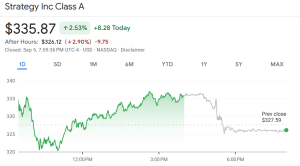
TLDR Strategy (MSTR) was excluded from S&P 500 despite meeting all eligibility criteria, causing stock to drop 2.9% after hours Bloomberg analyst Eric Balchunas blamed a “secret committee” for the rejection decision Robinhood (HOOD) was surprisingly added to the S&P 500 instead, boosting its stock 7% after market close MSTR stock fell below $330 level, [...] The post Strategy (MSTR) Stock: Snubbed by S&P 500 as “Secret Committee” Blamed for Exclusion appeared first on CoinCentral.

Author: Coincentral
Crucial Fed Rate Cuts: Barclays Predicts Three This Year

Crucial Fed Rate Cuts: Barclays Predicts Three This Year

BitcoinWorld Crucial Fed Rate Cuts: Barclays Predicts Three This Year The financial world is buzzing with a significant forecast from investment bank Barclays: they anticipate three Fed rate cuts this year. This projection, hot on the heels of Friday’s pivotal non-farm payrolls report, signals a potential shift in monetary policy that could ripple through the global economy. For investors, businesses, and even everyday consumers, understanding these predicted Fed rate cuts is crucial for navigating the months ahead. What Exactly Are Fed Rate Cuts, and Why Do They Matter? When the Federal Reserve (the Fed) decides on interest rates, they’re essentially setting the cost of borrowing money. A ‘rate cut’ means they are lowering their benchmark interest rate, making it cheaper for banks to borrow from the Fed. In turn, this can lead to lower interest rates on loans for consumers and businesses, such as mortgages, car loans, and business credit lines. Stimulating the Economy: Lower rates typically encourage borrowing and spending, which can boost economic activity. Inflation Management: Historically, rate cuts are considered when inflation is under control or the economy needs a push. Market Reactions: Financial markets, including stocks, bonds, and even cryptocurrencies, often react significantly to changes in interest rate expectations. Barclays specifically expects each of these upcoming Fed rate cuts to be 0.25 percentage points. Their forecast extends beyond this year, projecting two additional cuts in March and June of 2026. This long-term view provides a clearer picture of their economic outlook. What’s Driving Barclays’ Optimistic Outlook for Fed Rate Cuts? The recent non-farm payrolls report plays a key role in Barclays’ analysis. While a strong jobs report might typically suggest the economy is robust enough to handle higher rates, the nuances within the data, combined with other economic indicators, are painting a different picture for the investment bank. Factors like cooling inflation, subtle shifts in wage growth, and a generally stabilizing labor market are likely contributing to their belief that the Fed will have room to ease its monetary policy. The Federal Open Market Committee (FOMC) continuously assesses a wide array of economic data to make its decisions. Barclays’ economists believe that the current trajectory of these indicators supports a move towards lower borrowing costs, aiming to achieve a ‘soft landing’ – bringing inflation down without triggering a severe recession. How Might These Anticipated Fed Rate Cuts Impact Your Finances? The prospect of lower interest rates carries implications across various financial aspects: Borrowing Costs: If you’re planning to take out a mortgage, a car loan, or use credit, lower rates could mean more affordable monthly payments. This is a direct benefit for consumers and can stimulate big-ticket purchases. Savings and Investments: While borrowing becomes cheaper, interest rates on savings accounts and Certificates of Deposit (CDs) might also decrease. This could prompt savers to seek higher returns elsewhere, potentially in investments like stocks or even the volatile but high-growth cryptocurrency market. Business Expansion: For companies, cheaper borrowing can fund expansion, hiring, and innovation, potentially leading to increased corporate profits and economic growth. Understanding these potential shifts allows individuals and businesses to strategize effectively. For instance, locking in a lower mortgage rate could be a wise move, or re-evaluating investment portfolios to align with a new interest rate environment. Are There Any Challenges or Risks to These Fed Rate Cut Predictions? While Barclays’ forecast is compelling, the future is never set in stone. Several factors could influence the FOMC’s decisions and potentially alter the timeline or number of Fed rate cuts: Persistent Inflation: If inflation proves more stubborn than anticipated, the Fed might be hesitant to cut rates, as lower rates could reignite price pressures. Unexpected Economic Strength: A sudden surge in economic activity or an exceptionally strong labor market could also lead the Fed to maintain higher rates for longer, to prevent overheating. Geopolitical Events: Global events, such as supply chain disruptions or international conflicts, can introduce economic uncertainty and impact the Fed’s policy choices. The Fed’s primary mandate is to achieve maximum employment and price stability. Their decisions are data-dependent, meaning every new economic report can shift their outlook. Investors should remain agile and monitor official communications from the FOMC closely. Concluding Thoughts: Navigating the Future of Fed Rate Cuts Barclays’ projection of three Fed rate cuts this year offers a fascinating glimpse into a potential future where borrowing costs ease and economic activity receives a gentle nudge. This forecast, rooted in recent economic data, suggests a path toward a more accommodative monetary policy. While the specifics are subject to change, the overarching sentiment points towards a significant pivot from the aggressive rate hikes of the past. Staying informed about these developments is key to making sound financial decisions in an evolving economic landscape. Frequently Asked Questions (FAQs) Q1: What is the Federal Open Market Committee (FOMC)? A1: The FOMC is the monetary policy-making body of the Federal Reserve System. It consists of 12 members and is responsible for setting the federal funds rate, which influences other interest rates across the economy. Q2: How do Fed rate cuts affect the average consumer? A2: Fed rate cuts can lead to lower interest rates on various loans, such as mortgages, car loans, and credit cards, making borrowing cheaper. Conversely, returns on savings accounts and CDs might also decrease. Q3: What economic data influences the Fed’s decision on interest rates? A3: The Fed considers a broad range of data, including inflation rates (like the Consumer Price Index), employment figures (like the non-farm payrolls report), wage growth, consumer spending, and manufacturing output. Q4: Could Barclays’ prediction of Fed rate cuts change? A4: Yes, economic forecasts are dynamic. Barclays’ prediction is based on current data and trends, but unexpected shifts in inflation, economic growth, or global events could lead the FOMC to adjust its policy, thereby altering the timing or number of predicted Fed rate cuts. Q5: How might Fed rate cuts impact the cryptocurrency market? A5: Lower interest rates can make traditional, lower-risk investments less attractive, potentially encouraging investors to seek higher returns in more volatile assets like cryptocurrencies. This could lead to increased interest and investment in the crypto market. If you found this article insightful, please consider sharing it with your network on social media to help others understand the potential impact of future Fed decisions on the economy and their finances. To learn more about the latest explore our article on key developments shaping Fed rate cuts impact on the global economy. This post Crucial Fed Rate Cuts: Barclays Predicts Three This Year first appeared on BitcoinWorld and is written by Editorial Team

Author: Coinstats
Robinhood Soars 6% After S&P 500 Inclusion As Michael Saylor’s Strategy Misses Out

Robinhood Soars 6% After S&P 500 Inclusion As Michael Saylor’s Strategy Misses Out

Robinhood Markets Inc. (HOOD) surged 6% in after-hours trading after being added to the S&P 500 stock index, while Michael Saylor’s Strategy Inc. (MSTR) missed [...]

Author: Insidebitcoins