Index

A crypto Index provides a way for investors to gain diversified exposure to a specific basket of digital assets through a single tokenized product. These indices often track specific sectors, such as DeFi, DePIN, or RWA, and are automatically rebalanced via smart contracts. In 2026, AI-managed thematic indices have become the gold standard for passive investing, allowing users to track the "blue chips" of the Web3 economy without manual portfolio management. This tag covers index methodology, rebalancing frequency, and the benefits of diversified crypto baskets.

25803 Articles
Created: 2026/02/02 18:52
Updated: 2026/02/02 18:52
Metaplanet, El Salvador Boost Bitcoin Holdings, Saylor Teases New Purchase

Metaplanet, El Salvador Boost Bitcoin Holdings, Saylor Teases New Purchase

The post Metaplanet, El Salvador Boost Bitcoin Holdings, Saylor Teases New Purchase appeared on BitcoinEthereumNews.com. Japanese investment company Metaplanet and crypto-friendly country El Salvador bought more Bitcoin on Monday as the Bitcoin Fear & Greed Index returned to “neutral” after several days in “fear.”   Metaplanet said in a fresh disclosure on Monday that it had purchased an additional 136 Bitcoin (BTC), increasing its total stash to 20,136, worth over $2.2 billion at current prices. In June, CEO Simon Gerovich said the company’s long-term goal was to acquire 210,000 Bitcoin total by 2027, which would make it the second-largest holder of Bitcoin among public companies, behind Strategy, according to Bitbo. Metaplanet is currently the sixth-largest and top Japanese Bitcoin treasury out of the 186 being tracked. It paid roughly 16,554,535 Japanese yen ($111,830) per coin. Source: Metaplanet Stock price down Metaplanet first announced a Bitcoin buy on July 22, 2024, and its shares jumped by 19% to $1.10. However, subsequent buys haven’t yielded the same results. In the last trading session, Metaplanet’s shares were down nearly 3% to $4.65. The stock price is still up 92.45% year to date. Metaplanet also flagged plans to raise another $880 million through a public share offering in overseas markets on Aug. 27 after its stock decline put pressure on its capital-raising “flywheel” under stress. El Salvador buys more Bitcoin as anniversary present Meanwhile, El Salvador President Nayib Bukele said on Monday that the country had bought another 21 Bitcoin as part of Bitcoin Day, adding to its total stash of 6,313, as disclosed by its Bitcoin Office. The country’s Bitcoin office is celebrating “Bitcoin Day,” the anniversary of the law making Bitcoin legal tender, which took effect in September 2021. The International Monetary Fund published a report in July alleging that El Salvador hadn’t purchased any new Bitcoin since signing the $1.4 billion loan agreement in December 2024, which…

Author: BitcoinEthereumNews
Can Babies Be Tokenized? A Crypto Experiment to Solve the Population Crisis

Can Babies Be Tokenized? A Crypto Experiment to Solve the Population Crisis

Written by Lauris Compiled by Saoirse, Foresight News For most of human history, infants were productive economic assets. They weren't just objects to be cared for; they were also laborers—herding sheep at five, joining the farm or becoming apprentices by ten. More children meant higher output, greater resilience to risk, and greater family wealth. This model worked well, with fertility rates showing positive growth and fertility being a significant driver of GDP. Later, everything changed. At some point in the 20th century, children ceased participating in productive labor and became consumers. Schooling replaced the practice of labor, laws restricted child labor, and the emphasis of social education shifted from fostering initiative to emphasizing obedience. Parents continued to have children, but now each child became a net liability for the family for 18 years, and the marginal utility of having a child dropped below zero. This has led to the situation we face today: a sharp decline in birth rates, an inverted population structure, and an aging economy. Relying on child labor on farms is a thing of the past, but incorporating infants into the “bonding curve” mechanism (a mathematical model used for the issuance and pricing of crypto assets) can achieve the following goals: a) Develop a new financial infrastructure tool to help families accelerate their financial freedom; and b) Re-emerging children as economically productive assets, thereby unleashing a socially beneficial effect in terms of increasing birth rates. Opportunity: Babies as on-chain financial primitives Cryptography gives us the tools to solve this problem. Using composable smart contracts, identity metadata, and financial instruments, we can now integrate babies back into the economy. When a baby is born, a "baby bond" is minted. This is a hybrid ERC-404 token: part NFT (for identification) and part fungible token (for liquidity). This token represents the potential economic value of the baby over time, encompassing multiple dimensions such as memetic, social, and intellectual. The second derivative of value, growth acceleration, is also factored back into the birth rate. Contract Standard: ERC-404 and INFNT Token Traditional NFTs are not suitable for this scenario due to their lack of liquidity. Therefore, Baby Bonds adopt the ERC-404 standard. This is a hybrid standard that allows each baby-related token to: Fragmentation trading via INFNT tokens Individual identity recognition through parent NFT Combining badges with bonding curves to achieve dynamic valuation This design allows us to combine the advantages of both: permanence of identity and composability of mobility. From a mathematical point of view: let B(t) be the baby bond at time t, then the formula for its value change is: dB/dt = ∂INFNT/∂milestone + ∂INFNT/∂meme speed, where both variables are convex with respect to public interest and institutional verification. Traits, AI, and Badges Baby bonds are not just a token, but also a vital modular carrier that carries value accumulation and reputation transfer. AI-verified feature metadata: From the moment the token is minted, an AI agent monitors and records the infant's early developmental characteristics, such as movement speed, social behavior, and audio signal complexity. These characteristics are attached to the NFT via semi-immutable metadata (modifiable only through a trusted update oracle), ultimately forming a longitudinal, verifiable, and privacy-protected "baby feature profile." Educational Badges: Schools, universities, digital academies, and other institutions can issue cryptographic badges directly attached to NFTs. These badges, used to mark milestones (e.g., "Learned to read at age 3," "Admitted to MIT," "Top 1% in spatial IQ"), provide both public resources and exclusive advantages to token holders. Dynamic feature accumulation and modular governance: Before the age of 18, baby bonds are managed by parents, smart contracts, or decentralized autonomous organization (DAO) trustees. After turning 18, governance rights transfer to the baby. Furthermore, starting at age 13, babies can be granted an "exit right." Early voting decisions can be weighted quadratically to prevent aggressive large investors from manipulating governance. Fully auditable on the chain: All data and operations are recorded on the chain and can be audited at any time. Example: Trait Score Formula: TraitScore (t) = ∑ (Badgeᵢ * wᵢ) where Badgeᵢ represents a verified achievement signal and wᵢ represents a weight coefficient determined by the market. Convexity and Mechanism Design The value of baby tokenization does not come from linear cash flow, but from "unlocking convexity" - based on the baby's developmental results, the popularity of memes and external certification, it can generate significant nonlinear revenue growth. Bonding Curve-Based Issuance: INFNT tokens (the native token of non-fungible baby bonds) are issued through a bonding curve to reward early backers. As babies achieve more milestones or increase their social impact, the token's value will grow exponentially, making "baby investing" a new type of "seed investment." Third-party feature injection: Verification badges issued by authoritative organizations can drive token value growth along a nonlinear trajectory. For example, adding an “Olympic Gold Medal” badge can cause NFTs to experience discontinuous upward adjustments in value due to a meme-based “supply shock.” Protocol-based fertility incentives: Decentralized autonomous organizations (DAOs), Layer 2 networks, and even countries can implement composable incentive mechanisms. Examples include providing gas subsidies for families with children, quadratic matching of baby bonds held by low-income parents, and launching "fertility farming" programs for rural users. The design space is completely open. Downstream application scenarios After the baby is tokenized, it will become a programmable financial infrastructure. The following are some of the downstream applications: 1. Baby Mortgage Loans Families holding high-potential baby bonds can use their baby's expected income or meme stake as collateral to obtain long-term, low-interest mortgages. Loan approval is no longer based on parental income, but rather on the child's expected economic utility. For example, "We pay a 30% down payment, 10% in ETH and 20% in the baby's bond share." 2. Baby Index ETF Build curated portfolios of baby bonds by geographic region, talent area, or profile. For example, "Nigeria's Top 50 STEM Potential Babies," "Genius Portfolio - Level 1 IQ Scores," and "Elite Violin DAO." These portfolios can be issued as ERC-4626 standard vaults or tradable basket tokens. 3. Baby Perpetual Futures A comprehensive derivatives market will be built, allowing users to "go long" or "short" on the future socioeconomic benefits of specific groups. Contracts will be settled based on the on-chain composite key performance indicators (KPIs) of the infant at age 21, and oracle disputes will be resolved through multi-sig arbitration or memetic resolution mechanisms. 4. Baby Influence DAO Tokenized philanthropy is achieved from birth. Donors can contribute to baby bonds in impoverished areas, earning impact returns and receiving governance tokens in the "Baby Enhancement DAO." This "proof of impact" mechanism will replace traditional philanthropy models and establish a regenerative fertility finance system. 5. Narrative derivatives Bets are placed on speculative developmental trajectories of infants, such as: “Will Child X become a billionaire?” or “Will Child Y be embroiled in public controversy before the age of 12?” The on-chain prediction market will become a “narrative vehicle,” with token value increasing as the trajectory outcomes materialize. Ethical considerations Some may consider this proposal dystopian, arguing that it commodifies life. However, in reality, life has already become financialized in today's society, and children themselves are a cost center for families. We've simply been using a model with low transparency and poorly designed incentives. Tokenization isn't exploitation, but rather a readjustment of the existing system, allowing the coexistence of "life meaning" and "capital." The object of the transaction is never the baby itself, but the predicted value of its growth trajectory. in conclusion We can’t go back to a time when we relied on child farmers; that model is obsolete. The labor of infants on farms is a thing of the past, but by tokenizing babies—a combination of real-world assets (RWAs) and decentralized physical infrastructure (DePINs)—we can leverage token incentives and cryptography to solve one of modern society’s most pressing problems. Childbearing becomes a source of income. Parenting becomes a protocol to follow. Human society will also regain "mobility".

Author: PANews
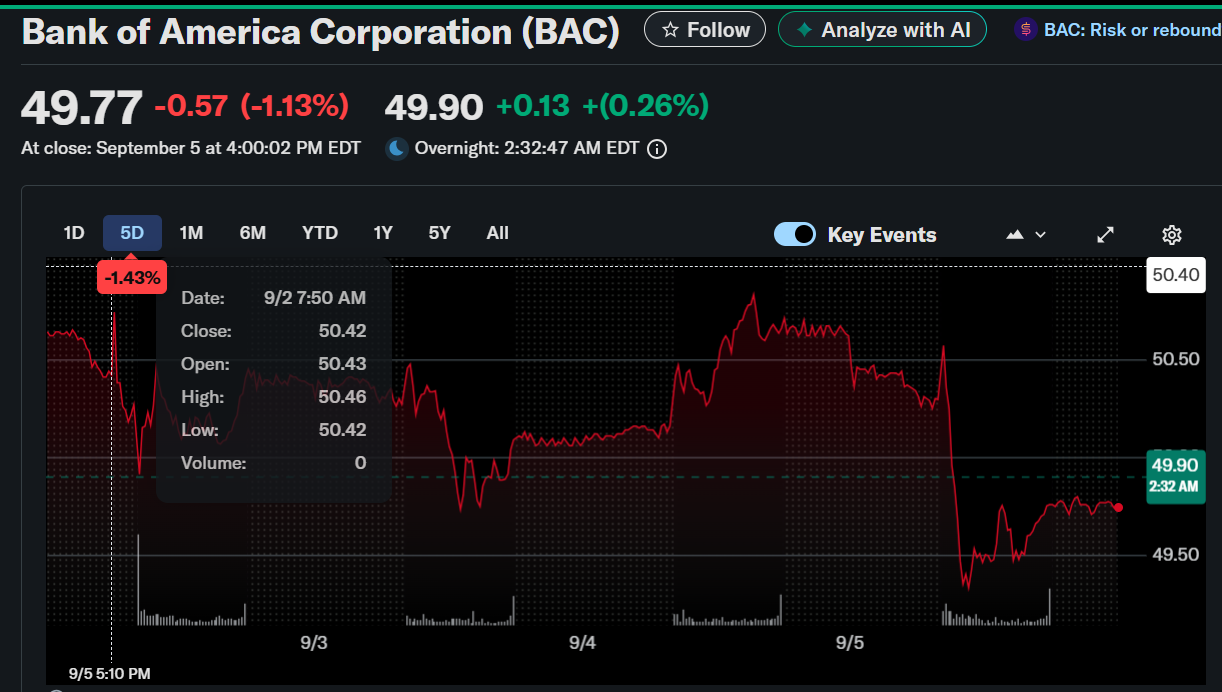
Bank of America Corp. ($BAC) Stock: Valuation Concerns as New Alts Access Program Targets Ultra-Wealthy

Bank of America Corp. ($BAC) Stock: Valuation Concerns as New Alts Access Program Targets Ultra-Wealthy

TLDR Bank of America (BAC) closed at $49.77 on September 5, down 1.13%, with after-hours trading at $49.74. The bank launched its Alts Expanded Access Program to give ultra-wealthy clients more exposure to private markets. BAC shares are up more than 10% in the past month and 31% over the past year. Analysts highlight the [...] The post Bank of America Corp. ($BAC) Stock: Valuation Concerns as New Alts Access Program Targets Ultra-Wealthy appeared first on CoinCentral.

Author: Coincentral
Experienced Analyst Assesses Bitcoin Dominance and Discusses the Possibility of an Altcoin Season

Experienced Analyst Assesses Bitcoin Dominance and Discusses the Possibility of an Altcoin Season

The post Experienced Analyst Assesses Bitcoin Dominance and Discusses the Possibility of an Altcoin Season appeared on BitcoinEthereumNews.com. Cryptocurrency analyst Crypto Daan made evaluations regarding Bitcoin dominance (BTC.D) and the altcoin market. According to the analyst, Bitcoin dominance has peaked in the current cycle and further increases could create good entry opportunities for strong altcoins against BTC. Daan stated that he expects a temporary surge in Bitcoin dominance in the short term, saying this could stem from two different scenarios: “Either Bitcoin tests lower levels and panics in the market, or it enters price discovery and outperforms altcoins. Both scenarios have their advantages.” Daan argued that for the market to progress healthily, it’s crucial for Bitcoin to lead the way out of consolidations. He stated that if altcoins simultaneously gain value while Bitcoin rises, this will bring short-term gains for investors but make the rally less sustainable. The analyst, who predicted that Bitcoin dominance would decline to lower levels in 2025, stated that the outperformance of altcoins against BTC would not be valid for all projects, and that, as in this cycle, Ethereum and a few strong altcoins would especially stand out. Daan also touched on his portfolio allocation, explaining that he currently holds 50% of his assets in Bitcoin and 50% in altcoins. He stated that he considers this balance healthy for the current phase of the cycle, noting that he had previously focused entirely on altcoins at this point, but that this was a high-risk choice and that investors should determine their own strategies based on their risk appetite. *This is not investment advice. Follow our Telegram and Twitter account now for exclusive news, analytics and on-chain data! Source: https://en.bitcoinsistemi.com/experienced-analyst-assesses-bitcoin-dominance-and-discusses-the-possibility-of-an-altcoin-season/

Author: BitcoinEthereumNews
Metaplanet, El Salvador add Bitcoin as sentiment shifts ‘neutral’

Metaplanet, El Salvador add Bitcoin as sentiment shifts ‘neutral’

                                                                               Metaplanet CEO Simon Gerovich said in June that the company’s long-term goal is to acquire 210,000 Bitcoin total by 2027.                     Japanese investment company Metaplanet and crypto-friendly country El Salvador bought more Bitcoin on Monday as the Bitcoin Fear & Greed Index returned to “neutral” after several days in “fear.”  Metaplanet said in a fresh disclosure on Monday that it had purchased an additional 136 Bitcoin (BTC), increasing its total stash to 20,136, worth over $2.2 billion at current prices.In June, CEO Simon Gerovich said the company’s long-term goal was to acquire 210,000 Bitcoin total by 2027, which would make it the second-largest holder of Bitcoin among public companies, behind Strategy, according to Bitbo.Read more

Author: Coinstats
Vitalik Buterin Assesses the Current State of Ethereum (ETH)

Vitalik Buterin Assesses the Current State of Ethereum (ETH)

The post Vitalik Buterin Assesses the Current State of Ethereum (ETH) appeared on BitcoinEthereumNews.com. Ethereum (ETH) co-founder Vitalik Buterin announced that the team has made significant progress this year towards Ethereum’s long-term goals of scalability, decentralization, and resilience. While Buterin argued that important milestones in the short-term roadmap are approaching, he also brought up a new technical proposal. Buterin introduced a proposal for a minimal zkVM (zero-knowledge virtual machine) called “leanVM.” Buterin noted that leanVM is optimized for XMSS aggregation and recursion, and that, compared to Cairo, leanVM significantly reduces processing costs by using a four-instruction ISA, multilinear STARKs, and logup lookups. Buterin said in a statement: The Ethereum team is doing a truly exceptional job across the board this year. I expect these ideas to come to fruition alongside key milestones in the near-term roadmap to ensure scalability, decentralization, and resilience. I also appreciate the emphasis placed on writing each piece in very few lines of code. Protocols are not just quick-fix solutions coded for short-term convenience. Protocols are, and should be, seen as, works of art. *This is not investment advice. Follow our Telegram and Twitter account now for exclusive news, analytics and on-chain data! Source: https://en.bitcoinsistemi.com/vitalik-buterin-assesses-the-current-state-of-ethereum-eth/

Author: BitcoinEthereumNews
Bitcoin Bull Michael Saylor Makes His First Appearance on the Billionaires List – Here’s His Net Worth and Details

Bitcoin Bull Michael Saylor Makes His First Appearance on the Billionaires List – Here’s His Net Worth and Details

The post Bitcoin Bull Michael Saylor Makes His First Appearance on the Billionaires List – Here’s His Net Worth and Details appeared on BitcoinEthereumNews.com. Michael Saylor, co-founder and chairman of MicroStrategy, has made his first appearance on the Bloomberg Billionaires Index. Saylor’s net worth has increased by $1 billion since the beginning of 2025, reaching $7.37 billion. This puts him at number 491 on the list. According to Bloomberg data, Saylor’s fortune consists of approximately $650 million in cash and $6.72 billion in MicroStrategy stock. The company’s most significant asset is its Bitcoin holdings, the largest of any publicly traded company. As of May 2025, MicroStrategy held approximately 580,000 Bitcoins, worth approximately $60 billion. The largest portion of Saylor’s wealth is his 8% stake in MicroStrategy. According to the company’s 2025 filings, this stake consists of 19.6 million Class B shares and 382,000 Class A shares. Saylor’s personal Bitcoin holdings were not included in the wealth calculation due to verifiability requirements. Saylor generated significant cash flow from selling more than $410 million in MicroStrategy shares in 2024. These cash holdings are reportedly updated based on tax and market performance. Saylor, 60, founded MicroStrategy in 1989 with friends from MIT. The company grew in the early years with data analytics software, then in the 1990s, it struck deals with large corporate clients like McDonald’s and went public in 1998. By the early 2000s, its stock price had risen more than 5,000%, and Saylor’s fortune had soared to $7.5 billion. However, by the end of that year, the company was required to restate its financials, and Saylor reached an $11 million settlement with the SEC. Today, MicroStrategy is described more as a “BTC treasure trove” than a traditional software company. Saylor is also noted as the architect of this transformation. In his past statements, he predicted that Bitcoin could reach $13 million by 2045. *This is not investment advice. Follow our Telegram and Twitter account now…

Author: BitcoinEthereumNews
3 Things That Could Influence Crypto Markets in Big Week for Inflation Data

3 Things That Could Influence Crypto Markets in Big Week for Inflation Data

A busy week lies ahead on the United States economic calendar, and all eyes are on key inflation reports before next week’s Federal Reserve meeting.

Author: CryptoPotato
XRP Price Momentum Builds As Traders Watch $5 Target

XRP Price Momentum Builds As Traders Watch $5 Target

The post XRP Price Momentum Builds As Traders Watch $5 Target appeared on BitcoinEthereumNews.com. The XRP price traded around $2.82 at press time after a strong series of rallies. Analysts examined momentum indicators and technical levels to determine if the token could extend toward $5. Could this push higher define the next stage of the trend? XRP Price Showed Steady Momentum in Recent Weeks The XRP price advanced through several resistance points in recent sessions. Buyers pushed the token beyond $2.90 and $3.40 before it consolidated near $3.65 at press time. This series of higher moves showed demand remained consistent even as the market absorbed profit-taking. Market observers compared the climb with earlier periods in XRP’s trading history. In prior cycles, clearing such resistance zones often opened the way to significant psychological levels. Traders now viewed $5 as the next checkpoint, combining both technical significance and symbolic importance. One widely followed market analyst said XRP remained in an established uptrend. He noted that as long as buyers continued to support higher levels, the probability of testing $5 increased. His assessment aligned with broader trading discussions on X, where many participants highlighted the importance of XRP holding above the $2.80 zone. The token’s ability to consolidate near recent highs without sharp retracement reinforced the idea that momentum remained intact. Market participants monitored whether accumulation at current levels would provide a base for another leg upward. Source: X Technical Indicators Supported Further Upside Potential At press time, the Relative Strength Index (RSI) stood near 62. Analysts pointed out that this reading placed XRP comfortably below the traditional overbought threshold of 70. The implication was that the token still had room for further gains before technical exhaustion became a concern. Some divergence appeared between the RSI and recent price peaks. Traders acknowledged this, but many argued it was typical during consolidation within an uptrend. Divergences of this…

Author: BitcoinEthereumNews
Urgent: Asia FX Faces Uncertainty as Japanese Yen Plunges Amid Fed Rate Cut Speculation

Urgent: Asia FX Faces Uncertainty as Japanese Yen Plunges Amid Fed Rate Cut Speculation

BitcoinWorld Urgent: Asia FX Faces Uncertainty as Japanese Yen Plunges Amid Fed Rate Cut Speculation In the dynamic world of cryptocurrency, understanding the broader macroeconomic landscape is not just an advantage; it’s a necessity. While digital assets often carve their own path, they are not immune to the gravitational pull of traditional financial markets. Recent developments in Asia FX, particularly the surprising muted response despite growing expectations of US Federal Reserve rate cuts, and the dramatic slide of the Japanese Yen following Prime Minister Ishiba’s resignation, highlight this intricate dance. For crypto enthusiasts and traders, these shifts in global currencies can signal underlying currents that ultimately influence capital flows, risk appetite, and even the perceived value of digital assets. Let’s unpack these critical movements and explore their potential ramifications. Understanding the Muted Tone in Asia FX: A Paradox? The global financial community has been buzzing with anticipation of potential interest rate cuts by the US Federal Reserve. Historically, such expectations would typically lead to a weakening US Dollar and a corresponding strengthening of Asian currencies as capital seeks higher yields or more stable growth prospects outside the US. However, the current landscape tells a different story: Asia FX has largely remained subdued, showing minimal appreciation. Why this paradox? Several factors are at play: Divergent Economic Recoveries: While some Asian economies show robust growth, others are grappling with domestic challenges, including property market woes (e.g., China) or inflationary pressures. This varied performance means a unified currency appreciation against a weaker dollar is unlikely. Central Bank Caution: Many Asian central banks are adopting a cautious stance, hesitant to cut rates too aggressively themselves, fearing a resurgence of inflation or capital flight. This reduces the appeal of their currencies even if the Fed cuts. Geopolitical Tensions: Ongoing trade disputes, regional geopolitical uncertainties, and supply chain reconfigurations contribute to a risk-averse sentiment, limiting significant inflows into Asian markets. USD Resilience: Despite rate cut bets, the US Dollar has shown surprising resilience. This is partly due to the US economy’s relatively strong performance compared to other major economies, and its role as a safe-haven asset during global uncertainty. This muted response from Asia FX indicates that investors are looking beyond just interest rate differentials, considering the broader economic health and stability of individual nations. For crypto investors, this means that a simple inverse correlation between the USD and other currencies might not always hold, requiring a more nuanced understanding of regional dynamics. The Critical Plunge of the Japanese Yen: A Confluence of Factors While the broader Asian currency market has been quiet, the Japanese Yen has taken a significant hit, sliding sharply after news broke of Prime Minister Ishiba’s resignation. This political instability has exacerbated existing pressures on the currency, pushing it to multi-decade lows against the US Dollar. What’s Driving the Yen’s Weakness? Political Uncertainty: The resignation of a sitting Prime Minister, especially unexpectedly, introduces a layer of political instability. Markets dislike uncertainty, and investors tend to pull capital from affected regions, leading to currency depreciation. Ishiba’s departure raises questions about future policy direction, particularly regarding economic stimulus and fiscal reforms. Monetary Policy Divergence: The Bank of Japan (BoJ) has maintained an ultra-loose monetary policy for an extended period, keeping interest rates near zero or even negative, in stark contrast to other major central banks like the Fed, which raised rates significantly. This substantial interest rate differential makes holding the Japanese Yen less attractive, encouraging investors to move their funds into higher-yielding currencies. The Carry Trade: The low-yielding Yen has long been a favorite for the ‘carry trade.’ This strategy involves borrowing in a low-interest rate currency (like the JPY) and investing in a higher-interest rate currency or asset. As long as interest rate differentials remain wide, the carry trade puts continuous downward pressure on the Yen. The BoJ’s recent, cautious moves away from negative rates have been too slow to reverse this trend significantly. Economic Fundamentals: Japan’s economy faces structural challenges, including an aging population, low productivity growth, and persistent deflationary pressures, which further weigh on the currency’s long-term outlook. The weakening Japanese Yen has significant implications globally, particularly for international trade and investment, and indirectly for markets like cryptocurrency, as Japanese investors may seek alternative hedges or investment avenues. Navigating Fed Rate Cuts: Global Impact and Regional Divergence The anticipation of Fed Rate Cuts is a major theme dominating global financial discussions. While a dovish Fed typically signals a weaker dollar and potentially stronger emerging market currencies, the current environment presents a more complex picture. How Do Fed Rate Cuts Influence Global Markets? Dollar Weakness: Lower US interest rates reduce the attractiveness of dollar-denominated assets, leading to capital outflow from the US and a depreciation of the dollar. Emerging Market Inflows: Capital typically flows into emerging markets, seeking higher returns as the cost of borrowing in dollars decreases. This can boost local currencies and asset prices. Commodity Prices: A weaker dollar often makes dollar-denominated commodities (like oil and gold) cheaper for international buyers, potentially driving up their prices. Risk Appetite: Lower global interest rates generally foster a ‘risk-on’ environment, encouraging investment in riskier assets, including equities and, increasingly, cryptocurrencies. However, the actual impact of Fed Rate Cuts on Asia FX and other markets is not uniform. As we’ve seen, local economic conditions, political stability, and the specific policies of regional central banks can significantly modify these global trends. For instance, if a country faces high inflation, its central bank might not follow the Fed’s lead in cutting rates, potentially strengthening its currency but risking economic slowdown. Implications for Forex Market Volatility and Beyond The confluence of these factors – muted Asia FX, a plunging Japanese Yen, and the impending uncertainty around Fed Rate Cuts – creates an environment ripe for heightened Forex Market Volatility. Traders and investors need to be acutely aware of these dynamics. Key Considerations for Volatility: Factor Impact on Forex Market Broader Market Implications Political Instability (Japan) Increased JPY selling pressure, flight to perceived safety (e.g., USD, Gold). Potential for regional economic slowdown, reduced foreign investment in Japan. Divergent Monetary Policies Widening interest rate differentials, favoring higher-yielding currencies. Increased carry trade activity, potential for sudden reversals if policies shift. Global Economic Outlook Sentiment-driven swings; risk-on/risk-off cycles. Impacts equity markets, commodity prices, and investor confidence in general. Geopolitical Events Sudden spikes in volatility for specific currencies or regions. Supply chain disruptions, trade policy changes, affecting global growth. High Forex Market Volatility can lead to rapid price swings, making traditional currency trading more challenging but also potentially more rewarding for those with robust strategies. For crypto, this volatility can sometimes act as a catalyst for capital flight into digital assets, particularly Bitcoin, which is often seen as a hedge against traditional financial instability, or it can exacerbate risk-off sentiment across all asset classes. Crafting Your Crypto Trading Strategy in Turbulent Times Given the significant shifts in the traditional financial landscape, how should a savvy crypto investor or trader adapt their Crypto Trading Strategy? Actionable Insights for Crypto Traders: Monitor Macroeconomic Indicators: Pay close attention to central bank announcements (especially the Fed and BoJ), inflation data, and GDP reports. These traditional indicators can provide early signals for shifts in global liquidity and risk appetite, which often spill over into crypto markets. Understand Intermarket Correlations: Observe how Bitcoin and other major cryptocurrencies react to movements in the US Dollar Index (DXY), gold, and major equity indices. A strong dollar can sometimes be a headwind for crypto, while increased Forex Market Volatility might push some investors towards Bitcoin as a perceived safe haven or inflation hedge. Consider Stablecoins for Stability: In periods of high currency volatility, stablecoins pegged to the US Dollar (like USDT, USDC) can offer a temporary refuge for capital, allowing traders to preserve value while waiting for clearer market signals. For those exposed to a weakening currency like the Japanese Yen, stablecoins can offer a way to maintain purchasing power against the dollar. Explore Arbitrage Opportunities: Significant currency movements can sometimes create arbitrage opportunities between different crypto exchanges, especially those with high exposure to specific fiat on/off-ramps. For example, if the JPY significantly weakens, there might be temporary price discrepancies for BTC/JPY pairs. Risk Management is Paramount: During periods of heightened uncertainty, proper risk management, including setting stop-losses, diversifying portfolios, and not over-leveraging, becomes even more critical. The unpredictable nature of both traditional and crypto markets demands discipline. Long-Term vs. Short-Term Perspective: Differentiate between short-term market noise driven by immediate news (like PM resignations) and long-term trends influenced by fundamental shifts (like sustained Fed Rate Cuts). Your Crypto Trading Strategy should adapt to both. The interplay between traditional finance and crypto is becoming increasingly intricate. By understanding the forces shaping Asia FX, the Japanese Yen, and the global impact of Fed Rate Cuts, crypto traders can refine their strategies to better navigate periods of intense Forex Market Volatility. Conclusion: Navigating the Interconnected Financial Labyrinth The current financial landscape is a complex tapestry woven with threads of economic policy, political shifts, and market sentiment. The muted performance of Asia FX despite expectations of Fed Rate Cuts, coupled with the dramatic slide of the Japanese Yen following Prime Minister Ishiba’s resignation, underscores the intricate and often unpredictable nature of global markets. These events contribute to significant Forex Market Volatility, creating both challenges and opportunities for investors across all asset classes, including cryptocurrencies. For those in the crypto space, recognizing these traditional market signals is no longer optional. A well-informed Crypto Trading Strategy must incorporate an understanding of macro trends, currency movements, and geopolitical events. As capital flows respond to interest rate differentials, political stability, and economic growth prospects, these shifts inevitably influence the broader investment environment, impacting risk appetite and the perceived value of digital assets. Staying vigilant, adapting strategies, and embracing a holistic view of the financial world will be key to thriving in these turbulent yet transformative times. To learn more about the latest Forex market trends, explore our article on key developments shaping the global currency landscape and their impact on institutional adoption. This post Urgent: Asia FX Faces Uncertainty as Japanese Yen Plunges Amid Fed Rate Cut Speculation first appeared on BitcoinWorld and is written by Editorial Team

Author: Coinstats