Dapp

Dapps are digital applications that run on a P2P network of computers rather than a single server, typically utilizing smart contracts to ensure transparency and uptime. In 2026, Dapps have achieved mass-market appeal through Account Abstraction, allowing for a "Web2-like" user experience with the security of Web3. This tag covers the entire ecosystem of decentralized software—from social media and productivity tools to governance platforms and identity management.

4957 Articles
Created: 2026/02/02 18:52
Updated: 2026/02/02 18:52
Revolutionizing The On-Chain User Experience

Revolutionizing The On-Chain User Experience

The post Revolutionizing The On-Chain User Experience appeared on BitcoinEthereumNews.com. Navigating the exciting yet often complex world of decentralized finance (DeFi) can feel like a labyrinth. However, a revolutionary project named Enso is emerging as a beacon of simplicity, poised to dramatically improve the on-chain user experience. According to a new report from global cryptocurrency research firm Four Pillars, Enso is designed to cut through the complexity, making DeFi accessible and efficient for everyone. How Does Enso Dramatically Simplify Your DeFi Journey? The intricate nature of blockchain interactions often deters new users and frustrates experienced ones. Think about the multiple steps involved in a typical DeFi transaction: security verifications, structuring trades, and optimizing gas fees. These processes, when done individually, consume valuable time and can lead to costly errors. This is where Enso shines. It acts as an intelligent aggregator, streamlining these complex operations into a single, intuitive request. Instead of performing separate actions for swaps, bridging assets between different blockchains, or depositing into various protocols, Enso allows you to bundle them all. This unified approach transforms a series of daunting tasks into one effortless click. Unified Transactions: Execute multiple DeFi activities like token swaps, cross-chain bridging, and protocol deposits simultaneously. Automated Optimization: Enso handles complex aspects such as security verification and gas fee optimization behind the scenes. Reduced Complexity: Eliminates the need for users to manually navigate various dApps and interfaces. What Makes Enso‘s Tokenomics a Game-Changer for Growth? Beyond its technological prowess, Enso is building a robust, community-driven ecosystem. To fuel this growth and ensure long-term sustainability, Enso has introduced its native governance token, ENSO. This isn’t just another digital asset; it’s the lifeblood of a contributor-centric economic system. Developers are at the heart of Enso’s expansion. Those who contribute by creating new “shortcuts” – optimized pathways for complex transactions – or by integrating additional protocols into the…

Author: BitcoinEthereumNews
Uphold to Debut $XRP, $BTC Loans in December, Boosting Crypto Utility and Bitcoin Hyper’s 10x Potential

Uphold to Debut $XRP, $BTC Loans in December, Boosting Crypto Utility and Bitcoin Hyper’s 10x Potential

Quick Facts: 1️⃣ Uphold has announced its integration with the Exactly Protocol, allowing its customers to earn yield or access credit through their crypto holdings. 2️⃣ The service will be launched in Florida and Latin America in December, with expansion to the greater US in Q1 2026. 3️⃣ Uphold will support and expand the utility […]

Author: Bitcoinist
Top 7 Upcoming Crypto Airdrops in 2025 (UPDATED)

Top 7 Upcoming Crypto Airdrops in 2025 (UPDATED)

Discover the top 6 upcoming crypto updates and airdrops for 2025, including IPO Genie ($IPO) presale priced at $0.0012. Don’t miss these next big trends.

Author: Blockchainreporter
Best Airdrops and Presales of Q4 2025: Featuring IPO Genie ($IPO)

Best Airdrops and Presales of Q4 2025: Featuring IPO Genie ($IPO)

Crypto seasonality has its own rhythm. For months, traders scroll through X, wondering if they missed “the next big one.” Then suddenly, timelines explode with screenshots of claims, reward calculators, and overnight token windfalls. Every year around this time, wallets that stayed patient are rewarded, and those who hesitated are left with regret. That fear […] The post Best Airdrops and Presales of Q4 2025: Featuring IPO Genie ($IPO) appeared first on Live Bitcoin News.

Author: LiveBitcoinNews
Next Crypto to Explode – Bitcoin Hyper’s Innovative L2 Solves Bitcoin’s Most Pressing Issues

Next Crypto to Explode – Bitcoin Hyper’s Innovative L2 Solves Bitcoin’s Most Pressing Issues

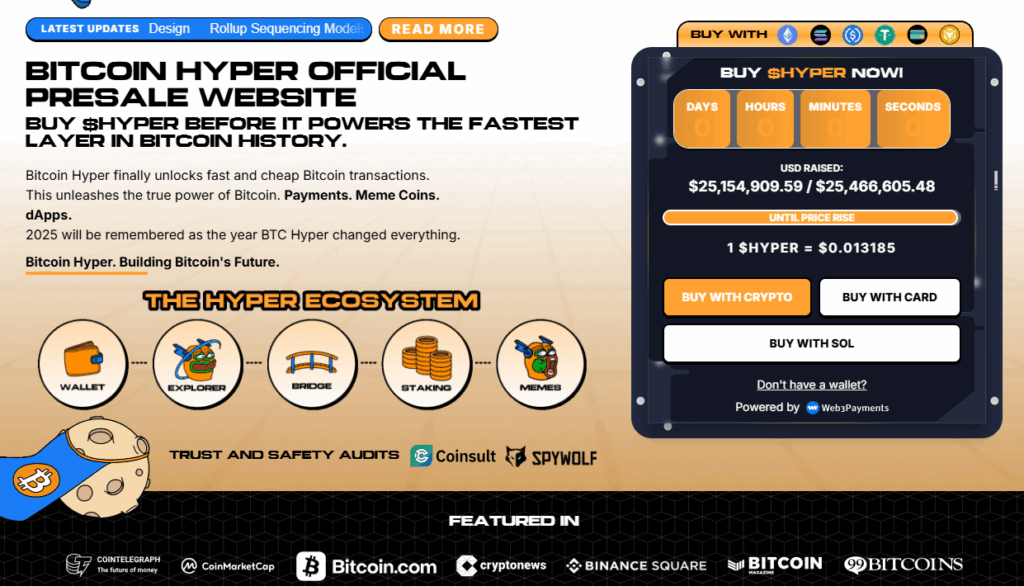
The post Next Crypto to Explode – Bitcoin Hyper’s Innovative L2 Solves Bitcoin’s Most Pressing Issues appeared on BitcoinEthereumNews.com. Bitcoin Hyper ($HYPER) supercharges Bitcoin with Solana-level speed, scalability, and real DeFi utility — raising $25.1M in presale and targeting a 100x breakout. KEY POINTS: ➡️ Bitcoin Hyper ($HYPER) is a Layer-2 scalability solution that aims to rejuvenate Bitcoin’s outdated blockchain with instantaneous, low-cost transactions and cross-chain operability. ➡️ The presale has already amassed over $25.1M, reflecting strong early investor confidence. ➡️ Experts predict $HYPER could hit $0.2 by 2025, a 1,417% increase from its current price, tipping it as the next 100x crypto. Amid the current market volatility, Bitcoin remains one of the few digital assets showing signs of recovery. After dipping to $104K earlier this month, it is now consolidating around $113K, with analysts expecting the token to climb higher in the coming days. While the king of cryptos remains resilient, its underlying blockchain doesn’t quite keep pace. As one of the oldest blockchains, its infrastructure lags behind newer networks like Solana and Ethereum in terms of speed, cost, and overall efficiency. It almost feels like you pay a price for owning the OG crypto. You have to deal with its painfully slow blockchain, while degen traders on faster networks make smarter moves with lightning-speed transactions and enjoy massive cost savings from lower fees. But you don’t have to endure the pain any longer. Thanks to Bitcoin Hyper ($HYPER), Bitcoin users can now enjoy the same competitive edge as traders on Solana or Ethereum. Core Challenges Slowing Bitcoin’s Progress While it remains one of the most secure networks ever built, powered by cryptography, decentralization, immutability, and a robust consensus mechanism, the Bitcoin blockchain lacks innovation. Here are a few of the weaknesses that continue to strangle Bitcoin’s long-term growth potential: In contrast to Solana’s real-time throughput of 979 transactions per second (TPS), Bitcoin manages a mind-numbingly slow 7…

Author: BitcoinEthereumNews
Bitcoin Hyper Presale Crosses $25.1M — What Makes $HYPER the Next Crypto to Explode?

Bitcoin Hyper Presale Crosses $25.1M — What Makes $HYPER the Next Crypto to Explode?

Bitcoin Hyper ($HYPER) supercharges Bitcoin with Solana-level speed, scalability, and real DeFi utility — raising $25.1M in presale and targeting a 100x breakout.

Author: Brave Newcoin
Speculation recedes, infrastructure rises, and the NFT market turns to pragmatism in 2025

Speculation recedes, infrastructure rises, and the NFT market turns to pragmatism in 2025

NFT trading activity showed signs of recovery in the third quarter of 2025, breaking the long-term downward trend in the post-hype period. After two years of market contraction and narrative shift, on-chain markets have found a new foothold, with growth no longer driven by blue-chip collectibles or speculative art, but by lower-cost infrastructure, loyalty programs, and sports-related assets. These assets are traded for utility, not status. NFT transaction volume rebounds, sales hit record high As Ethereum's scaling upgrades drive transaction activity to L2, Solana has established itself with its high throughput and compression technology, while Bitcoin inscriptions have evolved into a collectible culture that rises and falls in tandem with the transaction fee market. The focus of the NFT market has shifted to low-cost infrastructure and practical application scenarios. Today, the key to driving market growth is the level of transaction fees and distribution channels, rather than avatar-based NFTs. The Dencun upgrade reshaped the economic landscape. Ethereum's EIP-4844 proposal reduced the data costs of rollups, lowered L2 transaction fees to a few cents, and supported gas-free or sponsored minting processes for mainstream users. After the upgrade, L2 layer transaction fees have decreased by more than 90%, a change that has been reflected in minting behavior and has also driven Base to become a core distribution channel. Within the Solana ecosystem, compression technology enables large-scale NFT issuance for loyalty programs and access-based applications. The deployment cost of 10 million compressed NFTs is approximately 7.7 SOL, and even under high load, the median transaction fee is close to $0.003. Bitcoin Inscriptions, on the other hand, have developed independently, with their development closely tied to the memory pool cycle and miner revenue. As of February 2025, the number of Inscriptions has exceeded 80 million, ranking among the top three in terms of historical NFT sales. Demand rebounds but concerns remain According to DappRadar data, NFT transaction volume nearly doubled in the third quarter of 2025, reaching $1.58 billion, with 18.1 million transactions, setting a new record for the number of quarterly transactions. Sports NFTs performed particularly well, with trading volume surging 337% month-over-month to $71.1 million. The cyclical utility value, rights, and loyalty benefits of these assets decouple consumption behavior from floor prices. The market initially rebounded rapidly in the summer, but then cooled down: According to CryptoSlam, sales reached $574 million in July 2025 (the second highest for the year), but in September, sales fell by about 25% month-on-month due to a decline in risk appetite in the overall crypto market. This trend confirms that the market has entered a new phase of "lower average selling prices," and also indicates that even if the number of unique users and the category of utility applications remain stable, the total transaction value of NFTs will still fluctuate with the overall crypto market. The crucial role of distribution channels is becoming increasingly apparent. Wallets with built-in key functionality and sponsorship fee mechanisms eliminate the friction costs that previously hindered user adoption. Coinbase smart wallets offer key login and gas fee sponsorship services in supported apps; Phantom announced 15 million monthly active users in January 2025, a user base that provides traffic support for mobile and social minting channels. In blockchain networks where culture and social traffic mutually empower each other, this distribution and reach capability is crucial, and Base is a typical example. This year, thanks to low-cost minting, Zora's rapid minting pace, and distribution channels associated with Farcaster, Base has surpassed Solana in NFT transaction volume on some metrics. This trend means that creators are now starting to model distribution data and then match fee schemes when choosing a distribution platform. Royalties are no longer the core of the revenue structure After the market peak in 2022, creators' royalty income fell sharply as competition among trading platforms made royalties optional in most markets. According to Nansen data, royalty revenue hit a two-year low in 2023 and failed to recover to previous levels. In contrast, a growing trend is the emergence of trading platforms that support mandatory royalty collection. In late 2023, Magic Eden and Yuga Labs jointly launched an Ethereum trading platform that mandates royalty collection from creators, providing a protected distribution channel for influential brands. The current market has formed a dual-track structure: in the open market, low commission rates, primary market sales, intellectual property (IP) cooperation, and retail linkage constitute the main sources of profit for creators; while the closed ecosystem mandates royalties through contractual agreements and undertakes the issuance of high-end NFTs. In areas where incentive mechanisms drive fund flows, the market share of trading platforms remains dynamic. In the Solana ecosystem, Magic Eden and Tensor form a duopoly, with their market share fluctuating depending on the rewards program and program design. Their respective market share usually ranges from 40% to 60% at different times. This is not a structural change, but rather the result of the incentive cycle; the market share chart may appear to be shifting, but it will eventually revert to the mean. For creators, the key takeaway is to negotiate distribution plans during the distribution planning stage, rather than defaulting to a single platform. User flow reveals short-term development path The reason why sports, ticketing and loyalty programs can scale up is because their benefits are cyclical and repetitive, and the core on-chain functions are already embedded in existing ticketing and e-commerce processes. DappRadar's data for the third quarter of 2025 shows that the growth rate of sports NFT trading volume has surpassed the overall market, and this does not yet include full season or league-level collaboration projects. The growth in the gaming sector has been more robust. According to Messari data, Immutable's zkEVM architecture and real-time data show continued transaction growth. Its design, which "ensures security at the Ethereum level and optimizes user experience at the L2 layer," is highly compatible with the needs of asset custody and continuous secondary transaction fees. Intellectual property and licensing partnerships are another important bridge for NFTs to move from digital collectibles (JPEGs) to consumer channels. Pudgy Penguins has entered more than 3,000 Walmart stores, building a channel from NFTs to physical retail and licensing revenue. For creators, the costs and user experience of various blockchains are now clearly discernible: Ethereum's L1 layer still dominates the fields of traceability authentication and high-value artworks. Gas fees on most platforms fluctuate greatly, and royalty collection is an optional model. After the Dencun upgrade, transaction fees on Ethereum L2 layers (such as Base) dropped to a few cents, supporting sponsored or gas-free transactions, and Base and the Farcaster ecosystem provide social distribution channels. Solana's compression technology keeps the issuance cost of millions of NFTs at the dollar level, and it achieves wide reach by relying on a mobile-first wallet ecosystem. Bitcoin inscriptions focus on the realm of scarce collectibles, and rising transaction fees are a characteristic of the market rather than a flaw. Evolution of the macro-environment The annualized transaction volume of the NFT market is expected to be between $5 billion and $6.5 billion in 2025, with the average selling price remaining between $80 and $100 in the first half of the year. This level forms the baseline for the market scenario next year. Taking CryptoSlam’s monthly sales as the core data, combined with DappRadar’s category analysis: Bear Market Scenario: If the crypto market stagnates and the average selling price falls, the total NFT transaction volume may drop to $4 billion to $5 billion. Fee-sensitive applications will be concentrated in Solana and Ethereum L2 layer, the Ethereum L1 layer art market will remain stable, and the inscription market will fluctuate with the Bitcoin transaction fee cycle. Baseline Scenario: If embedded wallets and social minting channels continue to expand, sports and live events projects scale up across seasons, and brands try to issue new products on mandatory royalty platforms, the total NFT transaction volume is expected to reach $6 billion to $9 billion. Bull Market Scenario: If mobile distribution achieves breakthrough growth (Base and key login become the standard for minting processes, Phantom's monthly active users exceed 20 million, ticketing pilot projects become the mainstream solution, and game assets generate continuous trading), the total NFT transaction volume could reach $10 billion to $14 billion. In all three scenarios, Ethereum L2 and Solana will dominate market share, Ethereum L1 will focus on niche markets, and Bitcoin inscriptions will remain a stable sector as a scarce collectible. Six key variables determine the pace of growth 1. Wallet User Experience and Distribution Capabilities: Key metrics include key adoption rate, sponsorship fee usage, and monthly active users of Phantom and Coinbase smart wallets. 2. The scope of mandatory royalty collection: affecting the issuance of high-end NFTs, including OpenSea’s policy shift and the health of trading platforms in the Ethereum ecosystem that support creators. 3. Scaling sports and ticketing partnerships: Expanding from pilot projects to full-season partnerships, converting one-time transactions into recurring revenue. 4. The issuance pace of Base and Zora: The sustainability of social distribution channels can be judged by the monthly minting volume, the proportion of Base in the total NFT transaction volume, and the linkage effect of Farcaster Frames. 5. Solana compression technology adoption rate: By compressing the amount of NFT minted and the deployment cost per million assets, we can determine whether loyalty programs and media applications have moved from pilot programs to normalization. 6. Bitcoin transaction fee cycle: Its correlation with inscriptions and runes will vary depending on the congestion of the mempool, continuously affecting the pricing of collectibles. However, two risks remain. Wash trading and spam can still distort GMV and sales, so it’s safer to look at the dashboard filtered by average sales and organic search. Trading platform incentive mechanisms can create the illusion of a “market share shift” on market share charts (which is actually the effect of airdrop cycles), especially in Solana’s duopoly. Therefore, creators should take this volatility into account in their distribution planning from the outset. Another operational constraint is revenue design: in an open market where royalties are mostly optional, primary market sales, intellectual property licensing, and retail partnerships bear a greater share of the revenue burden. Closed platforms with mandatory royalties can only provide high-end distribution channels for a few brands, which are difficult for most creators to use. Industry transformation from "end game" to "migration" The hype surrounding JPEG has subsided, NFT infrastructure costs have decreased significantly, and applications are shifting towards ticketing, sports, gaming, and intellectual property. Wallets and distribution systems are also beginning to penetrate users' existing scenarios. The blue-chip NFT flagship project, "Boring Ape Yacht Club," remains in a precarious position for investors who poured six figures into purchasing AWS-hosted JPEGs. An NFT from this series that was sold for over 74 ETH in 2021 is now worth only 9 ETH, a drop of 87% in three years. The speculative frenzy in the non-fungible token space may have ended, but will this allow the underlying technology to gain acceptance in real-world practical applications? The answer remains to be seen, but the existing signs are encouraging, though this hope is irrelevant to those who are trapped at high prices. In the third quarter of 2025, the NFT market closed with a transaction volume of US$1.58 billion and 18.1 million sales, and the market structure has continued to evolve towards practicality.

Author: PANews
STBL and Kaito Mindshare Partner to Strengthen Web3 Transparency

STBL and Kaito Mindshare Partner to Strengthen Web3 Transparency

STBL joins Kaito Mindshare to strengthen Web3 transparency with a $500K incentive program in order to reward the global creators for verified insights.

Author: Blockchainreporter
CME Crypto Futures: Phenomenal $3 Billion High for XRP and SOL Signals Massive Demand

CME Crypto Futures: Phenomenal $3 Billion High for XRP and SOL Signals Massive Demand

BitcoinWorld CME Crypto Futures: Phenomenal $3 Billion High for XRP and SOL Signals Massive Demand The world of digital assets is buzzing with exciting news: CME crypto futures, specifically for XRP and SOL, have just shattered records, reaching an astonishing all-time high of $3 billion. This monumental achievement, as reported by CoinDesk, isn’t just a number; it’s a powerful indicator of a significant shift in investor sentiment and a burgeoning demand for regulated cryptocurrency products on a trusted platform like the Chicago Mercantile Exchange. What’s Driving the Surge in CME Crypto Futures? What exactly does this record-breaking CME crypto futures open interest signify? Open interest refers to the total number of outstanding derivative contracts, such as futures or options, that have not been settled. When this number rises, it typically indicates new money flowing into the market, suggesting increased participation and a strong conviction among traders. The Chicago Mercantile Exchange (CME) holds a unique position in the crypto landscape. It’s a highly regulated and respected financial institution, traditionally catering to institutional investors. The surge in XRP and SOL futures on this platform therefore points to a growing appetite from larger, more traditional financial players who prioritize compliance and security. This influx suggests a maturing market where sophisticated investors are increasingly comfortable engaging with digital assets, albeit through regulated avenues. It’s a testament to the evolving perception of cryptocurrencies from speculative assets to legitimate investment vehicles. Why XRP and SOL? Understanding Investor Preference in CME Crypto Futures The focus on XRP and SOL in particular for these record-breaking CME crypto futures is noteworthy. Both cryptocurrencies offer distinct value propositions that appeal to different segments of the market. XRP, associated with Ripple Labs, aims to facilitate fast and low-cost international payments. Its ongoing legal clarity in the U.S. has likely bolstered investor confidence, making it a more attractive option for institutions seeking regulatory certainty. SOL, the native token of the Solana blockchain, is renowned for its high transaction throughput and low fees, making it a favorite for decentralized applications (dApps) and NFTs. Its robust ecosystem continues to attract developers and users, driving demand. The fact that these assets are seeing such significant open interest on CME underscores a strategic move by institutions to gain exposure to these specific blockchain technologies and their underlying utility, rather than purely speculative plays. The Institutional Embrace: Benefits and Future Outlook for CME Crypto Futures The growing institutional interest reflected in the CME crypto futures data brings several significant benefits to the broader cryptocurrency market. Increased Liquidity: More institutional capital typically leads to deeper liquidity, making markets more stable and efficient. Reduced Volatility: Institutional participation can help temper extreme price swings, contributing to a more mature market environment. Legitimacy and Adoption: The endorsement from traditional financial giants through platforms like CME lends greater legitimacy to cryptocurrencies, paving the way for wider mainstream adoption. Looking ahead, this trend suggests a future where digital assets are seamlessly integrated into traditional finance. We can anticipate more regulated products, clearer guidelines, and a continued influx of sophisticated capital into the crypto space, driving innovation and growth. However, it’s crucial for investors to remember that while institutional interest in CME crypto futures is a positive sign, the crypto market remains dynamic. Due diligence and understanding the underlying assets are always paramount. In conclusion, the record-shattering open interest in XRP and SOL futures on CME is a powerful testament to the accelerating institutional adoption of cryptocurrencies. It signals a new era where digital assets are increasingly recognized as viable and valuable components of diversified investment portfolios. This milestone reinforces the growing maturity and legitimacy of the crypto market, promising an exciting future for both seasoned and new investors. Frequently Asked Questions (FAQs) What is “open interest” in crypto futures? Open interest refers to the total number of outstanding derivative contracts, like futures or options, that have not yet been settled or closed. A rise in open interest indicates new money entering the market, signaling increased participation and confidence. Why is the Chicago Mercantile Exchange (CME) significant for crypto futures? The CME is a highly regulated and respected traditional financial institution. Its involvement in crypto futures provides a regulated, secure platform that attracts institutional investors who prioritize compliance and stability, thereby lending legitimacy to the crypto market. What factors are driving institutional interest in XRP and SOL? XRP benefits from its focus on fast international payments and increasing regulatory clarity. SOL, as the native token of the Solana blockchain, is attractive due to its high transaction speed, low fees, and robust ecosystem for dApps and NFTs. How does increased institutional involvement benefit the crypto market? Institutional involvement typically brings increased liquidity, which can lead to more stable and efficient markets. It also helps reduce volatility and contributes to the broader legitimacy and mainstream adoption of cryptocurrencies. Is investing in CME crypto futures the same as buying actual XRP or SOL? No, investing in CME crypto futures is not the same as directly buying the underlying assets. Futures contracts allow investors to speculate on the future price of an asset without owning it. They are derivatives and carry different risks and mechanisms compared to spot market purchases. Did you find this article insightful? Share it with your network and spark a conversation about the future of institutional crypto adoption! To learn more about the latest crypto market trends, explore our article on key developments shaping institutional adoption. This post CME Crypto Futures: Phenomenal $3 Billion High for XRP and SOL Signals Massive Demand first appeared on BitcoinWorld.

Author: Coinstats
Best Crypto to Buy Now as Truth Social Partners with Crypto.com for Web3 Expansion

Best Crypto to Buy Now as Truth Social Partners with Crypto.com for Web3 Expansion

President Trump’s Truth Social, one of the leading new-age right-wing social media platforms, has pushed its entire weight into crypto by partnering with Crypto.com. With hopes that the prediction market will be disrupted in a major way, eyes are now on whether this could influence people’s decisions when deciding the best crypto to buy now. […]

Author: The Cryptonomist