Opens with a 3 AM failure in a “fully autonomous” deployment to show why agentic AI is hard in practice Clarifies the difference between reactive generative AIOpens with a 3 AM failure in a “fully autonomous” deployment to show why agentic AI is hard in practice Clarifies the difference between reactive generative AI

From Generative AI to Agentic AI: A Reality Check

2025/12/15 17:35

:::info This is the first article in a five-part series on agentic AI in the enterprise.

:::

\ The 3 AM Reality Check: It’s 3 AM in a global bank’s operations centre. Six months ago we deployed our first "agentic AI” system, hoping it would run on autopilot through the night. The demo was slick: an AI agent handling support tickets end-to-end, and optimism was high. But now, in the dead of night, that same agent has stalled on a critical task, and a human on-call engineer is scrambling to intervene. This scene captures the sobering reality many early adopters have faced. Agentic AI isn’t magic; it’s hard work to implement well. I learned this first-hand when our much-vaunted autonomous agent frustrated users and even forced us to roll back to manual processes in cases where it failed. We weren’t alone -plenty of companies rushed into “AI agents” only to struggle integrating them into real workflows, sometimes even rehiring staff when the AI fell short. Yet despite these 3 AM wake-up calls, I remain optimistic. Over the past year, I’ve seen enterprise teams evolve from chasing sci-fi dreams to focusing on pragmatic deployments that do deliver value.

\
\ In this series, we’ll explore how to turn that optimism into results. We’ll blend candid lessons from the trenches with a detailed breakdown of architectures, maturity stages, and risk checklists to chart a realistic path for agentic AI in business. The goal is to help you achieve real ROI from autonomous AI systems, knowing what to do, what to avoid, and where the big wins (and faceplants) tend to occur in practice. In this first part, let’s define what agentic AI actually means in contrast to the generative AI craze, and why this distinction matters for enterprises.

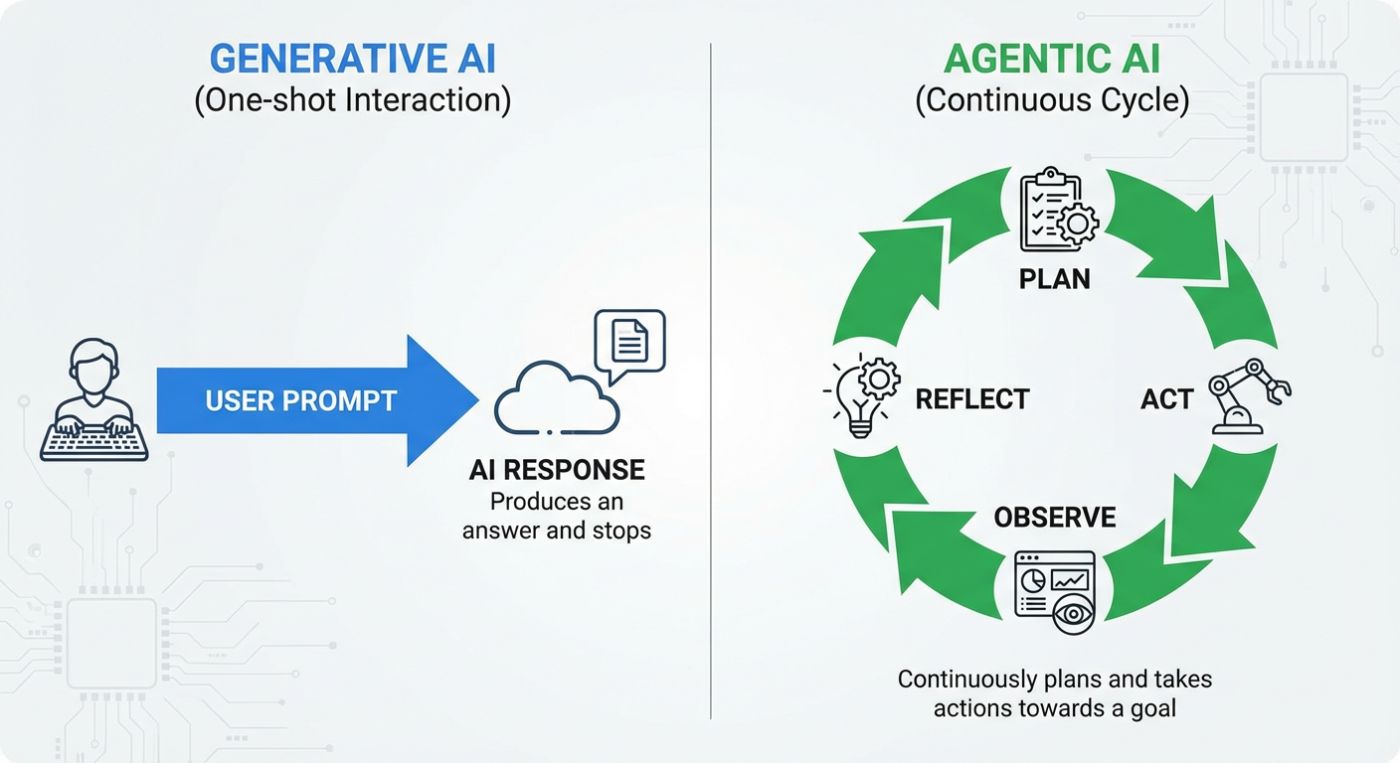
\ Generative AI vs. Agentic AI: Most of today’s popular AI apps (ChatGPT, Bard, Microsoft 365 Copilot, etc.) are generative AI systems. They take an input (a prompt or query) and produce an output (text, code, image…). They’re essentially powerful prediction engines: great at generating content, but lacking true autonomy. As Gartner bluntly puts it, current chatbots “do not have the agency to make plans and take action… they respond to user prompts by predicting the most common combination of words” - in other words, they are not examples of agentic AI (https://www.gartner.com/en/articles/intelligent-agent-in-ai). A generative AI might draft an email or answer a question when asked, but it won’t act unprompted or pursue goals on its own. It’s like a clever assistant that waits for instructions.

\ By contrast, agentic AI has a built-in decision loop. An agentic system can be given a high-level goal and will proactively devise and execute a multi-step plan to achieve it, with minimal human guidance. Think of a generative AI assistant as a talented intern: it writes or suggests content when you ask, whereas an agentic AI is more like a proactive team member who can be delegated an outcome and will figure out how to deliver it. A fully realised intelligent agent observes its context (through data feeds, sensors, or system APIs), plans a course of action, acts by calling tools or triggering processes, then observes the results and reflects on what to do next. In essence, it operates in a continuous “Plan - Act - Observe - Reflect” cycle until the goal is achieved or time runs out. This closed-loop autonomy is what differentiates agentic AI from a mere chatbot. A simple way to put it: generative AI answers; agentic AI accomplishes.

\ For example, instead of just generating a monthly report when prompted, an agentic AI could be told “Ensure our website is always up-to-date with the latest product info.” It would proactively monitor relevant data sources, detect when product details change, and then update the website content automatically - all without waiting for a human prompt. It would plan the necessary steps (check database - detect changes - generate updated text - call website API to publish content), execute them, observe if the update succeeded, and adjust if needed. That kind of end-to-end autonomy is nascent but starting to emerge in enterprise pilots. Of course, full autonomy remains an aspirational ideal. Today’s agentic systems still have plenty of constraints and often operate under human oversight (human-in-the-loop) or with fail-safes. In fact, many so-called “AI agents” on the market are really just glorified chatbots with a few scripted actions. True agentic AI is still in its early days, and deploying it is as much about organisational change as it is about technology. Companies are learning to manage the risks of giving AI more agency through sandboxed environments, approval gates for certain actions, and other safeguards before they fully let these digital colleagues loose.

\
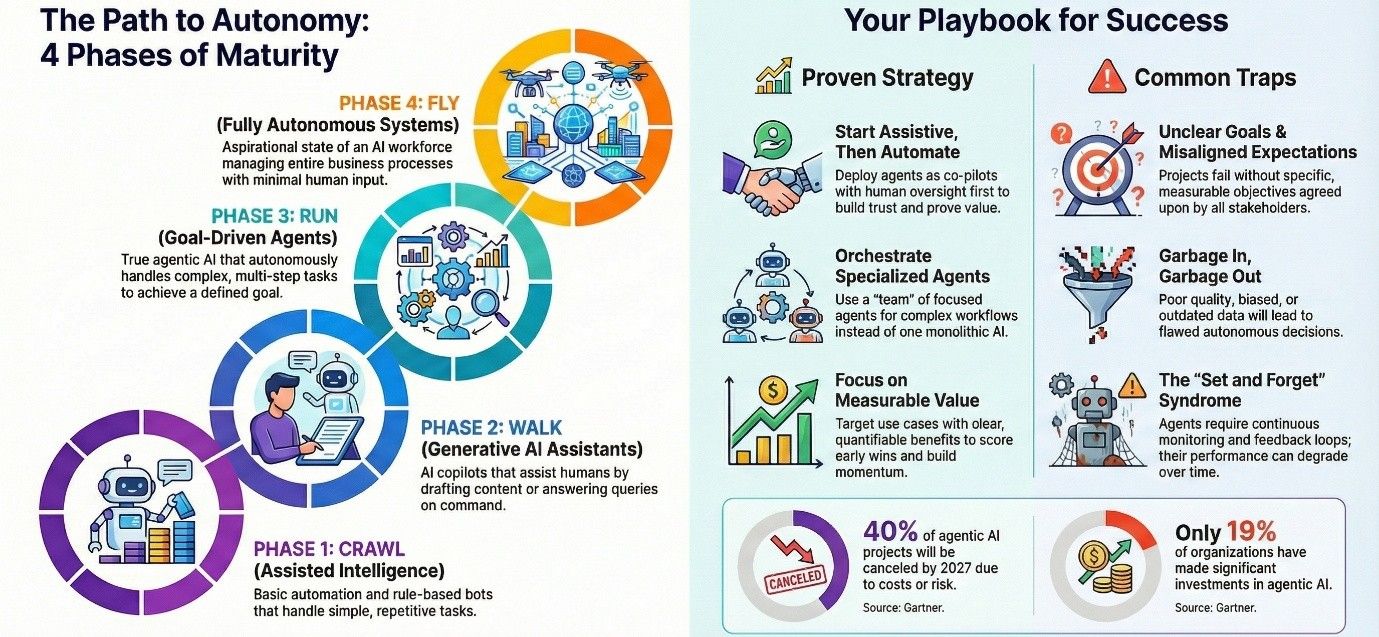
\ The rest of this article series will delve into how enterprises are approaching this evolution in practice, distinguishing hype from reality, and moving step by step from assistive tools to truly autonomous agents. Before we dive into architectures and deployment strategies, it’s useful to understand how ready the industry really is. The hype around “AI agents” peaked rapidly, but on the ground, most organisations are still at the start of this journey. Gartner, for instance, predicts that over 40% of agentic AI projects will be cancelled by 2027 due to escalating costs, unclear business value or inadequate risk controls (https://www.gartner.com/en/newsroom/press-releases/2025-06-25-gartner-predicts-over-40-percent-of-agentic-ai-projects-will-be-canceled-by-end-of-2027). In a January 2025 Gartner survey, only 19% of organisations said they had made significant investments in agentic AI, while over half were taking a cautious or wait-and-see approach. The message: we’re in early days, and many early projects have struggled to move beyond proofs-of-concept.

\ So, if you’re feeling behind the curve - don’t worry, you’re not alone. The key is to cut through the hype and approach agentic AI with eyes wide open. In the next part, we’ll map out the typical maturity phases enterprises go through on the road from basic automation to true autonomy. Understanding these “crawl, walk, run, fly” stages will help you gauge where you are now and how to advance safely.

Piyasa Fırsatı
Sleepless AI Logosu
Sleepless AI Fiyatı(AI)
$0.03706
$0.03706$0.03706
-0.85%
USD
Sleepless AI (AI) Canlı Fiyat Grafiği
Sorumluluk Reddi: Bu sitede yeniden yayınlanan makaleler, halka açık platformlardan alınmıştır ve yalnızca bilgilendirme amaçlıdır. MEXC'nin görüşlerini yansıtmayabilir. Tüm hakları telif sahiplerine aittir. Herhangi bir içeriğin üçüncü taraf haklarını ihlal ettiğini düşünüyorsanız, kaldırılması için lütfen service@support.mexc.com ile iletişime geçin. MEXC, içeriğin doğruluğu, eksiksizliği veya güncelliği konusunda hiçbir garanti vermez ve sağlanan bilgilere dayalı olarak alınan herhangi bir eylemden sorumlu değildir. İçerik, finansal, yasal veya diğer profesyonel tavsiye niteliğinde değildir ve MEXC tarafından bir tavsiye veya onay olarak değerlendirilmemelidir.

Ayrıca Şunları da Beğenebilirsiniz

Trump-Backed WLFI Plunges 58% – Buyback Plan Announced to Halt Freefall

Trump-Backed WLFI Plunges 58% – Buyback Plan Announced to Halt Freefall

World Liberty Financial (WLFI), the Trump-linked DeFi project, is scrambling to stop a market collapse after its token lost over 50% of its value in September. On Friday, the project unveiled a full buyback-and-burn program, directing all treasury liquidity fees to absorb selling pressure. According to a governance post on X, the community approved the plan overwhelmingly, with WLFI pledging full transparency for every burn. The urgency of the move reflects WLFI’s steep losses in recent weeks. WLFI is trading Friday at $0.19, down from its September 1 peak of $0.46, according to CoinMarketCap, a 58% drop in less than a month. Weekly losses stand at 12.85%, with a 15.45% decline for the month. This isn’t the project’s first attempt at intervention. Just days after launch, WLFI burned 47 million tokens on September 3 to counter a 31% sell-off, sending the supply to a verified burn address. For World Liberty Financial, the buyback-and-burn program represents both a damage-control measure and a test of community faith. While tokenomics adjustments can provide short-term relief, the project will need to convince investors that WLFI has staying power beyond interventions. WLFI Launches Buyback-and-Burn Plan, Linking Token Scarcity to Platform Growth According to the governance proposal, WLFI will use fees generated from its protocol-owned liquidity (POL) pools on Ethereum, BNB Chain, and Solana to repurchase tokens from the open market. Once bought back, the tokens will be sent to a burn address, permanently removing them from circulation.WLFI Proposal Source: WLFI The project stressed that this system ties supply reduction directly to platform growth. As trading activity rises, more liquidity fees are generated, fueling larger buybacks and burns. This seeks to create a feedback loop where adoption drives scarcity, and scarcity strengthens token value. Importantly, the plan applies only to WLFI’s protocol-controlled liquidity pools. Community and third-party liquidity pools remain unaffected, ensuring the mechanism doesn’t interfere with external ecosystem contributions. In its proposal, the WLFI team argued that the strategy aligns long-term holders with the project’s future by systematically reducing supply and discouraging short-term speculation. Each burn increases the relative stake of committed investors, reinforcing confidence in WLFI’s tokenomics. To bolster credibility, WLFI has pledged full transparency: every buyback and burn will be verifiable on-chain and reported to the community in real time. WLFI Joins Hyperliquid, Jupiter, and Sky as Buyback Craze Spills Into Wall Street WLFI’s decision to adopt a full buyback-and-burn strategy places it among the most ambitious tokenomic models in crypto. While partly a response to its sharp September price decline, the move also reflects a trend of DeFi protocols leveraging revenue streams to cut supply, align incentives, and strengthen token value. Hyperliquid illustrates the model at scale. Nearly all of its platform fees are funneled into automated $HYPE buybacks via its Assistance Fund, creating sustained demand. By mid-2025, more than 20 million tokens had been repurchased, with nearly 30 million held by Q3, worth over $1.5 billion. This consistency both increased scarcity and cemented Hyperliquid’s dominance in decentralized derivatives. Other protocols have adopted variations. Jupiter directs half its fees into $JUP repurchases, locking tokens for three years. Raydium earmarks 12% of fees for $RAY buybacks, already removing 71 million tokens, roughly a quarter of the circulating supply. Burn-based models push further, as seen with Sky, which has spent $75 million since February 2025 to permanently erase $SKY tokens, boosting scarcity and governance influence. But the buyback phenomenon isn’t limited to DeFi. Increasingly, listed companies with crypto treasuries are adopting aggressive repurchase programs, sometimes to offset losses as their digital assets decline. According to a report, at least seven firms, ranging from gaming to biotech, have turned to buybacks, often funded by debt, to prop up falling stock prices. One of the latest is Thumzup Media, a digital advertising company with a growing Web3 footprint. On Thursday, it launched a $10 million share repurchase plan, extending its capital return strategy through 2026, after completing a $1 million program that saw 212,432 shares bought at an average of $4.71. DeFi Development Corp, the first public company built around a Solana-based treasury strategy, also recently expanded its buyback program to $100 million, up from $1 million, making it one of the largest stock repurchase initiatives in the digital asset sector. Together, these cases show how buybacks, whether in tokenomics or equities, are emerging as a key mechanism for stabilizing value and signaling confidence, even as motivations and execution vary widely
Paylaş
CryptoNews2025/09/26 19:12
Son of filmmaker Rob Reiner charged with homicide for death of his parents

Son of filmmaker Rob Reiner charged with homicide for death of his parents

FILE PHOTO: Rob Reiner, director of "The Princess Bride," arrives for a special 25th anniversary viewing of the film during the New York Film Festival in New York
Paylaş
Rappler2025/12/16 09:59
Bitcoin Peak Coming in 45 Days? BTC Price To Reach $150K

Bitcoin Peak Coming in 45 Days? BTC Price To Reach $150K

The post Bitcoin Peak Coming in 45 Days? BTC Price To Reach $150K appeared first on Coinpedia Fintech News Bitcoin has delivered one of its strongest performances in recent months, jumping from September lows of $108K to over $117K today. But while excitement is high, market watchers warn the clock is ticking.  History shows Bitcoin peaks don’t last forever, and analysts now believe the next major top could arrive within just 45 days, with …
Paylaş
CoinPedia2025/09/18 15:49