

The Bitcoin Future Now Runs On Wall Street Inflows, BlackRock Exec Says
BlackRock’s head of crypto, Robbie Mitchnick, says the gravitational center of Bitcoin’s market structure has shifted decisively from miner issuance to exchange-traded fund demand—and that’s why classic four-year “halving cycles” should command far less attention than they used to. In a Bankless interview released November 10, Mitchnick argued that the ETF era is now the dominant flow regime for BTC, even as leverage and short-term derivatives noise continue to whipsaw prices.
ETF Inflows Now Dwarf The Bitcoin Halving
“It’s not over,” Mitchnick said when asked whether the latest sell-off marked the end of Bitcoin’s current cycle. “This is the fifth cycle we’ve seen […] through each successive cycle, the level that Bitcoin reached was massively higher than the prior cycle.” He added a pointed caveat for anyone still treating halvings as the metronome of BTC: “A lot of people believe the cycle is tied to [the] Bitcoin halving. The Bitcoin halving at this point is almost totally irrelevant […] when ETFs are accumulating inflows, the magnitude of those inflows is many, many multiples larger than any change in supply created by a Bitcoin halving event.”
Mitchnick’s framing puts Wall Street, not the protocol schedule, at the center of the next phase. BlackRock’s spot Bitcoin ETF, IBIT, “has been the fastest-growing ETF post-launch in history,” he said, reaching milestones at roughly four times the pace of the previous record. More telling than raw AUM, in his view, is the changing composition of holders. In the first quarter after launch, “IBIT was over 80% direct retail investors. Every quarter thereafter that number has come down […] today it’s close to 50%,” reflecting the steady rise of wealth advisory and institutional channels.
That institutional cohort is still early, but broadening. “If you think about the big categories of institutional investors, you’ve got family offices, asset managers, sovereign wealth funds, university endowments, foundations, corporate treasurers, insurers, pension funds. You have some adopters in every one of those archetypes, but not the majority, not even close,” he said.
For those allocating, typical position sizes land in the “1% to 3% range.” The gating factor, again, is less about custody or access—and more about how Bitcoin behaves inside a portfolio. “It’s all about correlation,” Mitchnick noted, recounting a conversation with a pension CIO who is “literally” watching that metric. If Bitcoin persistently tracks “digital gold” rather than “levered NASDAQ,” he argued, “it’s a slam dunk to put a couple percentage of portfolio allocation in it.”
The tension is that short-term market action still looks like crypto. Mitchnick called the October 10 washout—roughly “$21 billion in liquidations”—a leverage event rather than a shift in fundamentals, and contrasted it with the steadiness of fund buyers: “What was the impact on ETF outflows? Tiny […] a couple hundred million.” That discrepancy, he said, is precisely why cycles should attenuate over time: a larger, slower-moving base of ETF and advisory capital can absorb derivatives-driven shocks without mechanically exiting.
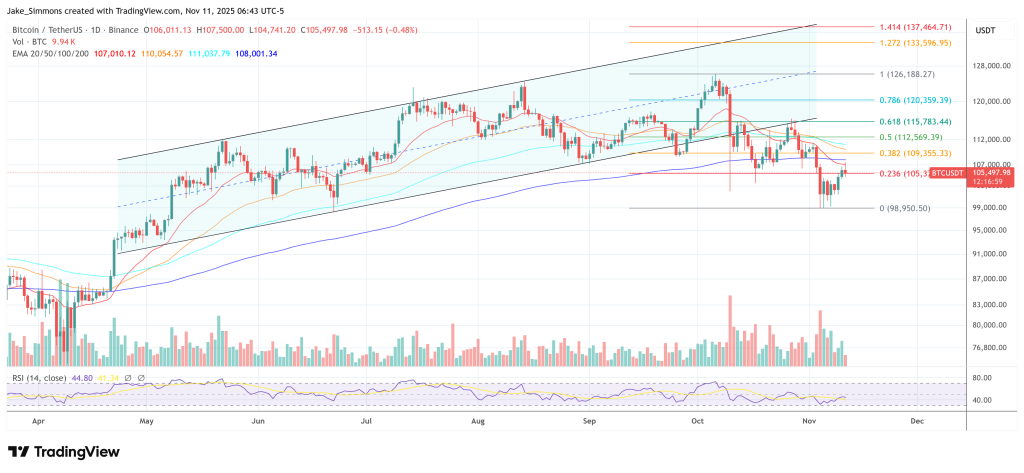
He also pushed back on narratives that Bitcoin’s 2025 underperformance versus gold invalidates the “uncorrelated hedge” thesis. The digital asset, he argued, already banked its “debasement trade” in late 2024, rallying from the “high $60s to over $100K,” and even notched a new all-time high around $126,000 before the October crash “derailed the momentum.” In other words, the year-to-date scoreboard reflects sequencing and leverage, not a structural repudiation of Bitcoin’s store-of-value pitch.
On supply dynamics, Mitchnick acknowledged that legacy cohorts have taken profits at psychological levels, but he dismissed the idea that Bitcoin is in an “IPO moment” where early adopters permanently hand the float to institutions. What’s more plausible, he said, is simple risk management by ultra-early holders whose basis sits at “$100 or $500,” many of whom had $100,000 as a round-number trim target. “At some point you do have to take some chips off the table,” he said, adding that long-term performance has favored patience over short-term, levered trading.
Mitchnick was careful not to oversell universal adoption among big pools of capital. Central banks, he suggested, remain a tail-risk buyer rather than a base case. The near-term path instead runs through the institutions already tiptoeing in—pensions, insurers, sovereign wealth funds—whose conviction will hinge on medium-term behavior and policy clarity.
The message for allocators facing their first full drawdown with ETFs live was direct: don’t mistake derivatives noise for broken fundamentals, and be selective. “There’s a reason Bitcoin is still roughly 65% of the market cap of the space,” he said. “One has to be very wary going far down the table […] the vast majority of [tokens] are or will be totally worthless.”
For Bitcoin, the test is whether it keeps behaving like what institutions think they’re buying. “People have to look beyond these short-term moves […] and more about, you know, medium and longer term how does it track,” Mitchnick said.
At press time, BTC traded at $105,497.
Ayrıca Şunları da Beğenebilirsiniz

The Channel Factories We’ve Been Waiting For

USDC Treasury mints 250 million new USDC on Solana
