

SEC Commissioner Says Philippines Is Prepared for RWA Tokenization
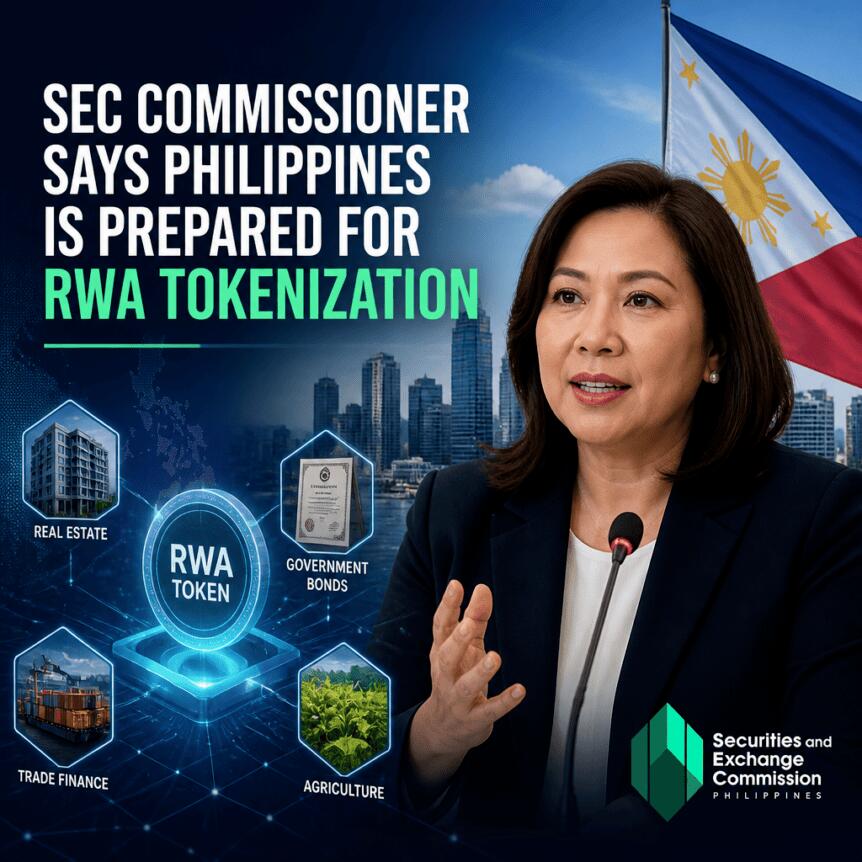
The Philippine Securities and Exchange Commission (SEC) has indicated it is prepared to regulate tokenization of real-world assets (RWAs), arguing that the Philippines has both the legal basis and supervisory mindset to handle the technology. SEC Commissioner Rogelio Quevedo made the comments during Philippine Blockchain Week 2026, framing tokenized assets as a potential catalyst for innovation in the capital markets while also improving investor protection.
In remarks shared with Cointelegraph, Quevedo said the SEC is “now fully convinced” that the country has the right laws and regulatory readiness to support asset tokenization. He also tied the development to a pressing local problem: scams that target overseas Filipino workers (OFWs) searching for legitimate places to invest. According to Quevedo, regulated tokenized investment products could offer OFWs a clearer path to putting their capital to work.
Key takeaways
- The Philippine SEC, through Commissioner Rogelio Quevedo, says the regulator believes the legal and regulatory groundwork for RWA tokenization is in place.
- Quevedo positioned tokenization not only as market modernization, but also as a tool to help combat investment scams that exploit OFWs.
- The SEC’s StratBox regulatory sandbox underpins how new financial products can be tested under supervision before broader rollout.
- Quevedo said the SEC is using artificial intelligence to identify and pursue illegal investment offerings online, including coordination efforts with major platforms.
Why tokenization is now on the SEC’s radar
Quevedo’s comments suggest the SEC is shifting from treating tokenization as a theoretical or emerging concept to viewing it as something that can fit within existing regulatory structures. Speaking at Philippine Blockchain Week 2026, he said the commission has the “proper law” and the appropriate regulatory experience to accept asset tokenization.
For investors and market participants, that matters because tokenization changes how ownership, settlement, and distribution of assets can be structured—especially when dealing with traditionally illiquid instruments like real estate or other hard-to-trade claims. A regulator that signals readiness can influence how quickly compliant issuers and platforms develop products, and it can also clarify expectations for disclosures, oversight, and investor safeguards.
Regulation as investor protection: focus on OFWs
Beyond capital markets modernization, Quevedo linked tokenized offerings to the protection of a specific group that has faced repeated targeting: OFWs. He told Cointelegraph that OFWs often have capital but lack knowledge about where to place their money productively, making them vulnerable to fraudulent schemes promising returns.
By highlighting regulated tokenized investment products as a more legitimate alternative, the SEC’s messaging aligns tokenization with a broader enforcement goal: reducing the gap between where consumers look for returns and the regulated channels that can safely meet that demand. In practice, this implies that the SEC is likely to scrutinize not just the technology, but also the marketing, product structure, and distribution model—especially for services marketed to Filipino investors abroad.
Using enforcement and AI to target scams
Quevedo said the SEC is better prepared to oversee emerging technologies because it has expanded enforcement capabilities. He also stated that the regulator is using artificial intelligence to identify “unscrupulous scams,” and that it is working with major online platforms—including Google and TikTok—to remove illegal investment offerings.
This is a significant signal for participants in the tokenization ecosystem. While asset tokenization is frequently discussed as a fintech or blockchain innovation, the real-world outcome for investors often depends on whether enforcement can keep pace with online distribution of fraudulent products. The SEC’s emphasis on AI-assisted investigations and platform cooperation indicates a strategy aimed at reducing the scale and reach of scam operations that rely on rapid online promotion.
Quevedo’s stance also fits into the SEC’s ongoing efforts to pursue unregistered investment schemes in the Philippines, an activity noted in the same Cointelegraph framing of the regulator’s broader posture.
StratBox and the roadmap for testing tokenized products
The SEC’s direction on tokenization builds on its Strategic Sandbox, known as StratBox. According to documentation from the SEC, StratBox is designed to let fintech companies test new products and business models in a live but controlled environment, under regulatory supervision. The framework permits the SEC—within the scope of its legal authority—to waive or modify certain regulatory requirements for individual sandbox participants.
However, Quevedo’s remarks do not suggest that the sandbox is a free pass. The StratBox structure also makes clear that participation does not automatically exempt a company from existing laws, and it cannot be used to bypass legal or regulatory obligations outside the boundaries of the sandbox arrangement.
That structure is particularly relevant for tokenized RWAs because the main compliance questions typically involve who can issue tokenized instruments, what disclosures are required, how custody and transfer mechanics are supervised, and how investor rights are protected. A supervised testing environment can reduce uncertainty for both regulators and market entrants—allowing regulators to observe real behavior while testing whether existing rules can accommodate the technology.
The StratBox approach has already been used for fintech experimentation. In November 2025, the SEC said four companies were admitted to the sandbox, including one testing a tokenized real estate offering. Two participants were exploring access to United States equities, and BlockShoals Technologies reportedly received in-principle approval to test crypto-related products and services—each showing that tokenized or crypto-adjacent infrastructure continues to fall within the sandbox’s practical scope.
For the market, the key question now is how the SEC intends to translate sandbox learning into clearer, repeatable guidance for tokenized RWAs. Tokenization can involve multiple parties—platforms, issuers, and intermediaries—so regulatory clarity on roles and responsibilities will be crucial for scaling compliant projects beyond pilots.
Readers should watch how the SEC follows up on Commissioner Quevedo’s readiness statement: whether additional sandbox admissions focus specifically on real-world asset tokenization, and whether the regulator’s AI- and platform-backed enforcement efforts expand in parallel as tokenized products gain visibility in the Philippines.
This article was originally published as SEC Commissioner Says Philippines Is Prepared for RWA Tokenization on Crypto Breaking News – your trusted source for crypto news, Bitcoin news, and blockchain updates.


Ayrıca Şunları da Beğenebilirsiniz

Gold Price Stages Resilient Recovery, Nears $4,650 Amid Market Uncertainty
Ethereum Price Prediction Eyes $2,000 as Glamsterdam Upgrade Testing Begins and Pepeto Presale Wallets Keep Building Positions
ApeMars Price Prediction: Why Traders Are Suddenly Watching Closely



