

Gold, Silver, Bitcoin, Ethereum, XRP Crash: Where Is Money Going?
Everything is selling off at once. Gold. Silver. Stocks. Bitcoin. Ethereum. XRP. The question traders are asking right now is simple: where is the money actually going?
More than $2.5 trillion was wiped from precious metals in the last 24 hours alone. Global equity indexes from Tokyo to London are in the red. Crypto liquidations crossed $452 million. Over 118,983 traders got wiped out.
This is not a normal down day.
What caused gold and silver to crash so hard today?
As per Crypto Rover, Gold just lost nearly $1.7 trillion in market value. Silver crashed by over 11% and shed around $800 billion.
These are not small moves. Precious metals are supposed to be the "safe haven." When they sell off this hard, it usually means one of two things. 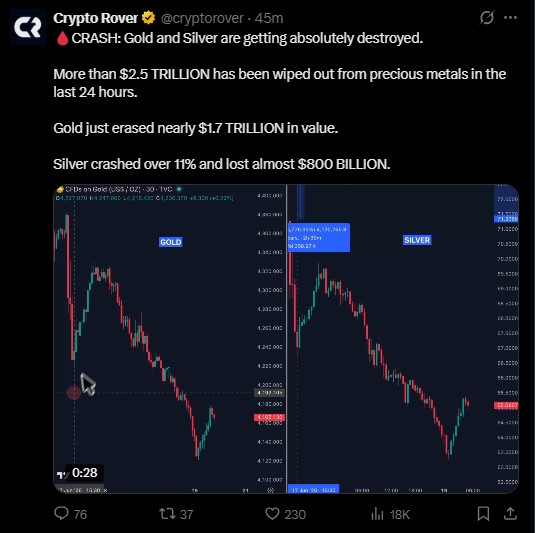
Either large institutions are being forced to raise cash, or a major macro shift is underway.
Risk-off trades and margin calls can force the liquidation of even safe-haven assets. When gold goes, everything tends to follow.
How are global stock markets performing right now?
The damage is spread across every major market on the planet.
Asia: The Hang Seng fell 1.59% to 23,924. KOSPI dropped 0.13% to 9,052, touching an intraday low of 8,831. ASX200 is off 1.14% at 8,809.
Europe: The FTSE 100 is down 0.23% at 10,375, trading well below its 52-week high of 10,934.
Emerging Markets: SENSEX fell 0.78% to 76,803. MOEX dropped 1.02% to 2,416. IBOVESPA is off 0.10% at 168,278.
US Futures: S&P 500 (US500) is at 7,474, down 0.34%. Nasdaq 100 (US100) is off 0.55% at 30,240. Dow (US30) is down 0.18% at 51,470.
Strategy's common stock closed at $112.53 on June 19, down 3.46% on the session, after opening at $117.64. The 20-day EMA sits at $133.21, and RSI has fallen to 34.04, near oversold territory.
As MSTR declines, that capital-raising engine weakens. Peter Schiff has argued the gap between MSTR's share price and its per-share $BTC value is widening sharply, calling the overall structure a "financial house of cards."
No region is spared. This is a synchronized global sell-off.
Why is Bitcoin price dropping today, and where is BTC headed?
Bitcoin is trading at $62,732, down 0.18% on the day. It opened at $62,902 and briefly hit $63,042 before reversing.
The daily RSI is at 34.69, just above the oversold threshold of 30. Historically, readings this low have preceded at least a short-term bounce. But macro conditions can override technical signals.
On the chart, BTC broke below a large ascending channel that ran from the February lows near $58,000. A smaller rising wedge is forming near current prices. Wedge patterns in a downtrend usually break to the downside.
HTF liquidity levels above price sit at $85,000, $92,500, and $97,500. Those are the magnets if a reversal happens. Below, key supports are at $60,000, $57,500, and $55,000.
Is Ethereum price going to recover or keep falling below $1,700?
Ethereum is at $1,700.73, down 0.61% on the day. The daily high was $1,719.51.
ETH has been in a consistent downtrend since February 2026, when it was trading above $2,500. It failed to hold the major HTF liquidity zone at $2,477. That was a significant bearish signal.
Daily RSI is 37.87, also near oversold. A small rising wedge is visible on the right edge of the chart between $1,600 and $1,700.
If this wedge breaks up, ETH could attempt a move toward $1,800. If it breaks down, $1,600 and $1,500 are the next levels to watch.
The $1,400 zone below is marked as strong HTF support on the chart. Bulls need a clear reclaim of $1,800 to shift the structure.
Will XRP drop below $1 as the crypto market crashes?
XRP is trading at $1.134, down 1.09%. The daily high was $1.153, and the low touched $1.1256.
Daily RSI is 39.12. Price has been grinding lower inside a descending channel since hitting $2.38 in early 2026. That was the 0.382 Fibonacci retracement at $2.3822.
The 0.786 Fib at $1.0237 is the critical floor. This lines up with the major $1.00 psychological level. Below that, there is very little structural support visible on the daily chart.
First resistance is the 0.618 Fib at $1.5886, then the 0.5 Fib at $1.9854, and the green HTF liquidity zone near $2.00.
A breakdown below $1.10 puts $1.0237 in play quickly. Traders are watching that level closely.
What is the crypto liquidation data showing right now?
According to CoinGlass data, 118,983 traders were liquidated in the past 24 hours, with total liquidations at $452.37 million.
Long liquidations dominated at $367.24 million versus just $85.12 million in shorts. This tells us the market was heavily positioned for upside. That bet has been crushed.
In just the last hour, $6.92 million was liquidated. $6.27 million of that was longs. Only $649K was short.
The biggest losers by coin on the liquidation heatmap:
-
SOL: $1.57 million
-
ETH: $573.20K
-
XRP: $470.27K
-
BTC: $289.47K
-
BEAT: $381.89K
-
1000PEPE: $215.68K
The largest single order was on Aster ETHUSDT at $10.49 million.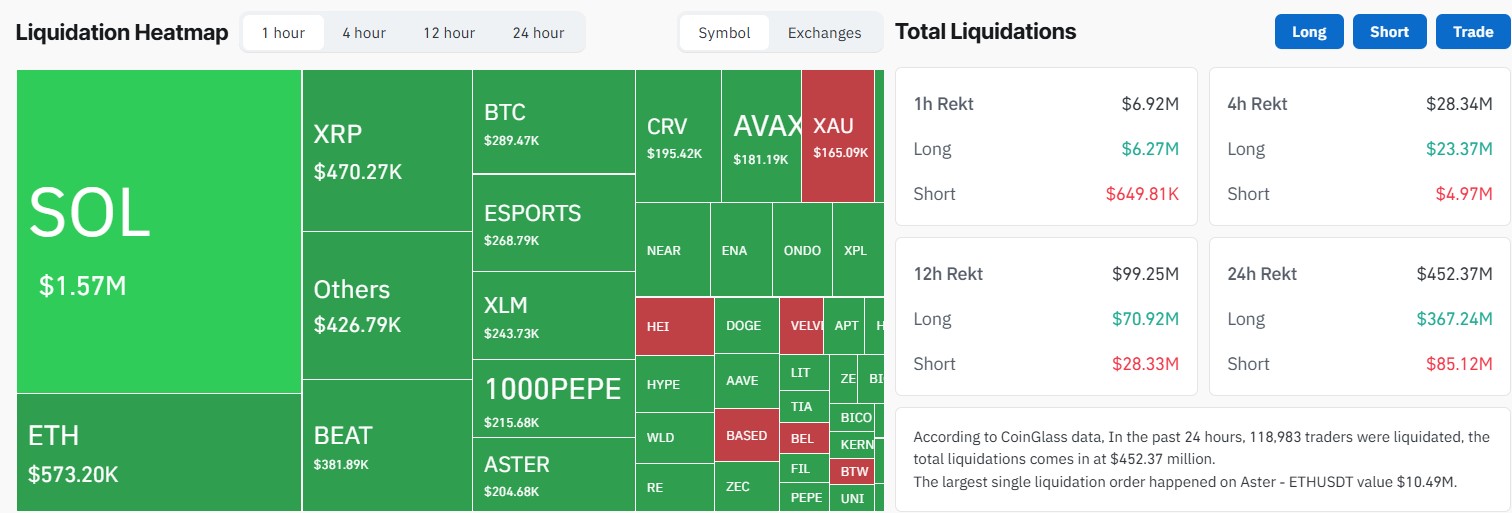
Where is the money going if everything is crashing at once?
This is the most important question right now. And the honest answer is: capital is not rotating. It is disappearing.
When gold, silver, stocks, and crypto all fall on the same day, that is not sector rotation. That is a deleveraging event. Institutions and funds are raising cash fast.
The US Dollar and Short-Term Treasuries
In every major risk-off event in recent history, money moves into two places first. The US dollar and short-dated US Treasury bills. These are the two assets that institutions run to when panic sets in.
The dollar tends to rise sharply when all other assets fall together. Treasury yields on the short end drop as demand for safety spikes. This dynamic is already playing out.
Cash is King in a Synchronized Sell-Off
When gold is not working as a safe haven, that is a signal of forced selling. Hedge funds and leveraged players are not choosing to sell gold. They are being made to.
Margin calls on losing equity and crypto positions force them to liquidate whatever has liquidity, and gold is extremely liquid.
This means the cash raised is not being redeployed yet. It is sitting. Waiting.
What about stablecoins in crypto?
Inside the crypto market, some capital moves into stablecoins like USDT and USDC during crashes. The liquidation data confirms this. Over $367 million in long positions were forcibly closed in 24 hours. That capital does not vanish. It converts to stablecoins or exits crypto entirely.
Stablecoin dominance on exchanges tends to rise during these events. That is a number worth watching over the next 48 hours.
Is any asset actually going up?
Not obviously. When the correlation between all assets hits 1, meaning everything moves down together, the only winner is the entity holding cash or short positions.
The 24-hour liquidation data shows short sellers collected only $85.12 million against $367.24 million in long losses. Shorts are winning but the scale of long pain is much larger.
What comes next?
Historically, synchronized sell-offs of this magnitude do not last more than a few days before a relief bounce occurs. The mechanism is simple. Forced sellers eventually run out of positions to sell.
Once that selling pressure exhausts itself, the lack of supply pushes prices back up sharply.
But that bounce is not a recovery. It is a dead cat bounce until the macro picture clears. The direction of the US dollar and Treasury yields over the next week will tell us whether this is a short flush or the beginning of something larger.
Bitcoin, Ethereum, and XRP Price Prediction for the Coming Week
Bitcoin: BTC is clinging to support at $62,000. RSI near 34 leaves room for a bounce, but the broken channel structure is bearish. A hold above $60,000 keeps the short-term setup alive. Below that, $57,500 is the next major level.
Ethereum: ETH at $1,700 is at a make-or-break zone. A bounce here targets $1,800 to $1,900. A break below $1,600 opens the door to $1,500 and eventually $1,400, which is marked as major support on the HTF chart.
XRP: The $1.10 level is critical. Hold it, and a relief rally to $1.30 to $1.40 is possible. Lose it, and the 0.786 Fib at $1.0237 becomes the next test. Sentiment would turn very bearish quickly if $1.00 is approached.
None of this is a guarantee. Markets are moving fast, and macro conditions are shifting hour to hour.
Disclaimer: This article is for informational purposes only and does not constitute financial advice. Cryptocurrency investments are highly volatile and carry significant risk. Always do your own research and consult a licensed financial advisor before making investment decisions.


Ayrıca Şunları da Beğenebilirsiniz

Ethereum koers toont zeldzaam dubbel koopsignaal en richt zich op $4.550

UK Gilt Yields Spike As Burnham Win Opens Door To Oust Starmer

HashKey Capital’s Strategic $540K STO Deposit to Binance Reveals Institutional Crypto Moves Amid Market Turmoil


Popüler Haberler
Daha fazla
