

Bitcoin Falls Below $63K Amid Middle East Tensions and Liquidations
The crypto market lost 1.90% in 24 hours, pulling the total market cap down to $2.16 trillion. BTC slipped below $63,000, Ethereum dropped below $1,700, and XRP fell to $1.13 as risk assets took a hit worldwide.
Bitcoin Falls to $62,500 as Middle East Tensions Wipe Out $452M
Bitcoin slid to $62,500 on Friday, June 19, ending a week that saw prices unravel from the $80,000 zone. The daily open was $62,902, touching a high of $63,042 before sellers drove it lower.
The drop was not random. Reports of Israeli military strikes in southern Lebanon rattled global financial markets, even as the United States and Iran signed a Memorandum of Understanding aimed at cooling tensions in the region.
Why Is Bitcoin Dropping Today?
The sell-off hit traders hard and fast.
CoinGlass data shows total crypto liquidations reached $452.73 million over the last 24 hours. Long positions bore most of the damage at $367.24 million, versus $85.12 million in shorts. More than 118,983 traders were wiped out in that window.
Bitcoin led all coins with $134.93 million in liquidated positions. Ethereum followed at $108.43 million. XRP, Solana, and Cardano also saw significant liquidations.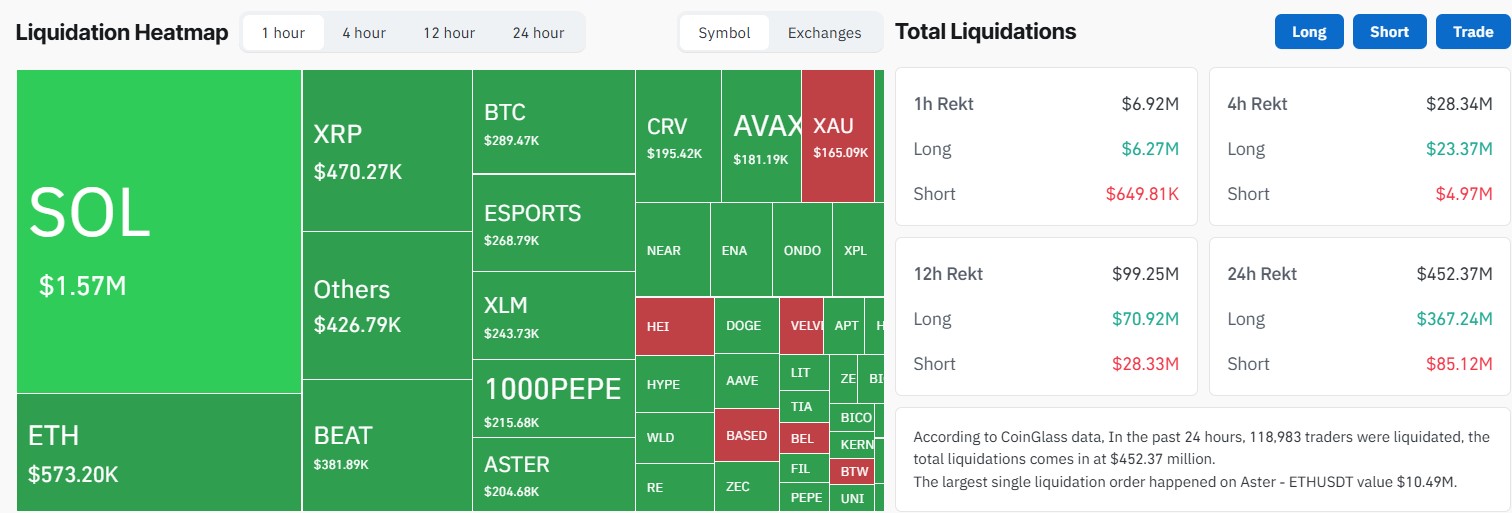
What Is the Bitcoin Chart Pattern Showing Right Now?
The daily chart, using LuxAlgo Smart Money Concepts, tells a cautious story.
Bitcoin broke below a rising channel structure that had been in place since the February 2026 lows near $53,000. That channel carried price all the way to the $82,000 range by late April and May.
A Change of Character signal now appears near $72,000, confirming a shift to bearish market structure.
Price is now sitting just above a demand zone between $60,000 and $62,500, marked with a green dotted line on the chart. This area attracted buyers during the prior accumulation.
A small rising wedge is forming in the most recent candles, drawn with white trendlines on the right side of the chart.
Rising wedges during downtrends tend to resolve lower unless buyers step in with real volume. Current volume reads just 0.44, which is light.
What Does the Bitcoin RSI Signal at These Levels?
The RSI on the daily timeframe sits at 34.19, deep in oversold territory.
That reading is historically significant. When Bitcoin last visited RSI levels this low in early 2026, the price was bottoming near $53,000 before staging a multi-month rally to $82,000.
Oversold RSI alone is not a buy signal, but it does suggest selling pressure may be getting exhausted.
The risk is that RSI can stay depressed for weeks in a sustained downtrend. The macro backdrop, including geopolitical stress and fresh liquidation damage, makes a quick bounce harder to sustain.
What Are the Key Bitcoin Support and Resistance Levels in June 2026?
Traders are watching several price zones closely this week.
On the support side, $62,500 is the immediate floor where the price is currently testing. Below that, $60,000 is a psychological round number that has drawn buyers historically.
A deeper breakdown could revisit $57,500, which marks the next visible demand area on the chart.
On the resistance side, $65,000 is the first level bulls need to reclaim to suggest a shift in momentum. The $70,000 area marks a prior CHoCH zone, and the old channel structure sits between $75,000 and $77,500.
A daily close below $62,000 would put $57,500 in play quickly. A close back above $65,000 would be the first sign that buyers are absorbing supply.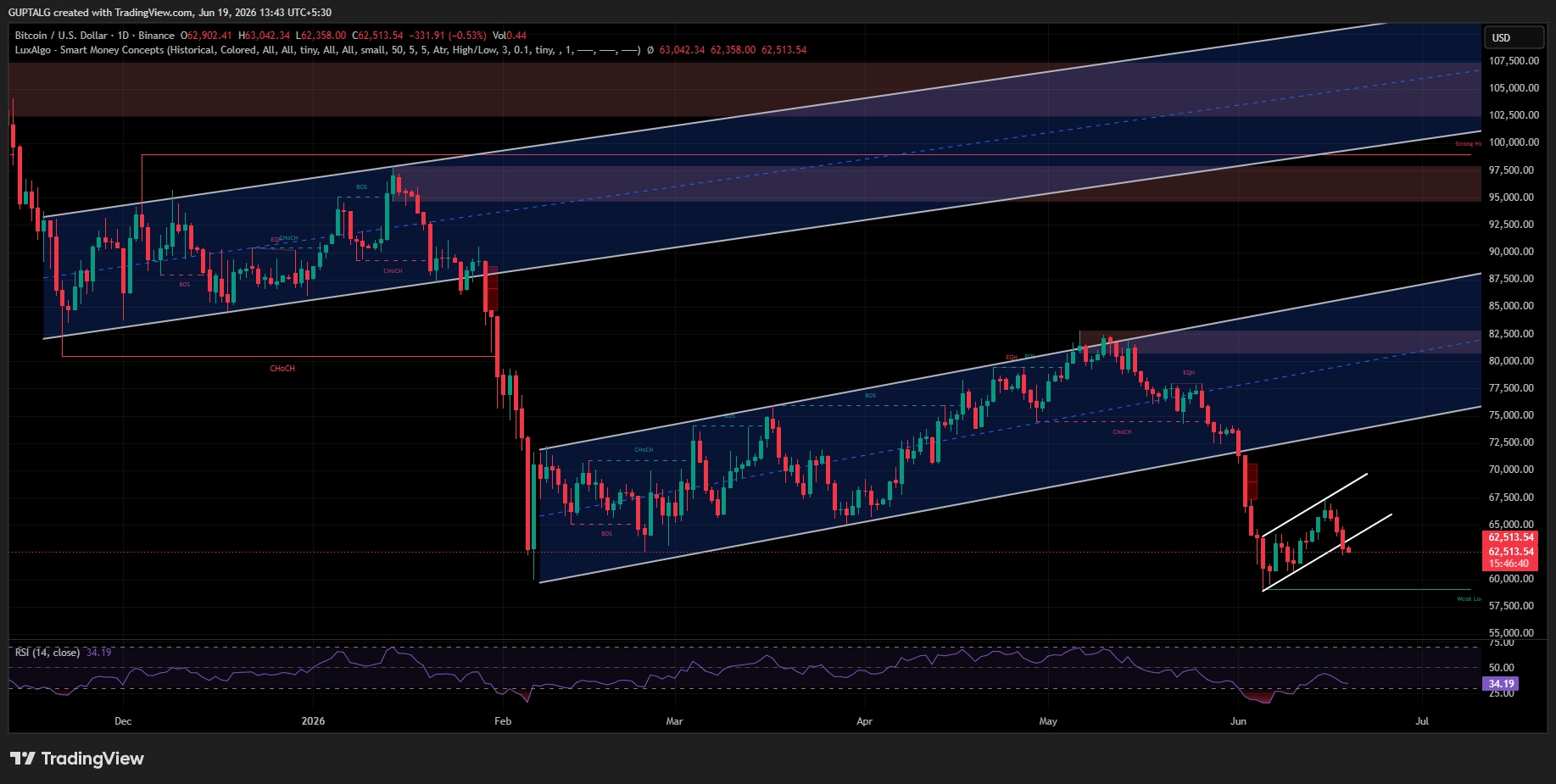
Will Bitcoin Price Go Up or Down From Here?
The daily trend is still bearish based on multiple CHoCH signals over the past two months. The weekly chart shows a failed attempt to hold above the old channel, which previously acted as support.
Short-term, if $62,500 holds and volume picks up, a bounce toward $65,000 to $67,000 is possible. That said, it would likely function as a relief rally rather than the start of a new leg higher.
For a sustainable recovery, Bitcoin needs to rebuild structure above $70,000 and see macro conditions stabilize.
A de-escalation in the Middle East or a shift in risk sentiment could help. But until the chart confirms a higher high on the daily timeframe, the path of least resistance remains down.
Disclaimer: This article is for informational purposes only. It does not constitute financial or investment advice. Cryptocurrency markets are highly volatile. Past performance does not guarantee future results. Always do your own research and consult a licensed financial advisor before making any investment decisions.


Ayrıca Şunları da Beğenebilirsiniz

Bitcoin Micro-Transactions Dominate Network Activity

Metaplanet buys 5,075 Bitcoin in Q1 to become 3rd-largest treasury

Bitcoin treasury sell-off accelerates as Riot, Bhutan, and public companies exit positions


Popüler Haberler
Daha fazla
