Cryptopolitan Report: 31% of Investors Would Buy the $1.75 Trillion SpaceX IPO Immediately: Here’s What the Rest Are Waiting For
In today’s world, Artificial Intelligence is seemingly taking centre stage among investors world over. That said, SpaceX’s record-setting IPO ambitions is signalling a quiet shift in how institutional money is rotating toward a new asset class, one where the infrastructure is real.
What SpaceX Is Actually Bringing to Market
SpaceX is on the verge of confidentially filing its IPO prospectus with the U.S. SEC within days, as noted by Bloomberg. The company’s management and advisory team are looking for a listing around mid-2026 at a whopping valuation of more than $1.75 trillion. For perspective, this valuation would place it as the most valuable company to ever go public and the company would be above every SP 500 constituent except for Nvidia, Apple, Alphabet, Microsoft and Amazon.
The raise alone which is reportedly over $75 billion would completely eclipse the current record set by Saudi Aramco in 2019. Again, to put things into perspective, the entire U.S. IPO market only raised more money than that in two of the last ten years combined.
This is certainly not a startup story. Morningstar reported that SpaceX generated around $16 billion in revenue and $7.5 billion in EBITDA last year. Its Starlink satellite segment alone saw over $10 billion revenue and more than $8 billion in profit.
The Thesis
Most people still think of SpaceX as a rocket company. The $1.75 trillion valuation, however, paints a completely different picture. Starlink is the actual engine here, a telecommunications network that now caters to around 9.2 million subscribers across 70+ countries. The Starlink coverage spans across everything from household broadband to government contracts and commercial aviation.
Traditional aerospace names like Lockheed Martin, Boeing and Northrop Grunman trade somewhere between 1.5x to 3x revenue. SpaceX on the other hand is being priced at around 113x its 2025 sales. The fact is, the investment thesis here is completely different compared to its aerospace peers. Markets are actually placing SpaceX’s value alongside the same conversation as NVIDIA and AWS.
The news that rolled out regarding its acquisition of xAI in February this year adds another layer to the investor thesis. By integrating Grok’s large language models with Starlink’s hardware, the conversation naturally evolves from SpaceX being a launch provider to one that competes in the cloud and AI infra market.
What Our Readers Said: Poll Results
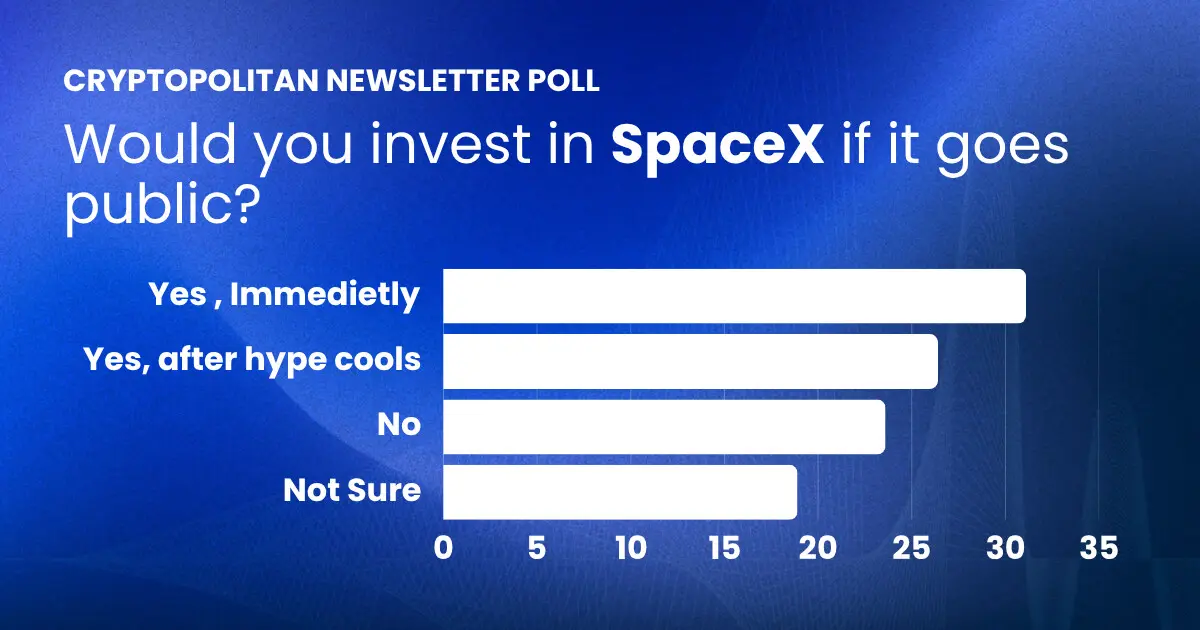
Cryptopolitan Newsletter Poll · March 2026 “Would you invest in SpaceX if it goes public?”
What the Sentiment Reveals
The poll conducted via the Cryptopolitan newsletter provides a useful perspective on how an audience that is primarily digitally savvy, investment aware spanning across various sectors such as crypto, AI and tech is thinking about the SpaceX IPO
31.1% are ready to buy now. For a company that’s still private with no public financials, that’s a meaningful signal. 26.4% share the same instinct but want the excitement to die down before pulling the trigger. Add them together, 57.5% want in. The timing differs, the direction doesn’t.
The 23.6% who pushed back did so on valuation grounds. At 113x sales, that’s a reasonable place to land. Even within an audience comfortable with aggressive growth multiples, nearly one in four drew a line. That’s worth noting.
18.9% are still watching. The S-1, the xAI numbers, the roadshow pricing, they need more before forming a view. Right now they’re the undecided middle. Once the prospectus hits, that changes fast.
The combined 57.5% with buying intent, across an audience that tracks both traditional and emerging markets, signals that the SpaceX IPO has already cleared the credibility threshold most new listings never reach.
Why This IPO Is a Capital Allocation Signal
Ever since early 2023, the dominant theme around every institutional deck, every fund manager and every retail conversation has centered around Artificial Intelligence. The SpaceX IPO, contrary to what many people might think, is actually not a move away from this existing conversation but actually a convergence of two of the biggest trends into a single asset.
When you pay close attention to Starlink’s subscriber growth story, it starts to look a lot like cloud adoption in the early days. Revenue per user is growing, government contracts are stacking up and the cash flows look more like a toll road than a tech startup. The xAI deal then drops an AI angle on top of that, without the binary risk of betting on a standalone LLM company. Not many businesses can credibly pitch both stories at once.
This news has already had an impact on space stocks. As reported by CNBC, space stocks such as AST SpaceMobile and Rocket Lab both jumped double digits after this news broke. Others in the sector like Firefly Aerospace and York rallied 16% and 5% respectively. The 30% allocation to retail investors is another telling sign that SpaceX is deliberately expanding away from the institutional and venture capital circle that has dominated this story for over a decade while bringing in a much wider pool of investors.
Key Risks to Monitor
The high valuation is naturally the first place to be mindful of. At 113x 2025 sales, there is quite literally no room for error and a disappointing quarter or a revenue miss could get punished hard.
xAI is the part that needs the most unpacking. Reports suggest the unit is cash-negative, meaning the people buying into this IPO aren’t just getting Starlink, they’re also on the hook for a large language model business still finding its footing financially. Two very different businesses, one price tag.
The S&P 500 question is quieter but just as important. Entry requires four straight profitable quarters. The timeline isn’t clear yet. And until SpaceX clears that bar, passive funds, which would otherwise be forced buyers at this market cap, sit out entirely. At $1.75 trillion, that’s not a small hole in the demand picture.
What to Watch Next
For those looking to participate in the IPO or even if you are undecided at this point in time, there are actually a few key updates and factors that one can track to fully understand the potential here.
First and foremost the S-1 filing will be the most important document to track. This is expected to come out very soon and it could very well validate the $1.75 trillion figure relatively quickly. This will be the first time anyone outside the company will get a complete overview of their financials in over two decades. Therefore, this is bound to be a major information event.
The next factor to track is the 30% planned allocation to retail investors. If this does get a confirmation, this would make it one of the largest IPOs set aside for retail to get involved in. As the listing date gets closer, it’s important for those looking to buy to keep an eye out for announcements from individual brokerages such as Fidelity, Schwab, Robinhood etc. The reality is that not every brokerage gets access to shares, and even if they do, there are usually some criteria to clear such as account size, trading history before being able to receive these shares.


Ayrıca Şunları da Beğenebilirsiniz

edgeX (EDGE) Surges 44.9% to All-Time High: Volume Spike Analysis

Governor gives thousands of prisoners commutation hope for first time since 1990s