Wells Fargo Cuts S&P 500 Year-End Target Amid Iran Conflict and Stagflation Fears
TLDR
- Wells Fargo trimmed its year-end S&P 500 target from 7,800 to 7,300, citing the Iran conflict as an unplanned risk
- Stocks are now pricing in more war risk than oil risk, a first according to the bank’s model
- The Nasdaq 100’s forward P/E ratio has contracted 29% since its peak
- Wells Fargo’s earnings per share forecast is $315 for 2026 and $365 for 2027
- Despite near-term pressure, the firm says it remains “structurally bullish” on U.S. stocks
Wells Fargo analyst Ohsung Kwon has cut his year-end S&P 500 price target from 7,800 to 7,300. The revision reflects growing uncertainty tied to the ongoing Iran conflict.
Kwon noted that the war was not part of the bank’s base case heading into 2026. He said the situation has added a layer of risk that was not previously factored in.
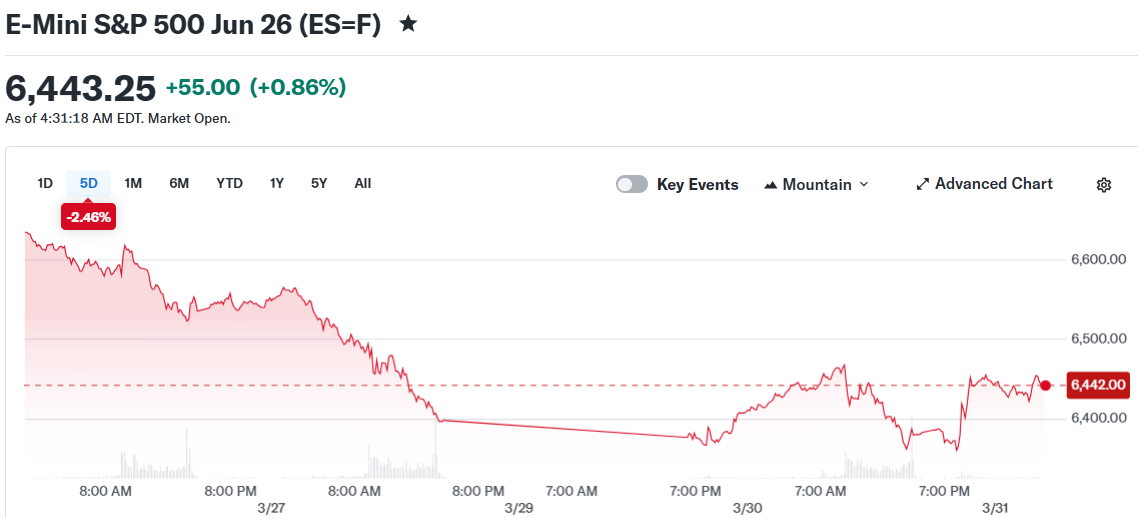 E-Mini S&P 500 Jun 26 (ES=F)
The S&P 500 is currently trading around 6,343, down about 7.7% on the year. Wells Fargo used an average of prices from February 28 and March 30 to set its revised base.
The bank’s internal war pricing model showed something unusual. For the first time, stocks are pricing in more risk from the conflict itself than from oil prices.
The Nasdaq 100’s forward price-to-earnings ratio has dropped 29% from its peak. About one-third of S&P 500 stocks are now trading at least one standard deviation below their five-year average valuation.
Macro Setup Called a “Lose-Lose”
Kwon described the current macro environment as a “lose-lose” situation ahead of key economic data this week. Strong data could push the Federal Reserve to hold rates higher for longer. Weak data could stoke stagflation fears and push investors further toward the exit.
Wells Fargo’s inventory-based model also flagged second-half inflation as a growing risk. The model suggests upward price pressure is building relative to current levels.
Despite the near-term headwinds, Wells Fargo said it is not turning outright bearish. The firm’s PRSM model — which tracks Profits, Rates, Sentiment, and Macro — still points to a 14% return over the next 12 months.
Earnings per share forecasts remain intact at $315 for 2026 and $365 for 2027. The bank says earnings are expected to stay resilient even as the macro backdrop gets more complex.
Equity Inflows Have Held Steady
One piece of data that stood out to Kwon: equities have kept attracting inflows since the war started. This is different from prior geopolitical shocks, where investors typically pulled money out.
Kwon said this suggests investors are choosing to hedge rather than fully exit. It points to a belief that the economic impact will be short-lived.
Also in March, analyst price target upgrades outnumbered downgrades across the market. That signals continued confidence in corporate earnings, even with the conflict ongoing.
Wells Fargo listed five reasons it stays bullish long-term. These include a contained oil shock, a valuation reset, U.S. energy independence, strong free cash flow from major tech companies, and a restocking cycle picking up speed.
The S&P 500 stands at 6,343 as of March 31, 2026, with the market down 7.7% year-to-date.
The post Wells Fargo Cuts S&P 500 Year-End Target Amid Iran Conflict and Stagflation Fears appeared first on CoinCentral.
You May Also Like

Aave DAO to Shut Down 50% of L2s While Doubling Down on GHO

New Crypto Investors Are Backing Layer Brett Over Dogecoin After Topping The Meme Coin Charts This Month