Google just sounded the alarm. The company published new research showing that quantum computers are much closer to breaking cryptocurrency cryptography than anyoneGoogle just sounded the alarm. The company published new research showing that quantum computers are much closer to breaking cryptocurrency cryptography than anyone

Google Just Dropped a Quantum Bomb: Bitcoin Private Keys Could Be Cracked in 9 Minutes

2026/03/31 19:00
3 min read
For feedback or concerns regarding this content, please contact us at crypto.news@mexc.com

Google just sounded the alarm. The company published new research showing that quantum computers are much closer to breaking cryptocurrency cryptography than anyone thought. The timeline has collapsed from months to minutes.

The breakthrough changes the threat model entirely. Mempool attacks (where an attacker steals funds before a transaction confirms) just became a real possibility.

Project Eleven, a research account focused on quantum risk, summed up the findings in a thread that quickly went viral. Their take: existing cryptography is dead. Migration to post-quantum standards needs to happen now.

The Numbers That Changed Everything

Google’s new resource estimates show that cracking a private key requires only 1,200 to 1,450 logical qubits, depending on the architecture. That is a 10‑fold improvement over previously published work. Until now, estimates placed the required qubit count well beyond current hardware capabilities. Google just shrunk the gap.

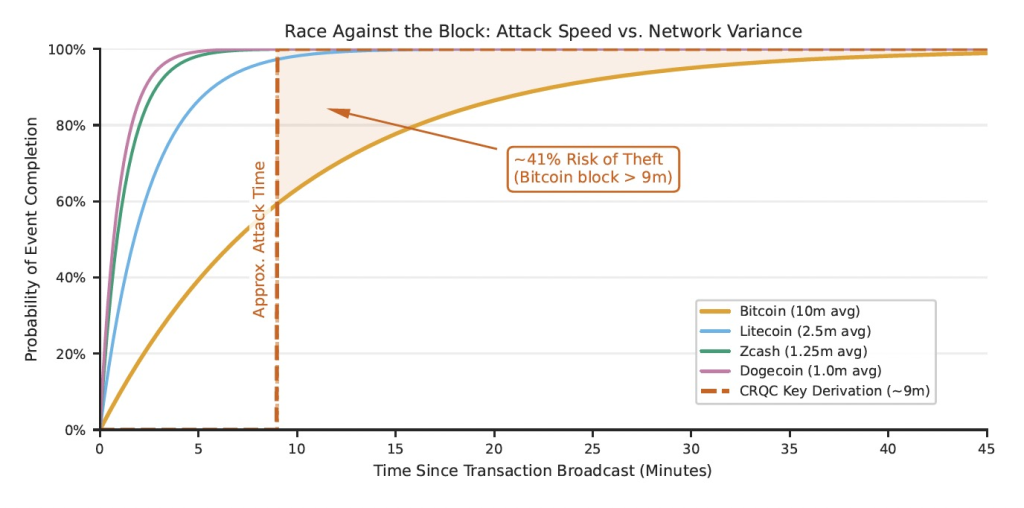
Even more alarming is the speed. A quantum computer could now crack a private key in nine minutes. Bitcoin’s average block time is ten minutes.
Source: X/@projecteleven

That timing matters. A mempool attack works like this: an attacker watches the mempool for a transaction, cracks the private key of the sending address before the transaction is confirmed, and broadcasts a competing transaction to redirect the funds. With a nine‑minute crack time, that window is wide open.

Vulnerable Bitcoin at Risk

Google used Project Eleven’s Bitcoin Risq List to identify the roughly 6.7 million Bitcoin sitting in vulnerable addresses. Of that total, 1.7 million BTC sits in P2PK scripts, including Satoshi-era mining rewards where the public key is permanently exposed onchain. Those coins are effectively sitting targets.

The top 1,000 Ethereum wallets, Google notes, could be broken in less than nine days.

Read also: Here’s What Happened the Last Time Bitcoin Price Had 6 “Red” Months in a Row

Google Is Treating This as a Security Vulnerability

In an unusual move, Google considered the underlying quantum circuits too dangerous to publish. Project Eleven pointed out that this is the first time such a precaution has been taken in quantum resource estimation. Google is treating blockchains like a security vulnerability that will be exploited unless the industry acts.

The company also warned that quantum progress will be swift. There will be no extra warning signs or canaries in the coal mine. What the public sees now is the threshold.

For Bitcoin and other blockchains, the path forward is clear but difficult. The industry must migrate to post‑quantum cryptography—signature schemes like SPHINCS+, Falcon, or Dilithium that resist quantum attacks. No major chain has completed that transition yet.

The clock is no longer theoretical. Google just showed that the math behind crypto’s security is not safe forever. The question now is how fast the industry can move before the first quantum computer gets used for something other than research.

Subscribe to our YouTube channel for daily crypto updates, market insights, and expert analysis.

The post Google Just Dropped a Quantum Bomb: Bitcoin Private Keys Could Be Cracked in 9 Minutes appeared first on CaptainAltcoin.

Market Opportunity
QUANTUM Logo
QUANTUM Price(QUANTUM)
$0.00269
$0.00269$0.00269
-0.59%
USD
QUANTUM (QUANTUM) Live Price Chart
Disclaimer: The articles reposted on this site are sourced from public platforms and are provided for informational purposes only. They do not necessarily reflect the views of MEXC. All rights remain with the original authors. If you believe any content infringes on third-party rights, please contact crypto.news@mexc.com for removal. MEXC makes no guarantees regarding the accuracy, completeness, or timeliness of the content and is not responsible for any actions taken based on the information provided. The content does not constitute financial, legal, or other professional advice, nor should it be considered a recommendation or endorsement by MEXC.
Tags:

You May Also Like

UK Reform Party argues stablecoin limits stifle innovation

UK Reform Party argues stablecoin limits stifle innovation

The post UK Reform Party argues stablecoin limits stifle innovation appeared on BitcoinEthereumNews.com. The United Kingdom’s minority party Reform has formally rejected the Bank of England’s proposal to cap stablecoin holdings and its broader plan to introduce a central bank digital currency (CBDC). In a Sept. 18 statement on X, the party’s head of policy, Zia Yusuf, alongside party figurehead Nigel Farage, warned that the measures would damage Britain’s competitiveness in the global digital economy. Last week, the Bank of England proposed restricting stablecoin exposure for individuals and businesses. Under the draft proposal, citizens would be limited to holding between £10,000 and £20,000 in systemic stablecoins, while businesses would face a maximum cap of £10 million. The regulator argues that the plan aims to reduce financial risks as digital assets become more mainstream. However, the Reform party leaders framed the proposal as an attack on innovation rather than a safeguard. They argued that limiting the use of stablecoins risks choking off demand for British government debt while strengthening the position of global rivals. According to the statement, dollar–pegged stablecoins like USDC and USDT funnel significant liquidity into US Treasuries, reinforcing the dollar’s dominance in digital finance. By contrast, the UK lacks any mechanism equivalent to a backstop demand for gilts. Yusuf wrote: “Now ask yourself: where is the British equivalent? Where is the pound-backed stablecoin with deep liquidity, one that global markets can trust, one that channels fresh demand into UK gilts? It doesn’t exist, because policymakers here have been openly hostile to innovators. Instead of building the future, Britain’s regulators have smothered it.” Considering this, Yusuf argued that “stablecoins are not a danger to financial stability.” Instead, he described the assets as: “[A] bridge between the digital world and the traditional banking system. A bridge between entrepreneurs and customers, between investors and opportunity. They are simply new wrappers around money – safer,…
Share
BitcoinEthereumNews2025/09/18 22:55
Metaplanet raises $1.4B to fuel BTC purchases and U.S. subsidiary launch

Metaplanet raises $1.4B to fuel BTC purchases and U.S. subsidiary launch

Metaplanet Inc. has formalized the subsidiary in Miami, Florida, naming it Metaplanet Income Corp.
Share
Cryptopolitan2025/09/17 23:34
New Crypto Investors Are Backing Layer Brett Over Dogecoin After Topping The Meme Coin Charts This Month

New Crypto Investors Are Backing Layer Brett Over Dogecoin After Topping The Meme Coin Charts This Month

Climbing to the top of the meme coin charts takes more than a viral mascot or celebrity tweets. Hype may spark attention, but only momentum, utility, and adaptability keep it alive. That’s why the latest debate among crypto enthusiasts is catching attention. While Dogecoin remains a household name, a new player has entered the arena […] The post New Crypto Investors Are Backing Layer Brett Over Dogecoin After Topping The Meme Coin Charts This Month appeared first on Live Bitcoin News.
Share
LiveBitcoinNews2025/09/18 00:30
