Can Outset Media Index (OMI) data be trusted for media planning?
Disclosure: This article does not represent investment advice. The content and materials featured on this page are for educational purposes only.
OMI introduces unified methodology combining multiple data sources to improve media planning insights.
- OMI combines data from Similarweb, Moz, and proprietary metrics to create a unified media performance index.
- The index solves fragmented media planning by aggregating 37 metrics across reach, SEO, and engagement.
- OMI helps advertisers and analysts compare outlets with standardized data, reducing misleading or inconsistent metrics.
OMI structures data from sources such as Similarweb and Moz alongside proprietary indicators and internal research, and applies a consistent methodology across the index.
A common limitation in media planning is that most tools rely on individual signals such as traffic, rankings, or publisher-provided data, but they do not show how those pieces come together in practice. That makes it difficult to understand how an outlet actually behaves in a campaign or what kind of outcome it tends to produce.
OMI is built around the idea of putting all the relevant media signals in one place, so planning doesn’t come down to stitching them together. It works through 37 metrics that span reach, engagement, SEO, and operational factors, applied across a dataset of more than 340 websites, which include crypto-native publications alongside finance, technology, and general news media focused on cryptocurrency coverage.
Media buying is known to be messy and confusing. Data varies across providers, vendors quote numbers that may not be consistent with reality, and publicly available top lists are often pay-to-play.
OMI is built for teams that work with media decisions directly:
- advertisers,
- PR and marketing teams,
- publishers,
- and analysts,
These are the people who actually deal with this mess when planning and placing content. The index addresses part of that by normalizing inputs before turning them into easy-scannable rankings, reducing the impact of inflated or misleading numbers.
To get a clearer sense of how that holds up, it helps to look at OMI’s methodology and scoring mechanisms, where the approach works well, and whether it has limits.
How OMI ranks media outlets
OMI ranks outlets by converting most of its inputs into two consolidated scores:
- General Score summarizes overall outlet strength on a 1–100 scale, and
- Convenience Score reflects how easy an outlet is to work with in practice, also on a 1–10 scale.
Underneath those scores is a mix of OMI’s normalized technical indicators and proprietary metrics, some of which include:
- Unique Score, which reflects the consistency of an outlet’s unique audience over time rather than short-term spikes,
- Composite Score, which combines relative (%) and absolute changes in traffic dynamics to show whether an outlet is growing, stable, or declining,
- Reading Behavior, which captures how deeply users interact with content once they land,
- Reprints Score, which tracks whether coverage tends to circulate beyond the original publication and how impactful that syndication actually is,
- and Editorial Rigidity, which reflects how flexible or restrictive an outlet is during the publishing process.
These normalized indicators rely on standard market signals, including but not limited to:
- Average Traffic (3m) and Total Traffic (3m), reflecting overall reach,
- Average Unique Traffic (3m), showing the size of the real audience,
- Referral Traffic (%), and especially LLM Referral Share (%), indicating how traffic flows from external sources,
- Visit Duration, Pages per Visit, and Bounce Rate (%) as benchmarks for audience behavior,
- Main GEO and GEO Breakdown, showing where the audience is concentrated,
- Price Per Post ($), reflecting the cost of placement.
Based on the General Score and the Convenience Score, the system ranks outlets across two corresponding ratings, the General Rating and the Convenience Rating, allowing for fair benchmarking without distorting performance with operational factors like turnaround speed, pricing models, or editorial control over submitted content.
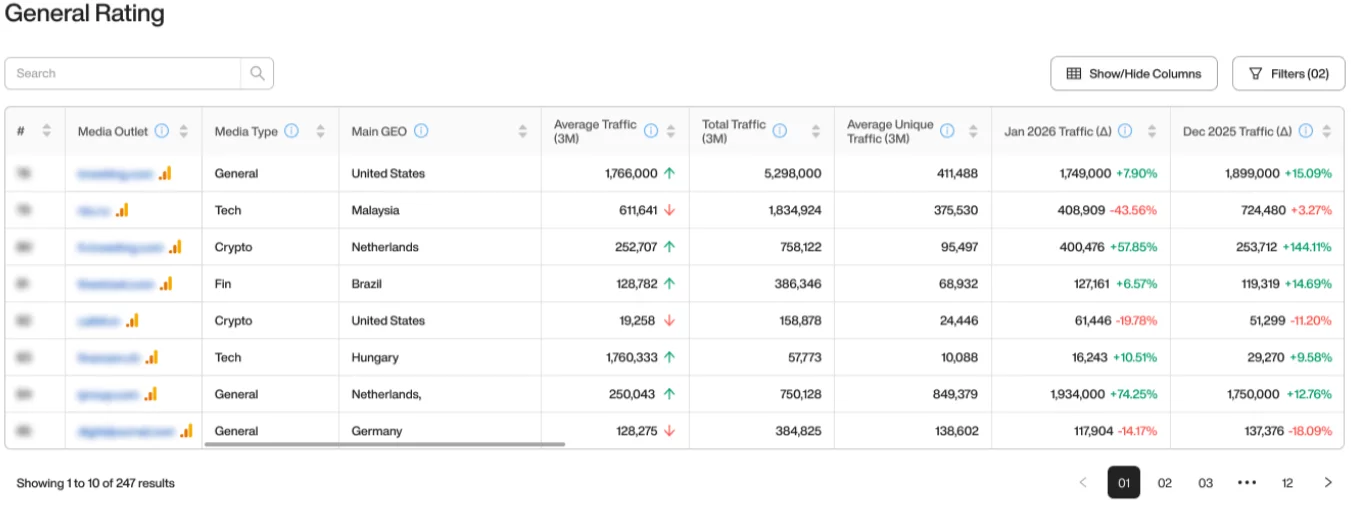
As with any composite scoring system, these rankings are designed to be directional. Even strong third-party estimates can vary, and no model fully captures how a placement will perform in every case. In that sense, OMI works best as a consistent analysis layer across the same dataset, helping teams shortlist outlets and structure decisions, rather than as a precise measure of any single publication’s influence.
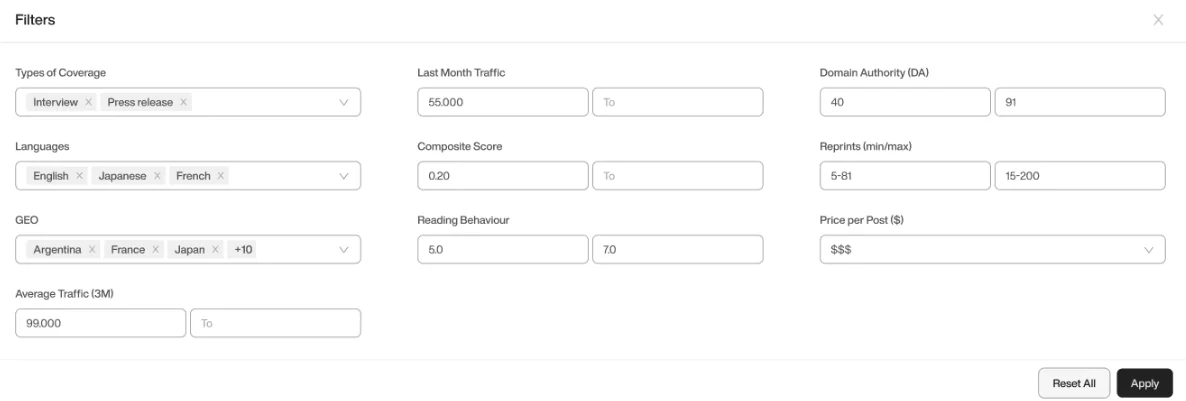
Rankings are not fixed views, but something teams can work through depending on what they are trying to understand. The table itself can be adjusted to focus on specific metrics based on campaign needs.
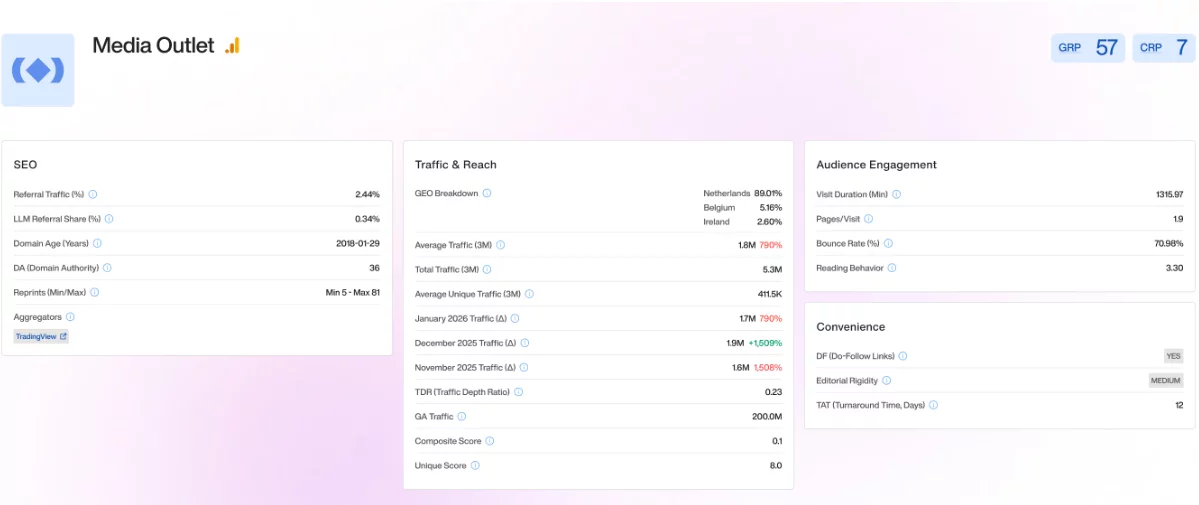
From there, the view often narrows further. Individual outlets can be opened in a separate Media Profile, where all underlying signals are pulled together in one place, making it easier to move from comparison to a more detailed analysis before making a decision.
Can OMI rankings be influenced by paid placements or inflated traffic?
OMI rankings are not influenced by paid placements and cannot be adjusted on request. The methodology is described as fixed and non-negotiable, with ranking visibility not subject to third-party influence.
That said, the broader media environment is not immune to manipulation. Publishers can attempt to inflate traffic or backlink signals, and no index can fully prevent that. The distinction here is that OMI itself does not boost or alter rankings in response to commercial relationships, which is a large part of why it holds up as a more reliable reference point in practice.
Rather than relying on a single signal, OMI analyzes outlets across the mentioned metrics, which helps reduce the impact of inflated visibility. Traffic alone is not treated as a decisive factor but considered alongside other signals to better reflect how an outlet actually performs.
In that sense, OMI does not try to “clean” the media landscape entirely, but it does structure rankings in a way that makes it harder for artificially inflated signals to dominate the outcome.
How often is OMI data updated?
OMI numbers aren’t updated all at once on a fixed schedule but refreshed in parts, depending on the type of data. Metrics like traffic, engagement, and scores are typically updated monthly, while more research-driven or structural details are revised less frequently, as new information is verified or becomes available.
From a media planning perspective, that actually makes more sense than forcing everything into one update cycle. Not all data moves at the same speed, and treating it as if it does can create a false sense of precision. A staggered update approach reflects how media data behaves in reality. Some signals change quickly, others don’t, which makes the overall picture more usable when making decisions.
There are fields in OMI that show a dash (—). That simply means there isn’t enough reliable data available for that metric at the moment. Instead of filling gaps with weak estimates, OMI leaves those values blank until the data meets its accuracy standards.
Leaving those fields empty avoids the trap of some smaller or less active outlets looking more defined than they actually are and keeps the comparison grounded in what can be supported, rather than what can be approximated.
When should OMI be used in media planning?
OMI tends to be most useful at the stage where media decisions are still being shaped. That usually means shortlisting outlets, analyzing options across similar tiers, and sense-checking whether a placement is likely to hold up before committing a budget.
It also becomes relevant when planning across multiple markets or formats, where differences between outlets are harder to track manually, and GEO, audience behavior, and operational factors can help narrow down options, while Outset Data Pulse adds a clearer picture of how those markets actually behave.
At the same time, OMI works best as a reference point rather than a final decision-maker. It helps structure the comparison and highlight trade-offs, but the final call still depends on context, campaign goals, and how the story itself is positioned.
Media planning rarely offers clear answers, but having a consistent way to read the signals makes those decisions easier to stand behind. That’s where tools like OMI tend to fit in: not as a final answer, but as something that makes the process more grounded.
How OMI becomes even more reliable from here
In a recent interview, founder Mike Ermolaev explained that the point of OMI was never to add one more tool to an already fragmented stack, but to replace that fragmentation with a system where signals are already organized and aligned.
As he put it, “OMI is not just another tool in the stack. It’s designed to replace the stack.”
That matters for reliability, because trust in media planning rarely comes from one metric being “correct.” It comes from having a framework that helps teams work through the same set of signals more consistently.
Sofia Belotskaia, OMI’s product manager, points to the next layer of that work. After the soft launch, the focus is on making the platform easier to use in practice, especially through more convenient benchmarking, better historical data visualization, and a more accurate segmentation of outlets.
Seen that way, the next stage of OMI is not just about growth. It is about making the system easier to read and harder to misinterpret – which is exactly what a media planning tool needs if it is going to be trusted over time.
The broader product roadmap includes enabling media outlets to contribute their own data, ranging from analytics to pricing and editorial requirements, under a moderated framework. In the longer term, this could reshape how media and advertisers interact, potentially leading to a marketplace for placements.
Disclosure: This content is provided by a third party. Neither crypto.news nor the author of this article endorses any product mentioned on this page. Users should conduct their own research before taking any action related to the company.
You May Also Like

Markets await Fed’s first 2025 cut, experts bet “this bull market is not even close to over”

Walmart Recession Signal points to 'sharp economic downtown': Wall Street insider