

New Bitcoin Reserve Bill Pressures Treasury On Custody Rules
The US House Appropriations Committee has advanced H.R. 5166 — the Financial Services and General Government (FSGG) spending bill for FY2026 — with language that would formally direct the Treasury Department to spell out how the federal government will custody Bitcoin and other digital assets it acquires, explicitly including holdings earmarked for the newly created Strategic Bitcoin Reserve. The bill was reported on September 5, 2025, as House Report 119-236 and placed on the Union Calendar.
Congress Demands Public Information On Bitcoin Reserve
At the statutory level, Section 138 of the reported bill requires the Treasury, within 90 days of enactment, to deliver a public plan for the “secure and efficient custody” of federal digital assets, “including assets held under the Strategic Bitcoin Reserve and the US Digital Asset Stockpile.” The plan must delineate custody architecture, legal authorities, cybersecurity controls, and interagency workflows for transfers and safekeeping.
Section 137 adds a second mandate: a report on the practicability of establishing the reserve and the related stockpile, addressing potential barriers, the expected impact on the Treasury Forfeiture Fund, how Bitcoin and other digital assets would be presented on the federal balance sheet, and any third-party contractors used for custody. Read together, the two sections would force the Treasury to clarify both whether and how the federal government will maintain long-term Bitcoin holdings — and what that means for government accounting and forfeiture-fund mechanics.
The committee report accompanying the bill underlines Congress’s intent to track the flow of seized assets into the program. It directs the Treasury to provide monthly tables of the Forfeiture Fund’s activity, including any “diversions from the Forfeiture Fund to the Bitcoin Strategic Reserve and/or the digital asset stockpile.” That same report section labels the custody directive “Custody of Digital Assets,” emphasizing strong safeguards to prevent loss, unauthorized access, or liquidation.
The push comes six months after the White House issued Executive Order 14233, which created both the Strategic Bitcoin Reserve and the US Digital Asset Stockpile by consolidating government-owned crypto seized in criminal and civil cases. The order states that government BTC placed into the reserve “shall not be sold,” positioning Bitcoin as a strategic asset held for national objectives subject to law. It also instructs Treasury and Commerce to develop ways to acquire additional government BTC on a budget-neutral basis.
H.R. 5166 would also bring the national-security community into the loop. Section 139 directs the Treasury Secretary and the Director of the National Security Agency to provide a classified report on inter-agency coordination within 90 days of enactment — a signal that lawmakers see digital-asset custody (and key management) as an operational risk surface as well as a balance-sheet question.
The legislative pressure is occurring alongside separate efforts to codify the reserve. In March, Rep. Byron Donalds introduced H.R. 2112 to give the executive order “the force and effect of law,” while other measures, such as H.R. 2032, have proposed building out a decentralized, cold-storage reserve network for government BTC. None of those standalone bills has been enacted, but the appropriations route, if passed, would time-box the Treasury to deliver concrete answers shortly after the spending bill becomes law.
What Changes If H.R. 5166 Becomes Law?
First, the Treasury would owe the public a detailed custody blueprint, not just internal memoranda or ad-hoc practices developed for asset seizures. Second, Congress would receive an analytical roadmap for how a Strategic Bitcoin Reserve and stockpile would interact with forfeiture processes and the federal balance sheet — key inputs for any future decision to scale the program beyond seized assets.
Third, the classified NSA-Treasury report would institutionalize security coordination around wallet infrastructure and interagency transfers. Together, those steps would shift the federal government’s handling of Bitcoin from case-by-case liquidation towards a defined reserve posture aligned with the March 6 policy that reserve BTC is not to be sold.
However, the measure does not itself appropriate BTC, purchase Bitcoin on the open market, or authorize immediate diversions into the reserve; it sets reporting and planning obligations contingent on enactment of the underlying appropriations bill. The House-reported text must still clear the full House, the Senate, and reconciliation before reaching the President’s desk. Until then, the timelines — “within 90 days of enactment” — are prospective.
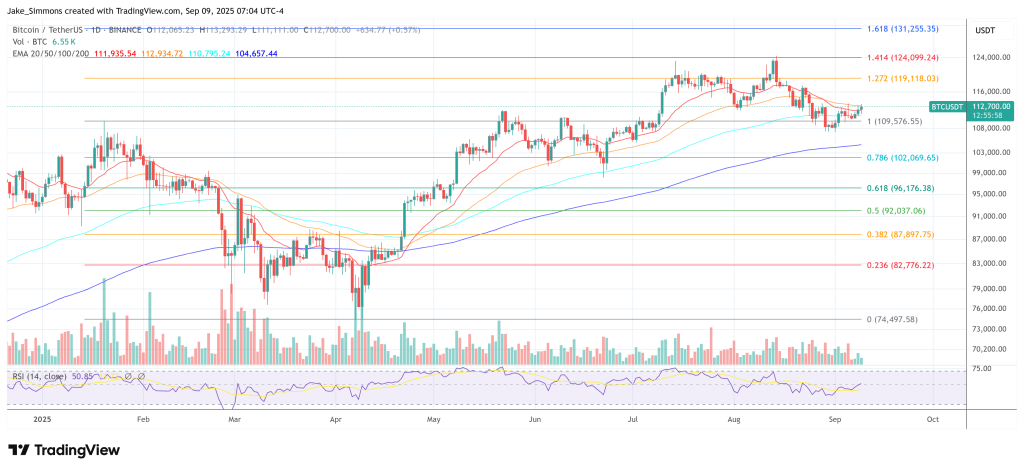
At press time, BTC traded at $112,700.
You May Also Like

Woman shot 5 times by DHS to stare down Trump at State of the Union address

CEO Sandeep Nailwal Shared Highlights About RWA on Polygon
