Polygon's network upgrade to the POL token is complete, with native staking now live on Ethereum. The announcement followed a speculative rally that saw trading volume peak at over $631 million. The post Polygon’s POL Migration Completes After “Buy the Rumor” Rally as Native Staking Goes Live appeared first on Coinspeaker.Polygon's network upgrade to the POL token is complete, with native staking now live on Ethereum. The announcement followed a speculative rally that saw trading volume peak at over $631 million. The post Polygon’s POL Migration Completes After “Buy the Rumor” Rally as Native Staking Goes Live appeared first on Coinspeaker.

Polygon’s POL Migration Completes After “Buy the Rumor” Rally as Native Staking Goes Live

3 min read

Polygon’s network [NC] upgrade from its MATIC token to POL is now complete, following a successful migration announced on September 3.

With the transition finalized, the network has enabled native staking for the new POL token directly on Ethereum ETH $4 419 24h volatility: 0.9% Market cap: $532.94 B Vol. 24h: $33.13 B , allowing users to earn validator rewards.

The market demonstrated strong anticipation for the news in a classic “buy the rumor” scenario. According to historical data from Coingecko, trading volume peaked at over $631 million on Sept. 1.

This momentum continued into September 2, pushing the token’s price to a high of nearly $0.29 as traders positioned themselves ahead of the official announcement.

Following the confirmation on September 3, the token’s price saw minor consolidation around the $0.28 mark. This price stability suggests the preceding rally had already captured the market’s positive sentiment surrounding the milestone.
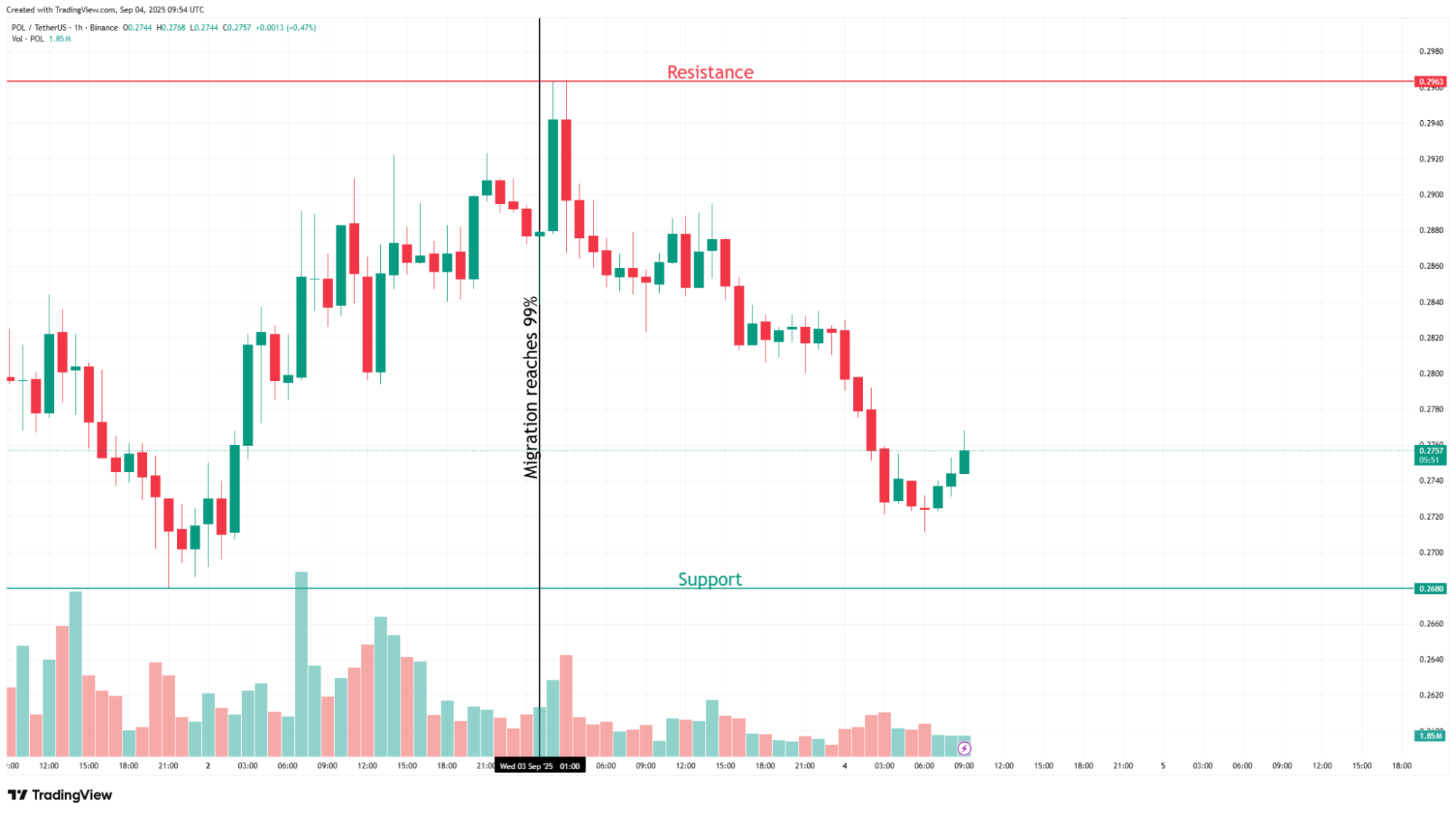
polygon price chart

Polygon price chart on TradingView. | Source: TradingView

Staking Features and Network Growth

The new staking functionality allows POL holders to help secure the Polygon network. In return for staking their tokens, participants can receive a portion of validator rewards and become eligible for future community airdrops.

This development positions POL as a notable option for users exploring the best crypto to stake in the current market.

The network’s underlying growth is reflected in its on-chain data. Polygon’s unique address counts are consistently on the rise, reaching 527 million as of September 3.

This user growth is complemented by a strong DeFi ecosystem, with the network’s Total Value Locked (TVL) reaching $1.23 billion in August, a 43% increase year-to-date.

This milestone comes during a period of leadership transition for the project. The departure of co-founder Mihailo Bjelic in May marked the third founder to step away from an active role, prompting discussions within the community about the protocol’s long-term stability.

The network’s continued adoption by government bodies further highlights its growth. For instance, the government of the Philippines recently adopted Polygon for document verification.

In the United States,Wyoming’s government-backed stablecoin, the Frontier Stable Token (FRNT), also launched on the Polygon network in August.

The POL token is designed for expanded utility beyond securing a single chain and is set to power Polygon’s Agglayer, an interoperability solution aimed at creating a more unified cross-chain ecosystem.

The upgrade maintained a 1:1 swap ratio from MATIC to POL and introduced a new tokenomics model with a 2% annual emission over ten years to fund network security and grants.

For users who have not yet migrated, a MATIC migration tool remains available on the Polygon Portal.

next

The post Polygon’s POL Migration Completes After “Buy the Rumor” Rally as Native Staking Goes Live appeared first on Coinspeaker.

Market Opportunity
TokenFi Logo
TokenFi Price(TOKEN)
$0.003191
$0.003191$0.003191
-1.72%
USD
TokenFi (TOKEN) Live Price Chart
Disclaimer: The articles reposted on this site are sourced from public platforms and are provided for informational purposes only. They do not necessarily reflect the views of MEXC. All rights remain with the original authors. If you believe any content infringes on third-party rights, please contact service@support.mexc.com for removal. MEXC makes no guarantees regarding the accuracy, completeness, or timeliness of the content and is not responsible for any actions taken based on the information provided. The content does not constitute financial, legal, or other professional advice, nor should it be considered a recommendation or endorsement by MEXC.

You May Also Like

Cashing In On University Patents Means Giving Up On Our Innovation Future

Cashing In On University Patents Means Giving Up On Our Innovation Future

The post Cashing In On University Patents Means Giving Up On Our Innovation Future appeared on BitcoinEthereumNews.com. “It’s a raid on American innovation that would deliver pennies to the Treasury while kneecapping the very engine of our economic and medical progress,” writes Pipes. Getty Images Washington is addicted to taxing success. Now, Commerce Secretary Howard Lutnick is floating a plan to skim half the patent earnings from inventions developed at universities with federal funding. It’s being sold as a way to shore up programs like Social Security. In reality, it’s a raid on American innovation that would deliver pennies to the Treasury while kneecapping the very engine of our economic and medical progress. Yes, taxpayer dollars support early-stage research. But the real payoff comes later—in the jobs created, cures discovered, and industries launched when universities and private industry turn those discoveries into real products. By comparison, the sums at stake in patent licensing are trivial. Universities collectively earn only about $3.6 billion annually in patent income—less than the federal government spends on Social Security in a single day. Even confiscating half would barely register against a $6 trillion federal budget. And yet the damage from such a policy would be anything but trivial. The true return on taxpayer investment isn’t in licensing checks sent to Washington, but in the downstream economic activity that federally supported research unleashes. Thanks to the bipartisan Bayh-Dole Act of 1980, universities and private industry have powerful incentives to translate early-stage discoveries into real-world products. Before Bayh-Dole, the government hoarded patents from federally funded research, and fewer than 5% were ever licensed. Once universities could own and license their own inventions, innovation exploded. The result has been one of the best returns on investment in government history. Since 1996, university research has added nearly $2 trillion to U.S. industrial output, supported 6.5 million jobs, and launched more than 19,000 startups. Those companies pay…
Share
BitcoinEthereumNews2025/09/18 03:26
XRP Ledger Unlocks Permissioned Domains With 91% Validator Backing

XRP Ledger Unlocks Permissioned Domains With 91% Validator Backing

XRP Ledger activated XLS-80 after 91% validator approval, enabling permissioned domains for credential-gated use on the public XRPL. The XRP Ledger has activated
Share
LiveBitcoinNews2026/02/06 13:00
TrendX Taps Trusta AI to Develop Safer and Smarter Web3 Network

TrendX Taps Trusta AI to Develop Safer and Smarter Web3 Network

The purpose of collaboration is to advance the Web3 landscape by combining the decentralized infrastructure of TrendX with AI-led capabilities of Trusta AI.
Share
Blockchainreporter2025/09/18 01:07