

Bitcoin: 50% of the past 24 months ended in gains, economist says
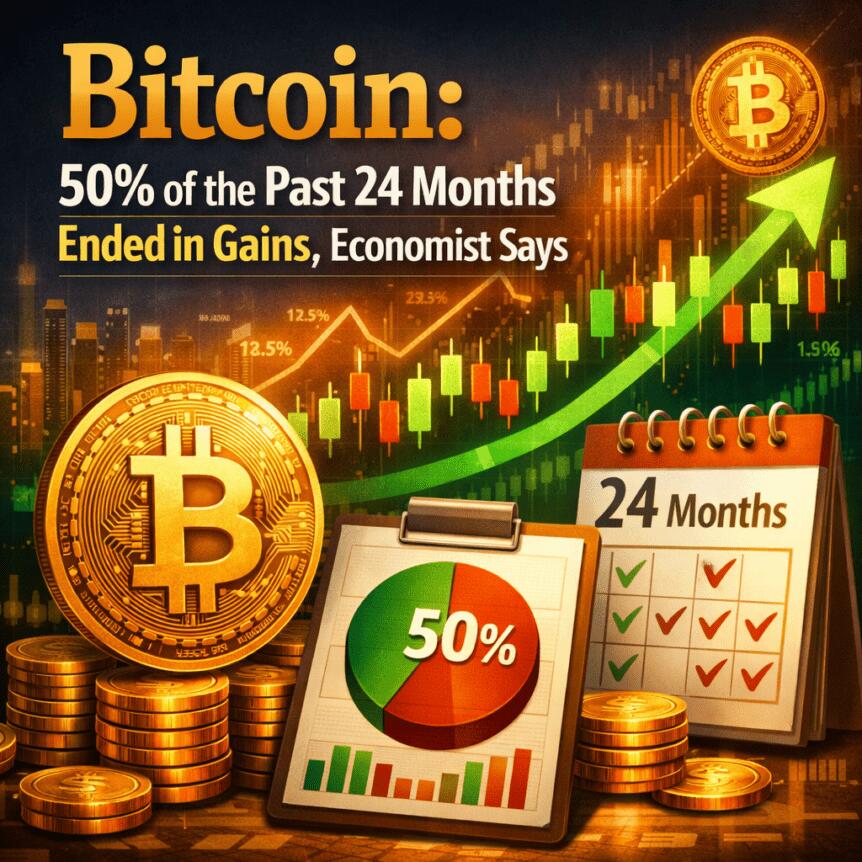
Bitcoin’s monthly performance pattern has become a focal point for investors trying to gauge the near-term trajectory of the market. An economist’s simple metric — counting how many months within a rolling two-year window produced gains — has sparked renewed debate about the odds of higher prices in the months ahead. The analysis comes as BTC has pulled back from peaks earlier in the year and as traders weigh a mix of seasonal tendencies, on-chain signals, and sentiment indicators that oscillate between caution and the prospect of a rebound. In 2025, BTC showed gains in six of the 12 months, a backdrop that shapes expectations for a market that remains highly sensitive to macro developments and liquidity conditions.
Key takeaways
- Bitcoin’s (CRYPTO: BTC) longer-run pattern shows that 50% of the last 24 months included positive monthly performance, a signal cited by economist Timothy Peterson to suggest a high probability of higher prices within the near term.
- Peterson’s method implies an approximately 88% chance that BTC will be higher 10 months from the reference point, highlighting how simple month-count metrics can inform timing debates in a volatile market.
- Polymarket currently assigns a 17% probability to December becoming Bitcoin’s best month of 2026, narrowly trailing November’s 18% odds.
- November remains historically strong for BTC, with CoinGlass data showing it as the best performing month on average since 2013, delivering substantial gains on many occasions.
- BTC was trading near $68,173 at the time of reporting, about a quarter below its level at the start of the year, underscoring the scale of retracement and the potential for a range-bound setup into year-end.
- Market sentiment appears mixed: the Crypto Fear & Greed Index signaled “Extreme Fear,” while sentiment analytics firm Santiment noted a cooling of price-predictive chatter, signaling a move toward neutral territory.
Tickers mentioned: $BTC
Market context: The data-driven debate unfolds as traders balance seasonal tendencies with a backdrop of cautious risk appetite. While one set of metrics points to upside potential, broader sentiment and liquidity considerations continue to weigh on positioning, making near-term moves more data-dependent than traditional catalysts alone.
Why it matters
The discussion around BTC’s month-to-month cadence matters because it reframes how investors think about timing in a market known for abrupt shifts. If the 24-month positive-month metric holds, the odds of a continuation of higher prices could tilt decisions toward positioning strategies that benefit from gradual upside rather than sharp, binary breakouts. The nuance matters for miners, traders, and institutions alike, because it suggests a probabilistic framework rather than a single price target. It also highlights how macro factors — such as liquidity cycles, macro risk sentiment, and regulatory signals — interact with seasonality to shape price expectations in a market where many participants rely on models that blend on-chain signals with traditional indicators.
The split among analysts adds texture to the risk assessment. Some optimists, like Michael van de Poppe, have cautioned that the near term could see a green week for BTC, pointing to potential candles that could buttress a broader rebound after a stretch of red months. Others, including veteran traders, have warned that a definitive bottom may not come quickly and suggested that a deeper or more drawn-out phase of weakness could precede a real recovery. In this tug-of-war, investors are watching not only price action but also how social sentiment evolves and whether institutional demand returns as volatility moderates.
Beyond Bitcoin’s price action, the narrative is influenced by how the market interprets data points from data providers and prediction markets. For instance, the December outlook on Polymarket reflects a probabilistic expectation rather than a verdict, with traders pricing in a non-trivial chance that the final month of the year outperforms others in 2026. Meanwhile, the long-run tail risk — often discussed in the context of macro liquidity and regulatory clarity — remains a factor that can alter the pace and composition of investor inflows or withdrawals. The interplay between these signals is what keeps BTC in a dynamic, data-driven environment rather than a static price path.
On-chain measurements and sentiment trackers add further texture. The Fear & Greed Index, a gauge of overall market mood, landed in a rare phase of extreme caution, underscoring the risk-off leaning prevailing in many corners of the crypto space. Yet, sentiment analytics outfit Santiment has noted a trend toward a more neutral stance as the crowd reduces speculative chatter around price predictions. This combination — cautious macro mood with subdued but stabilizing on-chain signals — helps explain why the market is watching for confirmatory catalysts that could turn pessimism into a more constructive price trajectory.
As traders parse these competing signals, the price backdrop remains a real-time constraint. BTC hovered around $68,173 at the time of publication, a level that sits noticeably below the year’s start and well under the all-time highs seen in late 2023 and early 2024. The current chapter is not about a single event but about a mosaic of indicators that could tip the balance toward a steadier ascent or a renewed period of consolidation. The breadth of opinions among seasoned traders reflects the broader reality: in a market as data-rich and narrative-driven as crypto, many of the strongest moves are born from a confluence of timing, sentiment, and macro liquidity rather than from any one signal alone.
In sum, the BTC narrative remains a study in contrasts — data points suggesting upside probability allied with cautionary sentiment and a price backdrop that invites patience. The coming weeks and months will test whether the 88% horizon implied by Peterson’s monthly-count framework materializes, or whether outcomes align more closely with the more conservative, risk-off mood reflected in short-term volatility measures. For market participants, the takeaway is to blend probabilistic thinking with disciplined risk management, rather than rely on a single data point to forecast the next leg of Bitcoin’s journey.
https://platform.twitter.com/widgets.js
What to watch next
- December’s outcome for BTC’s performance on Polymarket’s “best month in 2026” event (current odds: 17%), and whether November’s 18% edge holds.
- BTC’s price trajectory toward or away from the $70,000 level and how it interacts with the 10-month horizon referenced in Peterson’s metric.
- The evolution of market sentiment indicators, including the Fear & Greed Index and Santiment’s readings on sentiment normalization.
- On-chain activity and liquidity signals that could accompany a sustained price move, especially as macro factors influence risk appetite.
Sources & verification
- Timothy Peterson’s X post citing the 50% positive-month metric and the ~88% odds window: https://x.com/nsquaredvalue/status/2025275842394251560?s=20
- CoinGlass data on BTC’s 2025 monthly performance: https://www.coinglass.com/today
- Polymarket event page for “Bitcoin best month in 2026”: https://polymarket.com/event/bitcoin-best-month-in-2026
- Bitcoin price reference as of publication on CoinMarketCap: https://coinmarketcap.com/currencies/bitcoin/
- Crypto Fear & Greed Index for market sentiment: https://alternative.me/crypto/fear-and-greed-index/
Market reaction and key details
Bitcoin (CRYPTO: BTC) has traded within a data-rich framework that blends seasonal expectations with a skeptical sentiment backdrop. The 50% positive-month metric over the preceding 24 months, highlighted by Peterson in his X post, is not a price forecast but a probability-driven lens that can inform timing considerations. The implication that BTC has roughly an 88% chance of being higher in ten months is based on counting the number of positive months; such a metric is best viewed as one among many tools, not a standalone predictor. It underscores how revenue-focused and risk-managed investors may frame potential upside in a market known for abrupt swings.
Traders on prediction platforms see a nuanced picture for December. Polymarket’s pricing places a 17% probability on December becoming BTC’s best month of 2026, a signal that the market assigns to rare, outsized upside relative to other months, though still modest in absolute terms. November remains a benchmark; history shows it as the strongest calendar month for BTC on average since 2013, often delivering outsized gains. This historical context helps frame the December odds as part of a longer cycle rather than a stand-alone bet. The juxtaposition of seasonality against structural market fragility is why many market participants approach the next few weeks with hedged expectations.
From a price perspective, BTC hovered around $68,173 at press time, a level that sits well below the early-year peak and marks a sharp retracement from February’s ~$80,000 starting point. The pullback doesn’t negate the strategic value of the month-to-month dynamism; instead, it highlights the need for patience and disciplined risk controls as the market tests whether a base forms or if buyers should wait for a clearer signal. In this environment, the interplay between seasonal patterns and sentiment becomes particularly meaningful: a favorable November-to-December transition could set the stage for a more sustained move, but a reiteration of caution could prolong a period of consolidation as liquidity conditions remain sensitive to global macro developments.
Analysts remain divided on the near-term path. While some traders anticipate a green week for BTC and a potential extension of gains, others project further downside before a genuine bottom takes hold. The divergent views reflect a broader truth about crypto markets: price action is increasingly influenced by a combination of on-chain signals, probabilistic forecasting, and evolving investor psychology. The result is a market that rewards prudent risk management and flexible positioning, rather than single-factor bets. As the narrative evolves, investors will be watching not only price levels but also how sentiment metrics shift and whether predicted outcomes in prediction markets begin to align with actual market moves.
This article was originally published as Bitcoin: 50% of the past 24 months ended in gains, economist says on Crypto Breaking News – your trusted source for crypto news, Bitcoin news, and blockchain updates.
You May Also Like

Vitalik Buterin’s Strategic Decisions Cause Stir in Crypto Markets
XRP Just Flashed the Same Signal Before a 114% Explosion
