This article explores how re-ranking methods enhance retrieval recall across anatomical structures in AI models. By applying re-ranking, all evaluated models—DreamSim, DINOv1, and SwinTransformer—show improved performance. While DreamSim consistently achieves the best results in region-based and localized retrieval, DINOv1 and SwinTransformer also excel in specific conditions. The findings highlight how re-ranking not only raises recall rates but also strengthens localization, proving its critical role in medical imaging and anatomical AI systems.This article explores how re-ranking methods enhance retrieval recall across anatomical structures in AI models. By applying re-ranking, all evaluated models—DreamSim, DINOv1, and SwinTransformer—show improved performance. While DreamSim consistently achieves the best results in region-based and localized retrieval, DINOv1 and SwinTransformer also excel in specific conditions. The findings highlight how re-ranking not only raises recall rates but also strengthens localization, proving its critical role in medical imaging and anatomical AI systems.

Boosting Anatomical Retrieval Accuracy with Re-Ranking Methods

3 min read

Abstract and 1. Introduction

  1. Materials and Methods

    2.1 Vector Database and Indexing

    2.2 Feature Extractors

    2.3 Dataset and Pre-processing

    2.4 Search and Retrieval

    2.5 Re-ranking retrieval and evaluation

  2. Evaluation and 3.1 Search and Retrieval

    3.2 Re-ranking

  3. Discussion

    4.1 Dataset and 4.2 Re-ranking

    4.3 Embeddings

    4.4 Volume-based, Region-based and Localized Retrieval and 4.5 Localization-ratio

  4. Conclusion, Acknowledgement, and References

3.2 Re-ranking

This section presents the retrieval recalls after applying the re-ranking method of Section 2.5.

\ 3.2.1 Volume-based

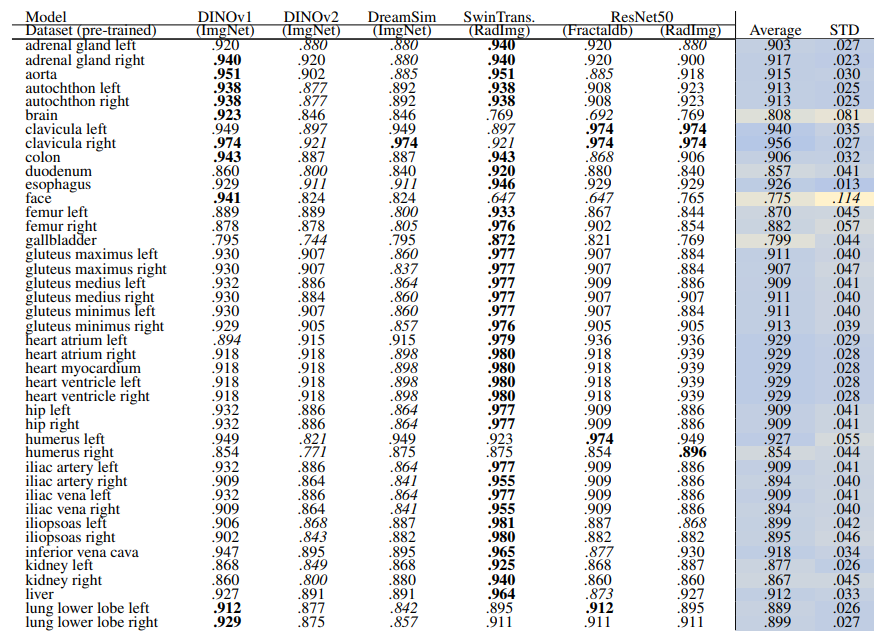
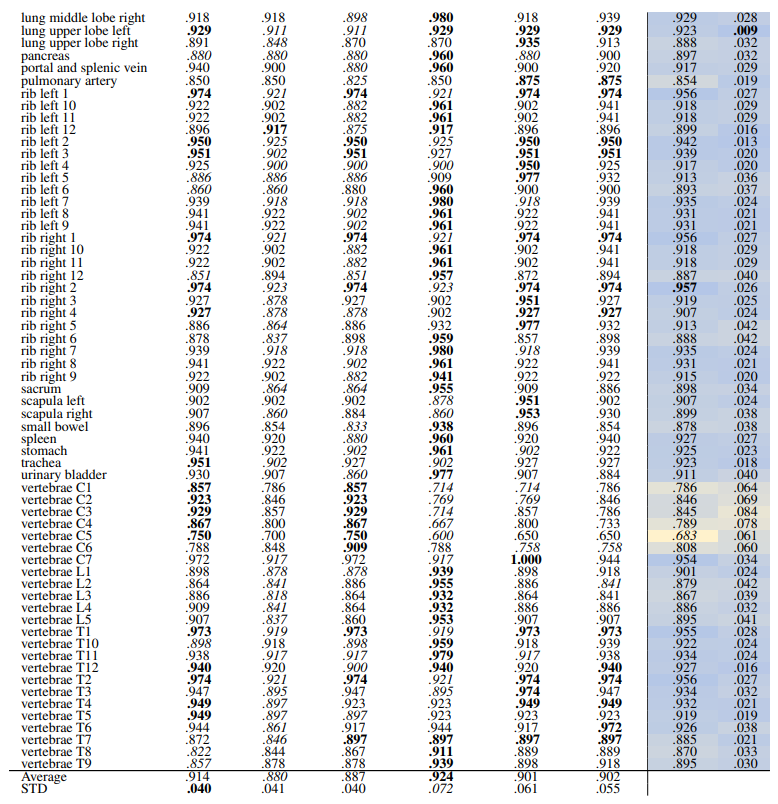
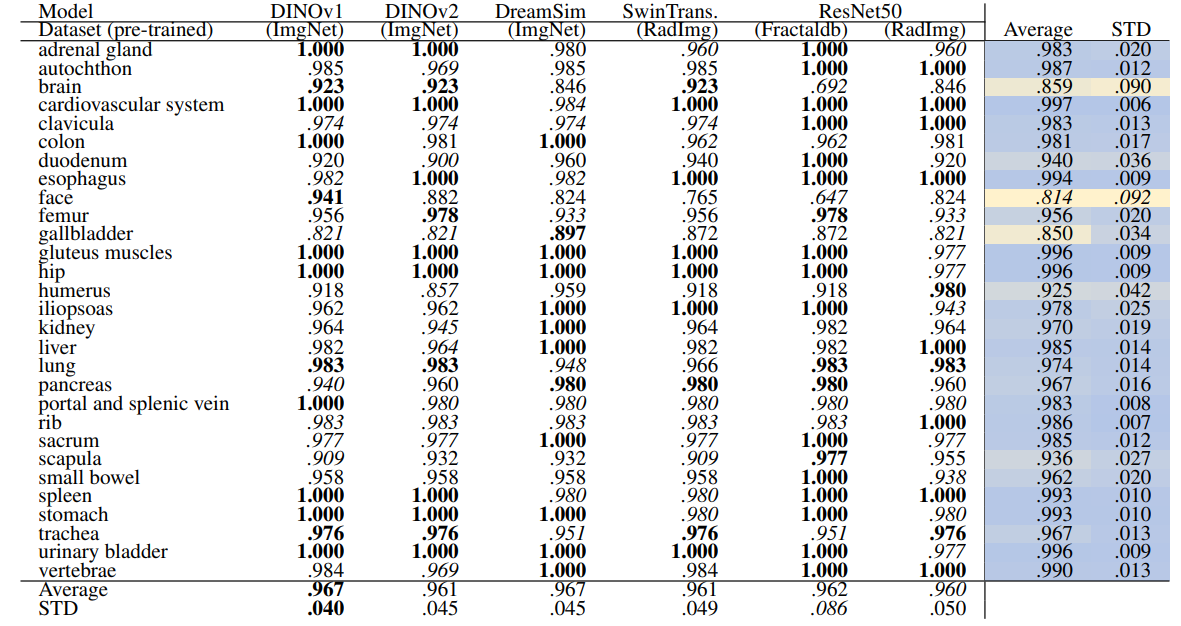
\ Table 12 and Table 13 show the retrieval recalls for 29 coarse anatomical structures and 104 original TS anatomical structures using the proposed re-ranking method. All the recalls are improved using re-ranking. The performance of the models for 29 classes is close with only slight differences. DINOv1 and DreamSim have a slightly better recall in comparison, with an average recall of .967 but the standard deviation of DINOv1 is slightly lower (.040 vs. .045). In 104 anatomical regions, SwinTransformer performs better than the other models with an average recall of .924 but its standard deviation (.072) is the lowest.

\ Table 12: Volume-based retrieval recall of coarse anatomical regions (29 classes) using HNSW Indexing and re-ranking. In each row, bold numbers represent the best-performing values, while italicized numbers indicate the worst-performing. The separate average and standard deviation (STD) columns are color-coded, with blue indicating the best-performing values and yellow indicating the worst-performing values across different models. Additionally, bold numbers in colored columns represent the best classes in terms of average and standard deviation, while italicized values represent the worst-performing class across the models.
\ Continue with the next figure

\ Table 13: Volume-based retrieval recall of all TS anatomical regions (104 classes) using HNSW Indexing and re-ranking. In each row, bold numbers represent the best-performing values, while italicized numbers indicate the worst-performing. The separate average and standard deviation (STD) columns are color-coded, with blue indicating the best-performing values and yellow indicating the worst-performing values across different models. Additionally, bold numbers in colored columns represent the best classes in terms of average and standard deviation, while italicized values represent the worst-performing class across the models.

\ 3.2.2 Region-based

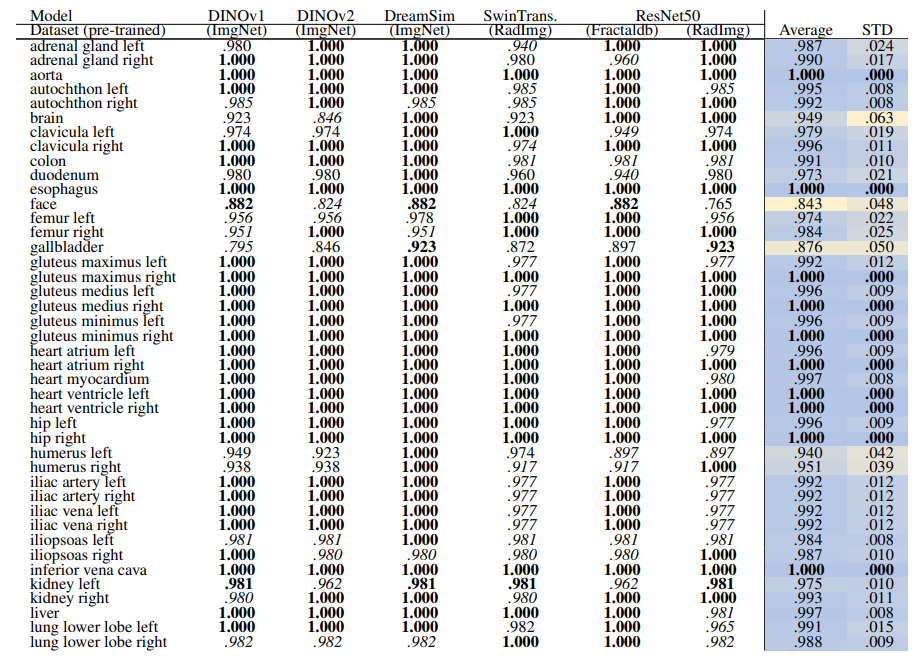
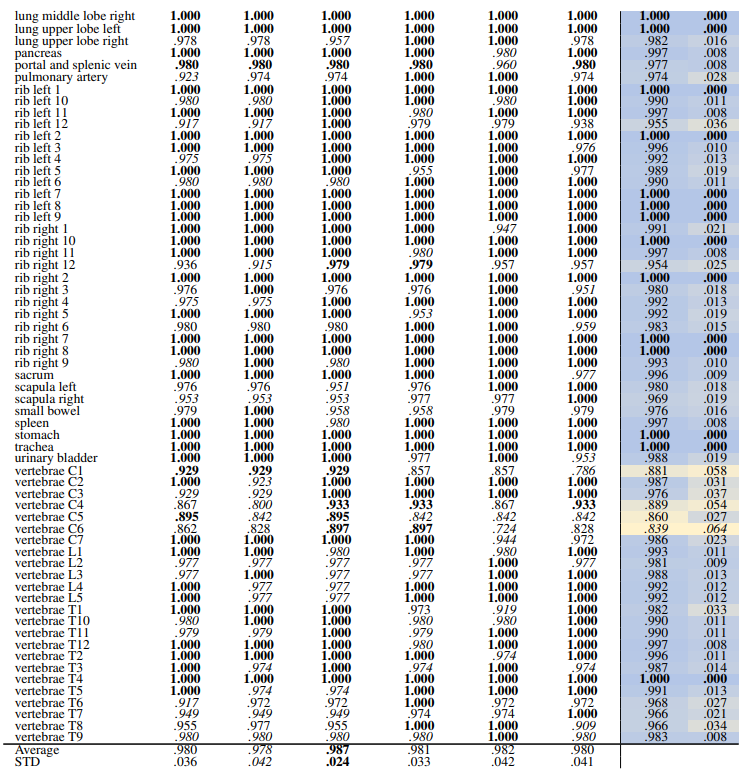
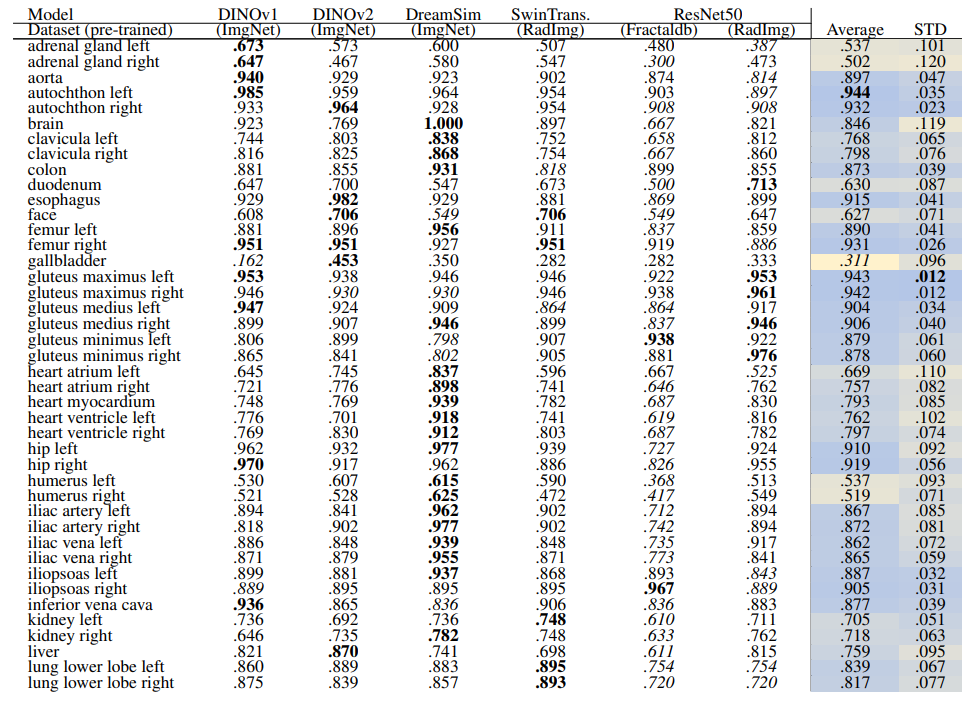
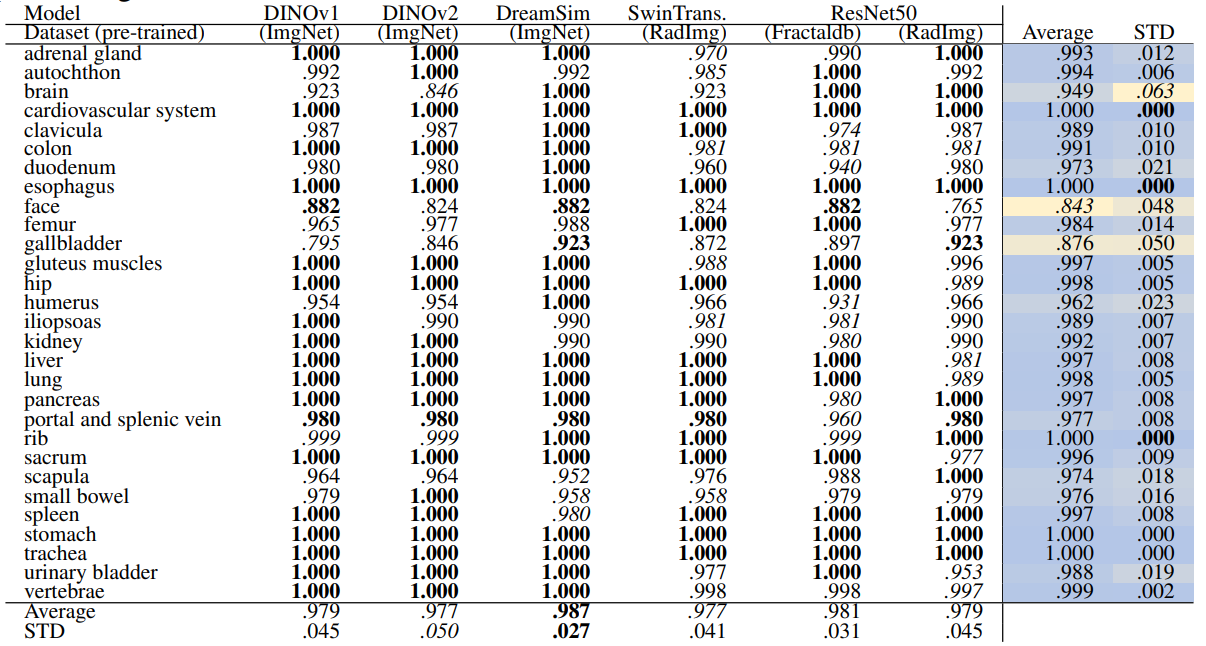
\ Table 14 and Table 15 show the retrieval recall for 29 coarse anatomical structures and 104 original TS anatomical structures employing the proposed re-ranking method. Using the re-ranking, the overall performance of all the models has improved. DreamSim performs the best with the average retrieval recall of .987 ± .027 and .987 ± .024 for 29 and 104 classes, respectively. There are only slight variations between the performance on coarse and all the original TS classes. Similar to the count-based method in the anatomical region retrieval many classes are perfectly retrieved (recall of 1.0). There is a low variation among models and between classes where the highest standard deviation is .064 and .042.

\ Table 14: Region-based retrieval recall of coarse anatomical regions (29 classes) using HNSW Indexing and re-ranking. In each row, bold numbers represent the best-performing values, while italicized numbers indicate the worst-performing. The separate average and standard deviation (STD) columns are color-coded, with blue indicating the best performing values and yellow indicating the worst-performing values across different models. Additionally, bold numbers in colored columns represent the best classes in terms of average and standard deviation, while italicized values represent the worst-performing class across the models.
\ Continue with the next figure

\ Table 15: Region-based retrieval recall of all TS anatomical regions (104 classes) using HNSW Indexing and re-ranking. In each row, bold numbers represent the best-performing values, while italicized numbers indicate the worst-performing. The separate average and standard deviation (STD) columns are color-coded, with blue indicating the best-performing values and yellow indicating the worst-performing values across different models. Additionally, bold numbers in colored columns represent the best classes in terms of average and standard deviation, while italicized values represent the worst-performing class across the models.

\ 3.2.3 Localized

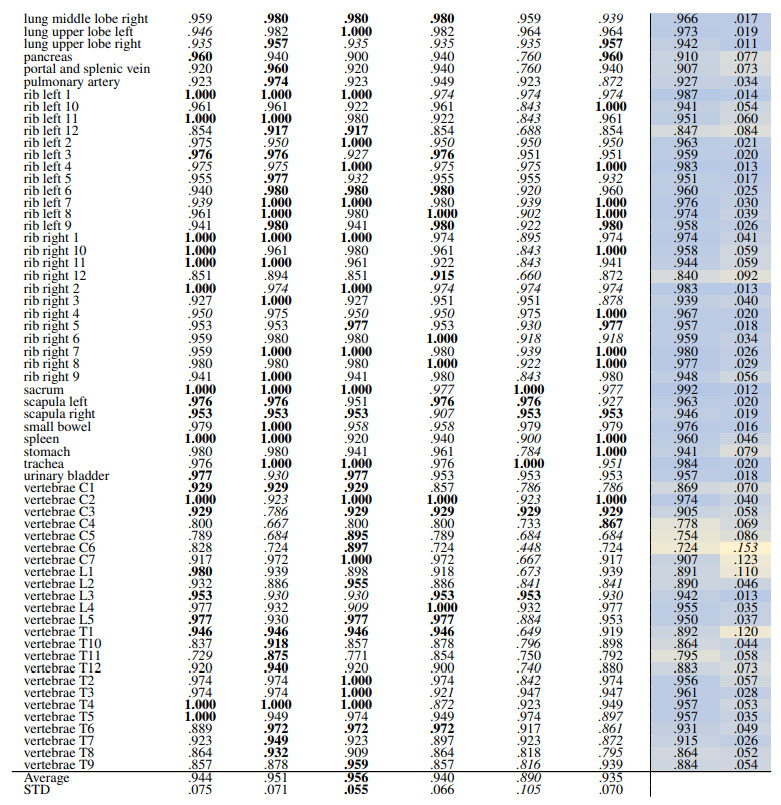
\ Localized Retrieval Recall Table 16 and Table 17 show the retrieval recall for 29 coarse anatomical structures and 104 original TS anatomical structures after re-ranking for L = 15. Re-ranking improved the localization for all the models. DreamsSim is the best-performing model with an average recall of .955 ± .062 for coarse anatomical structures and .956 ± .055 for original TS classes. Although the retrieval is lower compared to region-based or volume-based evaluation, it is still high which shows that the pretrained vision embeddings not only can retrieve similar cases but also can localize the corresponding region of interest.

\ Continue with the next figure
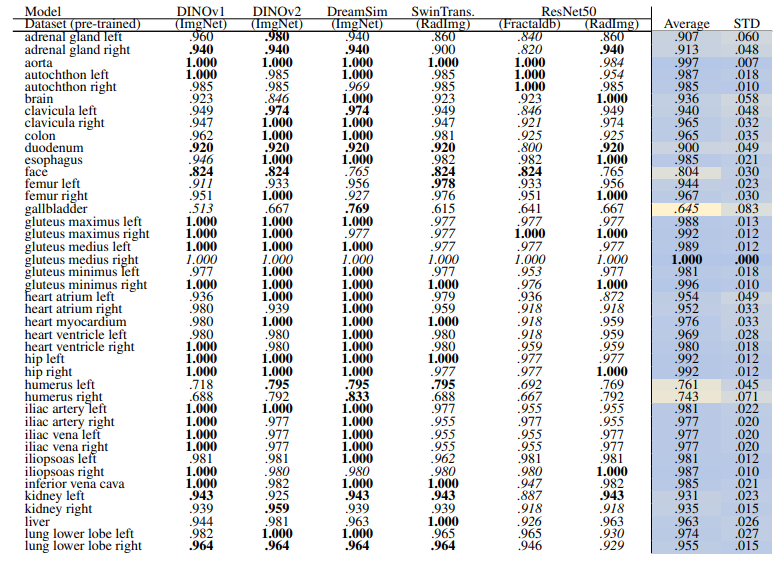
\ Table 17: Localized retrieval recall of all TS anatomical regions (104 classes) using HNSW Indexing and re-ranking, L = 15. In each row, bold numbers represent the best-performing values, while italicized numbers indicate the worst-performing. The separate average and standard deviation (STD) columns are color-coded, with blue indicating the best-performing values and yellow indicating the worst-performing values across different models. Additionally, bold numbers in colored columns represent the best classes in terms of average and standard deviation, while italicized values represent the worst-performing class across the models.

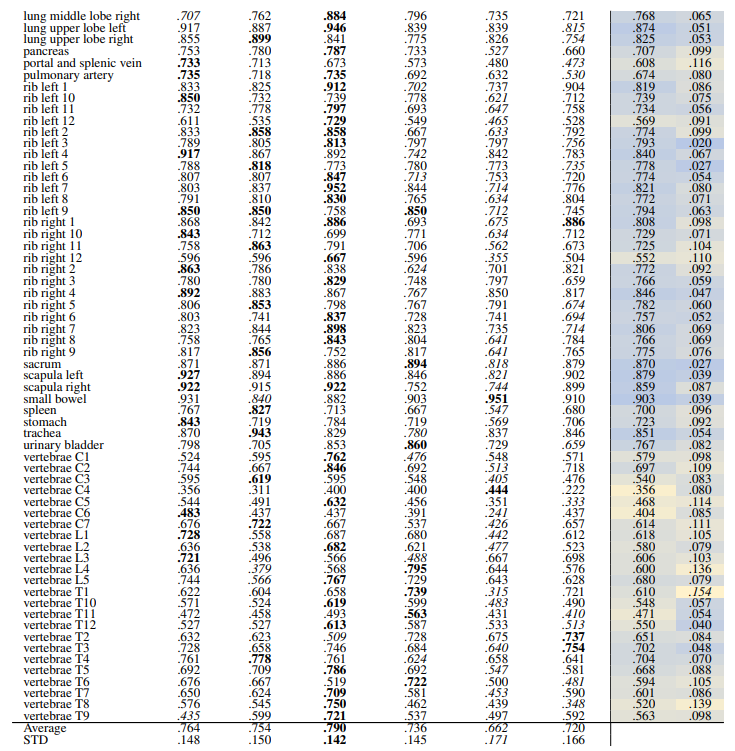
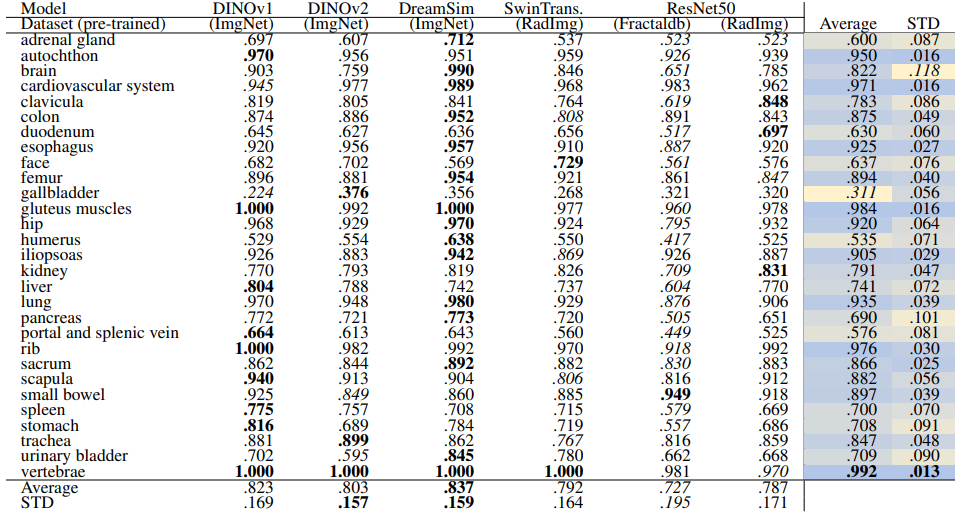
\ Localization-ratio The localization-ratio is calculated based on (7). Table 18 and Table 19 demonstrate the localization-ratio for 29 coarse and 104 original TS anatomical regions after re-ranking for L = 15. The bestperforming embedding is still DreamSim with a localization-ratio of .837 ± .159 and .790 ± .142 for 29 coarse and 104 original TS classes. After re-ranking the overall localization-ratio is reduced (previously, .864 ± .0145 and .803 ± .130, respectively).

\ Table 18: Localization-ratio of coarse anatomical regions (29 classes) using HNSW Indexing and re-ranking, L = 15. In each row, bold numbers represent the best-performing values, while italicized numbers indicate the worst-performing. The separate average and standard deviation (STD) columns are color-coded, with blue indicating the best-performing values and yellow indicating the worst-performing values across different models. Additionally, bold numbers in colored columns represent the best classes in terms of average and standard deviation, while italicized values represent the worst-performing class across the models.
\ Continue with the next figure

\ Table 19: Localization-ratio of all TS anatomical regions (104 classes) using HNSW Indexing and re-ranking, L = 15. In each row, bold numbers represent the best-performing values, while italicized numbers indicate the worst-performing. The separate average and standard deviation (STD) columns are color-coded, with blue indicating the best-performing values and yellow indicating the worst-performing values across different models. Additionally, bold numbers in colored columns represent the best classes in terms of average and standard deviation, while italicized values represent the worst-performing class across the models.

\

:::info Authors:

(1) Farnaz Khun Jush, Bayer AG, Berlin, Germany (farnaz.khunjush@bayer.com);

(2) Steffen Vogler, Bayer AG, Berlin, Germany (steffen.vogler@bayer.com);

(3) Tuan Truong, Bayer AG, Berlin, Germany (tuan.truong@bayer.com);

(4) Matthias Lenga, Bayer AG, Berlin, Germany (matthias.lenga@bayer.com).

:::


:::info This paper is available on arxiv under CC BY 4.0 DEED license.

:::

\

Market Opportunity
null Logo
null Price(null)
--
----
USD
null (null) Live Price Chart
Disclaimer: The articles reposted on this site are sourced from public platforms and are provided for informational purposes only. They do not necessarily reflect the views of MEXC. All rights remain with the original authors. If you believe any content infringes on third-party rights, please contact service@support.mexc.com for removal. MEXC makes no guarantees regarding the accuracy, completeness, or timeliness of the content and is not responsible for any actions taken based on the information provided. The content does not constitute financial, legal, or other professional advice, nor should it be considered a recommendation or endorsement by MEXC.

You May Also Like

BetFury is at SBC Summit Lisbon 2025: Affiliate Growth in Focus

BetFury is at SBC Summit Lisbon 2025: Affiliate Growth in Focus

The post BetFury is at SBC Summit Lisbon 2025: Affiliate Growth in Focus appeared on BitcoinEthereumNews.com. Press Releases are sponsored content and not a part of Finbold’s editorial content. For a full disclaimer, please . Crypto assets/products can be highly risky. Never invest unless you’re prepared to lose all the money you invest. Curacao, Curacao, September 17th, 2025, Chainwire BetFury steps onto the stage of SBC Summit Lisbon 2025 — one of the key gatherings in the iGaming calendar. From 16 to 18 September, the platform showcases its brand strength, deepens affiliate connections, and outlines its plans for global expansion. BetFury continues to play a role in the evolving crypto and iGaming partnership landscape. BetFury’s Participation at SBC Summit The SBC Summit gathers over 25,000 delegates, including 6,000+ affiliates — the largest concentration of affiliate professionals in iGaming. For BetFury, this isn’t just visibility, it’s a strategic chance to present its Affiliate Program to the right audience. Face-to-face meetings, dedicated networking zones, and affiliate-focused sessions make Lisbon the ideal ground to build new partnerships and strengthen existing ones. BetFury Meets Affiliate Leaders at its Massive Stand BetFury arrives at the summit with a massive stand placed right in the center of the Affiliate zone. Designed as a true meeting hub, the stand combines large LED screens, a sleek interior, and the best coffee at the event — but its core mission goes far beyond style. Here, BetFury’s team welcomes partners and affiliates to discuss tailored collaborations, explore growth opportunities across multiple GEOs, and expand its global Affiliate Program. To make the experience even more engaging, the stand also hosts: Affiliate Lottery — a branded drum filled with exclusive offers and personalized deals for affiliates. Merch Kits — premium giveaways to boost brand recognition and leave visitors with a lasting conference memory. Besides, at SBC Summit Lisbon, attendees have a chance to meet the BetFury team along…
Share
BitcoinEthereumNews2025/09/18 01:20
MAXI DOGE Holders Diversify into $GGs for Fast-Growth 2025 Crypto Presale Opportunities

MAXI DOGE Holders Diversify into $GGs for Fast-Growth 2025 Crypto Presale Opportunities

Presale crypto tokens have become some of the most active areas in Web3, offering early access to projects that blend culture, finance, and technology. Investors are constantly searching for the best crypto presale to buy right now, comparing new token presales across different niches. MAXI DOGE has gained attention for its meme-driven energy, but early [...] The post MAXI DOGE Holders Diversify into $GGs for Fast-Growth 2025 Crypto Presale Opportunities appeared first on Blockonomi.
Share
Blockonomi2025/09/18 00:00
Tether Advances Gold Strategy With $150 Million Stake in Gold.com

Tether Advances Gold Strategy With $150 Million Stake in Gold.com

TLDR Tether buys $150M Gold.com stake to expand digital gold infrastructure Partnership links physical gold supply with blockchain settlement rails XAUT token distribution
Share
Coincentral2026/02/06 10:09