This article explores how block-based parallelization improves the efficiency of probabilistic circuits by reducing both IO and computation overhead. Starting with fully connected sum layers, it explains how assigning indices, grouping node blocks, and padding with pseudo-nodes enable optimized kernel launches. Using dynamic programming for partitioning ensures minimal overhead while maximizing speed. Results show that larger block sizes cut IO operations dramatically, achieving up to 50x faster performance without significant cost from padded edges.This article explores how block-based parallelization improves the efficiency of probabilistic circuits by reducing both IO and computation overhead. Starting with fully connected sum layers, it explains how assigning indices, grouping node blocks, and padding with pseudo-nodes enable optimized kernel launches. Using dynamic programming for partitioning ensures minimal overhead while maximizing speed. Results show that larger block sizes cut IO operations dramatically, achieving up to 50x faster performance without significant cost from padded edges.

How Block-Based Parallelization Cuts IO and Computation Overhead

4 min read

Abstract and 1. Introduction

  1. Preliminaries and Related Work

  2. Key Bottlenecks in PC Parallelization

  3. Harnessing Block-Based PC Parallelization

    4.1. Fully Connected Sum Layers

    4.2. Generalizing To Practical Sum Layers

    4.3. Efficient Implementations by Compiling PC Layers

    4.4. Analysis: IO and Computation Overhead

  4. Optimizing Backpropagation with PC Flows

  5. Experiments

    6.1. Faster Models with PyJuice

    6.2. Better PCs At Scale

    6.3. Benchmarking Existing PCs

  6. Conclusion, Acknowledgements, Impact Statement, and References

A. Algorithm Details

B. Additional Technical Details

C. Experimental Details

D. Additional Experiments

\

4. Harnessing Block-Based PC Parallelization

This section takes gradual steps toward demonstrating how we can reduce both the IO and computation overhead using block-based parallelization. Specifically, we first utilize a fully connected sum layer to sketch the high-level idea (Sec. 4.1). Consequently, we move on to the general case, providing further details of the algorithm (Secs. 4.2, 4.3).

4.1. Fully Connected Sum Layers

Consider a fully connected sum layer comprised of M sum nodes, each connected to the same set of N product nodes as inputs. Under the parallelization strategy mentioned in

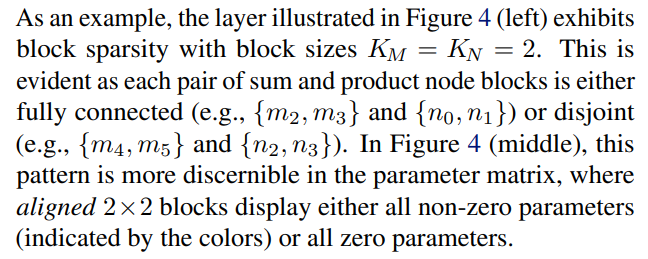
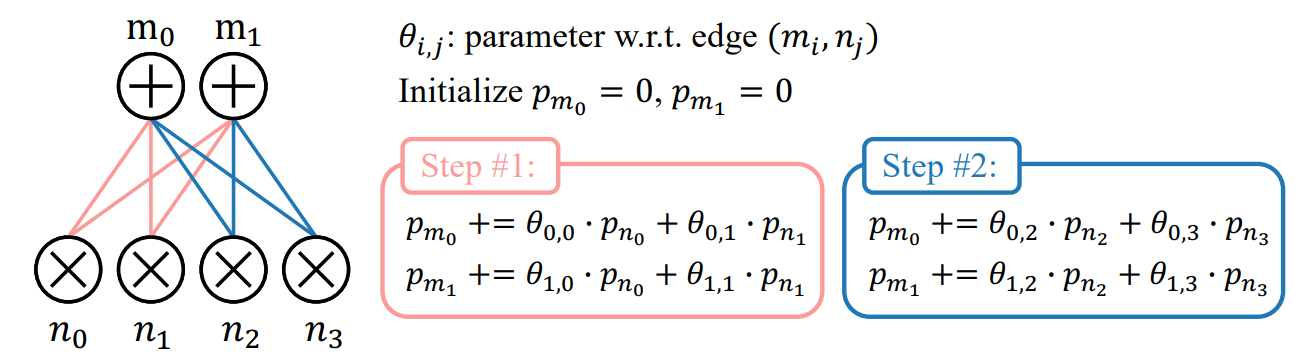
\ Figure 3. Illustration of block-based parallelization. A processor computes the output of 2 sum nodes, by iterating through blocks of 2 input product nodes and accumulating partial results.
\ Section 3, with a single sample, we have M processors each computing the output of a sum node. Since the layer is fully connected, every processor loads all N input log-probabilities, which results in M reloads of every input.

\
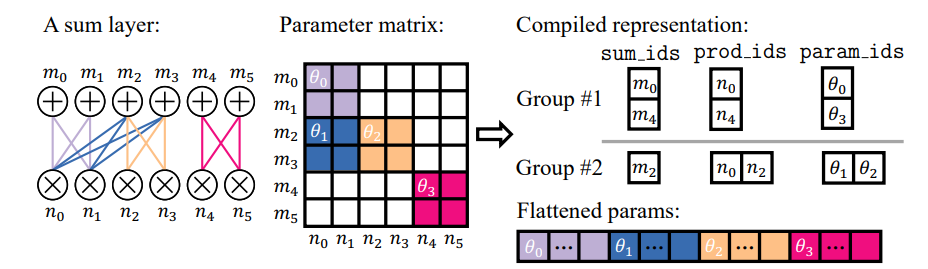
4.2. Generalizing To Practical Sum Layers

\
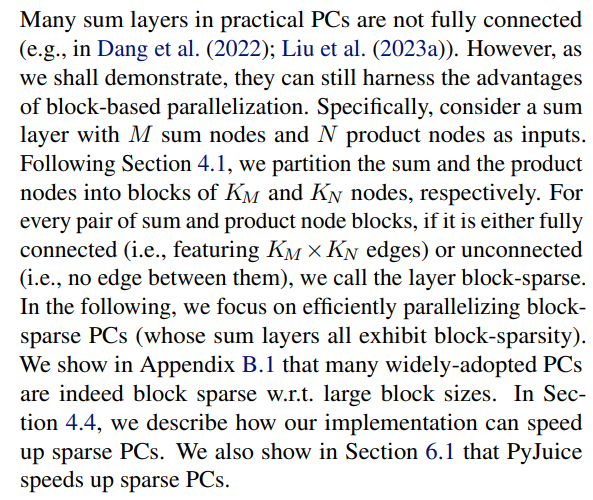
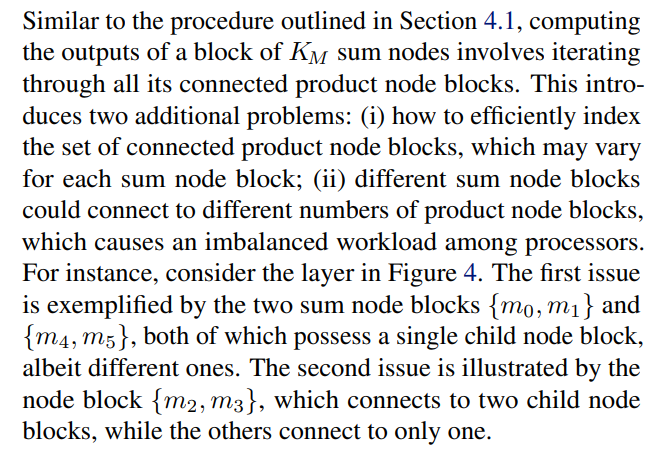
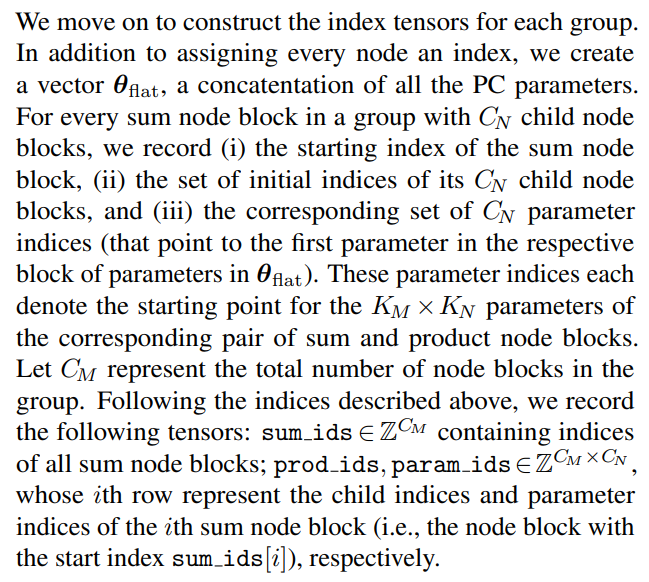
\ \ \ Figure 4. A sum layer (left) with a block-sparse parameter matrix (middle) is compiled into two kernels (right) each with a balanced workload. During execution, each kernel uses the compiled sum/prod/param indices to compute the outputs of m0, . . . , m5.
\ \ \

\ \ \

4.3. Efficient Implementations by Compiling PC Layers

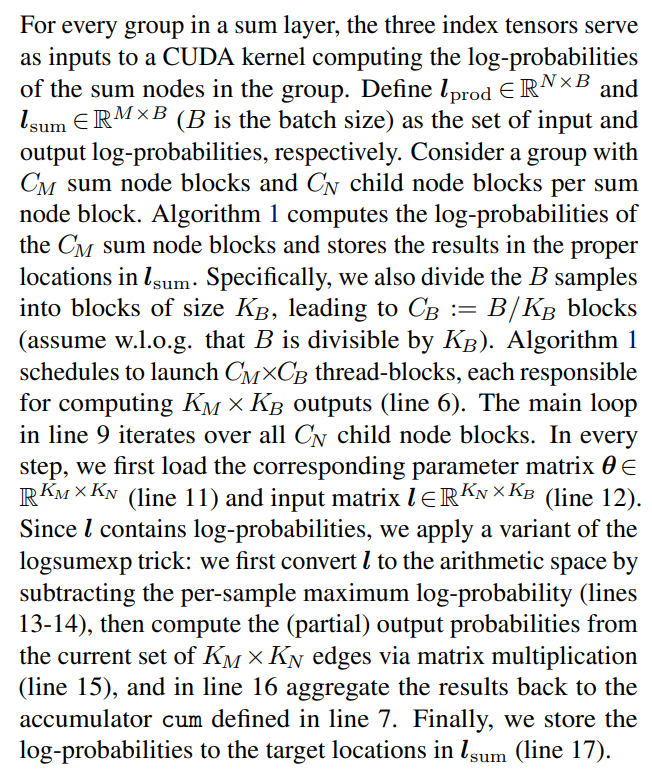
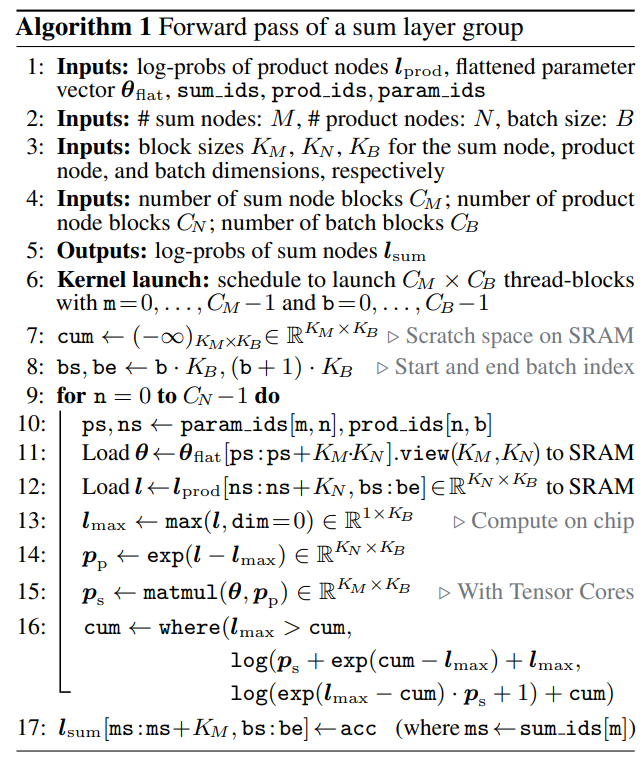
We address both problems through a compilation process, where we assign every node an index, and precompute index tensors that enable efficient block-based parallelization. The first step is to partition the sum node blocks into groups, such that every node block within a group has a similar number of connected child node blocks. We then pad the children with pseudo-product node blocks with probability 0 such that all sum node blocks in a group have the same number of children. The partition is generated by a dynamic programming algorithm that aims to divide the layer into the smallest possible number of groups while ensuring that the fraction of added pseudo-node blocks does not exceed a predefined threshold. Due to space constraints, we elaborate the node block partitioning algorithm in Appendix A.1. We also discuss its optimality and time/memory efficiency.

\ \
\ \ \
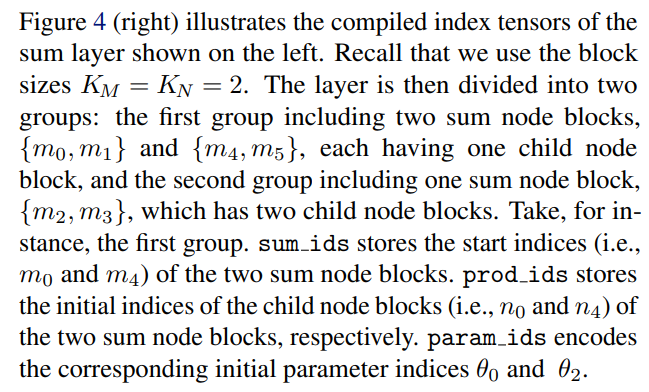
\ \ Partitioning a layer into groups with the same number of children allows us to use different kernel launching hyperparameters according to the specific setup of every node group (e.g., number of nodes) to achieve better performance.

\ \
\ \ \
\

4.4. Analysis: IO and Computation Overhead

\
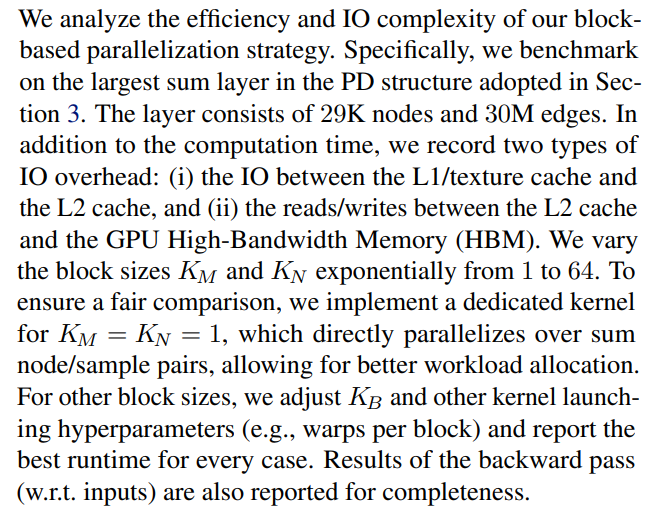
\ \ \ igure 5. Runtime and IO overhead of a sum layer from the PD structure (with 29K nodes and 30M edges). The results demonstrate significant performance gains from our block-based parallelization, even with small block sizes.
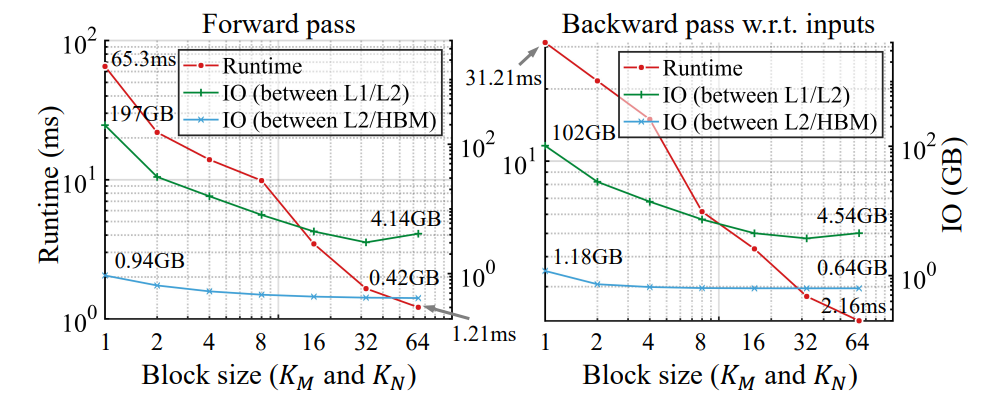
\ \ Results are shown in Figure 5. As the block size increases, both the forward and the backward pass become significantly faster. Notably, this is accompanied by a significant drop in IO overhead. Specifically, with a large block size, the kernel consumes 2x fewer reads/writes between the L2 cache and the HBM, and 25-50x fewer IO between the L1 and L2 cache. This corroborates the hypothesis stated in Section 3 that the extensive value reloads significantly slow down the computation.

\ \
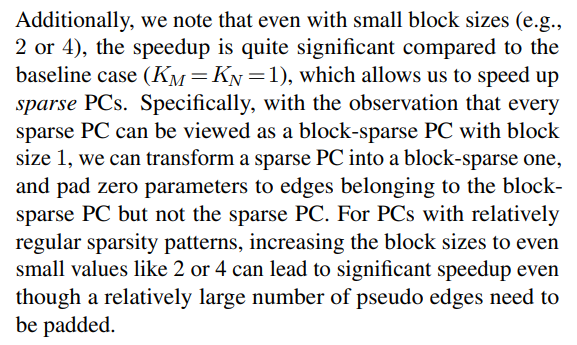
\ \ the speedup obtained by having a larger block size outpaces the overhead caused by padded edges with zero parameters, which leads to speed-ups.

\ \

:::info Authors:

(1) Anji Liu, Department of Computer Science, University of California, Los Angeles, USA (liuanji@cs.ucla.edu);

(2) Kareem Ahmed, Department of Computer Science, University of California, Los Angeles, USA;

(3) Guy Van den Broeck, Department of Computer Science, University of California, Los Angeles, USA;

:::


:::info This paper is available on arxiv under CC BY 4.0 DEED license.

:::
Market Opportunity
KernelDAO Logo
KernelDAO Price(KERNEL)
$0.05063
$0.05063$0.05063
-7.01%
USD
KernelDAO (KERNEL) Live Price Chart
Disclaimer: The articles reposted on this site are sourced from public platforms and are provided for informational purposes only. They do not necessarily reflect the views of MEXC. All rights remain with the original authors. If you believe any content infringes on third-party rights, please contact service@support.mexc.com for removal. MEXC makes no guarantees regarding the accuracy, completeness, or timeliness of the content and is not responsible for any actions taken based on the information provided. The content does not constitute financial, legal, or other professional advice, nor should it be considered a recommendation or endorsement by MEXC.

You May Also Like

Woman shot 5 times by DHS to stare down Trump at State of the Union address

Woman shot 5 times by DHS to stare down Trump at State of the Union address

A House Democrat has invited Marimar Martinez to attend President Donald Trump's State of the Union address in Washington, D.C., after she was shot by Customs and
Share
Rawstory2026/02/06 03:36
CEO Sandeep Nailwal Shared Highlights About RWA on Polygon

CEO Sandeep Nailwal Shared Highlights About RWA on Polygon

The post CEO Sandeep Nailwal Shared Highlights About RWA on Polygon appeared on BitcoinEthereumNews.com. Polygon CEO Sandeep Nailwal highlighted Polygon’s lead in global bonds, Spiko US T-Bill, and Spiko Euro T-Bill. Polygon published an X post to share that its roadmap to GigaGas was still scaling. Sentiments around POL price were last seen to be bearish. Polygon CEO Sandeep Nailwal shared key pointers from the Dune and RWA.xyz report. These pertain to highlights about RWA on Polygon. Simultaneously, Polygon underlined its roadmap towards GigaGas. Sentiments around POL price were last seen fumbling under bearish emotions. Polygon CEO Sandeep Nailwal on Polygon RWA CEO Sandeep Nailwal highlighted three key points from the Dune and RWA.xyz report. The Chief Executive of Polygon maintained that Polygon PoS was hosting RWA TVL worth $1.13 billion across 269 assets plus 2,900 holders. Nailwal confirmed from the report that RWA was happening on Polygon. The Dune and https://t.co/W6WSFlHoQF report on RWA is out and it shows that RWA is happening on Polygon. Here are a few highlights: – Leading in Global Bonds: Polygon holds 62% share of tokenized global bonds (driven by Spiko’s euro MMF and Cashlink euro issues) – Spiko U.S.… — Sandeep | CEO, Polygon Foundation (※,※) (@sandeepnailwal) September 17, 2025 The X post published by Polygon CEO Sandeep Nailwal underlined that the ecosystem was leading in global bonds by holding a 62% share of tokenized global bonds. He further highlighted that Polygon was leading with Spiko US T-Bill at approximately 29% share of TVL along with Ethereum, adding that the ecosystem had more than 50% share in the number of holders. Finally, Sandeep highlighted from the report that there was a strong adoption for Spiko Euro T-Bill with 38% share of TVL. He added that 68% of returns were on Polygon across all the chains. Polygon Roadmap to GigaGas In a different update from Polygon, the community…
Share
BitcoinEthereumNews2025/09/18 01:10
WLFI Drops 20% Weekly as Price Tests the Crucial $0.113 Support

WLFI Drops 20% Weekly as Price Tests the Crucial $0.113 Support

On Thursday, February 5, World Liberty Financial (WLFI) is continuing its decline and is trading at $0.1281, decreased by 5.89% in the past day. The token has lost
Share
Tronweekly2026/02/06 03:00