A viral post from analyst Alex Mason on X is making the rounds in the metals world, and it’s easy to see why. His claim is simple but explosive: the paper silverA viral post from analyst Alex Mason on X is making the rounds in the metals world, and it’s easy to see why. His claim is simple but explosive: the paper silver

Silver Price Time Bomb: Bank Shorts Are Now Bigger Than Global Supply

2026/02/12 16:00
4 min read

A viral post from analyst Alex Mason on X is making the rounds in the metals world, and it’s easy to see why. His claim is simple but explosive: the paper silver market has grown so large that bank short exposure now dwarfs the amount of physical silver the world can actually produce.

The chart he shared frames the situation as a potential “margin call threshold” event, where silver’s price approaching the $90–$100 zone could create stress across institutional short positions. Whether someone agrees with his conclusion or not, the setup highlights how unstable silver trading can become when leverage dominates the market.

The Core Claim: Paper Silver vs. Physical Reality

Mason points to a staggering imbalance: global silver production is roughly 800 million ounces per year, while bank short exposure is presented as 4.4 billion ounces. That’s multiple years of mining supply tied up in synthetic claims, which immediately raises questions about how “real” the pricing mechanism actually is.

This is the heart of the argument metals bulls always come back to. The silver price is being traded as a massive financial derivative product, where exposure can multiply far beyond what exists in vaults.

One of the most dramatic parts of Mason’s thread is the big drop from the low $90s into the mid-$60s in a very short window. He interprets that volatility not as normal price discovery, but as a forced reset designed to prevent silver from breaking into a zone where short positions become dangerous.

To be clear, silver is historically one of the most volatile major commodities, and sudden moves are not unusual. But Mason’s point is that these moves often happen exactly where liquidity is thinnest, which fuels suspicions about how heavily managed the paper market really is.

One interesting new development alongside all of this is that silver is no longer only a traditional futures trade. On Hyperliquid, silver can now be traded fully on-chain, meaning no-KYC access, instant execution, and the ability to trade even during weekends, unlike traditional TradFi metals platforms that shut down outside market hours. For traders who want flexibility this is a major change and with our link and code CAPTAIN4, trading fees also come with a discount.

The “Margin Call Threshold” Narrative

In the image, the $90+ region is marked as a critical stress zone, implying that a sustained push higher could trigger cascading margin calls for large institutional shorts. If enough leveraged players are positioned the wrong way, silver doesn’t need a slow grind upward. It can gap violently once pressure builds.
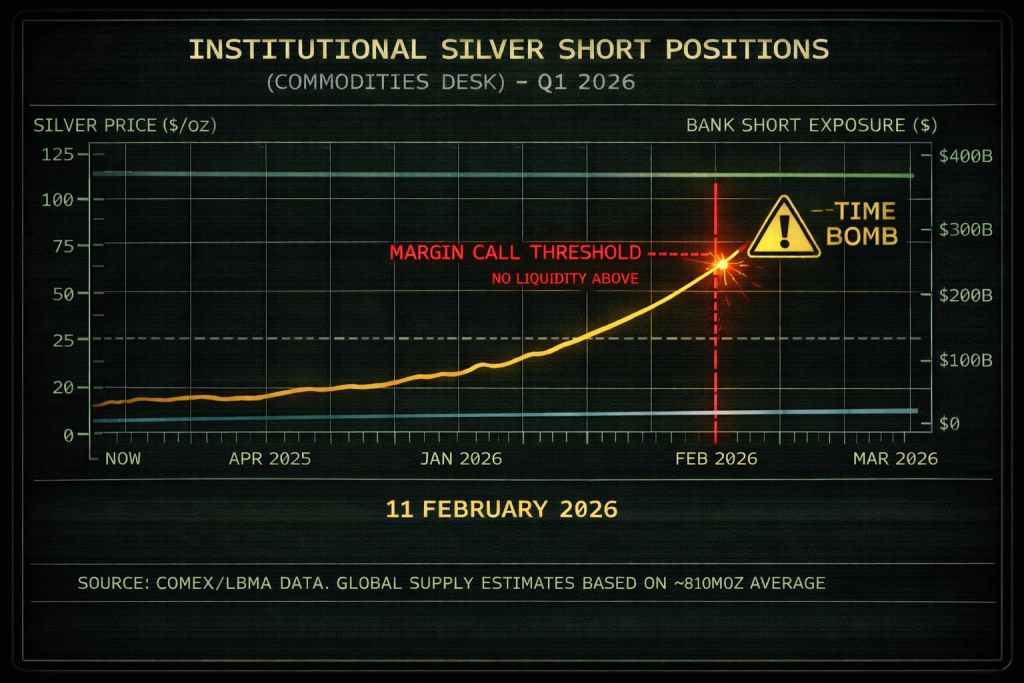
Source: X/@AlexMasonCrypto

That’s why silver rallies often feel discontinuous. The market can spend months doing nothing, then explode in weeks because positioning, not fundamentals, becomes the catalyst.

Mason also leans into the idea that physical silver demand is diverging from futures pricing. He mentions rising lease rates, delivery delays, and a scramble for immediate supply, suggesting that buyers increasingly want metal now, not contracts later.

This is a real theme worth watching, even without the apocalyptic framing. When physical tightness shows up, silver tends to react sharply because inventories are smaller and industrial demand is less flexible than people assume.

Read also: The Silver Price Chart Isn’t Lying – The $200 Math Is Starting to Show

My Take on the Silver Price “Time Bomb”

The broader message is directionally valid: silver is heavily financialized, and paper exposure absolutely amplifies volatility. Silver is not a clean supply-and-demand market like many retail investors imagine, and leverage plays a huge role in both rallies and crashes.

However, the most extreme conclusions (“banks will collapse” or “force majeure is next”) should be taken cautiously. The derivatives market is complex, and many short positions are hedges rather than naked bets, so the headline numbers alone don’t guarantee an imminent blow-up.

Still, Mason’s post captures something important: silver is sitting at the intersection of industrial necessity, monetary speculation, and extreme paper leverage. That combination is exactly why the next major silver move, whenever it comes, will probably not be quiet.

Read also: The Silver Price Doesn’t Look Real – And This Video Explains Why

Subscribe to our YouTube channel for daily crypto updates, market insights, and expert analysis.

The post Silver Price Time Bomb: Bank Shorts Are Now Bigger Than Global Supply appeared first on CaptainAltcoin.

Market Opportunity
Lorenzo Protocol Logo
Lorenzo Protocol Price(BANK)
$0,03161
$0,03161$0,03161
+4,49%
USD
Lorenzo Protocol (BANK) Live Price Chart
Disclaimer: The articles reposted on this site are sourced from public platforms and are provided for informational purposes only. They do not necessarily reflect the views of MEXC. All rights remain with the original authors. If you believe any content infringes on third-party rights, please contact service@support.mexc.com for removal. MEXC makes no guarantees regarding the accuracy, completeness, or timeliness of the content and is not responsible for any actions taken based on the information provided. The content does not constitute financial, legal, or other professional advice, nor should it be considered a recommendation or endorsement by MEXC.

You May Also Like

What Is an Uncontested Divorce and How Does It Work?

What Is an Uncontested Divorce and How Does It Work?

Divorce continues to be a common legal matter for families across Washington, reflecting broader shifts in how relationships change over time. Recent statewide
Share
Techbullion2026/02/12 18:08
Google's AP2 protocol has been released. Does encrypted AI still have a chance?

Google's AP2 protocol has been released. Does encrypted AI still have a chance?

Following the MCP and A2A protocols, the AI Agent market has seen another blockbuster arrival: the Agent Payments Protocol (AP2), developed by Google. This will clearly further enhance AI Agents' autonomous multi-tasking capabilities, but the unfortunate reality is that it has little to do with web3AI. Let's take a closer look: What problem does AP2 solve? Simply put, the MCP protocol is like a universal hook, enabling AI agents to connect to various external tools and data sources; A2A is a team collaboration communication protocol that allows multiple AI agents to cooperate with each other to complete complex tasks; AP2 completes the last piece of the puzzle - payment capability. In other words, MCP opens up connectivity, A2A promotes collaboration efficiency, and AP2 achieves value exchange. The arrival of AP2 truly injects "soul" into the autonomous collaboration and task execution of Multi-Agents. Imagine AI Agents connecting Qunar, Meituan, and Didi to complete the booking of flights, hotels, and car rentals, but then getting stuck at the point of "self-payment." What's the point of all that multitasking? So, remember this: AP2 is an extension of MCP+A2A, solving the last mile problem of AI Agent automated execution. What are the technical highlights of AP2? The core innovation of AP2 is the Mandates mechanism, which is divided into real-time authorization mode and delegated authorization mode. Real-time authorization is easy to understand. The AI Agent finds the product and shows it to you. The operation can only be performed after the user signs. Delegated authorization requires the user to set rules in advance, such as only buying the iPhone 17 when the price drops to 5,000. The AI Agent monitors the trigger conditions and executes automatically. The implementation logic is cryptographically signed using Verifiable Credentials (VCs). Users can set complex commission conditions, including price ranges, time limits, and payment method priorities, forming a tamper-proof digital contract. Once signed, the AI Agent executes according to the conditions, with VCs ensuring auditability and security at every step. Of particular note is the "A2A x402" extension, a technical component developed by Google specifically for crypto payments, developed in collaboration with Coinbase and the Ethereum Foundation. This extension enables AI Agents to seamlessly process stablecoins, ETH, and other blockchain assets, supporting native payment scenarios within the Web3 ecosystem. What kind of imagination space can AP2 bring? After analyzing the technical principles, do you think that's it? Yes, in fact, the AP2 is boring when it is disassembled alone. Its real charm lies in connecting and opening up the "MCP+A2A+AP2" technology stack, completely opening up the complete link of AI Agent's autonomous analysis+execution+payment. From now on, AI Agents can open up many application scenarios. For example, AI Agents for stock investment and financial management can help us monitor the market 24/7 and conduct independent transactions. Enterprise procurement AI Agents can automatically replenish and renew without human intervention. AP2's complementary payment capabilities will further expand the penetration of the Agent-to-Agent economy into more scenarios. Google obviously understands that after the technical framework is established, the ecological implementation must be relied upon, so it has brought in more than 60 partners to develop it, almost covering the entire payment and business ecosystem. Interestingly, it also involves major Crypto players such as Ethereum, Coinbase, MetaMask, and Sui. Combined with the current trend of currency and stock integration, the imagination space has been doubled. Is web3 AI really dead? Not entirely. Google's AP2 looks complete, but it only achieves technical compatibility with Crypto payments. It can only be regarded as an extension of the traditional authorization framework and belongs to the category of automated execution. There is a "paradigm" difference between it and the autonomous asset management pursued by pure Crypto native solutions. The Crypto-native solutions under exploration are taking the "decentralized custody + on-chain verification" route, including AI Agent autonomous asset management, AI Agent autonomous transactions (DeFAI), AI Agent digital identity and on-chain reputation system (ERC-8004...), AI Agent on-chain governance DAO framework, AI Agent NPC and digital avatars, and many other interesting and fun directions. Ultimately, once users get used to AI Agent payments in traditional fields, their acceptance of AI Agents autonomously owning digital assets will also increase. And for those scenarios that AP2 cannot reach, such as anonymous transactions, censorship-resistant payments, and decentralized asset management, there will always be a time for crypto-native solutions to show their strength? The two are more likely to be complementary rather than competitive, but to be honest, the key technological advancements behind AI Agents currently all come from web2AI, and web3AI still needs to keep up the good work!
Share
PANews2025/09/18 07:00
The FRS 102 Deadline Is Accelerating Finance Modernisation Across the UK

The FRS 102 Deadline Is Accelerating Finance Modernisation Across the UK

By Artie Minson, CEO of Trullion Every major change in accounting standards presents finance leaders […] The post The FRS 102 Deadline Is Accelerating Finance Modernisation
Share
ffnews2026/02/12 18:43