Bitcoin is navigating a critical juncture after reaching a new all-time high of $124,500 last week before quickly retreating. The price is now searching for support, with volatility intensifying and traders debating whether this is the start of a deeper correction or simply a healthy consolidation phase before continuation. Some analysts remain optimistic, seeing this pullback as a natural reset in an overheated market, while others argue that momentum is fading as bearish signals emerge. Related Reading: Ethereum Treasury Boom Drives Demand: Can The Market Handle The Risks? Adding weight to the discussion, CryptoQuant analyst Axel Adler highlighted a key trend in retail participation. The share of retail transfers in the $0–$10K range within Bitcoin’s total USD turnover has been steadily declining throughout this cycle. From a peak of 2.7%, the share has now dropped to just 0.6%. Historically, such declines in retail participation have coincided with the later stages of bull cycles. This dynamic raises questions about whether the current phase marks a cooling of retail enthusiasm at a critical time for Bitcoin, as institutional and long-term holders dominate market structure. Bitcoin Retail Activity Declines as Market Cools According to CryptoQuant analyst Axel Adler, while the share of retail activity in Bitcoin’s network has dropped sharply, in absolute terms it still remains significant. Retail transfers in the $0–$10K range amount to over $400 million per day, but this represents only 0.6% of total USD turnover across the network. This shrinking share highlights a clear trend: while small investors are still active, their relative impact on overall market flows is diminishing. Adler notes that this cooling of retail demand was also observed in autumn 2021, at the peak of the previous cycle. At that time, the retail share fell to a historic low of just 0.19%, coinciding with overheated market conditions and marking the final stages of that bull cycle. The current decline in retail participation mirrors that pattern, suggesting that the market could be approaching a similar late-cycle environment. This dynamic is important because retail investors have traditionally been a strong driver of momentum during bull markets. With their reduced influence, institutional flows, long-term holders, and treasury strategies now play an even greater role in shaping market direction. The coming weeks will be critical as altcoins, led by Ethereum, show renewed strength. ETH is approaching its 2021 all-time high, and many analysts believe that its performance could dictate the broader crypto market’s next move. If retail demand continues to fade while institutional accumulation grows, Bitcoin may consolidate further, while capital rotation toward altcoins gains momentum. Related Reading: Ethereum Demand Holds Despite Pullback: New Whales Enter With $192M Buys Bulls Defend Key Demand Level The 8-hour chart shows Bitcoin (BTC) under pressure as it trades near $113,400, struggling to hold above its 200-day moving average (red line), currently aligned around $113,416. This level has become a critical support zone after BTC failed to sustain momentum above the $123,217 resistance, which has acted as a clear rejection point multiple times this cycle. Shorter-term moving averages highlight the bearish momentum. The 50-day SMA (blue) at $117,017 and the 100-day SMA (green) at $117,087 are both trending above the current price, creating overhead resistance. The breakdown below these averages confirms a weakening trend, with BTC struggling to regain lost ground. Price action also shows a sequence of lower highs and lower lows since the rejection at the $124K zone, reinforcing bearish short-term sentiment. Related Reading: Bitcoin Short-Term Holders Flip To Losses For First Time Since January For bulls, reclaiming the 100-day SMA near $117K would be key to reversing momentum and reattempting a push toward the $120K–$123K range. Failure to hold the 200-day SMA risks accelerating downside, potentially opening the path toward $110K, a major psychological level. Featured image from Dall-E, chart from TradingViewBitcoin is navigating a critical juncture after reaching a new all-time high of $124,500 last week before quickly retreating. The price is now searching for support, with volatility intensifying and traders debating whether this is the start of a deeper correction or simply a healthy consolidation phase before continuation. Some analysts remain optimistic, seeing this pullback as a natural reset in an overheated market, while others argue that momentum is fading as bearish signals emerge. Related Reading: Ethereum Treasury Boom Drives Demand: Can The Market Handle The Risks? Adding weight to the discussion, CryptoQuant analyst Axel Adler highlighted a key trend in retail participation. The share of retail transfers in the $0–$10K range within Bitcoin’s total USD turnover has been steadily declining throughout this cycle. From a peak of 2.7%, the share has now dropped to just 0.6%. Historically, such declines in retail participation have coincided with the later stages of bull cycles. This dynamic raises questions about whether the current phase marks a cooling of retail enthusiasm at a critical time for Bitcoin, as institutional and long-term holders dominate market structure. Bitcoin Retail Activity Declines as Market Cools According to CryptoQuant analyst Axel Adler, while the share of retail activity in Bitcoin’s network has dropped sharply, in absolute terms it still remains significant. Retail transfers in the $0–$10K range amount to over $400 million per day, but this represents only 0.6% of total USD turnover across the network. This shrinking share highlights a clear trend: while small investors are still active, their relative impact on overall market flows is diminishing. Adler notes that this cooling of retail demand was also observed in autumn 2021, at the peak of the previous cycle. At that time, the retail share fell to a historic low of just 0.19%, coinciding with overheated market conditions and marking the final stages of that bull cycle. The current decline in retail participation mirrors that pattern, suggesting that the market could be approaching a similar late-cycle environment. This dynamic is important because retail investors have traditionally been a strong driver of momentum during bull markets. With their reduced influence, institutional flows, long-term holders, and treasury strategies now play an even greater role in shaping market direction. The coming weeks will be critical as altcoins, led by Ethereum, show renewed strength. ETH is approaching its 2021 all-time high, and many analysts believe that its performance could dictate the broader crypto market’s next move. If retail demand continues to fade while institutional accumulation grows, Bitcoin may consolidate further, while capital rotation toward altcoins gains momentum. Related Reading: Ethereum Demand Holds Despite Pullback: New Whales Enter With $192M Buys Bulls Defend Key Demand Level The 8-hour chart shows Bitcoin (BTC) under pressure as it trades near $113,400, struggling to hold above its 200-day moving average (red line), currently aligned around $113,416. This level has become a critical support zone after BTC failed to sustain momentum above the $123,217 resistance, which has acted as a clear rejection point multiple times this cycle. Shorter-term moving averages highlight the bearish momentum. The 50-day SMA (blue) at $117,017 and the 100-day SMA (green) at $117,087 are both trending above the current price, creating overhead resistance. The breakdown below these averages confirms a weakening trend, with BTC struggling to regain lost ground. Price action also shows a sequence of lower highs and lower lows since the rejection at the $124K zone, reinforcing bearish short-term sentiment. Related Reading: Bitcoin Short-Term Holders Flip To Losses For First Time Since January For bulls, reclaiming the 100-day SMA near $117K would be key to reversing momentum and reattempting a push toward the $120K–$123K range. Failure to hold the 200-day SMA risks accelerating downside, potentially opening the path toward $110K, a major psychological level. Featured image from Dall-E, chart from TradingView

Bitcoin Retail Transfers Collapse: Lowest Since Bull Market Peak In 2021

2025/08/22 04:00
3 min read

Bitcoin is navigating a critical juncture after reaching a new all-time high of $124,500 last week before quickly retreating. The price is now searching for support, with volatility intensifying and traders debating whether this is the start of a deeper correction or simply a healthy consolidation phase before continuation. Some analysts remain optimistic, seeing this pullback as a natural reset in an overheated market, while others argue that momentum is fading as bearish signals emerge.

Adding weight to the discussion, CryptoQuant analyst Axel Adler highlighted a key trend in retail participation. The share of retail transfers in the $0–$10K range within Bitcoin’s total USD turnover has been steadily declining throughout this cycle. From a peak of 2.7%, the share has now dropped to just 0.6%.

Historically, such declines in retail participation have coincided with the later stages of bull cycles. This dynamic raises questions about whether the current phase marks a cooling of retail enthusiasm at a critical time for Bitcoin, as institutional and long-term holders dominate market structure.

Bitcoin Retail Activity Declines as Market Cools

According to CryptoQuant analyst Axel Adler, while the share of retail activity in Bitcoin’s network has dropped sharply, in absolute terms it still remains significant. Retail transfers in the $0–$10K range amount to over $400 million per day, but this represents only 0.6% of total USD turnover across the network. This shrinking share highlights a clear trend: while small investors are still active, their relative impact on overall market flows is diminishing.
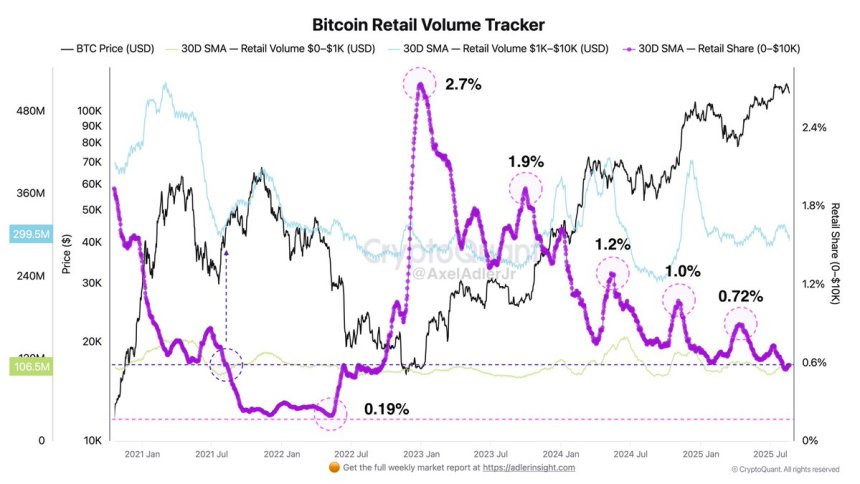
Bitcoin Retail Volume Tracker | Source: Axel Adler

Adler notes that this cooling of retail demand was also observed in autumn 2021, at the peak of the previous cycle. At that time, the retail share fell to a historic low of just 0.19%, coinciding with overheated market conditions and marking the final stages of that bull cycle. The current decline in retail participation mirrors that pattern, suggesting that the market could be approaching a similar late-cycle environment.

This dynamic is important because retail investors have traditionally been a strong driver of momentum during bull markets. With their reduced influence, institutional flows, long-term holders, and treasury strategies now play an even greater role in shaping market direction. The coming weeks will be critical as altcoins, led by Ethereum, show renewed strength. ETH is approaching its 2021 all-time high, and many analysts believe that its performance could dictate the broader crypto market’s next move.

If retail demand continues to fade while institutional accumulation grows, Bitcoin may consolidate further, while capital rotation toward altcoins gains momentum.

Bulls Defend Key Demand Level

The 8-hour chart shows Bitcoin (BTC) under pressure as it trades near $113,400, struggling to hold above its 200-day moving average (red line), currently aligned around $113,416. This level has become a critical support zone after BTC failed to sustain momentum above the $123,217 resistance, which has acted as a clear rejection point multiple times this cycle.
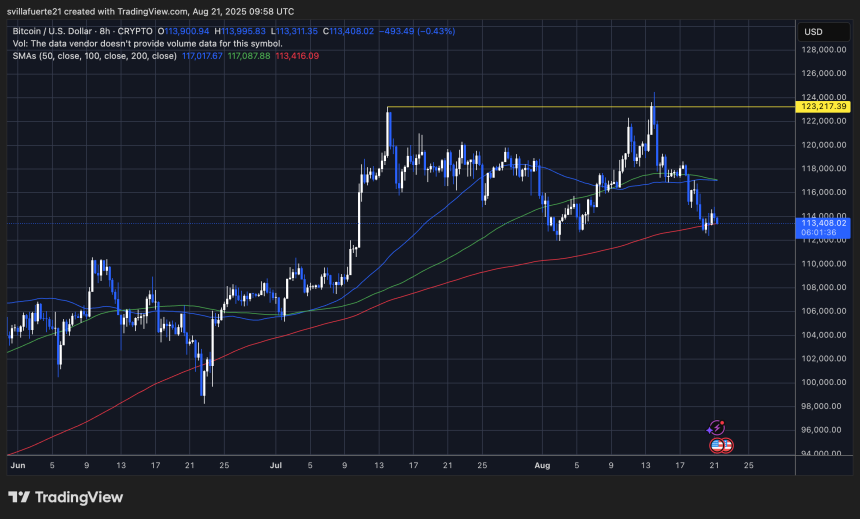
BTC testing pivotal level | Source: BTCUSDT chart on TradingView

Shorter-term moving averages highlight the bearish momentum. The 50-day SMA (blue) at $117,017 and the 100-day SMA (green) at $117,087 are both trending above the current price, creating overhead resistance. The breakdown below these averages confirms a weakening trend, with BTC struggling to regain lost ground. Price action also shows a sequence of lower highs and lower lows since the rejection at the $124K zone, reinforcing bearish short-term sentiment.

For bulls, reclaiming the 100-day SMA near $117K would be key to reversing momentum and reattempting a push toward the $120K–$123K range. Failure to hold the 200-day SMA risks accelerating downside, potentially opening the path toward $110K, a major psychological level.

Featured image from Dall-E, chart from TradingView

Market Opportunity
NEAR Logo
NEAR Price(NEAR)
$0.981
$0.981$0.981
-7.54%
USD
NEAR (NEAR) Live Price Chart
Disclaimer: The articles reposted on this site are sourced from public platforms and are provided for informational purposes only. They do not necessarily reflect the views of MEXC. All rights remain with the original authors. If you believe any content infringes on third-party rights, please contact service@support.mexc.com for removal. MEXC makes no guarantees regarding the accuracy, completeness, or timeliness of the content and is not responsible for any actions taken based on the information provided. The content does not constitute financial, legal, or other professional advice, nor should it be considered a recommendation or endorsement by MEXC.
Tags:

You May Also Like

Cashing In On University Patents Means Giving Up On Our Innovation Future

Cashing In On University Patents Means Giving Up On Our Innovation Future

The post Cashing In On University Patents Means Giving Up On Our Innovation Future appeared on BitcoinEthereumNews.com. “It’s a raid on American innovation that would deliver pennies to the Treasury while kneecapping the very engine of our economic and medical progress,” writes Pipes. Getty Images Washington is addicted to taxing success. Now, Commerce Secretary Howard Lutnick is floating a plan to skim half the patent earnings from inventions developed at universities with federal funding. It’s being sold as a way to shore up programs like Social Security. In reality, it’s a raid on American innovation that would deliver pennies to the Treasury while kneecapping the very engine of our economic and medical progress. Yes, taxpayer dollars support early-stage research. But the real payoff comes later—in the jobs created, cures discovered, and industries launched when universities and private industry turn those discoveries into real products. By comparison, the sums at stake in patent licensing are trivial. Universities collectively earn only about $3.6 billion annually in patent income—less than the federal government spends on Social Security in a single day. Even confiscating half would barely register against a $6 trillion federal budget. And yet the damage from such a policy would be anything but trivial. The true return on taxpayer investment isn’t in licensing checks sent to Washington, but in the downstream economic activity that federally supported research unleashes. Thanks to the bipartisan Bayh-Dole Act of 1980, universities and private industry have powerful incentives to translate early-stage discoveries into real-world products. Before Bayh-Dole, the government hoarded patents from federally funded research, and fewer than 5% were ever licensed. Once universities could own and license their own inventions, innovation exploded. The result has been one of the best returns on investment in government history. Since 1996, university research has added nearly $2 trillion to U.S. industrial output, supported 6.5 million jobs, and launched more than 19,000 startups. Those companies pay…
Share
BitcoinEthereumNews2025/09/18 03:26
XRP Ledger Unlocks Permissioned Domains With 91% Validator Backing

XRP Ledger Unlocks Permissioned Domains With 91% Validator Backing

XRP Ledger activated XLS-80 after 91% validator approval, enabling permissioned domains for credential-gated use on the public XRPL. The XRP Ledger has activated
Share
LiveBitcoinNews2026/02/06 13:00
TrendX Taps Trusta AI to Develop Safer and Smarter Web3 Network

TrendX Taps Trusta AI to Develop Safer and Smarter Web3 Network

The purpose of collaboration is to advance the Web3 landscape by combining the decentralized infrastructure of TrendX with AI-led capabilities of Trusta AI.
Share
Blockchainreporter2025/09/18 01:07