The growing practice of companies holding bitcoin and other cryptocurrencies in their treasuries may heighten credit risks, according to analysts at Morningstar DBRS.Over the past decade, cryptocurrencies such as bitcoin and ethereum have moved steadily into the mainstream, with both small and large companies adopting them for payments and investments. According to Morningstar DBRS analysts many companies are now using cryptocurrencies for treasury functions, effectively positioning bitcoin and other tokens as corporate reserve assets. These “cryptocurrency treasury companies” represent a growing niche within corporate finance, but one that carries heightened risks for credit profiles.Concentration and Market ExposureMorningstar analysts note that corporate bitcoin holdings remain concentrated among a handful of firms, with Strategy Inc. alone holding over 629,000 bitcoins — roughly 64 percent of all public company bitcoin treasury holdings. Michael Saylor’s Strategy has been adding to its reserves at a rapid pace, snapping up bitcoin almost weekly in recent months as part of an aggressive accumulation strategy. Strategy has acquired 430 BTC for ~$51.4 million at ~$119,666 per bitcoin and has achieved BTC Yield of 25.1% YTD 2025. As of 8/17/2025, we hodl 629,376 $BTC acquired for ~$46.15 billion at ~$73,320 per bitcoin. $MSTR $STRC $STRK $STRF $STRDhttps://t.co/8zSHvPTFJO— Strategy (@Strategy) August 18, 2025 The top 20 public companies collectively control an estimated 94 percent of corporate bitcoin reserves, underscoring how concentrated this exposure remains. In total, approximately 3.68 million bitcoins, valued at around $428 billion as of August 2025, are held across corporations, ETFs, governments, and custodians. This represents nearly 18 percent of the current circulating supply, says Morningstar. While the growth in adoption shows confidence among corporates and investors, reliance on such a volatile asset for treasury management introduces substantial challenges. Morningstar analysts caution that concentration risk coupled with the high market volatility of cryptocurrencies could complicate liquidity planning and affect corporate balance sheets during periods of stress.Risks Facing Corporate TreasuriesMorningstar DBRS analysts identify a range of risks for companies adopting a cryptocurrency treasury strategy. Regulatory uncertainty remains one of the most pressing challenges, with no uniform global framework governing cryptocurrencies. Although countries such as the U.S. and those in the eurozone have introduced clearer rules, these remain in flux, leaving corporates exposed to shifting compliance obligations.Liquidity also presents a concern. While digital asset markets have grown considerably, they can still thin out during times of volatility. In such moments, transactions may be delayed, and spreads can widen, undermining the reliability of cryptocurrency reserves as a financial backstop. Counterparty and security risks further complicate the landscape, as many firms depend on centralized exchanges for both trading and custody. Recent disputes, such as the SEC’s lawsuit against Coinbase — which was eventually dropped in 2025 — highlight the evolving and unpredictable regulatory environment surrounding major platforms.Another factor is the materiality of digital asset holdings on corporate balance sheets. Treasury functions are designed to safeguard financial stability and ensure liquidity, but when bitcoin becomes a company’s primary reserve asset, its volatility can undermine these objectives. A June 2024 study found that bitcoin was nearly five times more volatile than the S&P 500 in the short run and four times more volatile in the long run, suggesting significant exposure to price swings, acceding to Morningstar. Custodial considerations add further complexity, with firms needing to weigh the risks of self-custody against the vulnerabilities of third-party custodians.Implications for Corporate Credit ProfilesThe central purpose of corporate treasury management is to maintain stability, support consistent operations, and enable growth. Analysts argue that the incorporation of highly volatile cryptocurrencies into treasury reserves fundamentally alters this role. The volatility of assets such as bitcoin, combined with regulatory and custodial uncertainties, introduces new risks that can directly impact a company’s creditworthiness.Morningstar DBRS analysts conclude that while cryptocurrency adoption by corporates will likely continue to grow, particularly as regulatory clarity improves and integration into payment systems expands, these strategies carry meaningful implications for credit risk. The long-term success of corporate crypto treasuries will depend on whether they can balance the promise of digital assets with the fundamental responsibility of safeguarding financial health. The growing practice of companies holding bitcoin and other cryptocurrencies in their treasuries may heighten credit risks, according to analysts at Morningstar DBRS.Over the past decade, cryptocurrencies such as bitcoin and ethereum have moved steadily into the mainstream, with both small and large companies adopting them for payments and investments. According to Morningstar DBRS analysts many companies are now using cryptocurrencies for treasury functions, effectively positioning bitcoin and other tokens as corporate reserve assets. These “cryptocurrency treasury companies” represent a growing niche within corporate finance, but one that carries heightened risks for credit profiles.Concentration and Market ExposureMorningstar analysts note that corporate bitcoin holdings remain concentrated among a handful of firms, with Strategy Inc. alone holding over 629,000 bitcoins — roughly 64 percent of all public company bitcoin treasury holdings. Michael Saylor’s Strategy has been adding to its reserves at a rapid pace, snapping up bitcoin almost weekly in recent months as part of an aggressive accumulation strategy. Strategy has acquired 430 BTC for ~$51.4 million at ~$119,666 per bitcoin and has achieved BTC Yield of 25.1% YTD 2025. As of 8/17/2025, we hodl 629,376 $BTC acquired for ~$46.15 billion at ~$73,320 per bitcoin. $MSTR $STRC $STRK $STRF $STRDhttps://t.co/8zSHvPTFJO— Strategy (@Strategy) August 18, 2025 The top 20 public companies collectively control an estimated 94 percent of corporate bitcoin reserves, underscoring how concentrated this exposure remains. In total, approximately 3.68 million bitcoins, valued at around $428 billion as of August 2025, are held across corporations, ETFs, governments, and custodians. This represents nearly 18 percent of the current circulating supply, says Morningstar. While the growth in adoption shows confidence among corporates and investors, reliance on such a volatile asset for treasury management introduces substantial challenges. Morningstar analysts caution that concentration risk coupled with the high market volatility of cryptocurrencies could complicate liquidity planning and affect corporate balance sheets during periods of stress.Risks Facing Corporate TreasuriesMorningstar DBRS analysts identify a range of risks for companies adopting a cryptocurrency treasury strategy. Regulatory uncertainty remains one of the most pressing challenges, with no uniform global framework governing cryptocurrencies. Although countries such as the U.S. and those in the eurozone have introduced clearer rules, these remain in flux, leaving corporates exposed to shifting compliance obligations.Liquidity also presents a concern. While digital asset markets have grown considerably, they can still thin out during times of volatility. In such moments, transactions may be delayed, and spreads can widen, undermining the reliability of cryptocurrency reserves as a financial backstop. Counterparty and security risks further complicate the landscape, as many firms depend on centralized exchanges for both trading and custody. Recent disputes, such as the SEC’s lawsuit against Coinbase — which was eventually dropped in 2025 — highlight the evolving and unpredictable regulatory environment surrounding major platforms.Another factor is the materiality of digital asset holdings on corporate balance sheets. Treasury functions are designed to safeguard financial stability and ensure liquidity, but when bitcoin becomes a company’s primary reserve asset, its volatility can undermine these objectives. A June 2024 study found that bitcoin was nearly five times more volatile than the S&P 500 in the short run and four times more volatile in the long run, suggesting significant exposure to price swings, acceding to Morningstar. Custodial considerations add further complexity, with firms needing to weigh the risks of self-custody against the vulnerabilities of third-party custodians.Implications for Corporate Credit ProfilesThe central purpose of corporate treasury management is to maintain stability, support consistent operations, and enable growth. Analysts argue that the incorporation of highly volatile cryptocurrencies into treasury reserves fundamentally alters this role. The volatility of assets such as bitcoin, combined with regulatory and custodial uncertainties, introduces new risks that can directly impact a company’s creditworthiness.Morningstar DBRS analysts conclude that while cryptocurrency adoption by corporates will likely continue to grow, particularly as regulatory clarity improves and integration into payment systems expands, these strategies carry meaningful implications for credit risk. The long-term success of corporate crypto treasuries will depend on whether they can balance the promise of digital assets with the fundamental responsibility of safeguarding financial health.

Corporate Crypto Treasuries: Bitcoin Reserves Could Heighten Credit Risk, Analysts Warn

4 min read

The growing practice of companies holding bitcoin and other cryptocurrencies in their treasuries may heighten credit risks, according to analysts at Morningstar DBRS.

Over the past decade, cryptocurrencies such as bitcoin and ethereum have moved steadily into the mainstream, with both small and large companies adopting them for payments and investments.

According to Morningstar DBRS analysts many companies are now using cryptocurrencies for treasury functions, effectively positioning bitcoin and other tokens as corporate reserve assets.

These “cryptocurrency treasury companies” represent a growing niche within corporate finance, but one that carries heightened risks for credit profiles.

Concentration and Market Exposure

Morningstar analysts note that corporate bitcoin holdings remain concentrated among a handful of firms, with Strategy Inc. alone holding over 629,000 bitcoins — roughly 64 percent of all public company bitcoin treasury holdings.
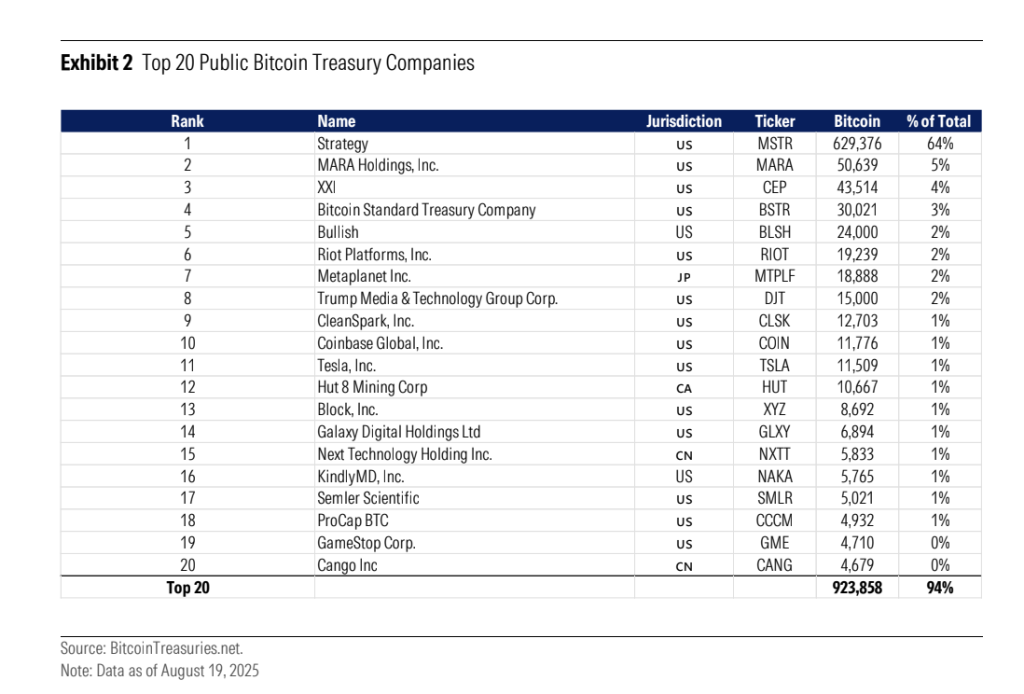
Michael Saylor’s Strategy has been adding to its reserves at a rapid pace, snapping up bitcoin almost weekly in recent months as part of an aggressive accumulation strategy.

The top 20 public companies collectively control an estimated 94 percent of corporate bitcoin reserves, underscoring how concentrated this exposure remains.

In total, approximately 3.68 million bitcoins, valued at around $428 billion as of August 2025, are held across corporations, ETFs, governments, and custodians. This represents nearly 18 percent of the current circulating supply, says Morningstar.

While the growth in adoption shows confidence among corporates and investors, reliance on such a volatile asset for treasury management introduces substantial challenges.

Morningstar analysts caution that concentration risk coupled with the high market volatility of cryptocurrencies could complicate liquidity planning and affect corporate balance sheets during periods of stress.

Risks Facing Corporate Treasuries

Morningstar DBRS analysts identify a range of risks for companies adopting a cryptocurrency treasury strategy. Regulatory uncertainty remains one of the most pressing challenges, with no uniform global framework governing cryptocurrencies.

Although countries such as the U.S. and those in the eurozone have introduced clearer rules, these remain in flux, leaving corporates exposed to shifting compliance obligations.

Liquidity also presents a concern. While digital asset markets have grown considerably, they can still thin out during times of volatility. In such moments, transactions may be delayed, and spreads can widen, undermining the reliability of cryptocurrency reserves as a financial backstop.

Counterparty and security risks further complicate the landscape, as many firms depend on centralized exchanges for both trading and custody. Recent disputes, such as the SEC’s lawsuit against Coinbase — which was eventually dropped in 2025 — highlight the evolving and unpredictable regulatory environment surrounding major platforms.

Another factor is the materiality of digital asset holdings on corporate balance sheets. Treasury functions are designed to safeguard financial stability and ensure liquidity, but when bitcoin becomes a company’s primary reserve asset, its volatility can undermine these objectives.

A June 2024 study found that bitcoin was nearly five times more volatile than the S&P 500 in the short run and four times more volatile in the long run, suggesting significant exposure to price swings, acceding to Morningstar.

Custodial considerations add further complexity, with firms needing to weigh the risks of self-custody against the vulnerabilities of third-party custodians.

Implications for Corporate Credit Profiles

The central purpose of corporate treasury management is to maintain stability, support consistent operations, and enable growth.

Analysts argue that the incorporation of highly volatile cryptocurrencies into treasury reserves fundamentally alters this role. The volatility of assets such as bitcoin, combined with regulatory and custodial uncertainties, introduces new risks that can directly impact a company’s creditworthiness.

Morningstar DBRS analysts conclude that while cryptocurrency adoption by corporates will likely continue to grow, particularly as regulatory clarity improves and integration into payment systems expands, these strategies carry meaningful implications for credit risk.

The long-term success of corporate crypto treasuries will depend on whether they can balance the promise of digital assets with the fundamental responsibility of safeguarding financial health.

Market Opportunity
Threshold Logo
Threshold Price(T)
$0.006531
$0.006531$0.006531
-6.76%
USD
Threshold (T) Live Price Chart
Disclaimer: The articles reposted on this site are sourced from public platforms and are provided for informational purposes only. They do not necessarily reflect the views of MEXC. All rights remain with the original authors. If you believe any content infringes on third-party rights, please contact service@support.mexc.com for removal. MEXC makes no guarantees regarding the accuracy, completeness, or timeliness of the content and is not responsible for any actions taken based on the information provided. The content does not constitute financial, legal, or other professional advice, nor should it be considered a recommendation or endorsement by MEXC.
Tags:

You May Also Like

Cashing In On University Patents Means Giving Up On Our Innovation Future

Cashing In On University Patents Means Giving Up On Our Innovation Future

The post Cashing In On University Patents Means Giving Up On Our Innovation Future appeared on BitcoinEthereumNews.com. “It’s a raid on American innovation that would deliver pennies to the Treasury while kneecapping the very engine of our economic and medical progress,” writes Pipes. Getty Images Washington is addicted to taxing success. Now, Commerce Secretary Howard Lutnick is floating a plan to skim half the patent earnings from inventions developed at universities with federal funding. It’s being sold as a way to shore up programs like Social Security. In reality, it’s a raid on American innovation that would deliver pennies to the Treasury while kneecapping the very engine of our economic and medical progress. Yes, taxpayer dollars support early-stage research. But the real payoff comes later—in the jobs created, cures discovered, and industries launched when universities and private industry turn those discoveries into real products. By comparison, the sums at stake in patent licensing are trivial. Universities collectively earn only about $3.6 billion annually in patent income—less than the federal government spends on Social Security in a single day. Even confiscating half would barely register against a $6 trillion federal budget. And yet the damage from such a policy would be anything but trivial. The true return on taxpayer investment isn’t in licensing checks sent to Washington, but in the downstream economic activity that federally supported research unleashes. Thanks to the bipartisan Bayh-Dole Act of 1980, universities and private industry have powerful incentives to translate early-stage discoveries into real-world products. Before Bayh-Dole, the government hoarded patents from federally funded research, and fewer than 5% were ever licensed. Once universities could own and license their own inventions, innovation exploded. The result has been one of the best returns on investment in government history. Since 1996, university research has added nearly $2 trillion to U.S. industrial output, supported 6.5 million jobs, and launched more than 19,000 startups. Those companies pay…
Share
BitcoinEthereumNews2025/09/18 03:26
XRP Ledger Unlocks Permissioned Domains With 91% Validator Backing

XRP Ledger Unlocks Permissioned Domains With 91% Validator Backing

XRP Ledger activated XLS-80 after 91% validator approval, enabling permissioned domains for credential-gated use on the public XRPL. The XRP Ledger has activated
Share
LiveBitcoinNews2026/02/06 13:00
TrendX Taps Trusta AI to Develop Safer and Smarter Web3 Network

TrendX Taps Trusta AI to Develop Safer and Smarter Web3 Network

The purpose of collaboration is to advance the Web3 landscape by combining the decentralized infrastructure of TrendX with AI-led capabilities of Trusta AI.
Share
Blockchainreporter2025/09/18 01:07