A new research brief published by DNSFilter indicates a rising threat to cryptocurrency users from fake CAPTCHA pages, which use deceptive “I’m not a robot” prompts to deliver malware targeting crypto wallets. According to DNSFilter, the malicious activity was first identified by one of its managed service provider (MSP) customers. What initially appeared to be a routine CAPTCHA verification was, in fact, an attempt to deploy Lumma Stealer, a fileless malware strain capable of exfiltrating browser-stored credentials and wallet information. While DNSFilter’s content filtering successfully blocked the attack, its researchers traced the infrastructure to reveal broader patterns of coordinated phishing efforts. Fake CAPTCHA Scam Targets Greek Bank Users, Delivers Lumma Stealer via PowerShell Trick The incident began when users encountered a CAPTCHA overlay on a Greek banking site. The page mimicked a legitimate CAPTCHA but displayed a message claiming a DNS “network error,” instructing users to press Windows + R, paste a command from the clipboard, and hit Enter. Following these steps would silently execute the Lumma Stealer payload via PowerShell outside the browser while performing a DNS lookup. Source: DNSFilter DNSFilter linked the campaign to two other domains: human-verify-7u.pages.dev, a Cloudflare Pages site that returns an error after the user clicks the button, and recaptcha-manual.shop, which executes commands outside the browser after users follow the prompts. Further investigation, detailed in DNSFilter’s case study , revealed that the campaign was a sophisticated blend of phishing and malware delivery. Attackers relied on fileless execution techniques, using legitimate browser processes to deliver payloads without writing to disk. DNSFilter deployed its content filtering and domain-blocking controls across the MSP’s network, preventing infections before any credentials or wallet data were compromised. Alerts and blocking policies were updated in real time, and the MSP conducted end-user education sessions to reinforce the dangers of interacting with suspicious CAPTCHA. “The malware in this event was Lumma Stealer, delivered through a fake CAPTCHA in a deceptive malvertising chain. Had the analyst’s device been infected, the PowerShell payload could have disabled Windows AMSI and loaded Lumma DLL,” the report explains. “The stealer immediately sweeps the system for anything it can monetize—browser-stored passwords and cookies, saved 2FA tokens, cryptocurrency-wallet data, remote-access credentials, and even password-manager vaults.” Analysis showed that the fake CAPTCHA was accessed 23 times across the DNSFilter network in just three days. More troubling, 17% of users who encountered the page followed its copy‑and‑paste instructions, triggering the malware payload attempt. While DNSFilter prevented successful infections in this case, researchers noted the potential scale if left unchecked. Rapid Laundering Leaves Scam Victims Powerless to Recover Stolen Crypto Reports have revealed that cybercriminals are laundering stolen cryptocurrency at unprecedented speeds. At these rates, victims of fake CAPTCHA schemes are left with virtually no chance of recovering their funds. As per the previous report, crypto hackers can now transfer stolen digital assets through laundering networks in under three minutes. 🚨 Hackers are stealing more crypto and moving it faster. One laundering process took only 2 minutes 57 seconds. Can the industry cope? #CryptoSecurity #Web3 #Blockchain #DeFi https://t.co/lGwutYsT6Q — Cryptonews.com (@cryptonews) August 12, 2025 Elliptic’s data shows that by using automated laundering tools and decentralized exchanges (DEXs), hackers are executing the entire laundering process in a matter of minutes. Source: Elliptic “This new speed makes real-time intervention nearly impossible,” the report warned. Cybersecurity experts warn that the fake CAPTCHA scams are not just a concern for big firms but also for regular users, as they are often disguised as part of login portals or app installations and target ordinary internet users who may not suspect foul play until their wallets are drained. “Bad actors take advantage of both the highs and lows of life,” said Ken Carnesi , CEO and co-founder of DNSFilter. “Any person at any organization has the same chance of encountering a malicious link. The standard cyber hygiene tips apply: use unique passwords, verify who you are ‘talking’ to before handing over credentials, and think before you click.” The rapid laundering process worsens the impact. Victims often discover the theft too late. Law enforcement agencies find it hard to trace the stolen funds across multiple blockchains. Experts note, however, that when cybersecurity firms intervene promptly, all or some of the stolen funds can still be recovered. “Speed is critical. Funds often can be recovered in whole or part if proper actions are taken within 24 to 72 hours,” Cameron G. Shilling, a cybersecurity expert, said in a publication . As hackers continue to shorten laundering times, the risks for victims are expected to grow. “The arms race between cybercriminals and defenders is accelerating,” Elliptic concluded. “Speed is now the hackers’ greatest weapon.”A new research brief published by DNSFilter indicates a rising threat to cryptocurrency users from fake CAPTCHA pages, which use deceptive “I’m not a robot” prompts to deliver malware targeting crypto wallets. According to DNSFilter, the malicious activity was first identified by one of its managed service provider (MSP) customers. What initially appeared to be a routine CAPTCHA verification was, in fact, an attempt to deploy Lumma Stealer, a fileless malware strain capable of exfiltrating browser-stored credentials and wallet information. While DNSFilter’s content filtering successfully blocked the attack, its researchers traced the infrastructure to reveal broader patterns of coordinated phishing efforts. Fake CAPTCHA Scam Targets Greek Bank Users, Delivers Lumma Stealer via PowerShell Trick The incident began when users encountered a CAPTCHA overlay on a Greek banking site. The page mimicked a legitimate CAPTCHA but displayed a message claiming a DNS “network error,” instructing users to press Windows + R, paste a command from the clipboard, and hit Enter. Following these steps would silently execute the Lumma Stealer payload via PowerShell outside the browser while performing a DNS lookup. Source: DNSFilter DNSFilter linked the campaign to two other domains: human-verify-7u.pages.dev, a Cloudflare Pages site that returns an error after the user clicks the button, and recaptcha-manual.shop, which executes commands outside the browser after users follow the prompts. Further investigation, detailed in DNSFilter’s case study , revealed that the campaign was a sophisticated blend of phishing and malware delivery. Attackers relied on fileless execution techniques, using legitimate browser processes to deliver payloads without writing to disk. DNSFilter deployed its content filtering and domain-blocking controls across the MSP’s network, preventing infections before any credentials or wallet data were compromised. Alerts and blocking policies were updated in real time, and the MSP conducted end-user education sessions to reinforce the dangers of interacting with suspicious CAPTCHA. “The malware in this event was Lumma Stealer, delivered through a fake CAPTCHA in a deceptive malvertising chain. Had the analyst’s device been infected, the PowerShell payload could have disabled Windows AMSI and loaded Lumma DLL,” the report explains. “The stealer immediately sweeps the system for anything it can monetize—browser-stored passwords and cookies, saved 2FA tokens, cryptocurrency-wallet data, remote-access credentials, and even password-manager vaults.” Analysis showed that the fake CAPTCHA was accessed 23 times across the DNSFilter network in just three days. More troubling, 17% of users who encountered the page followed its copy‑and‑paste instructions, triggering the malware payload attempt. While DNSFilter prevented successful infections in this case, researchers noted the potential scale if left unchecked. Rapid Laundering Leaves Scam Victims Powerless to Recover Stolen Crypto Reports have revealed that cybercriminals are laundering stolen cryptocurrency at unprecedented speeds. At these rates, victims of fake CAPTCHA schemes are left with virtually no chance of recovering their funds. As per the previous report, crypto hackers can now transfer stolen digital assets through laundering networks in under three minutes. 🚨 Hackers are stealing more crypto and moving it faster. One laundering process took only 2 minutes 57 seconds. Can the industry cope? #CryptoSecurity #Web3 #Blockchain #DeFi https://t.co/lGwutYsT6Q — Cryptonews.com (@cryptonews) August 12, 2025 Elliptic’s data shows that by using automated laundering tools and decentralized exchanges (DEXs), hackers are executing the entire laundering process in a matter of minutes. Source: Elliptic “This new speed makes real-time intervention nearly impossible,” the report warned. Cybersecurity experts warn that the fake CAPTCHA scams are not just a concern for big firms but also for regular users, as they are often disguised as part of login portals or app installations and target ordinary internet users who may not suspect foul play until their wallets are drained. “Bad actors take advantage of both the highs and lows of life,” said Ken Carnesi , CEO and co-founder of DNSFilter. “Any person at any organization has the same chance of encountering a malicious link. The standard cyber hygiene tips apply: use unique passwords, verify who you are ‘talking’ to before handing over credentials, and think before you click.” The rapid laundering process worsens the impact. Victims often discover the theft too late. Law enforcement agencies find it hard to trace the stolen funds across multiple blockchains. Experts note, however, that when cybersecurity firms intervene promptly, all or some of the stolen funds can still be recovered. “Speed is critical. Funds often can be recovered in whole or part if proper actions are taken within 24 to 72 hours,” Cameron G. Shilling, a cybersecurity expert, said in a publication . As hackers continue to shorten laundering times, the risks for victims are expected to grow. “The arms race between cybercriminals and defenders is accelerating,” Elliptic concluded. “Speed is now the hackers’ greatest weapon.”

Hackers Unleash Devious Malware That Steals Crypto Wallet Data Via Fake Captcha: Report

4 min read

A new research brief published by DNSFilter indicates a rising threat to cryptocurrency users from fake CAPTCHA pages, which use deceptive “I’m not a robot” prompts to deliver malware targeting crypto wallets.

According to DNSFilter, the malicious activity was first identified by one of its managed service provider (MSP) customers. What initially appeared to be a routine CAPTCHA verification was, in fact, an attempt to deploy Lumma Stealer, a fileless malware strain capable of exfiltrating browser-stored credentials and wallet information.

While DNSFilter’s content filtering successfully blocked the attack, its researchers traced the infrastructure to reveal broader patterns of coordinated phishing efforts.

Fake CAPTCHA Scam Targets Greek Bank Users, Delivers Lumma Stealer via PowerShell Trick

The incident began when users encountered a CAPTCHA overlay on a Greek banking site. The page mimicked a legitimate CAPTCHA but displayed a message claiming a DNS “network error,” instructing users to press Windows + R, paste a command from the clipboard, and hit Enter.

Following these steps would silently execute the Lumma Stealer payload via PowerShell outside the browser while performing a DNS lookup.
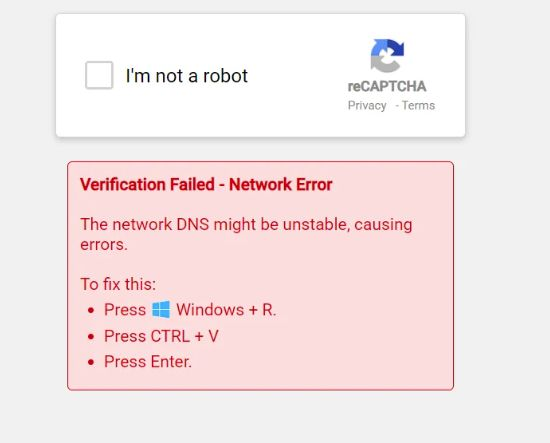
Source: DNSFilter

DNSFilter linked the campaign to two other domains: human-verify-7u.pages.dev, a Cloudflare Pages site that returns an error after the user clicks the button, and recaptcha-manual.shop, which executes commands outside the browser after users follow the prompts.

Further investigation, detailed in DNSFilter’s case study, revealed that the campaign was a sophisticated blend of phishing and malware delivery. Attackers relied on fileless execution techniques, using legitimate browser processes to deliver payloads without writing to disk.

DNSFilter deployed its content filtering and domain-blocking controls across the MSP’s network, preventing infections before any credentials or wallet data were compromised. Alerts and blocking policies were updated in real time, and the MSP conducted end-user education sessions to reinforce the dangers of interacting with suspicious CAPTCHA.

“The malware in this event was Lumma Stealer, delivered through a fake CAPTCHA in a deceptive malvertising chain. Had the analyst’s device been infected, the PowerShell payload could have disabled Windows AMSI and loaded Lumma DLL,” the report explains.

“The stealer immediately sweeps the system for anything it can monetize—browser-stored passwords and cookies, saved 2FA tokens, cryptocurrency-wallet data, remote-access credentials, and even password-manager vaults.”

Analysis showed that the fake CAPTCHA was accessed 23 times across the DNSFilter network in just three days. More troubling, 17% of users who encountered the page followed its copy‑and‑paste instructions, triggering the malware payload attempt. While DNSFilter prevented successful infections in this case, researchers noted the potential scale if left unchecked.

Rapid Laundering Leaves Scam Victims Powerless to Recover Stolen Crypto

Reports have revealed that cybercriminals are laundering stolen cryptocurrency at unprecedented speeds. At these rates, victims of fake CAPTCHA schemes are left with virtually no chance of recovering their funds.

As per the previous report, crypto hackers can now transfer stolen digital assets through laundering networks in under three minutes.

Elliptic’s data shows that by using automated laundering tools and decentralized exchanges (DEXs), hackers are executing the entire laundering process in a matter of minutes.

Source: Elliptic

“This new speed makes real-time intervention nearly impossible,” the report warned.

Cybersecurity experts warn that the fake CAPTCHA scams are not just a concern for big firms but also for regular users, as they are often disguised as part of login portals or app installations and target ordinary internet users who may not suspect foul play until their wallets are drained.

“Bad actors take advantage of both the highs and lows of life,” said Ken Carnesi, CEO and co-founder of DNSFilter. “Any person at any organization has the same chance of encountering a malicious link. The standard cyber hygiene tips apply: use unique passwords, verify who you are ‘talking’ to before handing over credentials, and think before you click.”

The rapid laundering process worsens the impact. Victims often discover the theft too late. Law enforcement agencies find it hard to trace the stolen funds across multiple blockchains. Experts note, however, that when cybersecurity firms intervene promptly, all or some of the stolen funds can still be recovered.

“Speed is critical. Funds often can be recovered in whole or part if proper actions are taken within 24 to 72 hours,” Cameron G. Shilling, a cybersecurity expert, said in a publication.

As hackers continue to shorten laundering times, the risks for victims are expected to grow. “The arms race between cybercriminals and defenders is accelerating,” Elliptic concluded. “Speed is now the hackers’ greatest weapon.”

Market Opportunity
Gravity Logo
Gravity Price(G)
$0.004012
$0.004012$0.004012
-5.35%
USD
Gravity (G) Live Price Chart
Disclaimer: The articles reposted on this site are sourced from public platforms and are provided for informational purposes only. They do not necessarily reflect the views of MEXC. All rights remain with the original authors. If you believe any content infringes on third-party rights, please contact service@support.mexc.com for removal. MEXC makes no guarantees regarding the accuracy, completeness, or timeliness of the content and is not responsible for any actions taken based on the information provided. The content does not constitute financial, legal, or other professional advice, nor should it be considered a recommendation or endorsement by MEXC.

You May Also Like

Trump swears he'll donate winnings in $10 billion lawsuit against his own IRS

Trump swears he'll donate winnings in $10 billion lawsuit against his own IRS

President Donald Trump told NBC News' Tom Llamas in an interview released on Wednesday that he has no interest in actually keeping any money he wins from his lawsuit
Share
Rawstory2026/02/05 10:43
US President Donald Trump says Warsh would’ve lost Fed if he pledged rate hike

US President Donald Trump says Warsh would’ve lost Fed if he pledged rate hike

The post US President Donald Trump says Warsh would’ve lost Fed if he pledged rate hike appeared on BitcoinEthereumNews.com. US President Donald Trump said that
Share
BitcoinEthereumNews2026/02/05 10:23
Health Insurers To Cover Covid Vaccines Despite RFK, Jr. Moves

Health Insurers To Cover Covid Vaccines Despite RFK, Jr. Moves

The post Health Insurers To Cover Covid Vaccines Despite RFK, Jr. Moves appeared on BitcoinEthereumNews.com. The nation’s biggest health insurance companies will continue to cover vaccinations – including those against Covid-19 and seasonal flu – previously recommended by a federal advisory committee, America’s Health Insurance Plans said Wednesday, Sept. 17, 2025. In this photo is a free flu and Covid-19 vaccine shots available sign, CVS, Queens, New York. (Photo by: Lindsey Nicholson/Universal Images Group via Getty Images) UCG/Universal Images Group via Getty Images The nation’s biggest health insurance companies will continue to cover vaccinations – including those against Covid-19 and seasonal flu – previously recommended by a federal advisory committee. The announcement by America’s Health Insurance Plans (AHIP), which includes CVS Health’s Aetna, Humana, Cigna, Centene and an array of Blue Cross and Blue Shield plans as members, comes ahead of the first meeting of the reconstituted Advisory Committee on Immunization Practices, which now has new members chosen by U.S. Health and Human Services Secretary Robert F. Kennedy Jr., a vaccine critic. “Health plans are committed to maintaining and ensuring affordable access to vaccines,” AHIP said in a statement Wednesday. “Health plan coverage decisions for immunizations are grounded in each plan’s ongoing, rigorous review of scientific and clinical evidence, and continual evaluation of multiple sources of data.” The move by AHIP is good news for millions of Americans at a time of year when they flock to drugstores, pharmacies, physician’s offices and outpatient clinics to get their seasonal flu and Covid shots. Kennedy’s changes to U.S. vaccine policy have created confusion across the country over whether certain vaccines long covered by insurance would continue to be. AHIP has now provided some clarity for millions of Americans. “Health plans will continue to cover all ACIP-recommended immunizations that were recommended as of September 1, 2025, including updated formulations of the COVID-19 and influenza vaccines, with no cost-sharing…
Share
BitcoinEthereumNews2025/09/18 03:11