The market is showing clear stress, and Solana price is now trading in a zone where forced selling, extreme fear, and short-term reflex bounces can all collide.The market is showing clear stress, and Solana price is now trading in a zone where forced selling, extreme fear, and short-term reflex bounces can all collide.

Short-Term Bounce Signals Emerge as Solana price Suffers Heavy Capitulation

12 min read
Solana price

The market is showing clear stress, and Solana price is now trading in a zone where forced selling, extreme fear, and short-term reflex bounces can all collide.
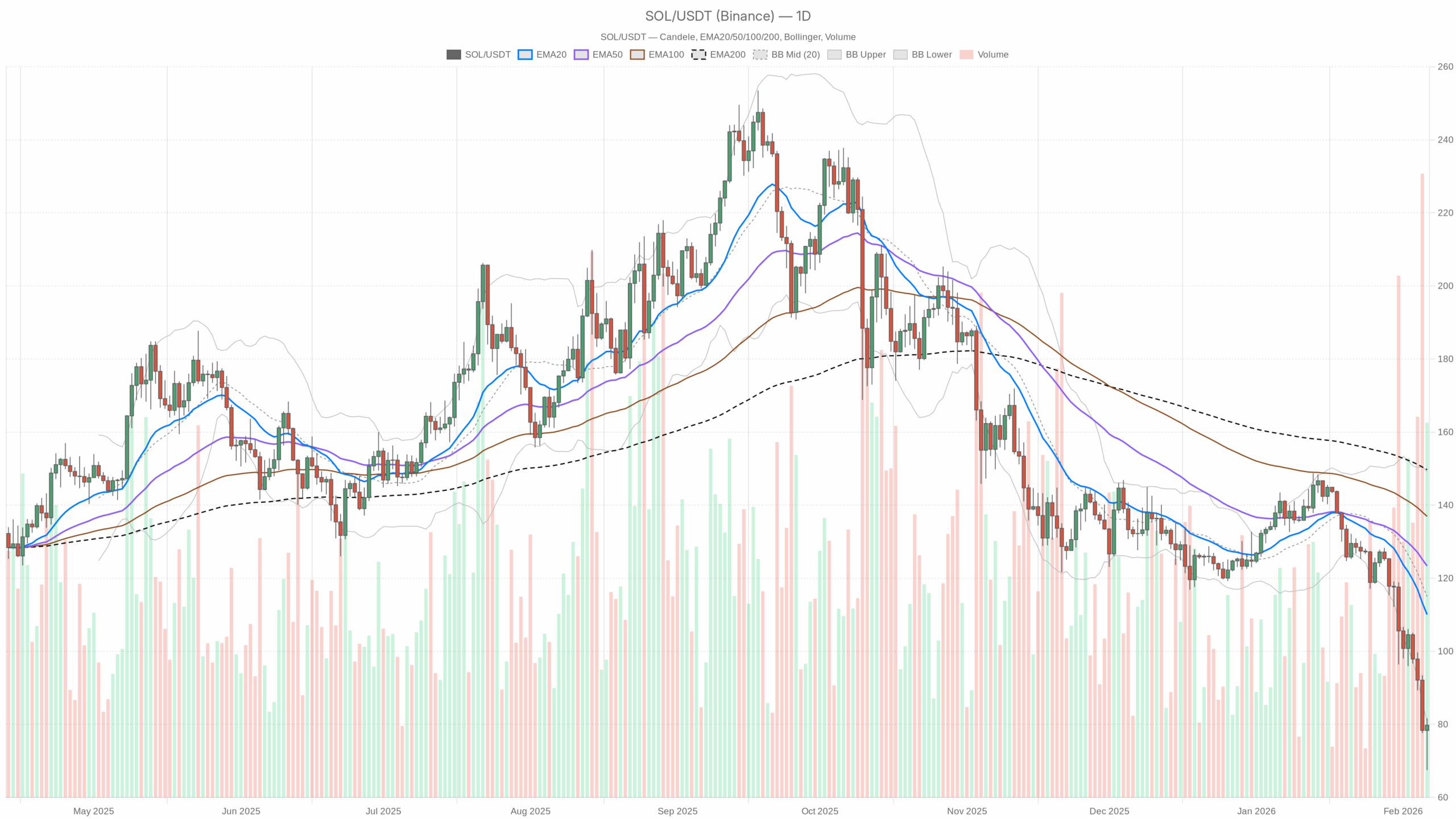
"<aSOL/USDT daily chart with EMA20, EMA50 and volume”
loading=”lazy” />SOL/USDT — daily chart with candlesticks, EMA20/EMA50 and volume.

Solana price: daily trend is broken, market trades like forced selling

Solana price against USDT is trading around $79–80, deep below its prior range and well under all key daily moving averages. This is not a mild correction; it looks like a full-blown liquidation phase in a crypto market that just saw a ~7.5% drop in total market cap and a spike in volume. BTC dominance near 56% and a fear & greed index at 9 (Extreme Fear) show what is driving flows: de-risking and forced selling, not patient rotation.

At this moment, the dominant force for Solana price is trend unwinding. The daily structure is firmly bearish, but intraday time frames are starting to stabilize, hinting at a possible short-term bounce inside a still-damaged macro trend. That tension between washed-out daily momentum and neutral intraday tone is the core of the current setup.

Daily chart (D1): macro bias clearly bearish

Price & EMAs
Solana price on the daily close is $79.79 with:

  • EMA 20: $110.07
  • EMA 50: $123.37
  • EMA 200: $149.74
  • Regime flag: bearish

Price is trading roughly 27% below the 20‑day EMA and even further below the 50 and 200. When an asset lives this far beneath its short and long EMAs, it signals a broken uptrend and aggressive trend-following selling. Any bounce from here is, by default, a rally into overhead supply until price can reclaim at least the 20‑day EMA.

RSI (14): 21.45
Daily RSI is deep in oversold territory. This is the kind of reading you typically see during capitulation or late-stage liquidations. It shows that the selloff has been both fast and one-sided. However, oversold does not automatically mean a bottom; in strong bear phases, RSI can stay depressed while price grinds lower. What it does say is that downside reward is compressing while short-term squeeze risk is rising.

MACD: line -12.38, signal -7.98, histogram -4.40
MACD is firmly negative with the line below the signal and a solid negative histogram. Momentum on the daily is still pointed down. There is no confirmed daily momentum reversal yet. This backs the idea that any near-term bounce would still be countertrend on this time frame.

Bollinger Bands: mid $114.99, upper $149.19, lower $80.80
Price is pinned right at the lower band (~$80.8) with a close at $79.79. Trading at or slightly outside the lower band after a strong drop usually marks exhaustion or panic. It is where short-term sellers start to run out of ammo and where mean-reversion traders begin probing. Still, as long as the band is sliding down and price cannot retake the middle band (~$115), the larger structure stays bearish.

ATR (14): $9.60
The daily ATR near $9.6 signals elevated volatility. Swings of 10–12% in a single day are fully on the table. This level of volatility usually coincides with liquidations and forced repositioning. It means both sides, longs and shorts, have to accept larger intraday ranges and greater slippage risk.

Daily Pivot Levels (reference from the system):
Pivot point (PP): $76.31
Resistance R1: $85.13
Support S1: $70.98

With Solana price at $79.79, it is trading just above the main daily pivot. The first resistance band is around $85. That is the nearest level where short-term profit taking by dip buyers and new shorts can reasonably appear. On the downside, the first support band is ~$71. If that breaks, it confirms that sellers are still firmly in control and that the capitulation phase is not done.

Daily takeaway: The D1 time frame is decisively bearish. Trend is broken, momentum is down, but conditions are stretched enough to justify a short-term relief rally. Macro bias: bearish until price at least reclaims the 20‑day EMA and holds above it.

1‑hour chart (H1): still bearish, but the bleeding is slowing

Price & EMAs
On H1, Solana price is $79.75 with:

  • EMA 20: $81.53
  • EMA 50: $87.19
  • EMA 200: $101.52
  • Regime flag: bearish

Price is still below the 20‑hour EMA, but only by a small margin, and far below the 50 and 200. That says the short-term downtrend is losing speed, even if it is not yet reversed. The 20‑hour EMA around $81.5 is the first intraday inflection: regain and hold it, and you start building a base; reject it, and the trend resumes lower.

RSI (14): 41.4
On the hourly, RSI has climbed from deeply oversold readings back toward neutral, but it is still below 50. This is what you usually see in a pause inside a downtrend. Selling pressure has eased, but buyers have not seized momentum. It opens the door to either a grindy base-building phase or another leg down if macro pressure returns.

MACD: line -3.01, signal -3.43, histogram +0.42
The MACD line is still negative, but the histogram has turned slightly positive. That is the first sign of a short-term momentum inflection: bears are no longer in complete control on this time frame. If this positive histogram persists and the MACD line crosses back above the signal, you would have confirmation of a short-term relief move inside the broader downtrend.

Bollinger Bands: mid $81.35, upper $89.39, lower $73.31
Price is trading just under the middle band on H1. After hugging the lower band during the drop, moving back toward the midline reflects a shift from panic selling to more balanced two-way trade. To talk about a proper intraday recovery, Solana price needs to establish itself above the mid-band (~$81–82) and start using it as support rather than resistance.

ATR (14): $3.52
Hourly ATR around $3.5 means the typical bar range is roughly 4–5%. Volatility remains elevated but has calmed down compared to the daily shock. For intraday traders, this still means wider stops and careful position sizing are necessary.

Hourly Pivot Levels:
Pivot point (PP): $79.71
Resistance R1: $80.65
Support S1: $78.80

Current price is hovering right at the hourly pivot. This is a classic decision zone after a selloff. A steady hold above $79.7–80.7 would support the case for a push toward the hourly upper band and daily R1 (~$85). Failure and sustained trade below $78.8 would signal that the pause was just a breather before another leg down.

Hourly takeaway: H1 remains bearishly aligned with the daily, but intraday momentum is stabilizing. It is early-stage repair, not a trend change.

15‑minute chart (M15): neutral, short-covering bounce territory

Price & EMAs
On M15, Solana price is $79.76 with:

  • EMA 20: $79.11
  • EMA 50: $79.75
  • EMA 200: $87.19
  • Regime flag: neutral

Price is above the 20‑EMA and sitting right on the 50‑EMA. Very short term, that is what a stabilizing or base-building pattern looks like after a flush. However, the 200‑EMA at $87 remains far above, so this is still just a bounce inside a bigger downtrend. The neutral regime tag fits: neither bulls nor bears are in full control on the execution time frame.

RSI (14): 54.66
RSI on M15 is slightly above 50, which lines up with a short-term relief rally or short covering rather than aggressive new buying. Momentum is mildly positive here, providing some breathing room for intraday longs, but it is not strong enough on its own to argue for a trend reversal.

MACD: line 0.44, signal 0.30, histogram 0.14
MACD has crossed into positive territory with a small positive histogram. Short-term momentum has flipped up. Typically, this type of profile appears after the heaviest part of the selling is done, as scalpers and short-term traders step in to fade the extremes. It is constructive for very short time frames but fragile if higher time frames reassert their downtrend.

Bollinger Bands: mid $78.67, upper $81.80, lower $75.55
Price is holding slightly above the mid-band on M15. The band structure shows reversion toward the mean rather than fresh trending behavior. For intraday execution, dips into the mid-band (~$78.5–79) that hold could serve as bounce zones, while rejection near the upper band (~$81.8) would mark the edge of this small relief move.

ATR (14): $1.01
With a 15‑minute ATR around $1, short-term swings of about 1–1.5% per bar are common. That is still noisy, but much more manageable than the daily shock. Execution-wise, this supports tactical trades with defined levels, provided one respects the broader bearish daily context.

15‑minute Pivot Levels:
Pivot point (PP): $79.76
Resistance R1: $80.23
Support S1: $79.28

Price is resting right at the M15 pivot, with a tight micro range between S1 (~$79.3) and R1 (~$80.2). This is short-term balance after stress. A clean break above R1 that holds would support a push back toward the hourly resistance band; a drop below S1 that sticks would show that the bounce is running out of steam.

15‑minute takeaway: Execution time frame is neutral to mildly constructive, showing the first leg of a potential short-covering bounce, but it exists entirely inside a much larger bearish framework.

Main scenario for Solana price: bearish with room for a reflex rally

The daily trend sets the tone: main scenario is bearish for Solana price. The asset is trading in a clear downtrend below all major EMAs, and daily MACD is still decisively negative. That is your structural backdrop.

At the same time, daily RSI in the low 20s, price pressed against the lower Bollinger Band, and stabilizing signals on H1 and M15 all point to conditions ripe for a short-term relief rally or at least a consolidation phase. So the dominant narrative is:

  • Macro: bearish trend, driven by risk-off sentiment, heavy crypto-wide deleveraging, and extreme fear.
  • Micro: short-term stabilization, with intraday traders probing for bounces and shorts beginning to manage risk.

These two forces can coexist: price can bounce hard inside a bear trend and still be structurally weak.

Clear bullish and bearish paths for Solana price

Bullish scenario (countertrend rally / bottoming attempt)

In the bullish path, the short-term stabilization on H1 and M15 turns into a stronger mean-reversion move.

  • What bulls need to see:
    • On M15/H1, Solana price holds above the local pivots (~$79.7) and stops making new intraday lows.
    • H1 RSI pushes above 50 and MACD completes a clean bullish cross with a widening positive histogram.
    • Price reclaims and holds above the H1 20‑EMA (~$81.5), then attacks the $85 region (daily R1 and H1 resistance zone).
    • On D1, price closes back inside the Bollinger Bands and starts moving toward the mid-band (~$115) over time.
  • Upside scope in this scenario:Initially, the realistic target is the $85–90 band (prior intraday resistance plus hourly upper band area). If the broader market stabilizes and Solana price can build higher lows above ~$80, an extended mean reversion toward the daily 20‑EMA around $110 becomes technically plausible. That move would still be a bear-market rally unless the 20‑day EMA is reclaimed and defended.
  • What would invalidate the bullish case:A decisive break and daily close below $71 (daily S1), especially on rising volume, would signal that the selling wave is not done. That would undercut the entire mean-reversion thesis and reset the downside, likely triggering another leg of forced liquidations.

Bearish scenario (continuation of the downtrend)

In the bearish path, current stabilization is just a pause before another drop.

  • What bears want to see:
    • H1 and M15 fail to hold the local pivots, with Solana price slipping back below $78.8 (H1 S1) and $79.3 (M15 S1) and staying there.
    • H1 RSI rolls back down from the low‑40s toward oversold without making a higher high, confirming trend continuation rather than repair.
    • Daily MACD stays negative and the histogram does not significantly contract, keeping macro momentum pointed down.
    • Price continues to ride or close below the daily lower Bollinger Band, indicating that forced selling remains in play.
  • Downside scope in this scenario:First, a test and potential break of the $71 area (daily S1). If that goes, the market will be trading in an air pocket where historical support is thin, and volatility, already high, could spike again. With daily ATR around $9.6, another $10–15 extension lower in a stress event is not out of the question.
  • What would invalidate the bearish case:If Solana price can reclaim and hold above the H1 50‑EMA (~$87), then later close the day back above the daily 20‑EMA (~$110), the character of this move changes. That would mark a structural improvement, suggesting that the selloff was a shakeout rather than the start of a deeper bear phase. Bears lose their clear trend-following edge in that environment.

How to think about positioning, risk, and uncertainty

Solana price is sitting in a zone where trend traders and mean‑reversion traders see very different pictures:

  • Trend and swing traders looking at the daily chart see a clear broken uptrend, with price below all major EMAs, negative MACD, and heavy market-wide risk-off.
  • Short-term traders on H1 and M15 see oversold conditions stabilizing, with the potential for a sharp squeeze if shorts become too crowded or if the broader market bounces.

Both can be right over their respective horizons. The key variables now are:

  • Volatility: Daily ATR near $10 and hourly ATR near $3.5 mean position sizing and stop placement need to assume wide swings. Small misjudgments in entry and exit can be amplified.
  • Market regime: A total crypto market cap drop of ~7.5% and an Extreme Fear reading of 9 are textbook deleveraging conditions. Liquidity can vanish quickly both ways, down on forced selling and up on sudden short squeezes.
  • Time frame alignment: The daily remains bearish while intraday is merely stabilizing. Until those time frames align on the upside, Solana price rallies are statistically more likely to be countertrend bounces within a broader downtrend.

In this environment, clarity comes from respecting the dominant daily bear trend while acknowledging that short, violent rallies are increasingly likely as the market becomes more oversold. Traders who ignore the volatility and the regime risk are effectively betting on clean, linear moves in a market that is anything but calm right now.

Market Opportunity
Solana Logo
Solana Price(SOL)
$82.04
$82.04$82.04
-3.03%
USD
Solana (SOL) Live Price Chart
Disclaimer: The articles reposted on this site are sourced from public platforms and are provided for informational purposes only. They do not necessarily reflect the views of MEXC. All rights remain with the original authors. If you believe any content infringes on third-party rights, please contact service@support.mexc.com for removal. MEXC makes no guarantees regarding the accuracy, completeness, or timeliness of the content and is not responsible for any actions taken based on the information provided. The content does not constitute financial, legal, or other professional advice, nor should it be considered a recommendation or endorsement by MEXC.

You May Also Like

Next Couple of Months Will Be Wild for XRP: Wealth Manager

Next Couple of Months Will Be Wild for XRP: Wealth Manager

Wealth manager Nate Geraci has reiterated his view that the coming months will be "wild" for XRP. This comes as the XRP community braces for another major milestone in the ETF space.Visit Website
Share
The Crypto Basic2025/09/18 17:09
Top 5 Cryptocurrency Data APIs: Comprehensive Comparison (2025)

Top 5 Cryptocurrency Data APIs: Comprehensive Comparison (2025)

Photo by Pierre Borthiry - Peiobty on Unsplash Cryptocurrency APIs are essential tools for developers building apps (e.g. trading bots, portfolio trackers) and for analysts conducting market research. These APIs provide programmatic access to historical price data, real-time market quotes, and even on-chain metrics from blockchain networks. Choosing the right API means finding a balance between data coverage, update speed, reliability, and cost. In this article, we compare five of the most popular crypto data API providers — EODHD, CoinMarketCap, CoinGecko, CryptoCompare, and Glassnode — focusing on their features, data types (historical, real-time, on-chain), rate limits, documentation, and pricing plans. We also highlight where EODHD’s crypto API stands out in this competitive landscape. Overview of the Top 5 Crypto Data API Providers
  1. EODHD (End-of-Day Historical Data) — All-in-One Multi-Asset Data EODHD is a versatile financial data provider covering stocks, forex, and cryptocurrencies. It offers an unmatched data coverage with up to 30 years of historical data across the global For crypto, EODHD supports thousands of coins and trading pairs (2,600+ crypto pairs against USD) and provides multiple data types under one service. Key features include:
Historical Price Data: Daily OHLCV (open-high-low-close-volume) for crypto assets, with records for major coins going back to 2009 eodhd.com (essentially as far back as Bitcoin’s history). This extensive archive facilitates long-term backtesting. Real-Time Market Data: Live crypto price quotes via REST API and WebSocket. EODHD’s “Live” plan delivers real-time (typically streaming) updates with high rate limits (up to 1,000 requests/minute on paid plans) Developers can also use bulk API endpoints to On-Chain & Fundamental Data: While not an on-chain analytics platform per se, EODHD provides crypto fundamental metrics such as market cap (actual and diluted), circulating/total/max supply, all-time high/low, and links to each project’s whitepaper, block explorer These fundamentals give context beyond price, though advanced on-chain metrics (e.g. active addresses) are not included. Additional Features: EODHD stands out for its ease of use and support tools. API responses are clean JSON by default (with an option for CSV), and the service offers no-code solutions like Excel and Google Sheets add-ons to fetch crypto data without programming Comprehensive documentation and an “API Academy” with examples help users get started EODHD also provides 24/7 live customer support, reflecting its 7+ years of reliable service Pricing & Limits: EODHD’s pricing is very competitive for the value. It has a free plan (registration required) which allows 20 API calls per day for trying out basic Paid plans start at $19.99/month for end-of-day and live crypto data, allowing up to 100,000 calls per day— a generous limit that far exceeds most competitors at that price. The next tier ($29.99/mo) adds real-time WebSocket streaming, and the top All-in-One plan ($99.99/mo) unlocks everything (historical, intraday, real-time, fundamentals, news, etc.) All paid plans come with high throughput (up to 1,000 requests/min) Enterprise or commercial licenses are available for custom needs, and students can even get 50% discounts for educational Overall, EODHD offers an excellent price-to-performance ratio, giving developers extensive crypto (and cross-asset) data for a fraction of the cost of some single-purpose crypto APIs. 2. CoinMarketCap — Industry-Standard Market Data CoinMarketCap (CMC) is one of the most well-known cryptocurrency data aggregators. It provides information on over 10,000 digital assets and aggregates data from hundreds of CMC’s API is a go-to choice for current market prices, rankings, and exchange statistics. Key features include: Real-Time Quotes & Global Metrics: The API offers real-time price quotes, market capitalization, trading volume, and rankings for thousands of cryptocurrencies. It also provides global market metrics like total market cap, total volume, Bitcoin dominance, etc., updated (CMC’s data updates roughly every 1–2 minutes by default; true streaming is not yet available via their API.) Historical Data: Paid tiers unlock access to historical price data. CMC has data going back to 2013 for many assets, and enterprise plans provide all historical OHLCV data since 2013.The API endpoints include daily and even intraday historical quotes, but note that the free tier does not include historical price retrieval(free users get only latest data). Exchange and Market Endpoints: CoinMarketCap’s API covers exchange-level data (e.g. exchange listings, trading pair metadata, liquidity scores) and derivative market data (futures, options prices) on higher plans. This is useful for monitoring exchange performance and volumes across both centralized and decentralized exchanges. However, on-chain analytics are not CMC’s focus — the API doesn’t provide blockchain metrics like address counts or transaction rates. Developer Support: CMC provides comprehensive documentation and a straightforward RESTful JSON API . The endpoints are well-documented with examples, and categories include latest listings, historical quotes, metadata/info (project details), exchange stats, and The service is known for its reliability and is used by major companies (Yahoo Finance, for example, uses CoinMarketCap’s data feeds in its crypto Pricing & Limits: CoinMarketCap offers a free Basic plan with 10,000 credits per month (approximately 333 calls/day) and access to 11 core endpoint. The free tier is suitable for simple apps that only need current market data on a limited number of assets. To get historical data or higher frequency updates, you must upgrade. The Hobbyist plan starts at around $29/month (paid annually) and offers a higher monthly call allowance (e.g. ~50,000 calls/month) and more endpoints. Mid-tier plans like Startup ($79/mo) and Standard ($199/mo) increase the rate limits and data access — e.g., more historical data and additional endpoints like derivatives or exchange listings. For example, Standard and above allow intraday historical quotes and more frequent updates. Professional/Enterprise plans ($699/mo and up, or custom) provide the highest limits (up to millions of calls per month), full historical datasets, and SLA . Rate limits on CMC are enforced via a credit system; different endpoints consume different credits, and higher plans simply grant more credits per month. In summary, CoinMarketCap’s API is very robust but can become expensive for extensive data needs — it targets enterprise use cases with its upper tiers. Smaller developers often stick to the free or Hobbyist plan for basic data (while accepting the lack of historical data in those tiers) 3. CoinGecko — Broad Coverage & Community Focus CoinGecko is another hugely popular cryptocurrency data provider known for its broad coverage and developer-friendly approach. CoinGecko’s API is often praised for having a useful free offering and covering not just standard market data but also categories like DeFi, NFTs, and community metrics. Notable features: Wide Asset Coverage: CoinGecko tracks over 13,000 cryptocurrencies (including many small-cap and emerging tokens). It also includes data on NFT collections and decentralized finance (DeFi) tokens and protocols. This makes it one of the most comprehensive datasets for the crypto market. If an asset is trading on a major exchange or DEX, CoinGecko likely has it listed. Market Data and Beyond: The API provides real-time price data, market caps, volumes, and historical charts for all these assets. Historical data can be retrieved in the form of market charts (typically with daily or hourly granularity depending on the time range). Additionally, CoinGecko offers endpoints for exchange data, trading pairs, categories (sectors), indices, and even asset contract info (mapping contract addresses to CoinGecko listings). They also expose developer and social metrics for each coin — e.g. GitHub repo stats (forks, stars, commits) and social media stats (Twitter followers, Reddit subscribers) This is valuable for analysts who want to gauge community interest or development activity alongside price. No WebSockets — REST Only: CoinGecko’s API is purely REST-based; there is no built-in WebSocket streaming. Data updates for price endpoints are cached at intervals (typically every 1–5 minutes for free users, and up to every 30 seconds for Pro users). So while you can get near-real-time data by polling, ultra-low-latency needs (like high-frequency trading) are better served by other providers or exchange-specific APIs. Documentation & Use: The API is very straightforward to use — in fact, for the free tier no API key was required historically (though recently CoinGecko introduced an optional “Demo” key for better tracking). A simple GET request to an endpoint like /simple/price returns current prices. CoinGecko’s documentation is clear, and they even highlight popular endpoints and provide examples. Because of its simplicity and generous free limits, CoinGecko’s API has been integrated into countless projects and tutorials. Pricing & Limits: CoinGecko operates a freemium model. The free tier (now referred to as the “Demo” plan) allows about 10–30 calls per minute (the exact rate is dynamic based on system load) In practical terms, that’s roughly up to 1,800 calls/hour if usage is maxed out — very sufficient for small applications. The free API gives access to most endpoints and data (including historical market charts) but with lower priority and slower update frequency. For higher needs, CoinGecko offers paid plans: Analyst, Lite, and Pro. For example, the Analyst plan (~$129/mo) offers 500,000 calls per month at 500 calls/minute rate limit, the Pro plan (~$499/mo) offers 2,000,000 calls/mo at the same rate, and an Enterprise plan (~$999/mo and up) can be tailored for even larger volumes. Paid plans also use a separate pro API endpoint with faster data updates (prices cached every 30 seconds) and come with commercial usage rights and support SLA Notably, CoinGecko’s free plan is one of the best among crypto APIs in terms of data offered for $0, but if you need heavy usage or guaranteed uptime, the cost can ramp up — at the high end, large enterprise users might negotiate custom plans beyond the listed Pro tier.
  1. CryptoCompare — Full Market Data + More CryptoCompare is a long-standing crypto data provider that offers a rich set of market data and analytics. It not only provides price data but also aggregates news, social sentiment, and even some on-chain data, making it a comprehensive source for crypto market Key features of CryptoCompare’s API include:
Market Data & Exchange Coverage: CryptoCompare covers 5,700+ coins and 260,000+ trading pairs across a wide array of exchanges. It collects trade data from more than 170 exchanges (both centralized and some decentralized) to produce its aggregate indices (known as CCCAGG prices). The API provides real-time price quotes, order book snapshots, trade history, and OHLCV candlesticks at various intervals. For advanced users, CryptoCompare can supply tick-level trade data and order book data for deep analysis (these are available via their WebSocket or extended API endpoints). Historical Data: CryptoCompare is strong in historical coverage. It offers historical daily data for many coins and historical intraday (minute) data as well. By default, all subscription plans include at least 7 days of minute-level history and full daily history; enterprise clients can get up to 1 year of minute-by-minute historical data (and raw trade data) for backtesting. This is valuable for quantitative researchers who require detailed price series. On-Chain Metrics and Other Data: In addition to market prices, CryptoCompare has expanded into on-chain metrics and alternative data. The API can provide certain blockchain statistics (they mention “blockchain metrics” and address data in their offerings)— for example, network transaction counts or wallet addresses for major chains. While it’s not as extensive as a dedicated on-chain provider, this allows blending on-chain indicators (like transaction volumes) with price data for analysis. CryptoCompare also integrates news feeds and social sentiment: the API has endpoints for the latest news articles and community sentiment analysis, which can help gauge market Reliability and Performance: CryptoCompare’s infrastructure is built for high performance. They claim support for up to 40,000 API calls per second bursts and hundreds of trades per second This makes it suitable for real-time applications and dashboards that need frequent updates. Their data is normalized through a proprietary algorithm to filter out bad data (e.g., outlier prices or exchange anomalies), aiming to deliver clean and consistent price indices (CCCAGG). The API itself is well-documented, and client libraries exist for languages like Python. Pricing & Limits: CryptoCompare historically offered a free public API (with IP-based limiting), but now uses an API key model with tiered plans. Personal/free use is still allowed — you can register for a free API key for non-commercial projects and get a decent allowance (exact call limits aren’t explicitly published, but users report free tiers on the order of a few thousand calls per day). For commercial or heavy use, their plans start around $80/month for a basic package and go up to ~$200/month for advanced packages. These plans might offer on the order of 100k to a few hundred thousand calls per month, plus higher data resolution. All plans grant access to ~60+ endpoints and features like full historical data download for daily/hourly (minute data beyond 7 days is enterprise-only). Enterprise solutions are available for customers needing custom data feeds, unlimited usage, white-label solutions, or bespoke datasets (pricing for these is via negotiation). In summary, CryptoCompare provides a very rich dataset and is priced in a mid-range: not as cheap as community resources, but more affordable than some institutional-grade providers. Its value is especially high if you need a mix of price, news, and basic on-chain data in one
  1. Glassnode — On-Chain Analytics Leader Glassnode is the premier platform for on-chain metrics and blockchain analytics. Unlike the other APIs in this list, Glassnode’s focus is less on real-time market prices and more on the fundamental health and usage of blockchain networks. It provides a wealth of on-chain data that is invaluable for crypto analysts and long-term investors. Key aspects of Glassnode’s API:

Extensive On-Chain Metrics: Glassnode offers over 800 on-chain metrics spanning multiple major blockchains (Bitcoin, Ethereum, Litecoin, and many others, as well as key ERC-20 tokens). This includes metrics like active addresses, transaction counts, transaction volumes, mining hash rates, exchange inflows/outflows, UTXO distributions, HODLer stats, realized cap, SOPR and much more. If you need to peer ino what’s happening inside a blockchain (not just its price on exchanges), Glassnode is the go-to source. For example, one can query the number of active Bitcoin addresses, the amount of BTC held by long-term holders vs. short-term, or Ethereum gas usage trends Market & Derivatives Data: In addition to pure on-chain data, Glassnode also incorporates off-chain market data for context. They provide spot price data for major assets (often used in tandem with metrics in their charts), and even some derivatives metrics (futures open interest, funding rates, etc. for major exchanges) at higher . This means Glassnode can be a one-stop shop for an analyst who wants to correlate on-chain activity with price movements or derivative market trends. Data Resolutions and API Access: The API allows retrieval of metrics at various time resolutions. Free users can typically access metrics at a daily resolution (one data point per day) and usually with a delayed timeframe (e.g. yesterday’s data). Paid tiers unlock higher frequency data — the mid-tier (Advanced) gives up to hourly data, and the top tier (Professional) can go down to 10-minute intervals for certain metrics This granularity is useful for near-real-time monitoring of on-chain events. It’s important to note that Glassnode’s API is primarily used for pulling time-series data of specific metrics (e.g., get the 24h moving average of active addresses, daily, over the last 5 years). The API is well-documented with a metric catalog detailing every metric and its available history and access tier. Analyst Tools: Glassnode provides an entire platform (Glassnode Studio) for visualizing these metrics with charts and alerts. While that’s beyond the API itself, it’s worth noting that many analysts use the web interface for research and the API for programmatic access when building models. Glassnode has become an industry standard for on-chain analysis — many research reports and crypto funds cite Glassnode metrics for insights on network adoption, investor behavior, and market cycles. Pricing & Limits: Glassnode’s offerings are tiered more by data access level than raw call counts. They have a Standard (Free) tier, an Advanced (Tier 2) paid tier, and a Professional (Tier 3) tier. The Free tier allows access to Basic metrics (Tier 1 metrics) at daily resolution, which covers a lot of fundamental data for major chains but not the more complex or derived metrics. The Advanced plan (around $29–$49 per month depending on promotions) unlocks Essential metrics (Tier 2) and provides up to hourly . The Professional plan (around $79 per month for individuals) gives access to all metrics (including Premium Tier 3 metrics) and finer resolution (10-min updates). However, there’s a catch: API access is only officially included for Professional/Enterprise users and may require a special add-on or enterprise . In practice, Glassnode does offer a free API but it is limited (e.g., you can query basic metrics via REST with a free API key, but many endpoints will return only if you have the right subscription). Enterprise clients who need programmatic access to extensive history or want to ingest Glassnode data into trading models can arrange custom packages (cost can run into the hundreds or thousands of dollars monthly for institutional licenses, which may include SLAs, custom metrics, or priority support). For the purpose of our comparison, Glassnode’s free option is great for community analysts to explore a subset of data, but serious use of their API requires the paid tiers. Glassnode is best suited for analysts and institutional users who heavily value on-chain rather than developers who just need straightforward price feeds. The table below summarizes the data coverage and features of these five API providers side-by-side: Ready to build with crypto data that just works? If you want reliable crypto prices + multi-asset coverage (stocks, FX, ETFs) + generous limits without piecing together 3–4 vendors, EODHD is the pragmatic pick. Why EODHD wins for most teams All-in-one: crypto + equities + FX under one API (consistent JSON/CSV). Great value: up to 100k calls/day from ~$19.99/mo — perfect for MVPs and production apps. Fast start: clean docs, code samples, Excel/Sheets add-ins, and bulk endpoints. Scale-ready: real-time REST & WebSocket, historical OHLCV, fundamentals, news. What you can ship this week Real-time crypto dashboards and alerts Backtests using years of OHLCV data Cross-asset analytics (BTC vs. S&P 500, ETH vs. USD) Spreadsheet models that refresh automatically 👉 Start for free with EODHD — grab your API key and make your first request in minutes.Try EODHD now (free tier available) and upgrade when you need more throughput. Top 5 Cryptocurrency Data APIs: Comprehensive Comparison (2025) was originally published in Coinmonks on Medium, where people are continuing the conversation by highlighting and responding to this story
Share
Medium2025/09/26 21:29
XRP Price Outlook As Peter Brandt Predicts BTC Price Might Crash to $42k

XRP Price Outlook As Peter Brandt Predicts BTC Price Might Crash to $42k

The post XRP Price Outlook As Peter Brandt Predicts BTC Price Might Crash to $42k appeared on BitcoinEthereumNews.com. XRP price led cryptocurrency losses on Friday
Share
BitcoinEthereumNews2026/02/06 19:06