This article was first published on The Bit Journal. The Bitcoin price rebounded after a volatile start to the week, offering short-term relief to a market stillThis article was first published on The Bit Journal. The Bitcoin price rebounded after a volatile start to the week, offering short-term relief to a market still

Bitcoin Rebounds to $76K, Lifting Ether and Majors as Caution Lingers

2026/02/04 19:00
4 min read

This article was first published on The Bit Journal.

The Bitcoin price rebounded after a volatile start to the week, offering short-term relief to a market still weighed down by caution. Sharp selloffs early in the week pushed prices lower before buyers returned, stabilizing conditions but not sentiment.

According to the source, the recovery reflects a pause in selling rather than renewed confidence. Market data and on-chain signals show investors leaning defensive, even as prices move higher.

Bitcoin Price Recovers From $76,000 Lows Yet Faces Strong Resistance

The Bitcoin price dropped near $76,000 during early-week trading before rebounding roughly five percent to trade above $78,000 during Asian and early European hours, based on updated figures available via publicly accessible market trackers. Thin liquidity and forced liquidations amplified the decline, allowing sharp moves in both directions.

Despite the rebound, gains stalled near resistance levels that have capped upside since early February. Short-term traders remain skeptical, struggling to extend rallies beyond narrow ranges. The Bitcoin price now trades in a fragile zone where momentum depends heavily on broader risk sentiment.
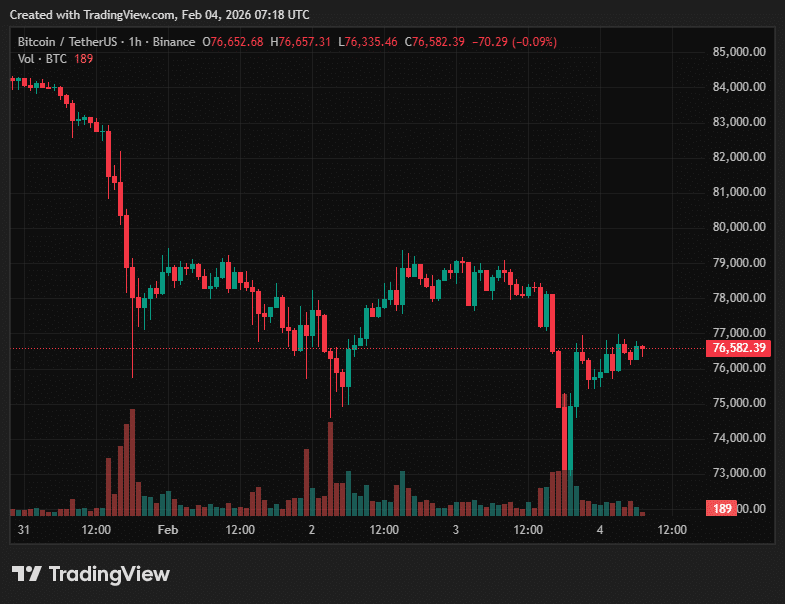
Ether PriceSource: Coingeko

Ether Price And Major Tokens Rise, But Recoveries Stay Uneven

While Bitcoin stabilized, the Ether price followed with modest gains that lagged the broader rebound. Ethereum remained well below earlier yearly highs, highlighting weaker demand for risk assets. The Ether price continues to reflect caution rather than conviction.

Among altcoins, performance varied. BNB led gains after renewed public support from Binance founder Changpeng Zhao, which briefly improved sentiment around the token.

Dogecoin also advanced following fresh social media mentions by Elon Musk, underscoring how narrative-driven assets remain sensitive to high-profile commentary. Still, most major tokens posted limited recoveries, keeping the Ether price and peers under pressure.

Outflows And On-Chain Data Signal Defensive Positioning

Fund flows reinforced the cautious mood. Digital asset investment products recorded $1.7 billion in weekly outflows, marking a second consecutive week of heavy redemptions, according to recently published flow data available online. Bitcoin-focused products accounted for most withdrawals, followed by ether-linked funds.

On-chain indicators added another layer of concern. Long-term bitcoin holders slipped into unrealized losses, a condition often associated with deeply bearish phases that can precede local bottoms, as highlighted in blockchain analytics research.

Options markets show early signs of traders positioning for stabilization, though hedging activity suggests protection remains the priority. The Bitcoin price reflects resilience, but positioning remains defensive.

Macro And Geopolitical Forces Shape Market Tone

Crypto markets moved alongside broader risk assets. Asian stocks pared losses after U.S. technology shares fell overnight, driven by concerns that rapid advances in artificial intelligence could disrupt traditional software business models. Investors rotated toward financials and industrials, echoing risk-averse behavior seen in digital assets.

Commodities added pressure. Oil prices rose after the U.S. Navy intercepted an Iranian drone in the Arabian Sea, increasing geopolitical tension.

Gold rebounded above $5,000 an ounce on dip buying, while the yen weakened as traders positioned ahead of Japan’s election. These cross-market signals continue to influence the Bitcoin price and the Ether price alike.

Institutional Exposure Shows A Market Divide

Corporate crypto exposure remains under scrutiny. Ether’s decline pushed unrealized losses higher at major holders, with BitMine’s paper losses nearing $7 billion.

Some institutional investors trimmed positions to manage risk, while others moved in the opposite direction. Strategy continued accumulating bitcoin despite volatility, signaling long-term conviction even as near-term uncertainty clouds the outlook.

Conclusion

The rebound offers stability, not certainty. The Bitcoin price has recovered from $76,000 lows, yet defensive flows and cautious positioning dominate the market. The Ether price mirrors that restraint, reflecting selective risk-taking rather than broad optimism.

For students, analysts, and builders, the message remains clear. Follow liquidity, respect resistance, and prepare for volatility. Fragile rebounds demand patience more than prediction.

Glossary Of Key Terms

Market Capitalization: The total value of a cryptocurrency based on its circulating supply.

On-Chain Data: Blockchain activity such as transactions and wallet behavior recorded on the network.

Unrealized Losses: Paper losses on assets that have not been sold.

Liquidity: The ease with which assets trade without sharp price swings.

FAQs About Bitcoin Price

Why did the Bitcoin price rebound from $76,000?

Buyers stepped in after liquidations eased selling pressure.

Why is the Ether price underperforming Bitcoin?

Ethereum faces weaker demand and higher institutional caution.

What do crypto fund outflows indicate?

Investors are reducing exposure amid uncertainty.

Is the current rebound sustainable?

Stabilization is possible, but risks remain elevated.

Sources/References

CoinDesk

Coingeko

Read More: Bitcoin Rebounds to $76K, Lifting Ether and Majors as Caution Lingers">Bitcoin Rebounds to $76K, Lifting Ether and Majors as Caution Lingers

Market Opportunity
Major Logo
Major Price(MAJOR)
$0.08718
$0.08718$0.08718
+5.11%
USD
Major (MAJOR) Live Price Chart
Disclaimer: The articles reposted on this site are sourced from public platforms and are provided for informational purposes only. They do not necessarily reflect the views of MEXC. All rights remain with the original authors. If you believe any content infringes on third-party rights, please contact service@support.mexc.com for removal. MEXC makes no guarantees regarding the accuracy, completeness, or timeliness of the content and is not responsible for any actions taken based on the information provided. The content does not constitute financial, legal, or other professional advice, nor should it be considered a recommendation or endorsement by MEXC.

You May Also Like

Cashing In On University Patents Means Giving Up On Our Innovation Future

Cashing In On University Patents Means Giving Up On Our Innovation Future

The post Cashing In On University Patents Means Giving Up On Our Innovation Future appeared on BitcoinEthereumNews.com. “It’s a raid on American innovation that would deliver pennies to the Treasury while kneecapping the very engine of our economic and medical progress,” writes Pipes. Getty Images Washington is addicted to taxing success. Now, Commerce Secretary Howard Lutnick is floating a plan to skim half the patent earnings from inventions developed at universities with federal funding. It’s being sold as a way to shore up programs like Social Security. In reality, it’s a raid on American innovation that would deliver pennies to the Treasury while kneecapping the very engine of our economic and medical progress. Yes, taxpayer dollars support early-stage research. But the real payoff comes later—in the jobs created, cures discovered, and industries launched when universities and private industry turn those discoveries into real products. By comparison, the sums at stake in patent licensing are trivial. Universities collectively earn only about $3.6 billion annually in patent income—less than the federal government spends on Social Security in a single day. Even confiscating half would barely register against a $6 trillion federal budget. And yet the damage from such a policy would be anything but trivial. The true return on taxpayer investment isn’t in licensing checks sent to Washington, but in the downstream economic activity that federally supported research unleashes. Thanks to the bipartisan Bayh-Dole Act of 1980, universities and private industry have powerful incentives to translate early-stage discoveries into real-world products. Before Bayh-Dole, the government hoarded patents from federally funded research, and fewer than 5% were ever licensed. Once universities could own and license their own inventions, innovation exploded. The result has been one of the best returns on investment in government history. Since 1996, university research has added nearly $2 trillion to U.S. industrial output, supported 6.5 million jobs, and launched more than 19,000 startups. Those companies pay…
Share
BitcoinEthereumNews2025/09/18 03:26
China Blocks Nvidia’s RTX Pro 6000D as Local Chips Rise
China Blocks Nvidia’s RTX Pro 6000D as Local Chips Rise

The post China Blocks Nvidia’s RTX Pro 6000D as Local Chips Rise appeared on BitcoinEthereumNews.com. China Blocks Nvidia’s RTX Pro 6000D as Local Chips Rise China’s internet regulator has ordered the country’s biggest technology firms, including Alibaba and ByteDance, to stop purchasing Nvidia’s RTX Pro 6000D GPUs. According to the Financial Times, the move shuts down the last major channel for mass supplies of American chips to the Chinese market. Why Beijing Halted Nvidia Purchases Chinese companies had planned to buy tens of thousands of RTX Pro 6000D accelerators and had already begun testing them in servers. But regulators intervened, halting the purchases and signaling stricter controls than earlier measures placed on Nvidia’s H20 chip. Image: Nvidia An audit compared Huawei and Cambricon processors, along with chips developed by Alibaba and Baidu, against Nvidia’s export-approved products. Regulators concluded that Chinese chips had reached performance levels comparable to the restricted U.S. models. This assessment pushed authorities to advise firms to rely more heavily on domestic processors, further tightening Nvidia’s already limited position in China. China’s Drive Toward Tech Independence The decision highlights Beijing’s focus on import substitution — developing self-sufficient chip production to reduce reliance on U.S. supplies. “The signal is now clear: all attention is focused on building a domestic ecosystem,” said a representative of a leading Chinese tech company. Nvidia had unveiled the RTX Pro 6000D in July 2025 during CEO Jensen Huang’s visit to Beijing, in an attempt to keep a foothold in China after Washington restricted exports of its most advanced chips. But momentum is shifting. Industry sources told the Financial Times that Chinese manufacturers plan to triple AI chip production next year to meet growing demand. They believe “domestic supply will now be sufficient without Nvidia.” What It Means for the Future With Huawei, Cambricon, Alibaba, and Baidu stepping up, China is positioning itself for long-term technological independence. Nvidia, meanwhile, faces…
Share
BitcoinEthereumNews2025/09/18 01:37
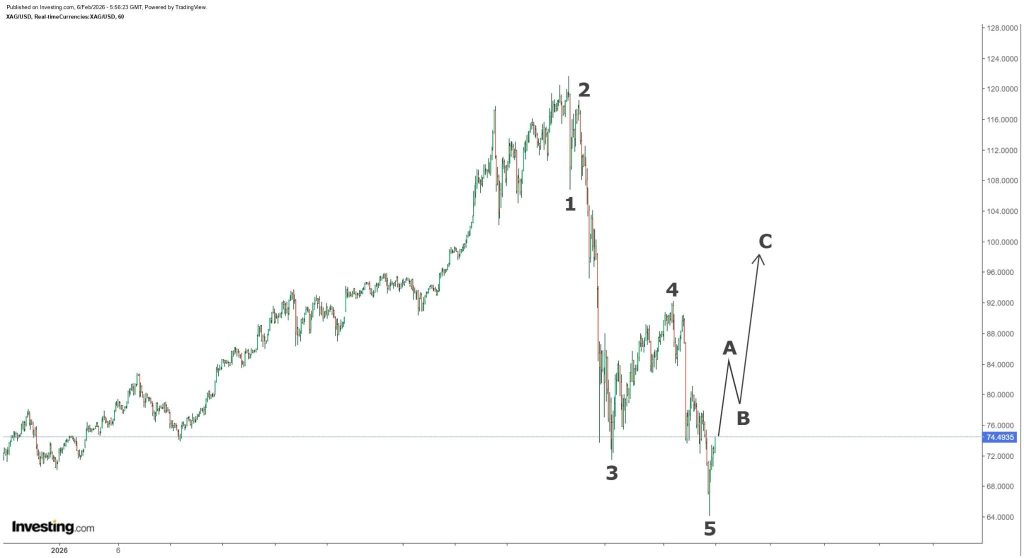
Silver Price Crash Is Over “For Real This Time,” Analyst Predicts a Surge Back Above $90

Silver Price Crash Is Over “For Real This Time,” Analyst Predicts a Surge Back Above $90

Silver has been taking a beating lately, and the Silver price hasn’t exactly been acting like a safe haven. After running up into the highs, the whole move reversed
Share
Captainaltcoin2026/02/07 03:15