The post USD/CNH declines towards 33-month low to near 6.9310 as Yuan gains on seasonal demand appeared on BitcoinEthereumNews.com. The USD/CNH pair trades lowerThe post USD/CNH declines towards 33-month low to near 6.9310 as Yuan gains on seasonal demand appeared on BitcoinEthereumNews.com. The USD/CNH pair trades lower

USD/CNH declines towards 33-month low to near 6.9310 as Yuan gains on seasonal demand

4 min read

The USD/CNH pair trades lower to 6.9350 during the late Asian trading session on Tuesday. The pair declines towards its 33-month low of 6.9310 as the Chinese Yuan (CNH) continues to outperform the US Dollar (USD) due to strong seasonal demand.

According to a note from China’s Ping An Bank, the upcoming spring festival holiday, combined with a weak dollar trend and seasonal demand for currency settlement, are continuing to support the yuan, Reuters reported.

Though investors have underpinned the Chinese Yuan against the US Dollar (USD) due to seasonality trend, the latter has broadly turned strong against its major currency peers, following the nomination of former Federal Reserve (Fed) governor Kevin Warsh as the successor of Chairman Jerome Powell.

As of writing, the US Dollar Index (DXY), which tracks the Greenback’s value against six major currencies, drops slightly lower to near 97.45, but is still close to its weekly high of 97.73.

The US Dollar has retraced marginally due to partial US federal shutdown, which will result in the suspension of key economic data releases.

On Monday, upbeat US ISM Manufacturing Purchasing Managers’ Index (PMI) data for January also supported the US Dollar. The ISM reported that the Manufacturing PMI returned to growth after declining for several months. The data came in at 52.6, higher than estimates of 48.5 and the prior release of 47.9. A figure above 50.00 is seen as an expansion in the business activity.

US Dollar FAQs

The US Dollar (USD) is the official currency of the United States of America, and the ‘de facto’ currency of a significant number of other countries where it is found in circulation alongside local notes. It is the most heavily traded currency in the world, accounting for over 88% of all global foreign exchange turnover, or an average of $6.6 trillion in transactions per day, according to data from 2022.
Following the second world war, the USD took over from the British Pound as the world’s reserve currency. For most of its history, the US Dollar was backed by Gold, until the Bretton Woods Agreement in 1971 when the Gold Standard went away.

The most important single factor impacting on the value of the US Dollar is monetary policy, which is shaped by the Federal Reserve (Fed). The Fed has two mandates: to achieve price stability (control inflation) and foster full employment. Its primary tool to achieve these two goals is by adjusting interest rates.
When prices are rising too quickly and inflation is above the Fed’s 2% target, the Fed will raise rates, which helps the USD value. When inflation falls below 2% or the Unemployment Rate is too high, the Fed may lower interest rates, which weighs on the Greenback.

In extreme situations, the Federal Reserve can also print more Dollars and enact quantitative easing (QE). QE is the process by which the Fed substantially increases the flow of credit in a stuck financial system.
It is a non-standard policy measure used when credit has dried up because banks will not lend to each other (out of the fear of counterparty default). It is a last resort when simply lowering interest rates is unlikely to achieve the necessary result. It was the Fed’s weapon of choice to combat the credit crunch that occurred during the Great Financial Crisis in 2008. It involves the Fed printing more Dollars and using them to buy US government bonds predominantly from financial institutions. QE usually leads to a weaker US Dollar.

Quantitative tightening (QT) is the reverse process whereby the Federal Reserve stops buying bonds from financial institutions and does not reinvest the principal from the bonds it holds maturing in new purchases. It is usually positive for the US Dollar.

Source: https://www.fxstreet.com/news/usd-cnh-declines-towards-33-month-low-to-near-69310-as-yuan-gains-on-seasonal-demand-202602030512


Disclaimer: The articles reposted on this site are sourced from public platforms and are provided for informational purposes only. They do not necessarily reflect the views of MEXC. All rights remain with the original authors. If you believe any content infringes on third-party rights, please contact service@support.mexc.com for removal. MEXC makes no guarantees regarding the accuracy, completeness, or timeliness of the content and is not responsible for any actions taken based on the information provided. The content does not constitute financial, legal, or other professional advice, nor should it be considered a recommendation or endorsement by MEXC.

You May Also Like

Fed Decides On Interest Rates Today—Here’s What To Watch For

Fed Decides On Interest Rates Today—Here’s What To Watch For

The post Fed Decides On Interest Rates Today—Here’s What To Watch For appeared on BitcoinEthereumNews.com. Topline The Federal Reserve on Wednesday will conclude a two-day policymaking meeting and release a decision on whether to lower interest rates—following months of pressure and criticism from President Donald Trump—and potentially signal whether additional cuts are on the way. President Donald Trump has urged the central bank to “CUT INTEREST RATES, NOW, AND BIGGER” than they might plan to. Getty Images Key Facts The central bank is poised to cut interest rates by at least a quarter-point, down from the 4.25% to 4.5% range where they have been held since December to between 4% and 4.25%, as Wall Street has placed 100% odds of a rate cut, according to CME’s FedWatch, with higher odds (94%) on a quarter-point cut than a half-point (6%) reduction. Fed governors Christopher Waller and Michelle Bowman, both Trump appointees, voted in July for a quarter-point reduction to rates, and they may dissent again in favor of a large cut alongside Stephen Miran, Trump’s Council of Economic Advisers’ chair, who was sworn in at the meeting’s start on Tuesday. It’s unclear whether other policymakers, including Kansas City Fed President Jeffrey Schmid and St. Louis Fed President Alberto Musalem, will favor larger cuts or opt for no reduction. Fed Chair Jerome Powell said in his Jackson Hole, Wyoming, address last month the central bank would likely consider a looser monetary policy, noting the “shifting balance of risks” on the U.S. economy “may warrant adjusting our policy stance.” David Mericle, an economist for Goldman Sachs, wrote in a note the “key question” for the Fed’s meeting is whether policymakers signal “this is likely the first in a series of consecutive cuts” as the central bank is anticipated to “acknowledge the softening in the labor market,” though they may not “nod to an October cut.” Mericle said he…
Share
BitcoinEthereumNews2025/09/18 00:23
While Shiba Inu and Turbo Chase Price, 63% APY Staking Puts APEMARS at the Forefront of the Best Meme Coin Presale 2026 – Stage 6 Ends in 3 Days!

While Shiba Inu and Turbo Chase Price, 63% APY Staking Puts APEMARS at the Forefront of the Best Meme Coin Presale 2026 – Stage 6 Ends in 3 Days!

What if your meme coin investment could generate passive income without selling a single token? Shiba Inu climbed 4.97% as 207 billion tokens left exchanges. Turbo
Share
Coinstats2026/02/04 03:15
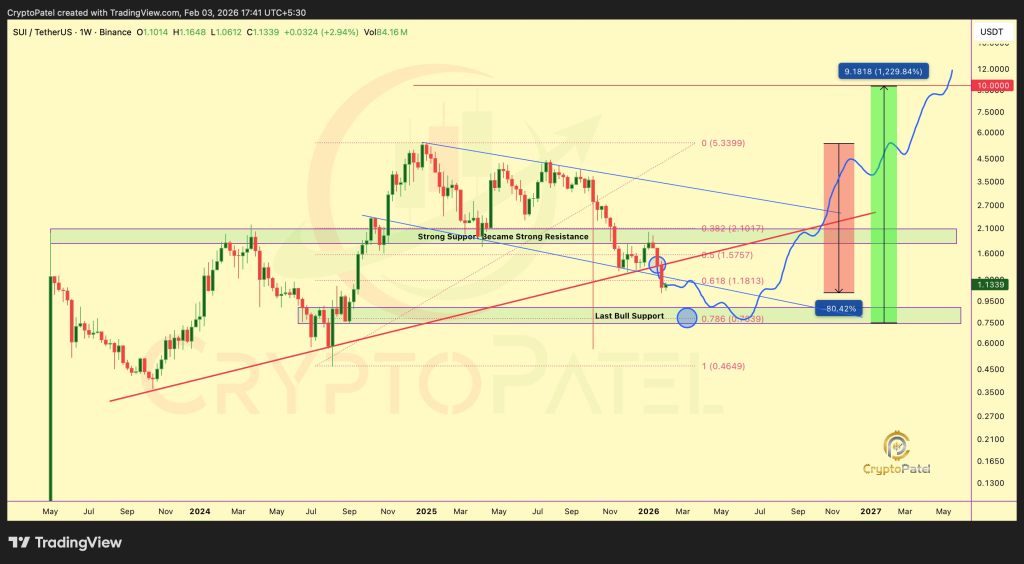
SUI Price Is Down 80%: Price Nears Level Bulls Cannot Afford to Lose

SUI Price Is Down 80%: Price Nears Level Bulls Cannot Afford to Lose

SUI price has quietly slipped into a zone that usually decides everything. Charts show an 80% drop from the peak, yet the market is no longer moving fast. This
Share
Captainaltcoin2026/02/04 03:00