

Ethereum’s $100M Ghost Fund Rises From the 2016 DAO Collapse — This Time Different?
Nearly a decade after one of crypto’s most defining crises, unclaimed Ether from the 2016 hack of The DAO is being repurposed to support Ethereum’s security, reviving a project whose collapse once threatened the network’s survival.
This time, its backers say, the goal is not experimentation but strengthening Ethereum’s defenses using resources left behind by the event that first exposed its vulnerabilities.
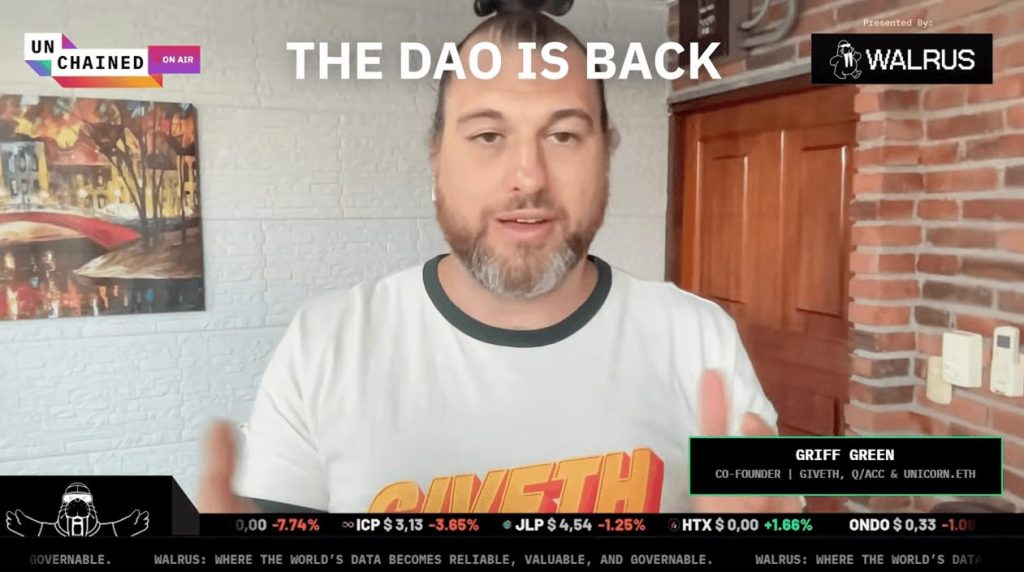
This week, Ethereum developer and longtime communal member Griff Green announced that hundreds of millions of dollars in Ether that went unclaimed following The DAO hack will be initiated into a new security-centered funding initiative.
 Source: Unchained
In an appearance on the Unchained podcast, Green asserted that huge amounts of ETH are trapped in contracts that were made to compensate victims of the exploit, but they never actually claimed them.
Instead, he said, that money will now be used to generate a staking income and fund security work throughout the Ethereum ecosystem.
Inside the DAO Hack and Ethereum’s Historic Fork
In early 2016, the DAO was initiated as a decentralized venture capital, which permitted tokenholders to make decisions on a shared basis about the allocation of capital. It collected over $150 million in ETH, the biggest crowdfunding project at the time.
In June 2016, an attacker used a vulnerability in its smart contracts, called a reentrancy vulnerability, to empty its smart contracts of around 3.6 million ETH into a second contract.
The hack caused an existential crisis in Ethereum and a controversial hard fork that refunded most of the stolen money to the investors.
That ruling divided the community and formed two blockchains: Ethereum and Ethereum Classic.
While the fork restored the majority of funds, the recovery process was not clean. Green said around $6 million was set aside to handle complex cases involving investors who were unable to claim their ETH through standard mechanisms.
He joined a multisignature wallet established to manage those cases. Over time, more than 80% of that balance was claimed, but the remainder, now worth around $200 million at current prices, was left untouched.
DAO Hack Era Funds Revived for Network Security
According to Green, those unclaimed funds will form the backbone of what is being called The DAO Security Fund. The plan involves roughly 70,500 ETH held in an ExtraBalance Withdrawal contract, along with about 4,600 ETH and DAO tokens from the original curator multisig.
The capital will be staked, with yield directed toward funding security efforts rather than distributed as a one-time payout. The initiative is being coordinated alongside the Ethereum Foundation and aligns with its broader “Trillion Dollar Security” push.
Green said the fund will operate using decentralized allocation methods rather than top-down grants. Proposed mechanisms include quadratic funding, retroactive public goods funding, ranked-choice voting, and other DAO-style distribution models.
Oversight will involve well-known figures from the Ethereum security community, including Vitalik Buterin, MetaMask co-founder Taylor Monahan, Jordi Baylina, and members of the SEAL 911 response group.
Giveth, a public goods funding platform co-founded by Green, is also expected to play a role in administering allocations.
Ethereum’s Long Road From Early Hacks to Billion-Dollar DAOs
The move comes as Ethereum security has become a central concern for both developers and institutions.
The DAO hack itself helped give rise to the modern smart contract audit industry, which barely existed before 2016.
Since then, Ethereum has grown into the backbone of decentralized finance, NFTs, and tokenized assets, with billions of dollars regularly secured by smart contracts.
The revival of the DAO name also reflects how far decentralized governance has evolved since its early days.
By 2025, decentralized organizations collectively managed more than $24 billion in treasury assets, with major protocols like Uniswap, Arbitrum, and Optimism overseeing billion-dollar balances.
You May Also Like

Over 60% of crypto press releases linked to high-risk or scam projects: Report

Outlook remains cautious – TD Securities
