

Why acquisitions, not fundraising, defined Africa’s tech ecosystem in 2025
In 2025, Africa’s tech ecosystem entered a new phase as funding cautiously returned and deal activity recovered; acquisitions, not fundraising, began to define the next stage of growth.
According to TechCabal Insights’ State of Tech in Africa (SOTIA) 2025: Year in Review report, acquisition is no longer a fallback exit but an intentional strategy in a more disciplined market.
The new question is no longer who can raise next, but who can survive, consolidate, and compound advantage under tighter conditions.
The surge in mergers and acquisitions (M&A) activity in 2025, 67 deals, a 72% increase from the 39 recorded in 2024, made the transformation evident: the ecosystem is transitioning from growth to consolidation.
For much of Africa’s tech boom, growth had been fragmented. Startups focused on narrow problems in payments, logistics, lending, mobility, or commerce, often constrained to single markets by regulation, currency risk, or infrastructure gaps. Venture capital rewarded rapid expansion, even when unit economics lagged behind ambition.
By 2025, that model had reached its limits. While total startup funding rebounded strongly to $3.42 billion from $2.24 billion in 2024, the capital was no longer evenly distributed. Investors concentrated their bets on fewer, more established companies like Moniepoint, with large deals capturing the vast majority of funding.
This concentration had two effects. First, it strengthened a small group of market leaders.
Second, it left many capable but capital-constrained startups facing a stark choice: struggle for increasingly scarce early-stage funding, or seek shelter through consolidation.
The shift culminated in a record wave of acquisitions. Rather than competing head-on in crowded markets, dominant players began buying their way into new capabilities, geographies, and regulatory footholds.
In April 2025, Kenyan-based foodtech company, Twiga Foods, acquired three distributors—Raisons in Mombasa, Sojpar in Kisumu, and Jumra in Nairobi—to strengthen its supply chain and advance an “asset-light” model.
In June 2025, online food delivery company Chowdeck acquired Mira to integrate POS tools and enhance vendor connections. The previous month, MaxAB-Wasoko acquired Egypt’s Fatura to expand its B2B commerce and fintech capabilities. Earlier in March 2025, hearX, a South African healthtech company, merged with US-based Eargo in a $100 million deal to form LXE Hearing, targeting the global hearing loss market.
Fintech leads the acquisition playbook
While fintech startups remained the most attractive to investors, they also led M&A activity in 2025.
Accounting for 31 deals, or roughly 46% of all acquisitions, fintechs used M&A strategically rather than indiscriminately.
Payment companies, for instance, pursued acquisitions to secure banking licenses. In June, Moniepoint acquired Sumac Microfinance Bank in Kenya and Bancom Europe Ltd in the UK to secure key lending and operating licences.
Meanwhile, lending startups focused on strengthening their balance sheets. In March 2025, Payhippo rebranded as Rivy after a $4 million raise, pivoting from general SME lending to specialised clean energy financing, and Wabeh, the East African startup facing rising default rates, scaled back its Buy Now, Pay Later (BNPL) product.
Platforms that once relied on partners moved to own more of the value chain outright. Moniepoint’s acquisitions across Africa and Europe were about regulatory access and international reach.
South African infrastructure firm Stitch’s purchases of payment infrastructure firms like ExiPay in January and Efficacy Payments in July were designed to internalise critical rails rather than depend on third parties.
Buying an already-licensed institution can compress years of approvals into a single transaction.
In markets where compliance is tightening and enforcement is aggressive, acquisitions offer certainty in an otherwise volatile environment.
Consolidation beyond fintech
While fintech dominated headlines, consolidation spread across sectors. In e-commerce and logistics, acquisitions focused on efficiency and vertical integration.
Companies like Twiga Foods strengthened supply chains by absorbing distributors. Food delivery platforms expanded their reach into merchant tools by acquiring POS and payments startups. Logistics firms assembled regional networks piece by piece.
Telecoms and media companies such as Vodacom Group, with its 30% stake in Maziv for approximately $752 million, also leaned into strategic buys, using acquisitions to deepen infrastructure control and content distribution. Healthcare and deeptech deals showed that even highly specialised startups could attract buyers when their technology addressed critical problems at scale. For example, Egyptian healthcare logistics startup Grinta acquired Citi Clinic to broaden its regional presence, while Adapt IT acquired ResRequest to grow its specialised hospitality software division.
Across sectors, the logic was consistent: in a market where capital is more expensive and regulation more assertive, ownership beats dependency.
Buying scale, instead of building it
In the past, startups tried to brute-force expansion through local hires and partnerships, often with mixed results.
In 2025, acquisitions emerged as a cleaner alternative. By buying existing players with established teams, licences, and customers, startups could enter new markets faster and with less risk. This strategy drove a surge in expansion activity, including moves beyond Africa into Europe and Latin America.
Moove’s acquisition of a Brazilian mobility startup in February 2025 illustrated how African companies are now exporting their models globally, not just regionally. Logistics and commerce players followed similar paths, stitching together pan-African footprints through targeted buys rather than greenfield launches. Wakanow, the Nigerian travel tech giant, acquired the digital ticketing lifestyle platform Nairabox, while Global Shop Group acquired the fashion e-commerce platform ANKA (formerly Afrikea) to strengthen its delivery networks.
You May Also Like
Crypto execs met with US lawmakers to discuss Bitcoin reserve, market structure bills
Lawmakers in the US House of Representatives and Senate met with cryptocurrency industry leaders in three separate roundtable events this week. Members of the US Congress met with key figures in the cryptocurrency industry to discuss issues and potential laws related to the establishment of a strategic Bitcoin reserve and a market structure.On Tuesday, a group of lawmakers that included Alaska Representative Nick Begich and Ohio Senator Bernie Moreno met with Strategy co-founder Michael Saylor and others in a roundtable event regarding the BITCOIN Act, a bill to establish a strategic Bitcoin (BTC) reserve. The discussion was hosted by the advocacy organization Digital Chamber and its affiliates, the Digital Power Network and Bitcoin Treasury Council.“Legislators and the executives at yesterday’s roundtable agree, there is a need [for] a Strategic Bitcoin Reserve law to ensure its longevity for America’s financial future,” Hailey Miller, director of government affairs and public policy at Digital Power Network, told Cointelegraph. “Most attendees are looking for next steps, which may mean including the SBR within the broader policy frameworks already advancing.“Read more
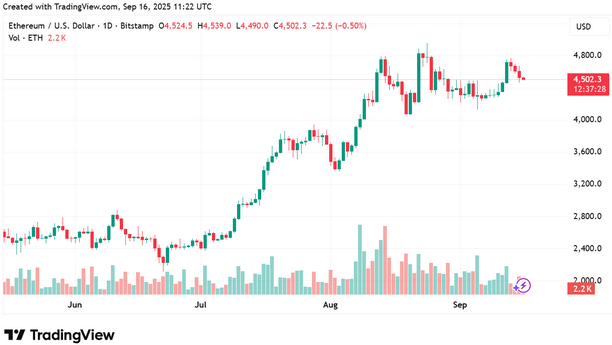
Ethereum Price Prediction: ETH Targets $10,000 In 2026 But Layer Brett Could Reach $1 From $0.0058
