House Republicans scrambled to win over holdouts on Wednesday to pass a procedural motion for several crypto bills by a vote of 217–212.House Republicans scrambled to win over holdouts on Wednesday to pass a procedural motion for several crypto bills by a vote of 217–212.

Crypto Week survives scare as House members scramble to advance procedural motion in a 217–212 vote

4 min read
  • House lawmakers passed a procedural motion to move several crypto bills to the floor for deliberation after hours of debate.
  • The development follows a dispute among Republican lawmakers over the merging of the CLARITY and Anti-CBDC Surveillance bills.
  • The GENIUS and CLARITY bills could receive a floor vote on Thursday after the Anti-CBDC bill was attached to the NDAA Act.

House Republicans scrambled to win over holdouts on Wednesday to pass a procedural motion for several crypto bills by a vote of 217–212. The longest House vote in history, which lasted nearly ten hours, will see the GENIUS and CLARITY bills head to the floor for final passage deliberations on Thursday.

House lawmakers pass procedural motion to keep Crypto Week hopes alive

The House Crypto Week faced a crucial test again on Wednesday after lawmakers scrambled to pass a procedural motion that would allow the GENIUS, CLARITY, and Anti-CBDC Surveillance bills to move forward. After lingering for nearly 10 hours, in what became the longest vote in the House, the procedural motion passed by a vote of 217–212, marking success in Republican efforts to bring the bills to the floor for final passage.
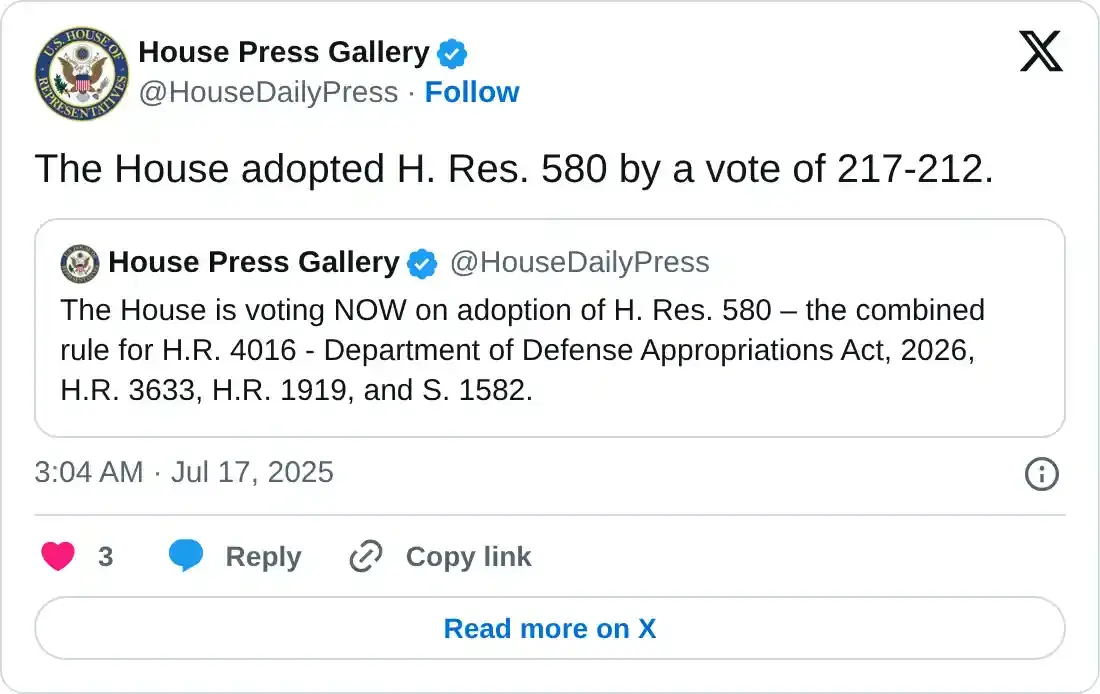
https://x.com/HouseDailyPress/status/1945680877196906923

The success came after most Republicans reversed their previous stance from a "no" to a "yes" within a few hours.

The development shook crypto community members, who had anticipated swift engagement from lawmakers after Tuesday's failed effort.

Through an initial 215–211 vote on Wednesday, lawmakers narrowly approved reconsideration of the procedural motion for the bills, but debates in the House stalled progress on the vote.

The setback came after nine Republicans initially withheld support, pushing for the CLARITY and Anti-CBDC Surveillance State bills to be joined into one. Insiders noted that joining both bills was part of a deal between former President Trump and 12 GOP lawmakers during a meeting late Tuesday. The agreement was expected to secure their backing for the procedural vote.

"It looks like some of the 12 Republicans who voted no yesterday [Tuesday] — but flipped to yes after meeting with Trump last night — did so on the promise that strong anti-CBDC language would be added to CLARITY, since GENIUS isn't open for amendments'" wrote Crypto in America's Eleanor Terret on X.

This comes after lawmakers initially attempted to bring the three crypto bills to the House floor for final deliberation on Tuesday. The attempt failed in a 196-223 vote, with 12 Republicans voting against the motion.

GOP members who initially refused to support the motion cited concerns over a central bank digital currency (CBDC) and the lack of a combined legislative package.

However, efforts to merge the market structure bill with the Anti-CBDC legislation also faced pushback from Republicans who wrote the CLARITY Act. This group expressed that merging the bills could make it difficult for CLARITY to pass, as the inclusion of anti-CBDC language could force Democrats to withdraw their support.

"The authors and a handful of other Financial Services Committee members have made it clear they believe adding anti-CBDC provisions to CLARITY [...] could jeopardize the bipartisan market structure legislation," Terret added.

After several meetings, Rep. Tom Emmer said the Anti-CBDC bill will be added to the National Defense Authorization Act (NDAA).

"Attaching our Anti-CBDC Surveillance State Act to the NDAA will ensure unelected bureaucrats are NEVER allowed to trade Americans' financial privacy for a CCP-style surveillance tool," said Majority Whip Tom Emmer in an X post.

The GENIUS and CLARITY bills could be set for a floor vote as early as Thursday for final passage.

The GENIUS bill specifically targets the regulation of stablecoins, while the CLARITY bill, also known as the market structure bill, aims to provide clear guidance for the broader cryptocurrency market. The Anti-CBDC Surveillance State bill, on the other hand, aims to restrict the Federal Reserve (Fed) from developing, issuing, or using a Central Bank Digital Currency (CBDC) for monetary purposes.


Market Opportunity
Housecoin Logo
Housecoin Price(HOUSE)
$0.000707
$0.000707$0.000707
-1.33%
USD
Housecoin (HOUSE) Live Price Chart
Disclaimer: The articles reposted on this site are sourced from public platforms and are provided for informational purposes only. They do not necessarily reflect the views of MEXC. All rights remain with the original authors. If you believe any content infringes on third-party rights, please contact service@support.mexc.com for removal. MEXC makes no guarantees regarding the accuracy, completeness, or timeliness of the content and is not responsible for any actions taken based on the information provided. The content does not constitute financial, legal, or other professional advice, nor should it be considered a recommendation or endorsement by MEXC.

You May Also Like

Recovery extends to $88.20, momentum improves

Recovery extends to $88.20, momentum improves

The post Recovery extends to $88.20, momentum improves appeared on BitcoinEthereumNews.com. Silver price extended its recovery for the second straight day, up by
Share
BitcoinEthereumNews2026/02/05 07:34
Fed Decides On Interest Rates Today—Here’s What To Watch For

Fed Decides On Interest Rates Today—Here’s What To Watch For

The post Fed Decides On Interest Rates Today—Here’s What To Watch For appeared on BitcoinEthereumNews.com. Topline The Federal Reserve on Wednesday will conclude a two-day policymaking meeting and release a decision on whether to lower interest rates—following months of pressure and criticism from President Donald Trump—and potentially signal whether additional cuts are on the way. President Donald Trump has urged the central bank to “CUT INTEREST RATES, NOW, AND BIGGER” than they might plan to. Getty Images Key Facts The central bank is poised to cut interest rates by at least a quarter-point, down from the 4.25% to 4.5% range where they have been held since December to between 4% and 4.25%, as Wall Street has placed 100% odds of a rate cut, according to CME’s FedWatch, with higher odds (94%) on a quarter-point cut than a half-point (6%) reduction. Fed governors Christopher Waller and Michelle Bowman, both Trump appointees, voted in July for a quarter-point reduction to rates, and they may dissent again in favor of a large cut alongside Stephen Miran, Trump’s Council of Economic Advisers’ chair, who was sworn in at the meeting’s start on Tuesday. It’s unclear whether other policymakers, including Kansas City Fed President Jeffrey Schmid and St. Louis Fed President Alberto Musalem, will favor larger cuts or opt for no reduction. Fed Chair Jerome Powell said in his Jackson Hole, Wyoming, address last month the central bank would likely consider a looser monetary policy, noting the “shifting balance of risks” on the U.S. economy “may warrant adjusting our policy stance.” David Mericle, an economist for Goldman Sachs, wrote in a note the “key question” for the Fed’s meeting is whether policymakers signal “this is likely the first in a series of consecutive cuts” as the central bank is anticipated to “acknowledge the softening in the labor market,” though they may not “nod to an October cut.” Mericle said he…
Share
BitcoinEthereumNews2025/09/18 00:23
Wormhole launches reserve tying protocol revenue to token

Wormhole launches reserve tying protocol revenue to token

The post Wormhole launches reserve tying protocol revenue to token appeared on BitcoinEthereumNews.com. Wormhole is changing how its W token works by creating a new reserve designed to hold value for the long term. Announced on Wednesday, the Wormhole Reserve will collect onchain and offchain revenues and other value generated across the protocol and its applications (including Portal) and accumulate them into W, locking the tokens within the reserve. The reserve is part of a broader update called W 2.0. Other changes include a 4% targeted base yield for tokenholders who stake and take part in governance. While staking rewards will vary, Wormhole said active users of ecosystem apps can earn boosted yields through features like Portal Earn. The team stressed that no new tokens are being minted; rewards come from existing supply and protocol revenues, keeping the cap fixed at 10 billion. Wormhole is also overhauling its token release schedule. Instead of releasing large amounts of W at once under the old “cliff” model, the network will shift to steady, bi-weekly unlocks starting October 3, 2025. The aim is to avoid sharp periods of selling pressure and create a more predictable environment for investors. Lockups for some groups, including validators and investors, will extend an additional six months, until October 2028. Core contributor tokens remain under longer contractual time locks. Wormhole launched in 2020 as a cross-chain bridge and now connects more than 40 blockchains. The W token powers governance and staking, with a capped supply of 10 billion. By redirecting fees and revenues into the new reserve, Wormhole is betting that its token can maintain value as demand for moving assets and data between chains grows. This is a developing story. This article was generated with the assistance of AI and reviewed by editor Jeffrey Albus before publication. Get the news in your inbox. Explore Blockworks newsletters: Source: https://blockworks.co/news/wormhole-launches-reserve
Share
BitcoinEthereumNews2025/09/18 01:55