President Donald Trump successfully rallied House Republicans back into line Tuesday night after personally meeting with GOP holdouts who had blocked major crypto legislation earlier in the day. The late-evening intervention secured commitments from 11 of the 12 Republicans needed to advance the stablecoin-focused GENIUS Act and companion crypto bills. Trump Steps Up After Unexpected Defeat The House voted 196-223 against a procedural rule Tuesday during “Crypto Week” that would have allowed the GENIUS Act, the CLARITY Act, and the Anti-CBDC Surveillance State Act to advance to floor debate. The unexpected defeat threatened to derail the administration’s push for comprehensive digital asset legislation. Trump wrote on Truth Social. Many Republicans who voted against the bills expressed concerns that the GENIUS Act could enable a central bank digital currency despite language explicitly prohibiting the Federal Reserve from creating one. The bill states it “shall not be construed as expanding the Fed’s authority to offer services directly to the public.” The turnaround came after months of bipartisan work on the GENIUS Act, which passed the Senate 68-30 in June with 18 Democrats joining most Republicans. The legislation requires stablecoin issuers to maintain full dollar backing and establishes clear federal oversight frameworks. Republican Revolt Nearly Derails Crypto Legislation Thirteen Republicans initially voted against the procedural rule, citing fears about potential CBDC authorization. The “no” votes included prominent conservatives such as Reps. Marjorie Taylor Greene (Ga.), Chip Roy (Texas), and Andy Biggs (Ariz.). “ I just voted NO on the Rule for the GENIUS Act because it does not include a ban on Central Bank Digital Currency and because Speaker Johnson did not allow us to submit amendments, ” Rep. Greene wrote on X. The revolt occurred despite House Republicans’ strategy to advance the Senate version without amendments, thereby expediting the bill’s arrival at Trump’s desk. This approach was designed to deliver the first major crypto legislation to clear both chambers of Congress. Speaker Mike Johnson participated in Tuesday’s Oval Office meeting via telephone and committed to scheduling the re-vote as early as possible Wednesday morning. 🚨NOTICE OF ACTION🚨 The Committee granted, by a recorded vote of 8-4, a rule providing for consideration of H.R. 4016, H.R. 3633, H.R. 1919, and S. 1582. Thanks to @HouseAppropsGOP , @FinancialCmte , and @HouseAgGOP for their testimony tonight. pic.twitter.com/oAqzRkXVRa — House Rules Committee (@RulesReps) July 15, 2025 The Committee on Rules had granted an 8-4 vote providing consideration for the crypto bills following testimony from key House committees. Rep. Warren Davidson, a Republican who generally supports crypto policy, opposed the GENIUS Act strategy , calling the decision to separate the bills “designed to ultimately fail.” However, Financial Services Chair French Hill defended the approach, stating the bills “will protect investors, consumers, and make America a leader in financial technology.” Even Congressman Tim Moore has voiced his support on X in a post he made a few hours ago. Congress has a real opportunity to ensure America leads on crypto. The House must pass the CLARITY Act, the GENIUS Act, and the Anti-CBDC Surveillance State Act to protect innovation, privacy, and the future of the U.S. dollar. pic.twitter.com/dZsRMh40fT — Congressman Tim Moore (@RepTimMooreNC) July 15, 2025 The GENIUS Act would establish federal licensing requirements for stablecoin issuers and mandate full backing with U.S. dollars or equivalent liquid assets. Consumer protections are included for bankruptcy scenarios, with stablecoin holders receiving priority payments. Treasury Chief Champions Stablecoins as Dollar Reinforcement Tool Treasury Secretary Scott Bessent has become one of the key advocates for the GENIUS Act, declaring that stablecoins can “reinforce dollar supremacy” rather than threaten U.S. monetary dominance. His comments directly address European concerns about American digital asset policies. Crypto is not a threat to the dollar. In fact, stablecoins can reinforce dollar supremacy. Digital assets are one of the most important phenomena in the world right now, yet they have been ignored by national governments for far too long. This administration is committed to… pic.twitter.com/vWsLgYyNW7 — Treasury Secretary Scott Bessent (@SecScottBessent) June 18, 2025 The Treasury chief characterized crypto as “one of the most important phenomena in the world right now “ while criticizing how digital assets have been “ignored by national governments for far too long.” His embrace contrasts sharply with growing European resistance to U.S. stablecoin expansion. Italian Economy Minister Giancarlo Giorgetti warned that U.S. stablecoin policies could pose a “more dangerous impact on the euro than trade tariffs.” European officials fear dollar-denominated stablecoins could undermine monetary sovereignty by offering Europeans alternative payment methods that bypass local financial institutions. The stablecoin market has grown from under $10 billion to $239 billion in five years, with 98% of stablecoins pegged to the dollar and 80% of transactions occurring outside the United States. This expansion has prompted the European Central Bank to accelerate its digital euro project , though implementation remains years away. In light of the near-conclusion of the political drama surrounding the GENIUS Act, Federal banking regulators issued guidance on Monday, clarifying that banks can provide cryptocurrency custody services in both fiduciary and non-fiduciary arrangements. The joint statement from the Federal Reserve, FDIC, and OCC emphasized existing risk-management protocols while removing previous restrictions on crypto business engagement.President Donald Trump successfully rallied House Republicans back into line Tuesday night after personally meeting with GOP holdouts who had blocked major crypto legislation earlier in the day. The late-evening intervention secured commitments from 11 of the 12 Republicans needed to advance the stablecoin-focused GENIUS Act and companion crypto bills. Trump Steps Up After Unexpected Defeat The House voted 196-223 against a procedural rule Tuesday during “Crypto Week” that would have allowed the GENIUS Act, the CLARITY Act, and the Anti-CBDC Surveillance State Act to advance to floor debate. The unexpected defeat threatened to derail the administration’s push for comprehensive digital asset legislation. Trump wrote on Truth Social. Many Republicans who voted against the bills expressed concerns that the GENIUS Act could enable a central bank digital currency despite language explicitly prohibiting the Federal Reserve from creating one. The bill states it “shall not be construed as expanding the Fed’s authority to offer services directly to the public.” The turnaround came after months of bipartisan work on the GENIUS Act, which passed the Senate 68-30 in June with 18 Democrats joining most Republicans. The legislation requires stablecoin issuers to maintain full dollar backing and establishes clear federal oversight frameworks. Republican Revolt Nearly Derails Crypto Legislation Thirteen Republicans initially voted against the procedural rule, citing fears about potential CBDC authorization. The “no” votes included prominent conservatives such as Reps. Marjorie Taylor Greene (Ga.), Chip Roy (Texas), and Andy Biggs (Ariz.). “ I just voted NO on the Rule for the GENIUS Act because it does not include a ban on Central Bank Digital Currency and because Speaker Johnson did not allow us to submit amendments, ” Rep. Greene wrote on X. The revolt occurred despite House Republicans’ strategy to advance the Senate version without amendments, thereby expediting the bill’s arrival at Trump’s desk. This approach was designed to deliver the first major crypto legislation to clear both chambers of Congress. Speaker Mike Johnson participated in Tuesday’s Oval Office meeting via telephone and committed to scheduling the re-vote as early as possible Wednesday morning. 🚨NOTICE OF ACTION🚨 The Committee granted, by a recorded vote of 8-4, a rule providing for consideration of H.R. 4016, H.R. 3633, H.R. 1919, and S. 1582. Thanks to @HouseAppropsGOP , @FinancialCmte , and @HouseAgGOP for their testimony tonight. pic.twitter.com/oAqzRkXVRa — House Rules Committee (@RulesReps) July 15, 2025 The Committee on Rules had granted an 8-4 vote providing consideration for the crypto bills following testimony from key House committees. Rep. Warren Davidson, a Republican who generally supports crypto policy, opposed the GENIUS Act strategy , calling the decision to separate the bills “designed to ultimately fail.” However, Financial Services Chair French Hill defended the approach, stating the bills “will protect investors, consumers, and make America a leader in financial technology.” Even Congressman Tim Moore has voiced his support on X in a post he made a few hours ago. Congress has a real opportunity to ensure America leads on crypto. The House must pass the CLARITY Act, the GENIUS Act, and the Anti-CBDC Surveillance State Act to protect innovation, privacy, and the future of the U.S. dollar. pic.twitter.com/dZsRMh40fT — Congressman Tim Moore (@RepTimMooreNC) July 15, 2025 The GENIUS Act would establish federal licensing requirements for stablecoin issuers and mandate full backing with U.S. dollars or equivalent liquid assets. Consumer protections are included for bankruptcy scenarios, with stablecoin holders receiving priority payments. Treasury Chief Champions Stablecoins as Dollar Reinforcement Tool Treasury Secretary Scott Bessent has become one of the key advocates for the GENIUS Act, declaring that stablecoins can “reinforce dollar supremacy” rather than threaten U.S. monetary dominance. His comments directly address European concerns about American digital asset policies. Crypto is not a threat to the dollar. In fact, stablecoins can reinforce dollar supremacy. Digital assets are one of the most important phenomena in the world right now, yet they have been ignored by national governments for far too long. This administration is committed to… pic.twitter.com/vWsLgYyNW7 — Treasury Secretary Scott Bessent (@SecScottBessent) June 18, 2025 The Treasury chief characterized crypto as “one of the most important phenomena in the world right now “ while criticizing how digital assets have been “ignored by national governments for far too long.” His embrace contrasts sharply with growing European resistance to U.S. stablecoin expansion. Italian Economy Minister Giancarlo Giorgetti warned that U.S. stablecoin policies could pose a “more dangerous impact on the euro than trade tariffs.” European officials fear dollar-denominated stablecoins could undermine monetary sovereignty by offering Europeans alternative payment methods that bypass local financial institutions. The stablecoin market has grown from under $10 billion to $239 billion in five years, with 98% of stablecoins pegged to the dollar and 80% of transactions occurring outside the United States. This expansion has prompted the European Central Bank to accelerate its digital euro project , though implementation remains years away. In light of the near-conclusion of the political drama surrounding the GENIUS Act, Federal banking regulators issued guidance on Monday, clarifying that banks can provide cryptocurrency custody services in both fiduciary and non-fiduciary arrangements. The joint statement from the Federal Reserve, FDIC, and OCC emphasized existing risk-management protocols while removing previous restrictions on crypto business engagement.

Trump Secures 11 GOP Votes for GENIUS Act Following Oval Office Meeting — Vote Expected Tomorrow

4 min read

President Donald Trump successfully rallied House Republicans back into line Tuesday night after personally meeting with GOP holdouts who had blocked major crypto legislation earlier in the day.

The late-evening intervention secured commitments from 11 of the 12 Republicans needed to advance the stablecoin-focused GENIUS Act and companion crypto bills.

Trump Steps Up After Unexpected Defeat

The House voted 196-223 against a procedural rule Tuesday during “Crypto Week” that would have allowed the GENIUS Act, the CLARITY Act, and the Anti-CBDC Surveillance State Act to advance to floor debate.

The unexpected defeat threatened to derail the administration’s push for comprehensive digital asset legislation.
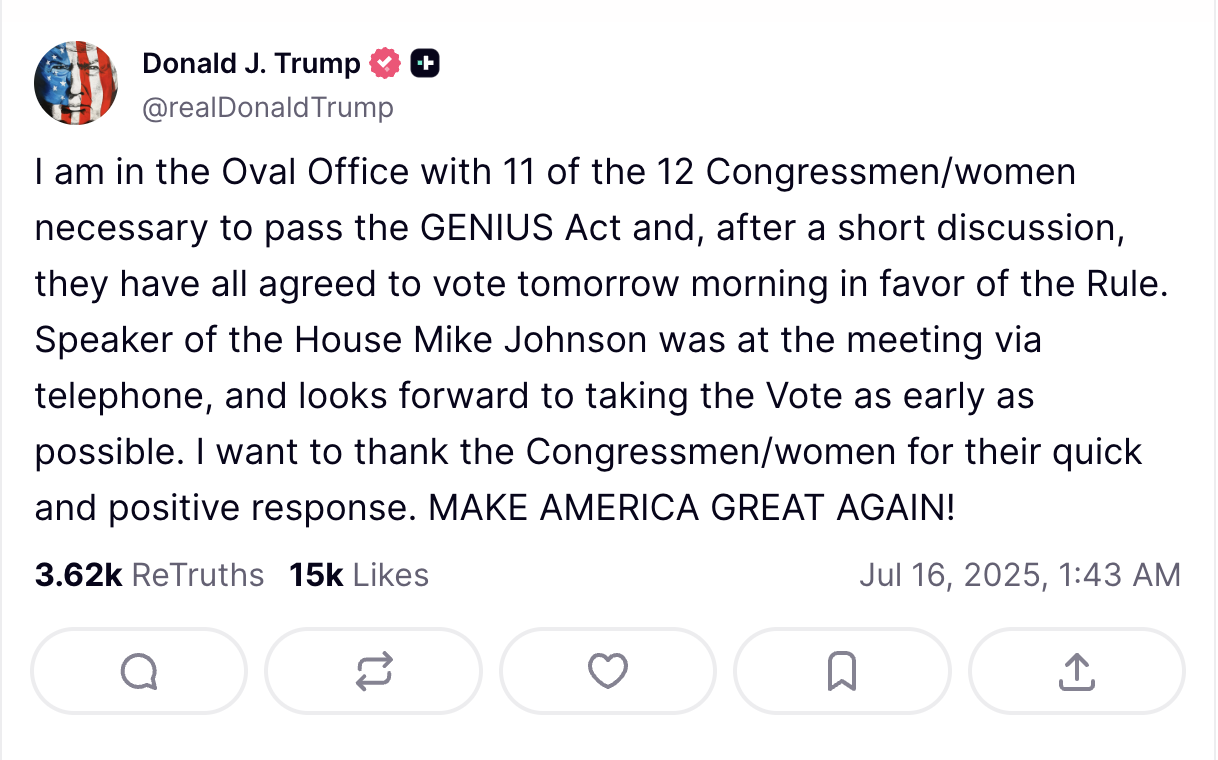
Trump Secures 11 GOP Votes for GENIUS Act Following Oval Office Meeting — Vote Expected TomorrowTrump wrote on Truth Social.

Many Republicans who voted against the bills expressed concerns that the GENIUS Act could enable a central bank digital currency despite language explicitly prohibiting the Federal Reserve from creating one.

The bill states it “shall not be construed as expanding the Fed’s authority to offer services directly to the public.”

The turnaround came after months of bipartisan work on the GENIUS Act, which passed the Senate 68-30 in June with 18 Democrats joining most Republicans.

The legislation requires stablecoin issuers to maintain full dollar backing and establishes clear federal oversight frameworks.

Republican Revolt Nearly Derails Crypto Legislation

Thirteen Republicans initially voted against the procedural rule, citing fears about potential CBDC authorization.

The “no” votes included prominent conservatives such as Reps. Marjorie Taylor Greene (Ga.), Chip Roy (Texas), and Andy Biggs (Ariz.).

I just voted NO on the Rule for the GENIUS Act because it does not include a ban on Central Bank Digital Currency and because Speaker Johnson did not allow us to submit amendments,” Rep. Greene wrote on X.

The revolt occurred despite House Republicans’ strategy to advance the Senate version without amendments, thereby expediting the bill’s arrival at Trump’s desk.

This approach was designed to deliver the first major crypto legislation to clear both chambers of Congress.

Speaker Mike Johnson participated in Tuesday’s Oval Office meeting via telephone and committed to scheduling the re-vote as early as possible Wednesday morning.

The Committee on Rules had granted an 8-4 vote providing consideration for the crypto bills following testimony from key House committees.

Rep. Warren Davidson, a Republican who generally supports crypto policy, opposed the GENIUS Act strategy, calling the decision to separate the bills “designed to ultimately fail.”

However, Financial Services Chair French Hill defended the approach, stating the bills “will protect investors, consumers, and make America a leader in financial technology.”

Even Congressman Tim Moore has voiced his support on X in a post he made a few hours ago.

The GENIUS Act would establish federal licensing requirements for stablecoin issuers and mandate full backing with U.S. dollars or equivalent liquid assets.

Consumer protections are included for bankruptcy scenarios, with stablecoin holders receiving priority payments.

Treasury Chief Champions Stablecoins as Dollar Reinforcement Tool

Treasury Secretary Scott Bessent has become one of the key advocates for the GENIUS Act, declaring that stablecoins can “reinforce dollar supremacy” rather than threaten U.S. monetary dominance.

His comments directly address European concerns about American digital asset policies.

The Treasury chief characterized crypto as “one of the most important phenomena in the world right now while criticizing how digital assets have been “ignored by national governments for far too long.”

His embrace contrasts sharply with growing European resistance to U.S. stablecoin expansion.

Italian Economy Minister Giancarlo Giorgetti warned that U.S. stablecoin policies could pose a “more dangerous impact on the euro than trade tariffs.”

European officials fear dollar-denominated stablecoins could undermine monetary sovereignty by offering Europeans alternative payment methods that bypass local financial institutions.

The stablecoin market has grown from under $10 billion to $239 billion in five years, with 98% of stablecoins pegged to the dollar and 80% of transactions occurring outside the United States.

This expansion has prompted the European Central Bank to accelerate its digital euro project, though implementation remains years away.

In light of the near-conclusion of the political drama surrounding the GENIUS Act, Federal banking regulators issued guidance on Monday, clarifying that banks can provide cryptocurrency custody services in both fiduciary and non-fiduciary arrangements.

The joint statement from the Federal Reserve, FDIC, and OCC emphasized existing risk-management protocols while removing previous restrictions on crypto business engagement.

Market Opportunity
NEAR Logo
NEAR Price(NEAR)
$1.158
$1.158$1.158
+0.95%
USD
NEAR (NEAR) Live Price Chart
Disclaimer: The articles reposted on this site are sourced from public platforms and are provided for informational purposes only. They do not necessarily reflect the views of MEXC. All rights remain with the original authors. If you believe any content infringes on third-party rights, please contact service@support.mexc.com for removal. MEXC makes no guarantees regarding the accuracy, completeness, or timeliness of the content and is not responsible for any actions taken based on the information provided. The content does not constitute financial, legal, or other professional advice, nor should it be considered a recommendation or endorsement by MEXC.

You May Also Like

Eric Trump bets Fed rate cut will send crypto stocks skyrocketing

Eric Trump bets Fed rate cut will send crypto stocks skyrocketing

Eric Trump is betting big on the fourth quarter. He says if the Federal Reserve cuts rates like everyone’s expecting, crypto stocks are going to rip higher… fast. “I just think you would potentially see this thing skyrocket,” Eric told Yahoo Finance, pointing to the usual year-end momentum in crypto. He says this moment matters […]
Share
Cryptopolitan2025/09/18 00:24
Vlna BitcoinFi boomu sa začína s HYPER

Vlna BitcoinFi boomu sa začína s HYPER

The post Vlna BitcoinFi boomu sa začína s HYPER appeared on BitcoinEthereumNews.com. Bitcoin Hyper získava 16 miliónov USD: Vlna BitcoinFi boomu sa začína s HYPER Sign Up for Our Newsletter! For updates and exclusive offers enter your email. Với hơn 5 năm làm việc trong lĩnh vực phân tích thị trường tiền điện tử, Khang luôn hướng tới mục tiêu đem lại các kiến thức bổ ích về crypto cho bạn đọc. Anh có rất nhiều bài viết chất lượng phân tích xu hướng blockchain, DeFi và các dự án presale coin tiềm năng mới. This website uses cookies. By continuing to use this website you are giving consent to cookies being used. Visit our Privacy Center or Cookie Policy. I Agree Source: https://bitcoinist.com/bitcoin-hyper-raises-16m-bitcoinfi-boom-with-hyper-vn/
Share
BitcoinEthereumNews2025/09/18 10:00
China Blocks Nvidia’s RTX Pro 6000D as Local Chips Rise

China Blocks Nvidia’s RTX Pro 6000D as Local Chips Rise

The post China Blocks Nvidia’s RTX Pro 6000D as Local Chips Rise appeared on BitcoinEthereumNews.com. China Blocks Nvidia’s RTX Pro 6000D as Local Chips Rise China’s internet regulator has ordered the country’s biggest technology firms, including Alibaba and ByteDance, to stop purchasing Nvidia’s RTX Pro 6000D GPUs. According to the Financial Times, the move shuts down the last major channel for mass supplies of American chips to the Chinese market. Why Beijing Halted Nvidia Purchases Chinese companies had planned to buy tens of thousands of RTX Pro 6000D accelerators and had already begun testing them in servers. But regulators intervened, halting the purchases and signaling stricter controls than earlier measures placed on Nvidia’s H20 chip. Image: Nvidia An audit compared Huawei and Cambricon processors, along with chips developed by Alibaba and Baidu, against Nvidia’s export-approved products. Regulators concluded that Chinese chips had reached performance levels comparable to the restricted U.S. models. This assessment pushed authorities to advise firms to rely more heavily on domestic processors, further tightening Nvidia’s already limited position in China. China’s Drive Toward Tech Independence The decision highlights Beijing’s focus on import substitution — developing self-sufficient chip production to reduce reliance on U.S. supplies. “The signal is now clear: all attention is focused on building a domestic ecosystem,” said a representative of a leading Chinese tech company. Nvidia had unveiled the RTX Pro 6000D in July 2025 during CEO Jensen Huang’s visit to Beijing, in an attempt to keep a foothold in China after Washington restricted exports of its most advanced chips. But momentum is shifting. Industry sources told the Financial Times that Chinese manufacturers plan to triple AI chip production next year to meet growing demand. They believe “domestic supply will now be sufficient without Nvidia.” What It Means for the Future With Huawei, Cambricon, Alibaba, and Baidu stepping up, China is positioning itself for long-term technological independence. Nvidia, meanwhile, faces…
Share
BitcoinEthereumNews2025/09/18 01:37