The new plan requires a KES 6,750 ($52.8) upfront payment, plus KES 16,250 ($125.8) in activation fees and KES 3,010 ($23.3) for shipping, with the balance spreadThe new plan requires a KES 6,750 ($52.8) upfront payment, plus KES 16,250 ($125.8) in activation fees and KES 3,010 ($23.3) for shipping, with the balance spread

Starlink rolls out instalment payments for internet kits in Kenya

2 min read

Starlink, the SpaceX-owned satellite internet service, has introduced instalment payments for its mini kits in Kenya, cutting upfront cost for users as it seeks to revive subscriber growth that has slowed over the past year.

The new plan requires a KES 6,750 ($52.8) upfront payment, plus KES 16,250 ($125.8) in activation fees and KES 3,010 ($23.3) for shipping, with the balance spread over six months. It adds KES 4,500 ($34.8) a month for the kit over six months to the standard KES 6,500 ($50.3) residential subscription fee.

The instalment plan cuts the upfront cost of Starlink’s equipment, which has been a barrier to adoption for most users. It is likely to increase access among price-sensitive users, particularly in rural and underserved areas where paying the full amount upfront has reduced uptake. Priced at KES 27,000 ($209.1), the mini kit now requires less upfront cash, with more of the cost spread across recurring monthly payments.
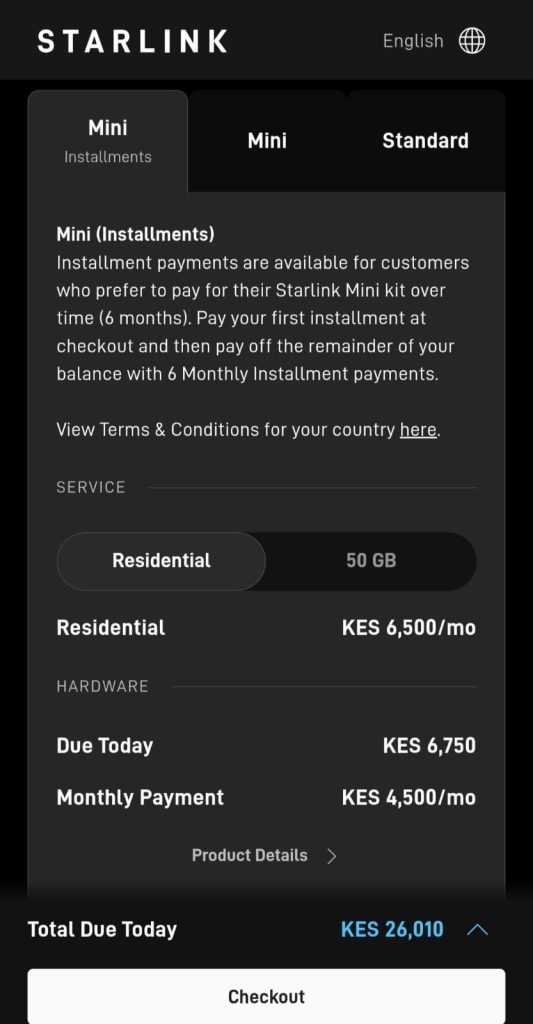
A screenshot of a checkout for a Starlink mini kit. Image source: TechCabal

The Starlink mini kit was introduced into the Kenyan market in September 2024, one year after the company launched to offer a cheaper alternative to the standard kit, which is KES 49,900 ($386.46).

Since it entered Kenya in 2023, the company has expanded rapidly within the first six months, reaching a 0.5% market share. According to data from the Communications Authority of Kenya, the number of customers rose from 16,786 in September 2024 to 19,146 as of December 2025.

However, growth was slowed after the company, in November 2024, halted new sign-ups in densely populated urban areas like Nairobi and Mombasa due to capacity challenges. The freeze, which remained in place until June 2025, reduced its momentum, with active subscriptions falling to 17,066 by March that year.

The pause created an opening for competitors. Safaricom and Airtel, the country’s biggest telcos, moved to deploy 5G routers priced below KES 3,000 ($23), targeting the same rural users Starlink had aimed to reach. Safaricom controls 35.6% of Kenya’s fixed internet market, followed by Jamii Telecom (20.6%), Wananchi Group (12.7%), Poa Internet (12.5%), Ahadi Wireless (7.5%), and Mawingu Networks (3.6%). Starlink follows at a distant (0.8%).

Market Opportunity
SIX Logo
SIX Price(SIX)
$0.00917
$0.00917$0.00917
-10.71%
USD
SIX (SIX) Live Price Chart
Disclaimer: The articles reposted on this site are sourced from public platforms and are provided for informational purposes only. They do not necessarily reflect the views of MEXC. All rights remain with the original authors. If you believe any content infringes on third-party rights, please contact service@support.mexc.com for removal. MEXC makes no guarantees regarding the accuracy, completeness, or timeliness of the content and is not responsible for any actions taken based on the information provided. The content does not constitute financial, legal, or other professional advice, nor should it be considered a recommendation or endorsement by MEXC.
Tags:

You May Also Like

Microsoft Corp. $MSFT blue box area offers a buying opportunity

Microsoft Corp. $MSFT blue box area offers a buying opportunity

The post Microsoft Corp. $MSFT blue box area offers a buying opportunity appeared on BitcoinEthereumNews.com. In today’s article, we’ll examine the recent performance of Microsoft Corp. ($MSFT) through the lens of Elliott Wave Theory. We’ll review how the rally from the April 07, 2025 low unfolded as a 5-wave impulse followed by a 3-swing correction (ABC) and discuss our forecast for the next move. Let’s dive into the structure and expectations for this stock. Five wave impulse structure + ABC + WXY correction $MSFT 8H Elliott Wave chart 9.04.2025 In the 8-hour Elliott Wave count from Sep 04, 2025, we saw that $MSFT completed a 5-wave impulsive cycle at red III. As expected, this initial wave prompted a pullback. We anticipated this pullback to unfold in 3 swings and find buyers in the equal legs area between $497.02 and $471.06 This setup aligns with a typical Elliott Wave correction pattern (ABC), in which the market pauses briefly before resuming its primary trend. $MSFT 8H Elliott Wave chart 7.14.2025 The update, 10 days later, shows the stock finding support from the equal legs area as predicted allowing traders to get risk free. The stock is expected to bounce towards 525 – 532 before deciding if the bounce is a connector or the next leg higher. A break into new ATHs will confirm the latter and can see it trade higher towards 570 – 593 area. Until then, traders should get risk free and protect their capital in case of a WXY double correction. Conclusion In conclusion, our Elliott Wave analysis of Microsoft Corp. ($MSFT) suggested that it remains supported against April 07, 2025 lows and bounce from the blue box area. In the meantime, keep an eye out for any corrective pullbacks that may offer entry opportunities. By applying Elliott Wave Theory, traders can better anticipate the structure of upcoming moves and enhance risk management in volatile markets. Source: https://www.fxstreet.com/news/microsoft-corp-msft-blue-box-area-offers-a-buying-opportunity-202509171323
Share
BitcoinEthereumNews2025/09/18 03:50
Marathon Digital BTC Transfers Highlight Miner Stress

Marathon Digital BTC Transfers Highlight Miner Stress

The post Marathon Digital BTC Transfers Highlight Miner Stress appeared on BitcoinEthereumNews.com. In a tense week for crypto markets, marathon digital has drawn
Share
BitcoinEthereumNews2026/02/06 15:16
Fintech in a Fragmented World: Building Financial Products Across Geopolitical Lines

Fintech in a Fragmented World: Building Financial Products Across Geopolitical Lines

For most of the last ten years, the fintech growth story was one without borders. Startups made digital wallets, payment platforms, lending systems, and trading
Share
Globalfintechseries2026/02/06 15:17