

LIBRA token scam investigation: from presidential endorsement to hacker tracking

Written by Yuliya, PANews
Since Trump issued the coin on January 18, Pump.Fun's zero-threshold coin issuance mechanism has gradually exposed its two-sided nature: on the one hand, it injects liquidity into the market, and on the other hand, it also provides a breeding ground for black and gray industries. The hidden dangers brought by this mechanism are getting bigger and bigger, and of course, it also provides hackers with more opportunities to make money. (Stole social accounts and gave a CA) Congratulations to you who didn't delve into the project and got on board successfully.
On February 15, Argentine President Milei's high-profile support for the LIBRA token on social media pushed the project, which had soared to a market value of $4 billion, to its peak. However, after Milei suddenly deleted the tweet and issued a clarification statement, the LIBRA token plummeted, with the lowest market value shrinking to $130 million, evaporating 96% from the peak. According to people familiar with the matter, as early as a week before the token was issued, there were reports that someone bribed senior officials around President Milei with $5 million in exchange for Milei's public support. This incident caused the market's enthusiasm for meme coins to subside sharply, and the Pump.Fun craze that lasted for a year is fading. The platform protocol fee has dropped by 84.57% from the historical peak of 72,506 SOL on January 1, and now the daily income is only 11,188 SOL.
Accidentally angered top white hat hackers
When KIP Protocol announced the launch of the "Viva la Libertad" project and boasted about the success of the token $LIBRA, it claimed that the project was led by private enterprises and had nothing to do with Argentine President Milei. However, this statement was quickly refuted.
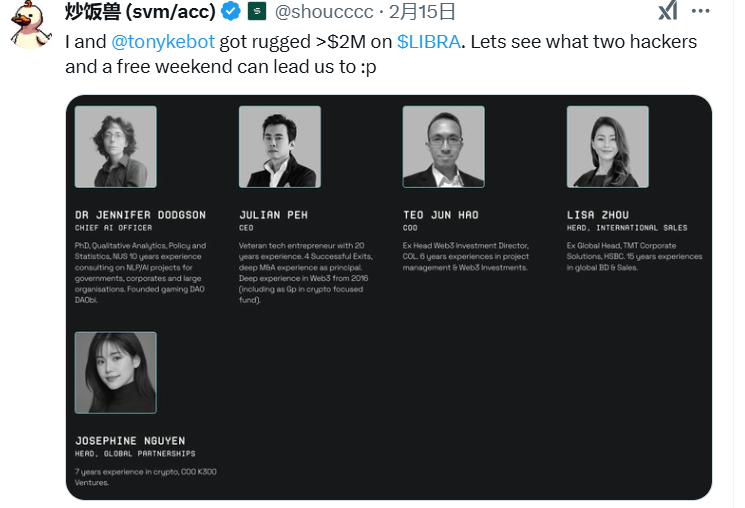
Fuzzland co-founder Chaofan Shou began to blast KIP Protocol, shouting "RNM, return the money!" He cried that he and Solayer engineer @tonykebot lost more than $2 million in the LIBRA project, and revealed the list of core members of KIP Protocol, the team behind LIBRA, saying "Let's see what two hackers and a free weekend can bring us", implying that action will be taken. (It is reported that Shou enjoys a high reputation in the field of network security. His team has successfully recovered more than $33 million in stolen funds and has received more than $1.9 million in bug bounties in the field of Web2 security.)
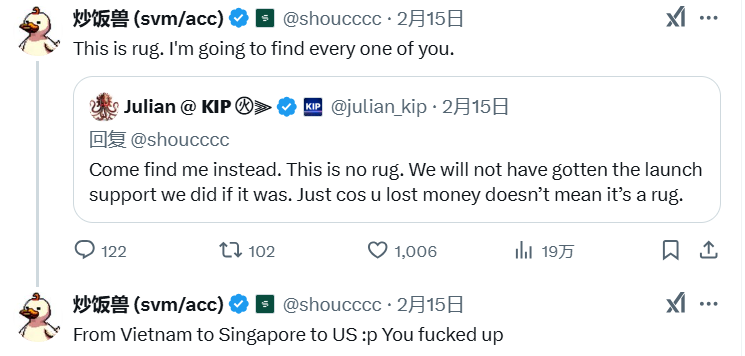
In the next few days, Shou and KIP Protocol co-founder Julian had an online "fight" on Twitter. Julian said, "If the project really rugged, then come to me. It's your problem if you lose money, and it doesn't mean that the project has rugged." In response, Shou threatened to track down the relevant responsible persons, "from Vietnam to Singapore and then to the United States, no one can escape." Then, Shou revealed Julian's personal identity information and bluntly said, "Whether you return the money or not, running away is running away." He warned that "a case of $200 million may face a sentence of up to 50 years in the United States, so I advise you to return to Singapore as soon as possible." Although running away is indeed hateful, the editor believes that it is inappropriate to disclose the identity of others before knowing the result.
Uncover the true face of the project
After the market was in turmoil, many Solana ecosystem projects said they had nothing to do with LIBRA. Meteora co-founder Ben Chow said he had never purchased, received or managed any LIBRA tokens; Jupiter co-founder Siong also said he had not joined forces with projects such as $LIBRA and $ENRON to commit evil.
An investigation by blockchain analysis company Bubblemaps shows that there is a close connection between LIBRA and the previously controversial MELANIA token project. The early sniping wallets of the two projects are highly overlapped, and both use similar "pump and dump" techniques.
- Using the Cross-Chain Protocol (CCTP) to transfer funds between different public chains
- Front-running transactions through multiple linked wallets
- About $87 million was withdrawn from the liquidity pool
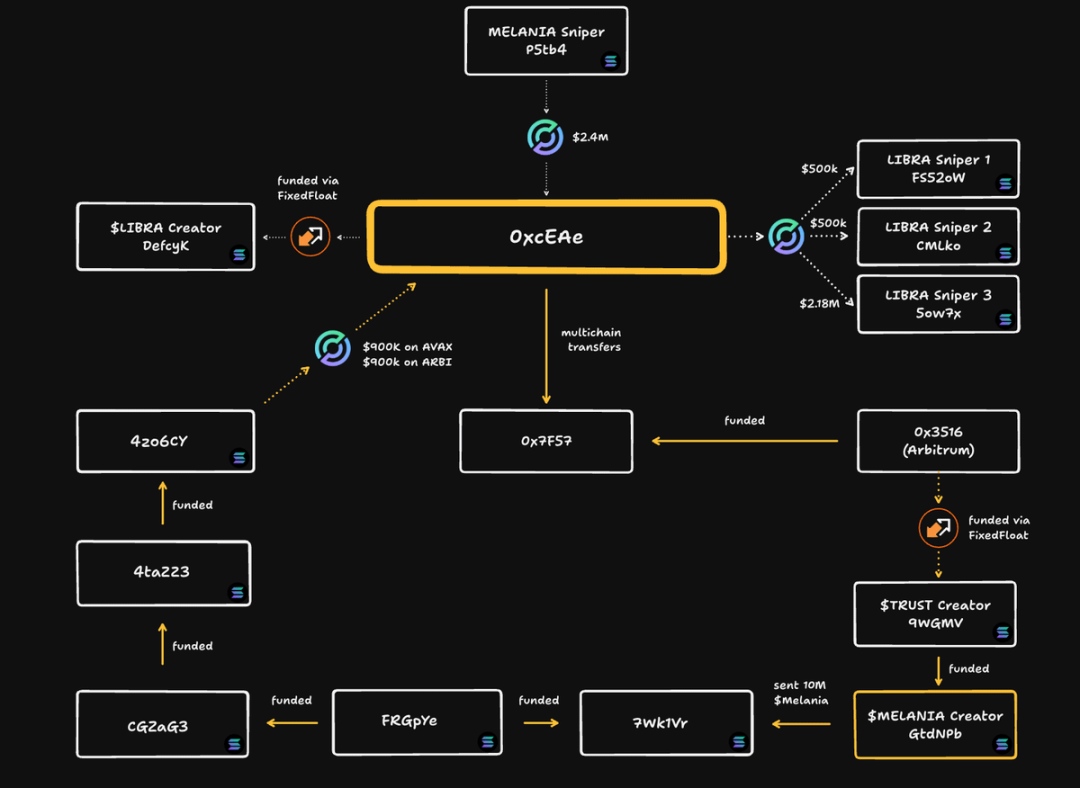
In an interview with YouTube blogger Coffeezilla, Hayden Davis admitted that the team conducted sniping transactions when both LIBRA and MELANIA projects were launched, but emphasized that the original intention of the operation was to protect the liquidity of the projects rather than to profit from them. The core members of the LIBRA project include:
- Hayden Davis (Founder, Kelsier Ventures)
- Julian Peh (Founder of KIP Protocol)
- Mauricio Novelli (Argentina Science and Technology Forum)
- Manuel Godoy (Argentina Technology Forum)
Hayden said that the issuance of LIBRA was not a "cutting of leeks", but a market crash caused by a failed plan. He currently has $100 million in funds and is looking for a solution. He revealed that sniping operations have become a common phenomenon in the meme coin field, and most projects will be exploited by insiders or high-frequency traders during the issuance stage.
In addition, Hayden also pointed out that large meme coin projects including TRUMP, MELANIA, and LIBRA are essentially "insider games" and it is difficult for ordinary investors to participate fairly. He also defended the role of Argentine President Javier Milei in LIBRA, saying that Milei has limited knowledge of cryptocurrencies and supports LIBRA more out of experimental attempts.
Reflection on the incident
The chain reaction caused by the incident continues to ferment:
- Market level: Bitcoin's market share has climbed to a four-year high of 60%. QCP Capital analysis points out that the "runaway" scandal of the LIBRA project may suppress the market of altcoins and meme coins for a long time;
- Judicial level: At present, the Argentine government has set up an inter-departmental investigation team to jointly investigate the case with financial supervision and anti-money laundering agencies. The former central bank governor and others have filed a lawsuit, accusing Milei of playing a key role in the project and suspected of fraud;
- Industry reflection: Zhu Su, co-founder of Three Arrows Capital, believes that the main mistake of the Libra team was to withdraw from the Meteora liquidity pool and conduct short-term arbitrage operations, otherwise it would have operated similarly to the TRUMP token.
This cryptocurrency drama, which combines political endorsement, hacker confrontation and capital manipulation, exposes three real dilemmas in the Web3 world:
- Government endorsement does not mean the project is credible
- Insider trading and market manipulation remain prevalent in the cryptocurrency market
- Community self-governance, especially with the participation of technical experts, may be more effective than traditional regulation
You May Also Like

Polygon: Bulls defend $0.10 demand zone – Can POL rally 15%?

Headwind Helps Best Wallet Token
