The U.S. economy just clocked a 4.3% GDP growth rate for the third quarter — the fastest pace in two years. Consumer spending rose, imports dipped, and overall The U.S. economy just clocked a 4.3% GDP growth rate for the third quarter — the fastest pace in two years. Consumer spending rose, imports dipped, and overall

Can XRP Recover as the U.S. Economy Grows?

The U.S. economy just clocked a 4.3% GDP growth rate for the third quarter — the fastest pace in two years. Consumer spending rose, imports dipped, and overall growth smashed expectations. Yet, XRP price remains subdued, trading around $1.86, slipping 1.39% today. You’d expect stronger economic numbers to boost risk appetite, but that hasn’t happened here. Let’s break down why XRP is still struggling — and what could come next.

XRP Price Prediction: Macro boost vs crypto caution

When economies expand, investors often rotate toward riskier assets, including crypto. But this time, the opposite’s happening. Traders are cautious because the GDP jump may be temporary — fueled by pre-tariff import adjustments and consumer stockpiling rather than sustainable growth. Markets are already pricing in a slowdown for Q4, which means crypto traders are hesitant to place bullish bets just yet.

For XRP price specifically, this hesitation is magnified by ongoing uncertainty around liquidity flows and institutional participation. While Bitcoin and Ethereum are inching higher on ETF optimism, XRP’s momentum has stalled due to technical resistance and lack of strong catalysts from Ripple’s side in recent weeks.

XRP Price Prediction: Stuck under pressure
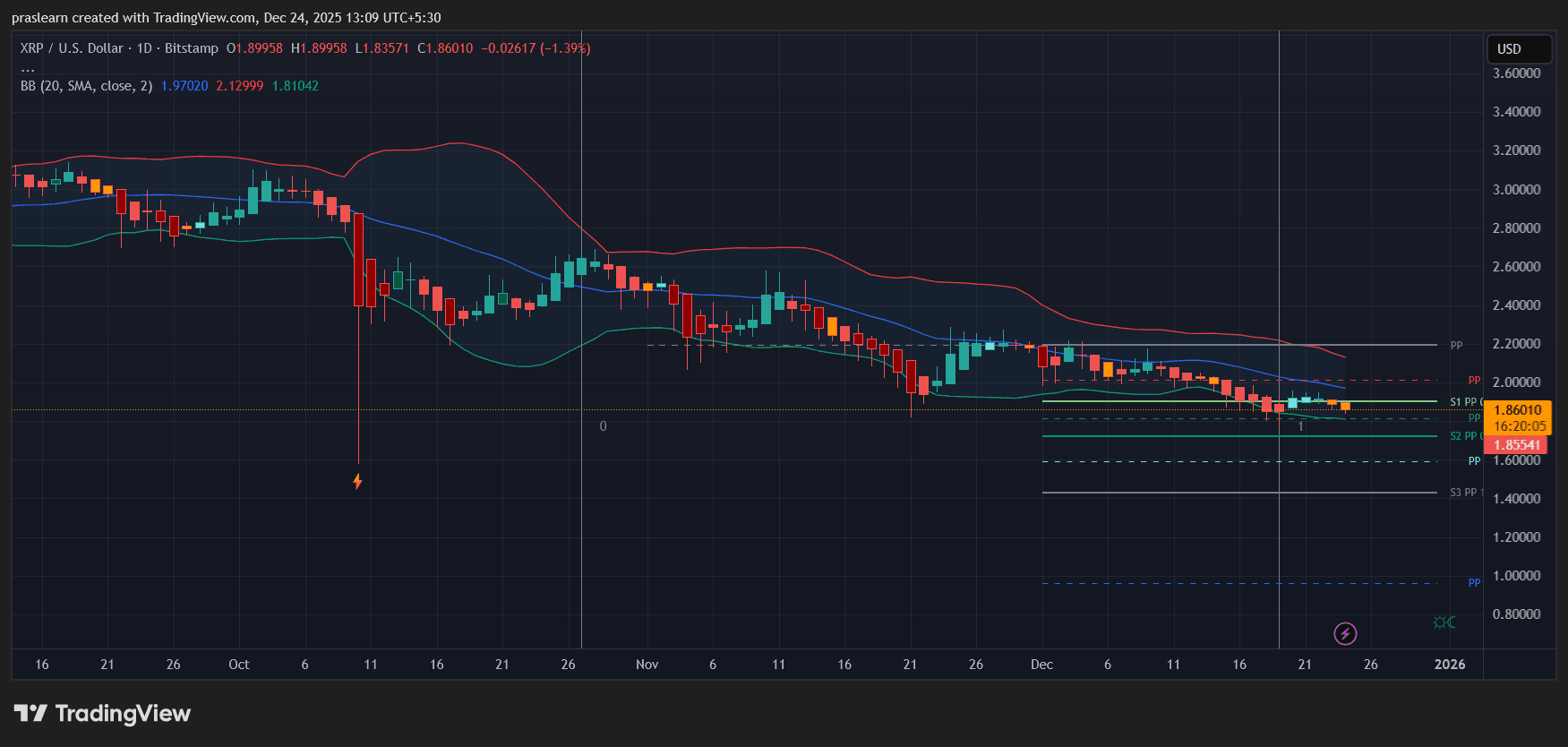
XRP Price predictionXRP/USD Daily Chart- TradingView

The daily chart shows XRP price locked in a narrow range. The price is hovering just below the middle Bollinger Band near $1.97, signaling weak bullish momentum. The lower band around $1.81 is acting as short-term support, while the upper band at $2.12 caps upside potential.

The candles have been consolidating beneath the 20-day SMA, suggesting bears still control the trend. Pivot points show a critical resistance near $2.00, while support zones cluster around $1.85 and $1.60. Unless XRP price breaks above the mid-band with solid volume, the bias remains bearish to neutral.

A close below $1.85 could open the door toward $1.60, aligning with the next S2 pivot line. On the flip side, a sustained move above $2.00 could trigger a short-term recovery rally toward $2.20–$2.30, though that requires a clear macro or Ripple-related catalyst.

Investor sentiment: cautious optimism

The market’s mood toward XRP price has shifted from optimism to quiet observation. The stronger U.S. economy, while positive for broader financial stability, also signals potential tightening by the Federal Reserve if inflation resurfaces. That usually dampens speculative crypto inflows. So, while the GDP number looks bullish on paper, it might indirectly restrain XRP’s upside through monetary tightening fears.

What to expect next?

If the U.S. economy cools slightly in Q4 — as analysts expect due to the earlier import rush and government shutdown effects — crypto markets could stabilize. Historically, XRP price performs better during moderate, not overheated, growth phases. Watch for:

  • A rebound above $2.00 with volume confirmation
  • Bollinger Band contraction signaling volatility buildup

If those align, XRP price could retest $2.20–$2.50 in early 2026. But failure to hold the $1.85 zone would point to a correction toward $1.60 before any rebound.

The economy may be booming, but $XRP is stuck waiting for conviction. Its chart structure shows a market in consolidation — not panic, but not excitement either. Unless Ripple delivers new institutional partnerships or macro sentiment turns risk-on again, XRP price could spend the next few weeks oscillating between $1.85 and $2.00. The breakout direction from that zone will likely define its first quarter of 2026.

Market Opportunity
XRP Logo
XRP Price(XRP)
$1.8606
$1.8606$1.8606
-0.13%
USD
XRP (XRP) Live Price Chart
Disclaimer: The articles reposted on this site are sourced from public platforms and are provided for informational purposes only. They do not necessarily reflect the views of MEXC. All rights remain with the original authors. If you believe any content infringes on third-party rights, please contact service@support.mexc.com for removal. MEXC makes no guarantees regarding the accuracy, completeness, or timeliness of the content and is not responsible for any actions taken based on the information provided. The content does not constitute financial, legal, or other professional advice, nor should it be considered a recommendation or endorsement by MEXC.

You May Also Like

The Channel Factories We’ve Been Waiting For

The Channel Factories We’ve Been Waiting For

The post The Channel Factories We’ve Been Waiting For appeared on BitcoinEthereumNews.com. Visions of future technology are often prescient about the broad strokes while flubbing the details. The tablets in “2001: A Space Odyssey” do indeed look like iPads, but you never see the astronauts paying for subscriptions or wasting hours on Candy Crush.  Channel factories are one vision that arose early in the history of the Lightning Network to address some challenges that Lightning has faced from the beginning. Despite having grown to become Bitcoin’s most successful layer-2 scaling solution, with instant and low-fee payments, Lightning’s scale is limited by its reliance on payment channels. Although Lightning shifts most transactions off-chain, each payment channel still requires an on-chain transaction to open and (usually) another to close. As adoption grows, pressure on the blockchain grows with it. The need for a more scalable approach to managing channels is clear. Channel factories were supposed to meet this need, but where are they? In 2025, subnetworks are emerging that revive the impetus of channel factories with some new details that vastly increase their potential. They are natively interoperable with Lightning and achieve greater scale by allowing a group of participants to open a shared multisig UTXO and create multiple bilateral channels, which reduces the number of on-chain transactions and improves capital efficiency. Achieving greater scale by reducing complexity, Ark and Spark perform the same function as traditional channel factories with new designs and additional capabilities based on shared UTXOs.  Channel Factories 101 Channel factories have been around since the inception of Lightning. A factory is a multiparty contract where multiple users (not just two, as in a Dryja-Poon channel) cooperatively lock funds in a single multisig UTXO. They can open, close and update channels off-chain without updating the blockchain for each operation. Only when participants leave or the factory dissolves is an on-chain transaction…
Share
BitcoinEthereumNews2025/09/18 00:09
Egypt to invite investors for projects in ‘golden triangle’

Egypt to invite investors for projects in ‘golden triangle’

Egypt is preparing a list of projects to show potential investors in its promising “golden triangle” area, home to nearly half the Arab country’s gold deposits.
Share
Agbi2025/12/25 04:09
OpenVPP accused of falsely advertising cooperation with the US government; SEC commissioner clarifies no involvement

OpenVPP accused of falsely advertising cooperation with the US government; SEC commissioner clarifies no involvement

PANews reported on September 17th that on-chain sleuth ZachXBT tweeted that OpenVPP ( $OVPP ) announced this week that it was collaborating with the US government to advance energy tokenization. SEC Commissioner Hester Peirce subsequently responded, stating that the company does not collaborate with or endorse any private crypto projects. The OpenVPP team subsequently hid the response. Several crypto influencers have participated in promoting the project, and the accounts involved have been questioned as typical influencer accounts.
Share
PANews2025/09/17 23:58