Aave founder says the new V4 Hub-and-Spoke liquidity model can improve capital efficiency.  Aave Labs is ready for the V4 mainnet upgrade to bring better value Aave founder says the new V4 Hub-and-Spoke liquidity model can improve capital efficiency.  Aave Labs is ready for the V4 mainnet upgrade to bring better value

Aave V4 Launches Hub-and-Spoke Liquidity Model to Boost DeFi Growth, Founder Shares Impact

  • Aave founder says the new V4 Hub-and-Spoke liquidity model can improve capital efficiency. 
  • Aave Labs is ready for the V4 mainnet upgrade to bring better value to users.

Stani Kulechov, the founder of Aave just showed the community the benefits of the protocol’s new V4 model. This Hub-and-Spoke model manages liquidity on Aave to promote its decentralized finance (DeFi) features.

Founder Stani Highlights Key Aave V4 Features

In an X post, Stani explained that Aave V4 is important in liquidity management. For emphasis, the V4 liquidation engine replaces the fixed mechanism of V3, as previously mentioned in our report.

The new system introduces dynamic liquidation thresholds and an automated auction mechanism. The goal is to reduce manual intervention and improve liquidation speed and capital efficiency.

In his post, the Aave founder noted that all liquidity is stored on hubs that allocate spokes access to draw liquidity. Each Spoke defines its own accepted collaterals, risk parameters, borrowing rules, and potentially specialized features.

However, Hubs are the primary venue where all supplied capital is stored and distributed based on chains connected to Aave. While suppliers deposit assets through Spokes, the assets then flow into the Hub for management. This model helps with overall efficiency.

According to Stani, the new Hub-and-Spoke Aave V4 model will ensure instant bootstrapping for emerging markets. This makes launching new features, asset support, or specialized modes much faster and more viable in a new market.
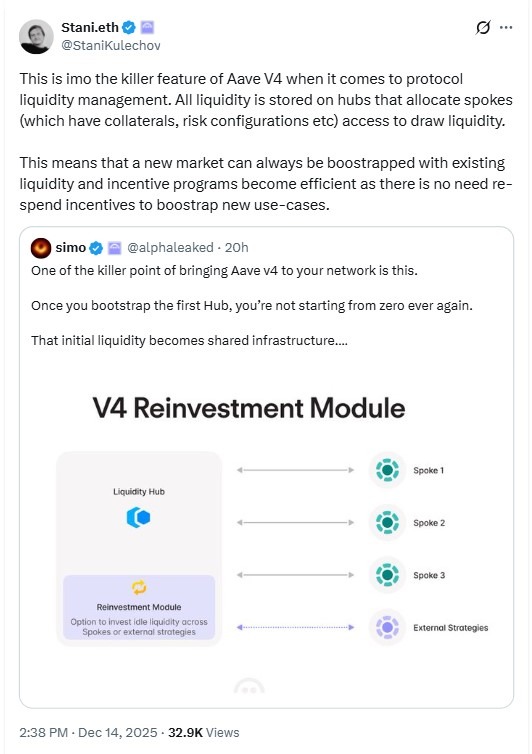
The Aave V4 New Liquidity Model SpotlightThe Aave V4 New Liquidity Model Spotlight | Source: Stani Kulechov on X

He added that incentives will become more targeted and effective because the shared Hub means liquidity is already available. In older versions, the protocol often had to spend AAVE tokens as incentives to grow a new market. 

However, with the new version, there is no need to re-spend incentives to bootstrap new use-cases. Primarily, this kind of design scales liquidity without wasting incentives.

Aave Gears Up for V4 Mainnet Upgrade

Alongside the new model, Aave has launched the V4 public testnet, as we covered in our latest report. The testnet came with a fully open-source V4 codebase and a developer preview of the upgraded Aave Pro interface.

It launched in a Tenderly-based fork environment, with the codebase set to migrate soon to the Aave DAO organization. In the near future, the team will present licensing frameworks for the DAO to review, vote on, and ultimately determine the official licensing approach.

In a related development, Aave Labs submitted a new governance proposal to deploy Aave V3 on MegaETH on the mainnet debut day. The protocol seeks to capture early user activity, deepen liquidity, and meet strong borrowing demand.

Furthermore, Aave also plans to close low-revenue V3 markets and apply a $2 million threshold for new deployments. Previously, we explored that the plan responds to widening revenue gaps between top-performing networks.

]]>
Market Opportunity
AaveToken Logo
AaveToken Price(AAVE)
$188.08
$188.08$188.08
-0.73%
USD
AaveToken (AAVE) Live Price Chart
Disclaimer: The articles reposted on this site are sourced from public platforms and are provided for informational purposes only. They do not necessarily reflect the views of MEXC. All rights remain with the original authors. If you believe any content infringes on third-party rights, please contact service@support.mexc.com for removal. MEXC makes no guarantees regarding the accuracy, completeness, or timeliness of the content and is not responsible for any actions taken based on the information provided. The content does not constitute financial, legal, or other professional advice, nor should it be considered a recommendation or endorsement by MEXC.

You May Also Like

The Channel Factories We’ve Been Waiting For

The Channel Factories We’ve Been Waiting For

The post The Channel Factories We’ve Been Waiting For appeared on BitcoinEthereumNews.com. Visions of future technology are often prescient about the broad strokes while flubbing the details. The tablets in “2001: A Space Odyssey” do indeed look like iPads, but you never see the astronauts paying for subscriptions or wasting hours on Candy Crush.  Channel factories are one vision that arose early in the history of the Lightning Network to address some challenges that Lightning has faced from the beginning. Despite having grown to become Bitcoin’s most successful layer-2 scaling solution, with instant and low-fee payments, Lightning’s scale is limited by its reliance on payment channels. Although Lightning shifts most transactions off-chain, each payment channel still requires an on-chain transaction to open and (usually) another to close. As adoption grows, pressure on the blockchain grows with it. The need for a more scalable approach to managing channels is clear. Channel factories were supposed to meet this need, but where are they? In 2025, subnetworks are emerging that revive the impetus of channel factories with some new details that vastly increase their potential. They are natively interoperable with Lightning and achieve greater scale by allowing a group of participants to open a shared multisig UTXO and create multiple bilateral channels, which reduces the number of on-chain transactions and improves capital efficiency. Achieving greater scale by reducing complexity, Ark and Spark perform the same function as traditional channel factories with new designs and additional capabilities based on shared UTXOs.  Channel Factories 101 Channel factories have been around since the inception of Lightning. A factory is a multiparty contract where multiple users (not just two, as in a Dryja-Poon channel) cooperatively lock funds in a single multisig UTXO. They can open, close and update channels off-chain without updating the blockchain for each operation. Only when participants leave or the factory dissolves is an on-chain transaction…
Share
BitcoinEthereumNews2025/09/18 00:09
Wyoming-based crypto bank Custodia files rehearing petition against Fed

Wyoming-based crypto bank Custodia files rehearing petition against Fed

The post Wyoming-based crypto bank Custodia files rehearing petition against Fed appeared on BitcoinEthereumNews.com. A Wyoming-based crypto bank has filed another
Share
BitcoinEthereumNews2025/12/16 22:06
US economy adds 64,000 jobs in November but unemployment rate climbs to 4.6%

US economy adds 64,000 jobs in November but unemployment rate climbs to 4.6%

The post US economy adds 64,000 jobs in November but unemployment rate climbs to 4.6% appeared on BitcoinEthereumNews.com. The economy moved in two directions at
Share
BitcoinEthereumNews2025/12/16 22:18