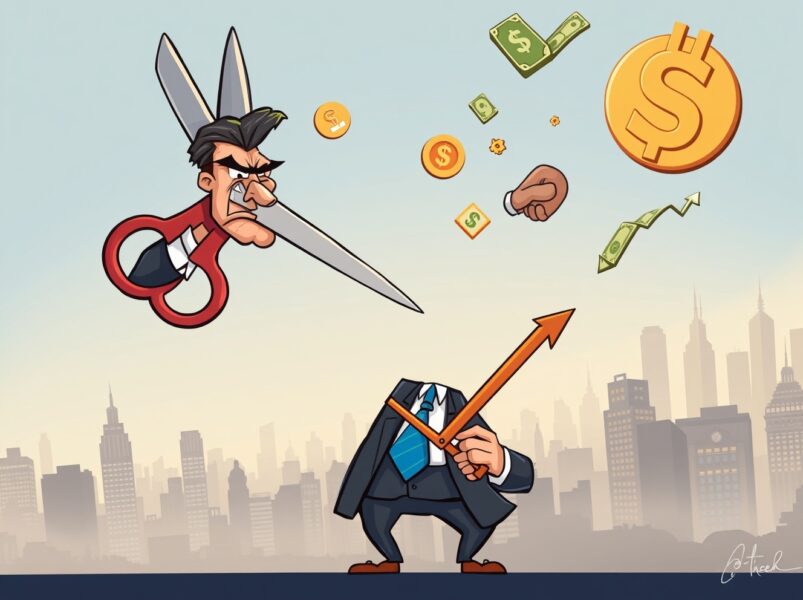
Most projects we see here are *totally useless* and won't exist for more than a few months. Most will be abandoned in 3 weeks when the founder realizes nobody wants to pay for their "revolutionary" todo app with AI. "AI-Powered" means nothing anymore.Most projects we see here are *totally useless* and won't exist for more than a few months. Most will be abandoned in 3 weeks when the founder realizes nobody wants to pay for their "revolutionary" todo app with AI. "AI-Powered" means nothing anymore.

Stop Building "AI-Powered" Sh*t. The SaaS Gold Rush is a Trap

"Check out my SaaS directory list" - nobody cares

"I Hit 10k MRR in 30 Days: Here's How" - stop lying

"I created an AI-powered chatbot" - no, you wrapped OpenAI's API

"Built my MVP in 48 hours with Cursor" - congrats, so did 50,000 other people this week

Most projects we see here are totally useless and won't exist for more than a few months. Actually, scratch that and most will be abandoned in 3 weeks when the founder realizes nobody wants to pay for their "revolutionary" todo app with AI.

And the culprit is you

Yes, you, who thought you'd get rich by:

  • Watching a 47-minute YouTube video titled "I Built a $10k/month SaaS with AI (You Can Too!)"
  • Spending 6 hours "coding" in Cursor (you mean prompting)
  • Slapping together NextJS + Supabase + PostgreSQL + Vercel
  • Adding "AI-Powered" to your landing page (it's literally just a ChatGPT wrapper)
  • Posting on 47 Reddit communities asking for "feedback" (begging for users)
  • Getting 3 signups (your mom, your best friend, and a bot)
  • Wondering why you're not a millionaire yet

Just because AI tools like Cursor, v0, and ChatGPT can help you code faster doesn't mean every AI-generated SaaS needs to exist.

We've seen this movie before

Remember when everyone was:

  • Launching crypto tokens → "This will revolutionize payments!" (Rugpulled in 6 months)
  • Minting NFTs → "Digital art is the future!" (Floor price: $0)
  • Dropshipping fidget spinners → "Passive income!" (Banned by Shopify)
  • Creating courses → "Share your expertise!" (12 sales, all refunded)
  • Starting agencies → "I'll manage your social media!" (Client ghosted after 2 weeks)

And now: Building AI SaaS → "Cursor will make me rich!" (0 MRR after 4 months)

Different costumes, same empty promises.

The harsh truth nobody tells you

1. Your SaaS isn't special

There are 47,000+ SaaS products launched every year. Most die within 12 months.

Why? Because you didn't solve a problem but you created a solution looking for a problem.

Nobody wakes up thinking: "Man, I really wish there was an AI-powered calendar that summarizes my meetings and sends me a haiku about my productivity."

2. "AI-Powered" means nothing anymore

Every SaaS now has "AI" slapped on it:

  • AI project management (it's Trello with GPT)
  • AI email assistant (Gmail + OpenAI API)
  • AI note-taking (Notion clone with embeddings)
  • AI analytics (charts + ChatGPT summaries)

Customers don't care about AI. They care about solving their problem faster, cheaper, or better.

If your only differentiator is "we added AI," you have no differentiator.

3. Tech stack doesn't matter (yet you obsess over it)

You spend 40 hours debating:

  • "Should I use NextJS or Remix?"
  • "Supabase or Firebase?"
  • "TailwindCSS or Chakra UI?"
  • "Vercel or Netlify?"

Nobody gives a shit.

Your customers don't care if you built it in NextJS, PHP, or hand-coded assembly. They care if it solves their problem.

Dropbox's MVP was a video. Airbnb's MVP was Craigslist + a camera. Stripe's first version couldn't even handle edge cases.

Stop optimizing your tech stack. Start talking to customers.

4. You're not a founder. You're a code monkey with delusions

Real founders:

  • Spend 80% of time talking to customers
  • Understand sales, marketing, distribution
  • Obsess over problem-solution fit
  • Build in public and iterate based on feedback
  • Know their numbers (CAC, LTV, churn, MRR)

Fake founders:

  • Spend 80% of time "perfecting" the product
  • Think "if I build it, they will come"
  • Launch on Product Hunt and wonder why nobody cares
  • Have zero customers but "plan to monetize later"
  • Refuse to do sales because "I'm technical, not a salesperson"

If you can't sell, you can't build a business. Period.

5. The only people making money are selling you the dream

That YouTuber with "How I Built a $50k/month SaaS"?

  • Their SaaS makes $2k/month
  • Their course about building SaaS makes $48k/month

That "indie hacker" with a Twitter following?

  • Their product makes $5k/month
  • Their paid community/newsletter makes $30k/month

That "AI automation agency" guy?

  • His agency has 2 clients
  • His "agency blueprint" course has 847 students at $297 each

They're not experts. They're salespeople. And they're good at one thing: making you believe you're just one AI prompt, one tech stack, one "secret framework" away from financial freedom.

You're not.

What we actually need to do (the uncomfortable truth):

1. Stop building. Start validating

Before you write a single line of code:

  • Talk to 50 potential customers
  • Ask: "What's your biggest pain point with [X]?"
  • Ask: "How do you currently solve this?"
  • Ask: "Would you pay $[price] to solve this?"
  • If 30+ say "yes," you might have something

If you can't find 50 people to talk to, you don't understand your market.

2. Solve problems you've personally experienced

The best SaaS founders build solutions to their own problems:

  • Notion → Frustrated with clunky wikis
  • Superhuman → Email was too slow
  • Linear → Jira was a nightmare
  • Figma → Design tools were desktop-only

What problem are you so frustrated with that you'd build a solution even if nobody paid you?

If your answer is "I saw a gap in the market," you're already wrong.

3. Build expertise, not MVPs

Stop launching half-baked products every month. Start building deep expertise in one domain.

Spend 6-12 months:

  • Learning everything about a specific industry
  • Talking to practitioners daily
  • Understanding workflows, pain points, budgets
  • Building a reputation as someone who "gets it"

Then build a solution.

4. Learn sales first, code second

Controversial take: You don't need to code to build a SaaS.

You need to:

  • Identify a painful problem
  • Sell the solution before it exists
  • Hire developers to build it
  • Sell more, iterate, scale

If you're "technical" but can't sell, you're not a founder then you're an engineer looking for a co-founder who'll do the hard part.

Learn sales. Learn copywriting. Learn positioning. Then worry about your tech stack.

5. Build for purpose, not profit (initially)

If your only goal is "make money," you'll quit the moment it gets hard.

The best founders are obsessed with the problem:

  • They'd work on it even without pay
  • They can talk about it for hours
  • They have strong opinions about the industry
  • They've been thinking about this for years

If you're just chasing "passive income," go buy index funds.

Take a breath and ask yourself:

  • What am I genuinely world-class at? (Not "pretty good"—world-class)
  • What problems do I understand better than 99% of people?
  • What could I talk about for 3 hours without notes?
  • What industry do I have insider knowledge about?
  • What would I build even if I knew it would never make money?

If you can't answer these, you're not ready to build a SaaS. You're ready to learn, research, and gain experience.

Let's stop the madness

Stop building:

  • Another AI chatbot
  • Another project management tool "with AI"
  • Another no-code directory
  • Another "Notion alternative"
  • Another Chrome extension that "boosts productivity"

Start building:

  • Deep expertise in a specific domain
  • Relationships with potential customers
  • Sales and marketing skills
  • Financial literacy (understand unit economics)
  • Resilience (because 99% of startups fail)

A brutal reality check

🔴 95% of SaaS products fail

🔴 Only 1% reach $1M ARR

🔴 40% of startups fail due to no market need

🔴 Average time to profitability: 3-5 years(not 30 days)

🔴Most "successful" indie hackers have 5+ failed products behind them

Still want to build a SaaS? Good.

But do it for the right reasons:

  • Because you're obsessed with solving a specific problem
  • Because you have unique insights others don't
  • Because you're willing to spend years learning and iterating
  • Because you understand that coding is 10% of the work

Not because some YouTuber said you could get rich quick with Cursor and NextJS.

Final thoughts:

I'm not saying don't use AI tools. I'm not saying don't build products.

I'm saying: Stop building thoughtless garbage that adds zero value to the world.

If your elevator pitch is "It's like [successful product] but with AI," you don't have a business. You have a copycat with a ChatGPT API key.

If you can't explain why your product needs to exist in one sentence without mentioning "AI," "ML," or "automation," you haven't found product-market fit.

And if your go-to-market strategy is "post on Reddit and hope," you're not serious about building a business.

Build less. Think more. Sell first. Code last.

That's the formula. Everything else is noise.

TL;DR:

  • Stop building AI-powered clones with Cursor
  • Tech stack doesn't matter if you have no customers
  • The only people making money are selling courses
  • Learn sales before you learn to code
  • Solve problems you deeply understand
  • Build expertise, not MVPs
  • 95% of SaaS products fail so don't be a statistic

Now go delete your "revolutionary AI SaaS" and start talking to real humans about real problems.

Or don't. Your choice. Just don't complain when your "10k MRR in 30 days" turns into "$0 MRR after 6 months."

\

Market Opportunity
LETSTOP Logo
LETSTOP Price(STOP)
$0.01637
$0.01637$0.01637
+0.18%
USD
LETSTOP (STOP) Live Price Chart
Disclaimer: The articles reposted on this site are sourced from public platforms and are provided for informational purposes only. They do not necessarily reflect the views of MEXC. All rights remain with the original authors. If you believe any content infringes on third-party rights, please contact service@support.mexc.com for removal. MEXC makes no guarantees regarding the accuracy, completeness, or timeliness of the content and is not responsible for any actions taken based on the information provided. The content does not constitute financial, legal, or other professional advice, nor should it be considered a recommendation or endorsement by MEXC.

You May Also Like

Crucial Insights: Two Fed Interest Rate Cuts on the Horizon?
Crucial Insights: Two Fed Interest Rate Cuts on the Horizon?

BitcoinWorld Crucial Insights: Two Fed Interest Rate Cuts on the Horizon? The financial world is buzzing with discussions around the future of monetary policy, and a recent statement from a key Federal Reserve official has added fuel to the fire. Investors, businesses, and consumers alike are keenly watching for signals regarding potential Fed interest rate cuts and their broader economic implications. What’s Driving Talk of Fed Interest Rate Cuts? Neel Kashkari, the president of the Minneapolis Federal Reserve Bank, recently made headlines by stating his belief that two additional Fed interest rate cuts would be appropriate this year. This isn’t the first time Kashkari has shared this perspective; he expressed a similar view back in August. His comments offer a glimpse into the ongoing internal debates and varying outlooks among policymakers regarding the optimal path for the nation’s economy. Understanding the context behind such statements is crucial. The Federal Reserve uses interest rates as a primary tool to manage inflation and support employment. When inflation is high, the Fed typically raises rates to cool down economic activity. Conversely, when economic growth slows or inflation targets are met, the Fed might consider cutting rates to stimulate spending and investment. How Do Fed Interest Rate Cuts Impact You? The prospect of Fed interest rate cuts carries significant weight for everyone. For instance, lower interest rates generally translate to: Cheaper Borrowing: Mortgages, car loans, and credit card interest rates can decrease, making it more affordable for consumers to borrow money. This can encourage home buying and larger purchases. Business Investment: Companies find it less expensive to borrow for expansion, new projects, and hiring, potentially boosting economic growth and job creation. Stock Market Performance: Lower rates can make bonds less attractive, pushing investors towards stocks, which might see increased valuations. This can also signal a more optimistic economic outlook. Savings Account Returns: On the flip side, interest rates on savings accounts and Certificates of Deposit (CDs) might also fall, offering lower returns for savers. These ripple effects touch various sectors, from housing to retail, and even extend into the cryptocurrency markets, where investor sentiment is often influenced by broader economic conditions and liquidity. Navigating the Economic Landscape: Why Are Policymakers Divided on Fed Interest Rate Cuts? While some policymakers, like Kashkari, see the appropriateness of multiple Fed interest rate cuts, others may hold different views. The Federal Reserve’s decisions are complex, balancing the need to control inflation with the goal of maintaining maximum employment. Key factors influencing these decisions include: Inflation Data: The pace at which inflation is returning to the Fed’s 2% target is a primary concern. Sustained progress is needed. Employment Figures: A strong job market might give the Fed more leeway to keep rates higher for longer, whereas signs of weakness could prompt cuts. Global Economic Conditions: International economic trends and geopolitical events can also influence the Fed’s domestic policy decisions. Market Expectations: The Fed also considers how financial markets are pricing in future rate movements, aiming to avoid undue volatility. The path forward is rarely straightforward, and the Fed’s approach is often described as data-dependent, meaning decisions can shift as new economic information becomes available. The Outlook for Future Fed Interest Rate Cuts Kashkari’s consistent view on two Fed interest rate cuts this year provides an important perspective, but it’s essential to remember that he is one voice among many on the Federal Open Market Committee (FOMC). The committee as a whole determines monetary policy through a consensus-driven process. As the year progresses, market participants will be closely monitoring upcoming inflation reports, employment data, and official Fed statements for further clarity. The timing and magnitude of any potential rate adjustments will significantly shape the economic environment, influencing everything from investment strategies to everyday household budgets. In summary: Neel Kashkari’s consistent advocacy for two Fed interest rate cuts this year highlights a potential shift in monetary policy. These cuts, if they materialize, could offer relief to borrowers, stimulate economic activity, and impact various markets. However, the ultimate decision rests with the broader Federal Reserve committee, which weighs a multitude of economic indicators before acting. Frequently Asked Questions (FAQs) Q1: What does it mean when the Fed cuts interest rates? When the Federal Reserve cuts interest rates, it generally means they are reducing the cost for banks to borrow money. This, in turn, often leads to lower interest rates for consumers and businesses on loans like mortgages, car loans, and credit cards, aiming to stimulate economic activity. Q2: Why would the Fed consider two Fed interest rate cuts this year? The Fed might consider two interest rate cuts if they believe inflation is consistently moving towards their 2% target, or if there are signs of slowing economic growth that could benefit from stimulation. Policymakers like Kashkari may feel the current rates are too restrictive given the economic outlook. Q3: How quickly do Fed interest rate cuts affect the economy? The effects of Fed interest rate cuts can be seen relatively quickly in financial markets, but they typically take several months to fully filter through to the broader economy, impacting consumer spending, business investment, and inflation. Q4: Will Fed interest rate cuts impact my cryptocurrency investments? While not a direct impact, Fed interest rate cuts can indirectly affect cryptocurrency markets. Lower traditional interest rates might make riskier assets like cryptocurrencies more attractive to investors seeking higher returns. Additionally, a more liquid and stimulated economy can sometimes boost overall market sentiment, benefiting crypto assets. Q5: Who is Neel Kashkari? Neel Kashkari is the president of the Federal Reserve Bank of Minneapolis. He is one of the twelve regional Federal Reserve Bank presidents who contribute to the Federal Open Market Committee (FOMC) discussions, which set the nation’s monetary policy. Did you find this article insightful? Share your thoughts and help others understand the potential impact of future Fed decisions! You can share this article on your favorite social media platforms. To learn more about the latest crypto market trends, explore our article on key developments shaping Bitcoin price action. This post Crucial Insights: Two Fed Interest Rate Cuts on the Horizon? first appeared on BitcoinWorld.
Share
Coinstats2025/09/19 19:35
US Senators Introduce SAFE Crypto Act to Target Rising Crypto Scams

US Senators Introduce SAFE Crypto Act to Target Rising Crypto Scams

The post US Senators Introduce SAFE Crypto Act to Target Rising Crypto Scams appeared first on Coinpedia Fintech News Crypto scams are getting faster, smarter and
Share
CoinPedia2025/12/17 18:33
Crypto.com Data Leak Revealed: Hidden Attack Exposed by Bloomberg

Crypto.com Data Leak Revealed: Hidden Attack Exposed by Bloomberg

Bloomberg exposes Crypto.com’s 2023 user data leak. The perpetrators used phishing to access employee accounts, compromising privacy. A data breach that occurred in 2023 at Crypto.com compromised the personal information of its users, according to a disclosure by Bloomberg.  The hacking was planned by a well-known hacker organization known as Scattered Spider.  This team was […] The post Crypto.com Data Leak Revealed: Hidden Attack Exposed by Bloomberg appeared first on Live Bitcoin News.
Share
LiveBitcoinNews2025/09/23 03:00