The funding, announced Thursday, will support Candi Solar's distributed solar projects for commercial and industrial clients in India and South Africa.The funding, announced Thursday, will support Candi Solar's distributed solar projects for commercial and industrial clients in India and South Africa.

Candi Solar bags $58.5M from International Finance Corp
2025/11/28 18:13
3 min read

Candi Solar on Thursday said it raised $58.5 million in new debt financing from the International Finance Corporation, marking the clean energy company’s largest funding round to date and pushing its total capital raised past $200 million.

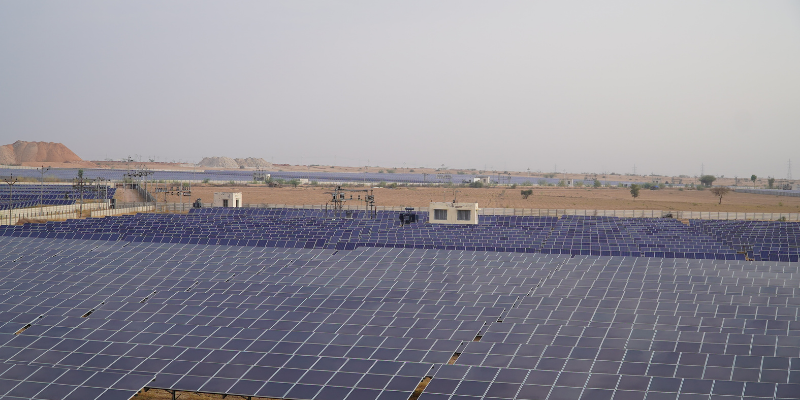
The funds will support the company’s distributed solar projects for commercial and industrial clients in India and South Africa. Candi’s installed portfolio has more than doubled in the past 18 months to over 220 MW at peak hours, enough to power thousands of homes in India.

“This is the largest funding facility we have ever closed,” said Bruno Rauis, Director of Candi Solar. “It propels us into our next phase of growth and strengthens our ambition to be the leading distributed energy partner in India, South Africa, and beyond. IFC’s involvement is catalytic.”

The IFC package includes $6.5 million from the Canada-IFC Blended Climate Finance Platform, up to $42 million equivalent for IFC’s own account across multiple currencies—a portion of which is also supported by its Managed Co-lending Portfolio Program, and a concessional loan of up to $10 million from the Clean Technology Fund.

“This milestone marks an inflection point for Candi Solar in India,” said Nishant Sood, Managing Director of Candi Solar. “It empowers us to scale distributed projects faster, deliver substantial energy savings for our clients, and advance India’s net-zero pathway.”

Also Read
IFC commits $60M to Everstone Capital to invest in mid-market companies

IFC said the structure is designed to blend concessional and commercial capital to absorb early-stage operational risks in distributed generation markets while meeting ESG and governance requirements.

“At IFC, we see distributed solar as a powerful lever for accelerating energy access and efficiency in emerging markets,” said Cláudia Conceição, IFC Regional Director for Southern Africa. “Our partnership with Candi Solar demonstrates how innovative financing models can unlock private capital at scale.”

Candi said the funds will finance nearly 200 MWp of new projects and support broader goals, including emissions reduction, grid stability, and job creation. The company’s client roster includes global manufacturers and retailers such as Toyota, IFF, Pick'n Pay and Suryalakshmi Cotton Mills.

“This facility is a strong validation of our results-based model and its ability to deliver reliable returns,” said KJ Mahoney, Head of Capital Structuring at Candi Solar. “IFC’s involvement demonstrates that distributed solar can meet the highest standards of performance, governance, and impact.”

The latest round follows Candi’s $24 million equity and mezzanine raise earlier this year. The company plans to expand its contracted portfolio beyond 400 MWp by 2026 and deepen its performance-linked offerings, including storage solutions.


Edited by Suman Singh

Disclaimer: The articles reposted on this site are sourced from public platforms and are provided for informational purposes only. They do not necessarily reflect the views of MEXC. All rights remain with the original authors. If you believe any content infringes on third-party rights, please contact service@support.mexc.com for removal. MEXC makes no guarantees regarding the accuracy, completeness, or timeliness of the content and is not responsible for any actions taken based on the information provided. The content does not constitute financial, legal, or other professional advice, nor should it be considered a recommendation or endorsement by MEXC.

You May Also Like

Stripe-Owned Bridge Wins Conditional OCC Approval to Become National Crypto Bank

Stripe-Owned Bridge Wins Conditional OCC Approval to Become National Crypto Bank

Bridge advances toward federal banking status as regulators implement new US stablecoin rules under the GENIUS Act. The post Stripe-Owned Bridge Wins Conditional
Share
Cryptonews AU2026/02/18 14:40
Wormhole Unleashes W 2.0 Tokenomics for a Connected Blockchain Future

Wormhole Unleashes W 2.0 Tokenomics for a Connected Blockchain Future

TLDR Wormhole reinvents W Tokenomics with Reserve, yield, and unlock upgrades. W Tokenomics: 4% yield, bi-weekly unlocks, and a sustainable Reserve Wormhole shifts to long-term value with treasury, yield, and smoother unlocks. Stakers earn 4% base yield as Wormhole optimizes unlocks for stability. Wormhole’s new Tokenomics align growth, yield, and stability for W holders. Wormhole [...] The post Wormhole Unleashes W 2.0 Tokenomics for a Connected Blockchain Future appeared first on CoinCentral.
Share
Coincentral2025/09/18 02:07
Vitalik Buterin Reveals Ethereum’s (ETH) Future Plans – Here’s What’s Planned

Vitalik Buterin Reveals Ethereum’s (ETH) Future Plans – Here’s What’s Planned

The post Vitalik Buterin Reveals Ethereum’s (ETH) Future Plans – Here’s What’s Planned appeared on BitcoinEthereumNews.com. Ethereum founder Vitalik Buterin presented the network’s new roadmap, which includes its short-, medium-, and long-term goals, at the Developer Conference held in Japan today. Scalability, cross-layer compatibility, privacy, and security were the prominent topics in Buterin’s speech. Buterin stated that the short-term focus will be on increasing gas limits on the Ethereum mainnet (L1). He said that tools such as block-level access lists, ZK-EVMs, gas price restructuring, and slot optimization will be used in this context. The goal is to maintain the network’s decentralization while increasing scalability. The medium-term goal is to enable trustless asset transfers between Layer-2 (L2) networks and achieve faster transaction finality. In this context, “Stage 2 Rollup” solutions, proof-of-conduct combinations, and optimizations for reading data from L1 are on the agenda. Furthermore, network optimizations such as shortening slot times, fast finality protocols, and erasure coding are planned to improve user experience and security. Buterin emphasized that privacy is a priority for both the short and medium term. Zero-knowledge (ZK) proofs, anonymous pools, encrypted voting, and scrambling network solutions are highlighted to protect the privacy of users’ on-chain payments, voting, DeFi transactions, and account changes. Furthermore, secure execution environments, secret query techniques, and the ability to conceal fraudulent requests and data access patterns are also targeted when reading data from the chain. Buterin’s long-term vision highlights a minimalist, secure, and simple Ethereum. This roadmap includes resistance to the risks posed by quantum computers, securing the protocol with mathematical methods (formal verification), and transitioning to ideal cryptographic solutions. Buterin stated that these strategic steps will transform Ethereum into a more scalable, user-friendly, and secure infrastructure. With the strengthening of L2 networks, more users will be able to use Ethereum with less trust assumptions. The ultimate goal is for Ethereum to become a reliable foundational infrastructure for global…
Share
BitcoinEthereumNews2025/09/18 15:57