What to Know: Saylor’s ‘I Won’t Back Down’ message comes as Bitcoin slides toward $80K–$85K, pressuring leveraged players and reigniting crash warnings. Strategy’s 649K+ BTC stack remains profitable on paper, but the stock premium has nearly vanished, testing investor patience with the treasury bet. U.Today+1 Bitcoin Hyper aims to solve Bitcoin’s throughput, fees, and programmability issues with an SVM-based Layer-2 that keeps Bitcoin as the settlement layer. The $HYPER presale has raised over $28M, offers around 41% staking rewards, and targets multi-X upside if its Layer-2 roadmap and ecosystem delivery succeed. Bitcoin just pulled off one of the nastiest rug-pull-looking dips of the entire cycle. In a matter of hours, the price fell from above $120K to sub-$90K and even wicked into the $80,600 zone, wiping out billions in longs and reigniting the classic “it’s over, lads” chorus across Crypto X. And right in the middle of the chaos, Michael Saylor dropped four words that could basically be printed on his business card: “I won’t back down.” This time, the line carried extra weight. His company, Strategy, is now sitting on roughly 649,870 BTC at an average price near $74,430, still in profit despite the crash, even as the stock gets punished and critics wonder how long a leveraged Bitcoin maxi can stare down this kind of volatility. Strategy even ran a poll that showed nearly 78% of respondents were simply HODLing through the sell-off. Hardcore Bitcoiners still see turbulence, not terminal failure, but not everyone’s built for that degree of mark-to-market pain. Retail, smaller funds, and DeFi traders are increasingly searching for ways to keep Bitcoin exposure without just holding spot and praying. That’s where the new rotation narrative comes in. If Bitcoin stays the monetary backbone of crypto, the best altcoins this cycle may be the ones solving what Bitcoin can’t: throughput, fees, and programmability. Bitcoin Hyper ($HYPER) fits that thesis almost too well, positioning itself as a Bitcoin Layer-2 designed to make BTC behave like a fast, flexible, programmable asset, all without compromising the base layer. Bitcoin Hyper Turns Bitcoin Volatility Into Layer-2 Utility Behind the branding, Bitcoin Hyper is targeting a very real structural gap in the Bitcoin ecosystem. BTC still handles only a handful of transactions per second, and fees spike whenever activity increases, which is why most of today’s DeFi, NFTs, and on-chain experimentation have migrated to faster environments, such as Solana. Bitcoin Hyper’s solution is a rollup-style Layer-2 anchored to Bitcoin but powered by an SVM (Solana Virtual Machine) execution layer. Users send BTC to a monitored main-chain address, a canonical bridge verifies the deposit, and the network mints an equivalent amount of wrapped BTC on Hyper. From there, transactions run on a high-throughput chain with near-instant finality and low fees, while zero-knowledge proofs periodically settle back to Bitcoin L1. The architecture aims to preserve Bitcoin’s security while moving actual activity, payments, DEX trades, lending, NFT markets, even meme-coin chaos, onto a chain that feels Solana-fast. Because it uses SVM, existing Rust developers can port their apps with minimal friction, giving Hyper a realistic shot at building an ecosystem instead of becoming another pretty but empty L2. Of course, there are risks. $HYPER is still in presale, and the roadmap is ambitious: audits and presale throughout 2025, mainnet and SVM+dApp integration between late 2025 and early 2026, then token listings, SDKs, and a DAO rollout in 2026. Execution needs to hit those milestones for the L2 thesis to play out. Security is at least trending positively. The contracts have already cleared audits from Coinsult and SpyWolf, with no hidden mint functions or obvious backdoors flagged, a good start, even if it doesn’t eliminate the typical smart-contract and market risks associated with new chains. For anyone who wants to stay structurally long Bitcoin while also capturing upside from where the next wave of blockspace demand might land, $HYPER offers a clean play. If Bitcoin activity increases and DeFi migrates toward BTC-secured infrastructure, a functioning Bitcoin-anchored Layer-2 could absorb a disproportionate share of that value. Inside the Bitcoin Hyper Presale and $HYPER Token Economics While Bitcoin has been violently whipsawing, the Bitcoin Hyper presale has been doing the opposite, grinding steadily upward. It has now crossed $28.3M raised, with the current stage pricing $HYPER around $0.013325. That still puts it in micro-cap range, but the raise is now large enough that this is no longer a small degen side-quest. Real capital is flowing in. Presale buyers can also stake $HYPER at 41% rewards, with more than a billion tokens already locked. Those yields will naturally taper off as more wallets join in, but the intent is clear: early participants are encouraged to behave like long-term network partners, not short-term flippers. It aligns neatly with the idea of $HYPER acting as a “beta on Bitcoin’s evolution” rather than just another momentum meme. On the valuation side, upside scenarios being circulated are bold but at least mathematically grounded. One widely shared fundamental review puts a potential 2025 high near $0.02595 once mainnet is live and liquidity deepens, roughly a 2x from the current presale range if the thesis holds. More aggressive models project further out, mapping a possible 2026 high around $0.08625 and a 2030 target near $0.253, assuming the roadmap lands, the ecosystem fills in, and major exchanges eventually list the token. Relative to today’s pricing, that implies roughly 6–7x to the 2026 level and close to 19x by 2030. Nothing is guaranteed, but it explains why $HYPER keeps showing up in alt-rotation threads whenever traders discuss asymmetric setups tied to Bitcoin infrastructure instead of random meme noise. Crucially, $HYPER isn’t pitched as a hedge against Bitcoin; it’s pitched as a way to amplify it. If Saylor’s “I Won’t Back Down” stance represents the diamond-hands end of the spectrum, Bitcoin Hyper is where the more risk-tolerant crowd is rotating: still ideologically long BTC, but looking to high-beta Layer-2 infrastructure for bigger potential multiples as the cycle churns through volatility. This article is informational only; crypto, especially presales, is highly volatile. Always do your own research and never risk rent money. Authored by Aaron Walker, NewsBTC – https://www.newsbtc.com/news/best-altcoins-saylor-wont-back-down-bitcoin-hyper-presaleWhat to Know: Saylor’s ‘I Won’t Back Down’ message comes as Bitcoin slides toward $80K–$85K, pressuring leveraged players and reigniting crash warnings. Strategy’s 649K+ BTC stack remains profitable on paper, but the stock premium has nearly vanished, testing investor patience with the treasury bet. U.Today+1 Bitcoin Hyper aims to solve Bitcoin’s throughput, fees, and programmability issues with an SVM-based Layer-2 that keeps Bitcoin as the settlement layer. The $HYPER presale has raised over $28M, offers around 41% staking rewards, and targets multi-X upside if its Layer-2 roadmap and ecosystem delivery succeed. Bitcoin just pulled off one of the nastiest rug-pull-looking dips of the entire cycle. In a matter of hours, the price fell from above $120K to sub-$90K and even wicked into the $80,600 zone, wiping out billions in longs and reigniting the classic “it’s over, lads” chorus across Crypto X. And right in the middle of the chaos, Michael Saylor dropped four words that could basically be printed on his business card: “I won’t back down.” This time, the line carried extra weight. His company, Strategy, is now sitting on roughly 649,870 BTC at an average price near $74,430, still in profit despite the crash, even as the stock gets punished and critics wonder how long a leveraged Bitcoin maxi can stare down this kind of volatility. Strategy even ran a poll that showed nearly 78% of respondents were simply HODLing through the sell-off. Hardcore Bitcoiners still see turbulence, not terminal failure, but not everyone’s built for that degree of mark-to-market pain. Retail, smaller funds, and DeFi traders are increasingly searching for ways to keep Bitcoin exposure without just holding spot and praying. That’s where the new rotation narrative comes in. If Bitcoin stays the monetary backbone of crypto, the best altcoins this cycle may be the ones solving what Bitcoin can’t: throughput, fees, and programmability. Bitcoin Hyper ($HYPER) fits that thesis almost too well, positioning itself as a Bitcoin Layer-2 designed to make BTC behave like a fast, flexible, programmable asset, all without compromising the base layer. Bitcoin Hyper Turns Bitcoin Volatility Into Layer-2 Utility Behind the branding, Bitcoin Hyper is targeting a very real structural gap in the Bitcoin ecosystem. BTC still handles only a handful of transactions per second, and fees spike whenever activity increases, which is why most of today’s DeFi, NFTs, and on-chain experimentation have migrated to faster environments, such as Solana. Bitcoin Hyper’s solution is a rollup-style Layer-2 anchored to Bitcoin but powered by an SVM (Solana Virtual Machine) execution layer. Users send BTC to a monitored main-chain address, a canonical bridge verifies the deposit, and the network mints an equivalent amount of wrapped BTC on Hyper. From there, transactions run on a high-throughput chain with near-instant finality and low fees, while zero-knowledge proofs periodically settle back to Bitcoin L1. The architecture aims to preserve Bitcoin’s security while moving actual activity, payments, DEX trades, lending, NFT markets, even meme-coin chaos, onto a chain that feels Solana-fast. Because it uses SVM, existing Rust developers can port their apps with minimal friction, giving Hyper a realistic shot at building an ecosystem instead of becoming another pretty but empty L2. Of course, there are risks. $HYPER is still in presale, and the roadmap is ambitious: audits and presale throughout 2025, mainnet and SVM+dApp integration between late 2025 and early 2026, then token listings, SDKs, and a DAO rollout in 2026. Execution needs to hit those milestones for the L2 thesis to play out. Security is at least trending positively. The contracts have already cleared audits from Coinsult and SpyWolf, with no hidden mint functions or obvious backdoors flagged, a good start, even if it doesn’t eliminate the typical smart-contract and market risks associated with new chains. For anyone who wants to stay structurally long Bitcoin while also capturing upside from where the next wave of blockspace demand might land, $HYPER offers a clean play. If Bitcoin activity increases and DeFi migrates toward BTC-secured infrastructure, a functioning Bitcoin-anchored Layer-2 could absorb a disproportionate share of that value. Inside the Bitcoin Hyper Presale and $HYPER Token Economics While Bitcoin has been violently whipsawing, the Bitcoin Hyper presale has been doing the opposite, grinding steadily upward. It has now crossed $28.3M raised, with the current stage pricing $HYPER around $0.013325. That still puts it in micro-cap range, but the raise is now large enough that this is no longer a small degen side-quest. Real capital is flowing in. Presale buyers can also stake $HYPER at 41% rewards, with more than a billion tokens already locked. Those yields will naturally taper off as more wallets join in, but the intent is clear: early participants are encouraged to behave like long-term network partners, not short-term flippers. It aligns neatly with the idea of $HYPER acting as a “beta on Bitcoin’s evolution” rather than just another momentum meme. On the valuation side, upside scenarios being circulated are bold but at least mathematically grounded. One widely shared fundamental review puts a potential 2025 high near $0.02595 once mainnet is live and liquidity deepens, roughly a 2x from the current presale range if the thesis holds. More aggressive models project further out, mapping a possible 2026 high around $0.08625 and a 2030 target near $0.253, assuming the roadmap lands, the ecosystem fills in, and major exchanges eventually list the token. Relative to today’s pricing, that implies roughly 6–7x to the 2026 level and close to 19x by 2030. Nothing is guaranteed, but it explains why $HYPER keeps showing up in alt-rotation threads whenever traders discuss asymmetric setups tied to Bitcoin infrastructure instead of random meme noise. Crucially, $HYPER isn’t pitched as a hedge against Bitcoin; it’s pitched as a way to amplify it. If Saylor’s “I Won’t Back Down” stance represents the diamond-hands end of the spectrum, Bitcoin Hyper is where the more risk-tolerant crowd is rotating: still ideologically long BTC, but looking to high-beta Layer-2 infrastructure for bigger potential multiples as the cycle churns through volatility. This article is informational only; crypto, especially presales, is highly volatile. Always do your own research and never risk rent money. Authored by Aaron Walker, NewsBTC – https://www.newsbtc.com/news/best-altcoins-saylor-wont-back-down-bitcoin-hyper-presale

Saylor Says ‘I Won’t Back Down’ As Traders Eye Best Altcoins Like Bitcoin Hyper

2025/11/24 20:43
6 min read

What to Know:

  • Saylor’s ‘I Won’t Back Down’ message comes as Bitcoin slides toward $80K–$85K, pressuring leveraged players and reigniting crash warnings.
  • Strategy’s 649K+ BTC stack remains profitable on paper, but the stock premium has nearly vanished, testing investor patience with the treasury bet. U.Today+1
  • Bitcoin Hyper aims to solve Bitcoin’s throughput, fees, and programmability issues with an SVM-based Layer-2 that keeps Bitcoin as the settlement layer.
  • The $HYPER presale has raised over $28M, offers around 41% staking rewards, and targets multi-X upside if its Layer-2 roadmap and ecosystem delivery succeed.

Bitcoin just pulled off one of the nastiest rug-pull-looking dips of the entire cycle. In a matter of hours, the price fell from above $120K to sub-$90K and even wicked into the $80,600 zone, wiping out billions in longs and reigniting the classic “it’s over, lads” chorus across Crypto X.

And right in the middle of the chaos, Michael Saylor dropped four words that could basically be printed on his business card: “I won’t back down.” This time, the line carried extra weight.

His company, Strategy, is now sitting on roughly 649,870 BTC at an average price near $74,430, still in profit despite the crash, even as the stock gets punished and critics wonder how long a leveraged Bitcoin maxi can stare down this kind of volatility.
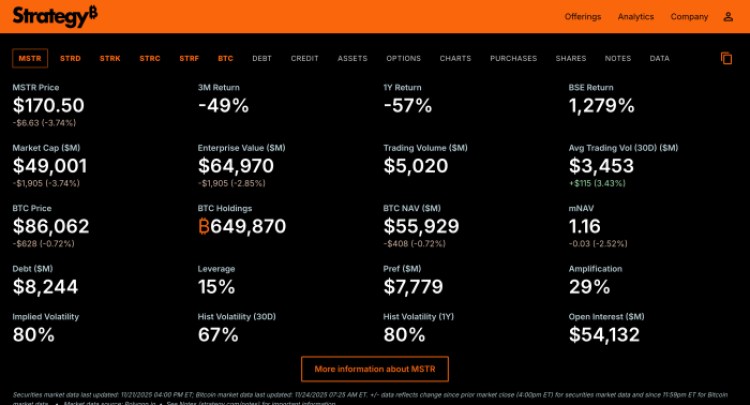
Strategy Bitcoin Holdings

Strategy even ran a poll that showed nearly 78% of respondents were simply HODLing through the sell-off. Hardcore Bitcoiners still see turbulence, not terminal failure, but not everyone’s built for that degree of mark-to-market pain.

Retail, smaller funds, and DeFi traders are increasingly searching for ways to keep Bitcoin exposure without just holding spot and praying.

That’s where the new rotation narrative comes in. If Bitcoin stays the monetary backbone of crypto, the best altcoins this cycle may be the ones solving what Bitcoin can’t: throughput, fees, and programmability.

Bitcoin Hyper ($HYPER) fits that thesis almost too well, positioning itself as a Bitcoin Layer-2 designed to make BTC behave like a fast, flexible, programmable asset, all without compromising the base layer.

Bitcoin Hyper Turns Bitcoin Volatility Into Layer-2 Utility

Behind the branding, Bitcoin Hyper is targeting a very real structural gap in the Bitcoin ecosystem. BTC still handles only a handful of transactions per second, and fees spike whenever activity increases, which is why most of today’s DeFi, NFTs, and on-chain experimentation have migrated to faster environments, such as Solana.

Bitcoin Hyper’s solution is a rollup-style Layer-2 anchored to Bitcoin but powered by an SVM (Solana Virtual Machine) execution layer. Users send BTC to a monitored main-chain address, a canonical bridge verifies the deposit, and the network mints an equivalent amount of wrapped BTC on Hyper.

From there, transactions run on a high-throughput chain with near-instant finality and low fees, while zero-knowledge proofs periodically settle back to Bitcoin L1.

The architecture aims to preserve Bitcoin’s security while moving actual activity, payments, DEX trades, lending, NFT markets, even meme-coin chaos, onto a chain that feels Solana-fast.

Because it uses SVM, existing Rust developers can port their apps with minimal friction, giving Hyper a realistic shot at building an ecosystem instead of becoming another pretty but empty L2.

Of course, there are risks. $HYPER is still in presale, and the roadmap is ambitious: audits and presale throughout 2025, mainnet and SVM+dApp integration between late 2025 and early 2026, then token listings, SDKs, and a DAO rollout in 2026. Execution needs to hit those milestones for the L2 thesis to play out.

Security is at least trending positively. The contracts have already cleared audits from Coinsult and SpyWolf, with no hidden mint functions or obvious backdoors flagged, a good start, even if it doesn’t eliminate the typical smart-contract and market risks associated with new chains.

For anyone who wants to stay structurally long Bitcoin while also capturing upside from where the next wave of blockspace demand might land, $HYPER offers a clean play.

If Bitcoin activity increases and DeFi migrates toward BTC-secured infrastructure, a functioning Bitcoin-anchored Layer-2 could absorb a disproportionate share of that value.

Inside the Bitcoin Hyper Presale and $HYPER Token Economics

While Bitcoin has been violently whipsawing, the Bitcoin Hyper presale has been doing the opposite, grinding steadily upward. It has now crossed $28.3M raised, with the current stage pricing $HYPER around $0.013325.

That still puts it in micro-cap range, but the raise is now large enough that this is no longer a small degen side-quest. Real capital is flowing in.

Presale buyers can also stake $HYPER at 41% rewards, with more than a billion tokens already locked. Those yields will naturally taper off as more wallets join in, but the intent is clear: early participants are encouraged to behave like long-term network partners, not short-term flippers.

It aligns neatly with the idea of $HYPER acting as a “beta on Bitcoin’s evolution” rather than just another momentum meme.

On the valuation side, upside scenarios being circulated are bold but at least mathematically grounded. One widely shared fundamental review puts a potential 2025 high near $0.02595 once mainnet is live and liquidity deepens, roughly a 2x from the current presale range if the thesis holds.

More aggressive models project further out, mapping a possible 2026 high around $0.08625 and a 2030 target near $0.253, assuming the roadmap lands, the ecosystem fills in, and major exchanges eventually list the token.

Relative to today’s pricing, that implies roughly 6–7x to the 2026 level and close to 19x by 2030. Nothing is guaranteed, but it explains why $HYPER keeps showing up in alt-rotation threads whenever traders discuss asymmetric setups tied to Bitcoin infrastructure instead of random meme noise.

Crucially, $HYPER isn’t pitched as a hedge against Bitcoin; it’s pitched as a way to amplify it.

If Saylor’s “I Won’t Back Down” stance represents the diamond-hands end of the spectrum, Bitcoin Hyper is where the more risk-tolerant crowd is rotating: still ideologically long BTC, but looking to high-beta Layer-2 infrastructure for bigger potential multiples as the cycle churns through volatility.

This article is informational only; crypto, especially presales, is highly volatile. Always do your own research and never risk rent money.

Authored by Aaron Walker, NewsBTC – https://www.newsbtc.com/news/best-altcoins-saylor-wont-back-down-bitcoin-hyper-presale

Market Opportunity
Threshold Logo
Threshold Price(T)
$0.006994
$0.006994$0.006994
+0.66%
USD
Threshold (T) Live Price Chart
Disclaimer: The articles reposted on this site are sourced from public platforms and are provided for informational purposes only. They do not necessarily reflect the views of MEXC. All rights remain with the original authors. If you believe any content infringes on third-party rights, please contact service@support.mexc.com for removal. MEXC makes no guarantees regarding the accuracy, completeness, or timeliness of the content and is not responsible for any actions taken based on the information provided. The content does not constitute financial, legal, or other professional advice, nor should it be considered a recommendation or endorsement by MEXC.

You May Also Like

Pi Network Tech Upgrade Unlocks Mainnet Migration for 2.5 Million Users and Introduces Palm Print Security

Pi Network Tech Upgrade Unlocks Mainnet Migration for 2.5 Million Users and Introduces Palm Print Security

Pi Network has announced a major technological breakthrough that marks a new chapter in its evolution. According to information shared by Twitter user @strong3
Share
Hokanews2026/02/07 12:28
PayPal P2P, Google AI Payments, Miner Pivot — Crypto Biz

PayPal P2P, Google AI Payments, Miner Pivot — Crypto Biz

The post PayPal P2P, Google AI Payments, Miner Pivot — Crypto Biz appeared on BitcoinEthereumNews.com. Crypto’s center of gravity is shifting from speculation to services. PayPal is opening the door to peer-to-peer (P2P) cryptocurrency transfers, building on its growing presence in digital assets. Its stablecoin, PYUSD, has already surpassed $1 billion in market capitalization. Google is piloting a payment protocol designed for AI agents, with built-in support for stablecoins — highlighting the role dollar-pegged crypto could play in the emerging web economy. Meanwhile, Bitcoin miners face tighter margins from rising costs, higher difficulty levels and growing competition. Yet several companies are thriving by pivoting into data-center and AI infrastructure, sending their share prices sharply higher in recent weeks. This week’s Crypto Biz covers PayPal’s P2P rollout, the shifting economics of Bitcoin mining, Google’s open-source AI payment initiative and Bitwise’s bid for a new exchange-traded fund (ETF) focused on stablecoins and tokenization. PayPal rolls out P2P crypto transfers with new “links” feature PayPal is expanding its peer-to-peer offerings with a new feature that allows US users to send and receive cryptocurrencies directly within PayPal and Venmo, without relying on external exchanges. The service, called PayPal links, generates one-time links in the app that can be shared via text, email or chat. The feature will extend to Venmo, enabling direct transfers of cryptocurrencies and PayPal’s stablecoin, PYUSD, between users. For US customers, PayPal said that personal friends-and-family crypto transfers will not trigger 1099-K tax reporting, though other types of crypto transactions may still be taxable The rollout is part of PayPal World, the company’s interoperability framework aimed at connecting wallets and payment systems across its ecosystem. PayPal’s stablecoin, PYUSD, has experienced significant growth since launch, reaching a market cap of roughly $1.3 billion. Source: CoinMarketCap Bitcoin miners outperform BTC Shares of several major Bitcoin mining companies have surged over the past month, even as Bitcoin’s (BTC) price…
Share
BitcoinEthereumNews2025/09/20 22:22
Federal Reserve Cuts Rates: What Does This Mean for Crypto?

Federal Reserve Cuts Rates: What Does This Mean for Crypto?

TLDR: The Federal Reserve lowered rates by 25 bps, starting its first easing cycle of 2025. Lower rates tend to weaken the dollar, often driving capital into risk assets like crypto. Analysts say cheaper liquidity can fuel Bitcoin and altcoin demand as yields fall. Investors are watching price reactions closely as markets price in more [...] The post Federal Reserve Cuts Rates: What Does This Mean for Crypto? appeared first on Blockonomi.
Share
Blockonomi2025/09/18 14:10