Ledger brought a new multisig interface to make it easier to sign secure transactions with numerous devices. Users praised the technical changes, but criticized the company for adding a direct transaction fee that had not previously existed. The flat fees are in addition to standard blockchain network gas fees. Ledger Multisig app now charges $10 […]Ledger brought a new multisig interface to make it easier to sign secure transactions with numerous devices. Users praised the technical changes, but criticized the company for adding a direct transaction fee that had not previously existed. The flat fees are in addition to standard blockchain network gas fees. Ledger Multisig app now charges $10 […]

Ledger’s $10 Multisig Fee Update Triggers User Backlash in 2025
2025/10/26 20:25
3 min read
Ledger
  • Ledger’s multisig update improves security but adds a $10 fee and 0.05% charge on token transfers.
  • Users say new multisig fees oppose self-custody goals and challenge Ledger’s open access stance. 
  • Critics argue essential protection features should not become a paid revenue stream for Ledger.

Ledger brought a new multisig interface to make it easier to sign secure transactions with numerous devices. Users praised the technical changes, but criticized the company for adding a direct transaction fee that had not previously existed. The flat fees are in addition to standard blockchain network gas fees.

Ledger Multisig app now charges $10 flat transaction fee. Instead, transfers of tokens contain a variable 0.05% fee. These fees are paid to platform and they do not make up the blockchain transaction fee that you must also pay for on the network.

An Ethereum developer who goes by pcaversaccio on X slammed the change. He claimed that company wants to create a center of power in the sector. He cautioned that the fee system is in conflict with decentralized philosophies which underpin the notion of self-sovereign ownership.

Users Challenge Ledger’s Fee Policy

The update drew criticism on social media from a number of cryptocurrency users who said it runs counter to Ledger’s public pledge to bring open access. Multisig, they argued in their comments, helps to stop wallet compromises. They argue that a critical protection ought not be used as a cash register.

Also Read: Sygnum Bank Introduces Bitcoin-Backed Multisignature Lending Product with Debifi

Users also complained of the company’s inconsistent communication on the issue. Clear signing was vigorously pushed by company CTO Charles Guillemet’s as essential for secure crypto. Critics said it was inconsistent to charge fees for recurring features that prevent fraudulent transactions.

Confusion Over Multisig Messaging

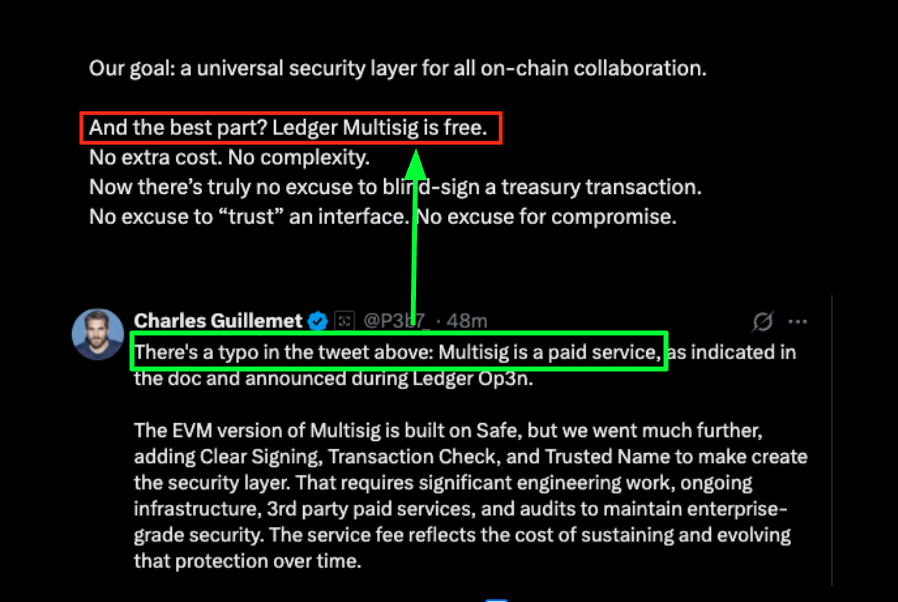
Guillomet’s comments were made more confusing by the fact that he then immediately implied multisig access would still be free. Documented in Ledger did not appear to agree with that statement. He later explained that calling the service free was a typo. Several users asked how an error like that could be included in official messaging.
Source: X

Ledger is still one of the most well-regarded names in crypto self-custody. The company says it has sold over 7.5 million devices around the world. It boasts securing about 20% of the world cryptocurrency value using its hardware wallets.

Private keys are stored offline in hardware wallets. This means they do not directly face the dangers of the Internet. Ledger also is quick to note that none of its devices have been compromised in the field. The company still emphasizes engineering and firmware updates as testament to its ongoing security focus.

Offline protection does not eliminate risk, security analysts said. Phishing and Social Engineering Attacks Still Target Users Kaspersky researchers cautioned that users remain targets of phishing and social engineering attacks. Victims are typically duped into revealing recovery phrases. This discloses control of the wallet regardless of whether the device has been hacked.

Human error remains the weakest link, analysts said. Criminals prey on confusion, urgency or mistakes, they said. They noted safe handling of seed phrases is still critical for all hardware wallets.

Ledger agreed that the pricing sustains the development and maintenance. It said that there were ongoing resource requirements for multisig updates. The firm has not said it will pull or lower the fees. Now, however, customers must decide whether the upgrade is worth the extra money.

Also Read: Ripple vs Swift: Blockchain Ledger Sparks New Payment Battle

Market Opportunity
Sign Logo
Sign Price(SIGN)
$0.02744
$0.02744$0.02744
+0.91%
USD
Sign (SIGN) Live Price Chart
Disclaimer: The articles reposted on this site are sourced from public platforms and are provided for informational purposes only. They do not necessarily reflect the views of MEXC. All rights remain with the original authors. If you believe any content infringes on third-party rights, please contact service@support.mexc.com for removal. MEXC makes no guarantees regarding the accuracy, completeness, or timeliness of the content and is not responsible for any actions taken based on the information provided. The content does not constitute financial, legal, or other professional advice, nor should it be considered a recommendation or endorsement by MEXC.

You May Also Like

UAE’s Central Bank Approves the DSSC Stablecoin Launch by IHC, FAB, and Sirius

UAE’s Central Bank Approves the DSSC Stablecoin Launch by IHC, FAB, and Sirius

The post UAE’s Central Bank Approves the DSSC Stablecoin Launch by IHC, FAB, and Sirius appeared on BitcoinEthereumNews.com. CBUAE has approved the dirham-backed
Share
BitcoinEthereumNews2026/02/13 04:30
Unyielding Challenges Stall US Crypto Bill Progress

Unyielding Challenges Stall US Crypto Bill Progress

The post Unyielding Challenges Stall US Crypto Bill Progress appeared on BitcoinEthereumNews.com. The enduring quest to establish a regulatory framework for cryptocurrencies
Share
BitcoinEthereumNews2026/02/13 04:04
Vitalik Buterin Reveals Ethereum’s Bold Plan to Stay Quantum-Secure and Simple!

Vitalik Buterin Reveals Ethereum’s Bold Plan to Stay Quantum-Secure and Simple!

Buterin unveils Ethereum’s strategy to tackle quantum security challenges ahead. Ethereum focuses on simplifying architecture while boosting security for users. Ethereum’s market stability grows as Buterin’s roadmap gains investor confidence. Ethereum founder Vitalik Buterin has unveiled his long-term vision for the blockchain, focusing on making Ethereum quantum-secure while maintaining its simplicity for users. Buterin presented his roadmap at the Japanese Developer Conference, and splits the future of Ethereum into three phases: short-term, mid-term, and long-term. Buterin’s most ambitious goal for Ethereum is to safeguard the blockchain against the threats posed by quantum computing.  The danger of such future developments is that the future may call into question the cryptographic security of most blockchain systems, and Ethereum will be able to remain ahead thanks to more sophisticated mathematical techniques to ensure the safety and integrity of its protocols. Buterin is committed to ensuring that Ethereum evolves in a way that not only meets today’s security challenges but also prepares for the unknowns of tomorrow. Also Read: Ethereum Giant The Ether Machine Takes Major Step Toward Going Public! However, in spite of such high ambitions, Buterin insisted that Ethereum also needed to simplify its architecture. An important aspect of this vision is to remove unnecessary complexity and make Ethereum more accessible and maintainable without losing its strong security capabilities. Security and simplicity form the core of Buterin’s strategy, as they guarantee that the users of Ethereum experience both security and smooth processes. Focus on Speed and Efficiency in the Short-Term In the short term, Buterin aims to enhance Ethereum’s transaction efficiency, a crucial step toward improving scalability and reducing transaction costs. These advantages are attributed to the fact that, within the mid-term, Ethereum is planning to enhance the speed of transactions in layer-2 networks. According to Butterin, this is part of Ethereum’s expansion, particularly because there is still more need to use blockchain technology to date. The other important aspect of Ethereum’s development is the layer-2 solutions. Buterin supports an approach in which the layer-2 networks are dependent on layer-1 to perform some essential tasks like data security, proof, and censorship resistance. This will enable the layer-2 systems of Ethereum to be concerned with verifying and sequencing transactions, which will improve the overall speed and efficiency of the network. Ethereum’s Market Stability Reflects Confidence in Long-Term Strategy Ethereum’s market performance has remained solid, with the cryptocurrency holding steady above $4,000. Currently priced at $4,492.15, Ethereum has experienced a slight 0.93% increase over the last 24 hours, while its trading volume surged by 8.72%, reaching $34.14 billion. These figures point to growing investor confidence in Ethereum’s long-term vision. The crypto community remains optimistic about Ethereum’s future, with many predicting the price could rise to $5,500 by mid-October. Buterin’s clear, forward-thinking strategy continues to build trust in Ethereum as one of the most secure and scalable blockchain platforms in the market. Also Read: Whales Dump 200 Million XRP in Just 2 Weeks – Is XRP’s Price on the Verge of Collapse? The post Vitalik Buterin Reveals Ethereum’s Bold Plan to Stay Quantum-Secure and Simple! appeared first on 36Crypto.
Share
Coinstats2025/09/18 01:22