Bitmine has drawn renewed attention as markets weigh exchange dynamics, treasury posture and evolving regulation.Bitmine has drawn renewed attention as markets weigh exchange dynamics, treasury posture and evolving regulation.

Bitmine redefines ETH treasury dominance and risk

bitmine eth ethereum treasury

Bitmine has drawn renewed attention as markets weigh exchange dynamics, treasury posture and evolving regulation. The miner’s ETH position sits at the crossroads of liquidity, market structure and broader blockchain trends.

Bitmine ETH holdings and market context

Bitmine’s visible ETH reserves are part of a broader conversation about how miners and treasuries interact with the crypto market. Observers track holdings because they influence exchange flows, price formation and short‑term volatility. Exchanges and OTC desks react to large movements. That, in turn, affects Bitcoin and Ethereum correlations and the wider DeFi and NFT markets.

Industry sources highlight that miner sales often follow reward cycles. Yet liquidity needs, hedging strategies and operational costs all shape disposition decisions. It should be noted that miners may also use derivatives on regulated venues to mitigate exposure. The combination of on‑chain flows and off‑chain hedges matters for traders and regulators alike.
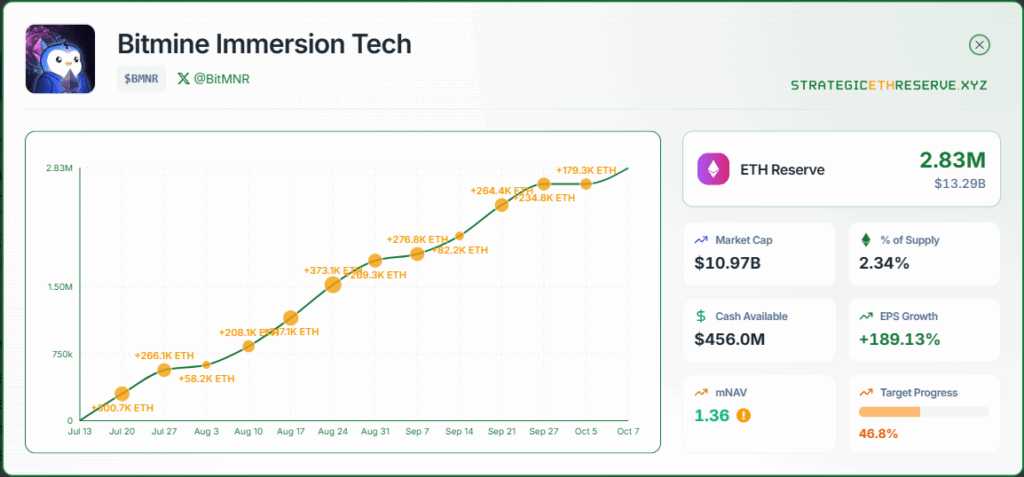
Bitmine Immersion Tech ($BMNR) ETH reserves over time. Source: STRATEGICETHRESERVE.XYZ

Largest Ethereum treasury: scale and risks

When a miner or operator controls a significant portion of ETH, it becomes a de facto market participant with outsized influence. Such holdings can amplify market moves during periods of stress. Regulators and market participants watch for concentration risks, counterparty exposures and the potential for rapid unwinding.

From a corporate perspective, the priorities are clear: preserve liquidity, enforce robust custody, and report transparently. An EEAT reviewer emphasized treasury practices, which underpins many firms’ frameworks: 

BMNR daily trading volume and liquidity patterns

Trading volume metrics, such as BMNR daily trading volume, are a proxy for market depth and resilience. Higher volumes generally reduce price impact for large trades. Conversely, thin order books can turn routine liquidations into larger price dislocations.

Market makers and exchanges respond to shifts in volume swiftly. They widen spreads or throttle risk when flows spike. That behaviour has implications for institutional participants and for retail investors accessing DeFi protocols or centralized exchanges.

Market Opportunity
Ethereum Logo
Ethereum Price(ETH)
$2,083.81
$2,083.81$2,083.81
+5.22%
USD
Ethereum (ETH) Live Price Chart
Disclaimer: The articles reposted on this site are sourced from public platforms and are provided for informational purposes only. They do not necessarily reflect the views of MEXC. All rights remain with the original authors. If you believe any content infringes on third-party rights, please contact service@support.mexc.com for removal. MEXC makes no guarantees regarding the accuracy, completeness, or timeliness of the content and is not responsible for any actions taken based on the information provided. The content does not constitute financial, legal, or other professional advice, nor should it be considered a recommendation or endorsement by MEXC.

You May Also Like

Pi Network Tech Upgrade Unlocks Mainnet Migration for 2.5 Million Users and Introduces Palm Print Security

Pi Network Tech Upgrade Unlocks Mainnet Migration for 2.5 Million Users and Introduces Palm Print Security

Pi Network has announced a major technological breakthrough that marks a new chapter in its evolution. According to information shared by Twitter user @strong3
Share
Hokanews2026/02/07 12:28
PayPal P2P, Google AI Payments, Miner Pivot — Crypto Biz

PayPal P2P, Google AI Payments, Miner Pivot — Crypto Biz

The post PayPal P2P, Google AI Payments, Miner Pivot — Crypto Biz appeared on BitcoinEthereumNews.com. Crypto’s center of gravity is shifting from speculation to services. PayPal is opening the door to peer-to-peer (P2P) cryptocurrency transfers, building on its growing presence in digital assets. Its stablecoin, PYUSD, has already surpassed $1 billion in market capitalization. Google is piloting a payment protocol designed for AI agents, with built-in support for stablecoins — highlighting the role dollar-pegged crypto could play in the emerging web economy. Meanwhile, Bitcoin miners face tighter margins from rising costs, higher difficulty levels and growing competition. Yet several companies are thriving by pivoting into data-center and AI infrastructure, sending their share prices sharply higher in recent weeks. This week’s Crypto Biz covers PayPal’s P2P rollout, the shifting economics of Bitcoin mining, Google’s open-source AI payment initiative and Bitwise’s bid for a new exchange-traded fund (ETF) focused on stablecoins and tokenization. PayPal rolls out P2P crypto transfers with new “links” feature PayPal is expanding its peer-to-peer offerings with a new feature that allows US users to send and receive cryptocurrencies directly within PayPal and Venmo, without relying on external exchanges. The service, called PayPal links, generates one-time links in the app that can be shared via text, email or chat. The feature will extend to Venmo, enabling direct transfers of cryptocurrencies and PayPal’s stablecoin, PYUSD, between users. For US customers, PayPal said that personal friends-and-family crypto transfers will not trigger 1099-K tax reporting, though other types of crypto transactions may still be taxable The rollout is part of PayPal World, the company’s interoperability framework aimed at connecting wallets and payment systems across its ecosystem. PayPal’s stablecoin, PYUSD, has experienced significant growth since launch, reaching a market cap of roughly $1.3 billion. Source: CoinMarketCap Bitcoin miners outperform BTC Shares of several major Bitcoin mining companies have surged over the past month, even as Bitcoin’s (BTC) price…
Share
BitcoinEthereumNews2025/09/20 22:22
Federal Reserve Cuts Rates: What Does This Mean for Crypto?

Federal Reserve Cuts Rates: What Does This Mean for Crypto?

TLDR: The Federal Reserve lowered rates by 25 bps, starting its first easing cycle of 2025. Lower rates tend to weaken the dollar, often driving capital into risk assets like crypto. Analysts say cheaper liquidity can fuel Bitcoin and altcoin demand as yields fall. Investors are watching price reactions closely as markets price in more [...] The post Federal Reserve Cuts Rates: What Does This Mean for Crypto? appeared first on Blockonomi.
Share
Blockonomi2025/09/18 14:10