TLDR A Russian crypto network moved over $6 billion through the A7A5 stablecoin after U.S. sanctions targeted its operators in August 2025 Network administrators destroyed and re-minted more than 80% of A7A5 tokens to break links to sanctioned wallets including Grinex exchange The A7 network has processed $86 billion in 10 months and received formal [...] The post Russian A7A5 Stablecoin Processes $6 Billion After U.S. Sanctions Hit Operators appeared first on CoinCentral.TLDR A Russian crypto network moved over $6 billion through the A7A5 stablecoin after U.S. sanctions targeted its operators in August 2025 Network administrators destroyed and re-minted more than 80% of A7A5 tokens to break links to sanctioned wallets including Grinex exchange The A7 network has processed $86 billion in 10 months and received formal [...] The post Russian A7A5 Stablecoin Processes $6 Billion After U.S. Sanctions Hit Operators appeared first on CoinCentral.

Russian A7A5 Stablecoin Processes $6 Billion After U.S. Sanctions Hit Operators

2025/10/06 16:26
4 min read

TLDR

  • A Russian crypto network moved over $6 billion through the A7A5 stablecoin after U.S. sanctions targeted its operators in August 2025
  • Network administrators destroyed and re-minted more than 80% of A7A5 tokens to break links to sanctioned wallets including Grinex exchange
  • The A7 network has processed $86 billion in 10 months and received formal digital financial asset status in Russia last week
  • Russia’s Central Bank will conduct a comprehensive audit of the nation’s crypto holdings in early 2026
  • The bank has ordered Moscow Exchange and commercial banks to provide monthly reports on crypto derivatives transactions

A Russian cryptocurrency network has moved $6 billion since August after the United States sanctioned several of its operators. The transactions involved A7A5, a stablecoin that sits at the center of Russia’s cross-border payment system.

The U.S. sanctioned the Grinex exchange in August. Officials called it a successor to Garantex, which was shut down in March for alleged connections to hacking and ransomware. Grinex has denied any connection to Garantex.

The day after sanctions were announced, A7A5 administrators emptied two wallets connected to Grinex. The wallets held 33.8 billion tokens worth $405 million. They used a function called “destroyBlackFunds” to mark the assets as “dirtyShares.”

New tokens for the same amount were then created in a different wallet. This broke the connection between the old sanctioned funds and the new tokens. The new wallet, named TNpJj, has since processed $6.1 billion in transactions.

The A7 network was created after Russian banks were cut off from the U.S.-led financial system following the 2022 invasion of Ukraine. The network provides an alternative payment system for Russian trade. A7A5 runs on Tron and Ethereum blockchains.

On March 10, 4.5 billion A7A5 tokens moved between four wallets in ten minutes. This happened after U.S. action against Garantex. On May 6, one wallet funded a new address called TChBA.

On August 14, the U.S. sanctioned two wallets tied to Garantex and Grinex. By August 15, funds in TChBA were destroyed and re-minted in TNpJj. The same pattern repeated on September 2 with another wallet.

Network Operations and Ownership

The TNpJj wallet shows the same patterns as older wallets. It operates during Moscow working hours with peak activity between 10 a.m. and 12 p.m. local time. Little movement happens overnight or on weekends.

A7A5’s chatbot operates weekdays from 10 a.m. to 8 p.m. Moscow time. Clients can buy the token in cash at Grinex’s over-the-counter section inside a Moscow skyscraper. The location is Federation Tower, 14th floor, the same address Garantex previously used.

The coin is registered in Kyrgyzstan. Its issuer, Old Vector, was blacklisted by the U.S. in August. Last week Russia granted A7A5 formal digital financial asset status.

Russian exporters and importers can now use A7A5 officially through a platform owned by Promsvyazbank. The state-owned defense lender already under sanctions holds a 49 percent stake in the A7 network. The bank backs each token with a rouble.

Promsvyazbank’s chief executive Petr Fradkov told President Vladimir Putin the bank is creating a system of cross-border settlements based on A7. The network has received large loans from VEB, a Russian state development bank.

Central Bank Audit Plans

Russia’s Central Bank announced it will conduct a comprehensive audit of the nation’s crypto holdings in early 2026. The bank will survey companies and individuals over the first two months of the year.

The audit will review crypto investments and lending volumes for companies in the space. The Central Bank said it also plans to review individual investments in digital financial products whose returns are tied to crypto prices.

This includes crypto derivatives that launched on the Moscow Exchange this year. The bank has ordered the exchange and commercial banks offering crypto derivatives to send monthly reports on transactions and volumes.

The bank said the survey’s goal is to assess the volume of investments in cryptocurrencies by regulated entities. This includes investments for risk hedging purposes. One expert told Russian newspaper Izvestia the bank and government will use the information to help form regulatory policy and generate tax revenue.

Network Expansion

A7’s majority owner and chief executive Ilan Șor is a fugitive Moldovan oligarch living in Moscow. He claims the network has moved more than $86 billion in 10 months. The A7 network is expanding to Africa.

Financial professionals told the Financial Times the A7 network may represent a large part of Russia’s cross-border payments market. Besides crypto, A7 also handles payments via promissory notes. The Centre for Information Resilience predicted Russia’s war economy will raise the network’s political profile in enabling exports.

The post Russian A7A5 Stablecoin Processes $6 Billion After U.S. Sanctions Hit Operators appeared first on CoinCentral.

Market Opportunity
Union Logo
Union Price(U)
$0.001453
$0.001453$0.001453
-0.27%
USD
Union (U) Live Price Chart
Disclaimer: The articles reposted on this site are sourced from public platforms and are provided for informational purposes only. They do not necessarily reflect the views of MEXC. All rights remain with the original authors. If you believe any content infringes on third-party rights, please contact service@support.mexc.com for removal. MEXC makes no guarantees regarding the accuracy, completeness, or timeliness of the content and is not responsible for any actions taken based on the information provided. The content does not constitute financial, legal, or other professional advice, nor should it be considered a recommendation or endorsement by MEXC.

You May Also Like

Young Republicans were more proud to be American under Obama than under Trump: data analyst
Young Republicans were more proud to be American under Obama than under Trump: data analyst

CNN data analyst Harry Enten sorts through revealing polls and surveys of American attitudes, looking for shifts, and his latest finding is an indictment of President
Share
Alternet2026/02/10 22:18
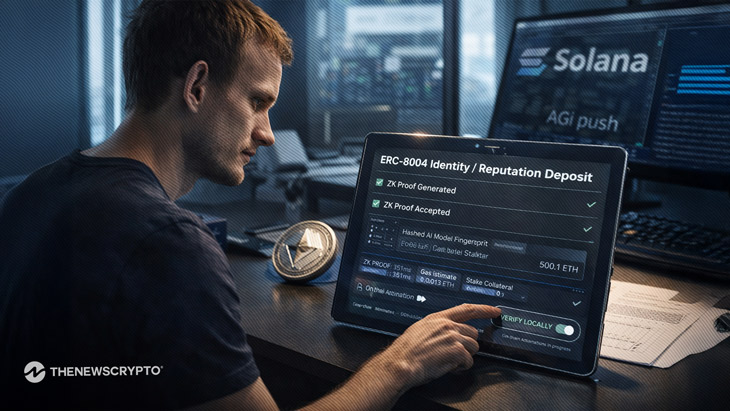
Vitalik Buterin Outlines Ethereum’s AI Framework, Pushes Back Against Solana’s Acceleration Thesis

Vitalik Buterin Outlines Ethereum’s AI Framework, Pushes Back Against Solana’s Acceleration Thesis

Ethereum co-founder Vitalik Buterin has reacted to Solana’s artificial general intelligence acceleration initiative. He did this through the establishment of his
Share
Thenewscrypto2026/02/10 18:40
Vitalik Buterin Reveals Ethereum’s Bold Plan to Stay Quantum-Secure and Simple!

Vitalik Buterin Reveals Ethereum’s Bold Plan to Stay Quantum-Secure and Simple!

Buterin unveils Ethereum’s strategy to tackle quantum security challenges ahead. Ethereum focuses on simplifying architecture while boosting security for users. Ethereum’s market stability grows as Buterin’s roadmap gains investor confidence. Ethereum founder Vitalik Buterin has unveiled his long-term vision for the blockchain, focusing on making Ethereum quantum-secure while maintaining its simplicity for users. Buterin presented his roadmap at the Japanese Developer Conference, and splits the future of Ethereum into three phases: short-term, mid-term, and long-term. Buterin’s most ambitious goal for Ethereum is to safeguard the blockchain against the threats posed by quantum computing.  The danger of such future developments is that the future may call into question the cryptographic security of most blockchain systems, and Ethereum will be able to remain ahead thanks to more sophisticated mathematical techniques to ensure the safety and integrity of its protocols. Buterin is committed to ensuring that Ethereum evolves in a way that not only meets today’s security challenges but also prepares for the unknowns of tomorrow. Also Read: Ethereum Giant The Ether Machine Takes Major Step Toward Going Public! However, in spite of such high ambitions, Buterin insisted that Ethereum also needed to simplify its architecture. An important aspect of this vision is to remove unnecessary complexity and make Ethereum more accessible and maintainable without losing its strong security capabilities. Security and simplicity form the core of Buterin’s strategy, as they guarantee that the users of Ethereum experience both security and smooth processes. Focus on Speed and Efficiency in the Short-Term In the short term, Buterin aims to enhance Ethereum’s transaction efficiency, a crucial step toward improving scalability and reducing transaction costs. These advantages are attributed to the fact that, within the mid-term, Ethereum is planning to enhance the speed of transactions in layer-2 networks. According to Butterin, this is part of Ethereum’s expansion, particularly because there is still more need to use blockchain technology to date. The other important aspect of Ethereum’s development is the layer-2 solutions. Buterin supports an approach in which the layer-2 networks are dependent on layer-1 to perform some essential tasks like data security, proof, and censorship resistance. This will enable the layer-2 systems of Ethereum to be concerned with verifying and sequencing transactions, which will improve the overall speed and efficiency of the network. Ethereum’s Market Stability Reflects Confidence in Long-Term Strategy Ethereum’s market performance has remained solid, with the cryptocurrency holding steady above $4,000. Currently priced at $4,492.15, Ethereum has experienced a slight 0.93% increase over the last 24 hours, while its trading volume surged by 8.72%, reaching $34.14 billion. These figures point to growing investor confidence in Ethereum’s long-term vision. The crypto community remains optimistic about Ethereum’s future, with many predicting the price could rise to $5,500 by mid-October. Buterin’s clear, forward-thinking strategy continues to build trust in Ethereum as one of the most secure and scalable blockchain platforms in the market. Also Read: Whales Dump 200 Million XRP in Just 2 Weeks – Is XRP’s Price on the Verge of Collapse? The post Vitalik Buterin Reveals Ethereum’s Bold Plan to Stay Quantum-Secure and Simple! appeared first on 36Crypto.
Share
Coinstats2025/09/18 01:22