Crypto Market Trust Crisis Deepens as Binance Risk Systems Face New Questions
The crypto market trust crisis has become a central reason behind the slow digital asset recovery in mid-2026. Industry leaders now say confidence, not price, is the main problem.
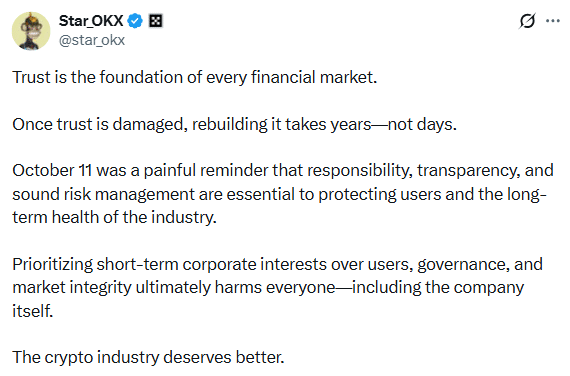
On July 2, OKX Founder and CEO Star Xu brought the issue back into focus. He publicly supported comments from Wei Zhou, the former Binance chief financial officer and current CEO of Coins.ph.
Their exchange pointed to a deeper concern across centralized crypto platforms. The concern is that investors still do not fully trust exchange risk systems after the October 2025 crash.
Crypto Market Trust Crisis Deepens After $19B Liquidation Shock
The debate is tied to the events of October 10, 2025. On that day, about $19 billion in leveraged crypto positions were wiped out across global derivatives markets.
 Source: X
The liquidation wave began after a major macro shock. The United States announced 100% tariffs on Chinese imports during a high-volume trading weekend.
However, Xu and Zhou argued that exchange systems also deserve scrutiny. They said the Crypto market trust crisis grew because users and institutions could not clearly see how liquidation engines worked.
Zhou said the market is stuck because large traders remain cautious. He argued that institutions and market makers are not ready to return capital to platforms with opaque margin systems.
His view carries weight because of his background. Zhou worked as Binance CFO from 2018 to 2021 before moving to other regional crypto platforms.
 Source: X
October Crash Damaged Market Confidence
The October crash left a lasting mark on the market. It showed how fast leveraged positions can collapse during a macro shock.
For many traders, the concern was not only the size of the losses. It was also the limited visibility into how platforms priced collateral and triggered liquidations.
That lack of visibility has kept the Crypto market trust crisis alive. Institutions want clearer systems before they increase exposure again.
Binance Risk Systems Face Questions
The sharpest criticism focused on Binance. According to the supplied account, a database read-path regression caused a 33-minute internal processing delay under heavy demand.
The platform’s unified account margin system also came under focus. It reportedly valued cross-collateral assets using Binance’s internal order book depth.
Critics said this created a weak point during extreme volatility. They argued that external, multi-venue pricing oracles could have reduced the risk of local price distortions.
USDe, BNSOL and WBETH Deviation Adds Pressure
Synthetic and wrapped assets became a major part of the debate. These included Ethena’s USDe, BNSOL, and WBETH.
On Binance, USDe reportedly fell to $0.65 during the event. At the same time, it remained near $1.00 across the wider market.
That price gap triggered forced liquidations. It also strengthened claims that the Crypto market trust crisis is linked to internal exchange design.
Wei Zhou Points to Black Box Systems
Zhou said centralized exchanges still hide too much of their risk infrastructure. He pointed to liquidation rules, margin valuations, and risk-engine mechanics.
He argued that large players do not want to trade in systems they cannot verify. This is especially true after a weekend shock that caused sudden losses.
His comments also carried historical context. Investigative findings cited in the supplied material said Zhou was denied full access to Binance’s consolidated corporate financial accounts during his time as CFO.
Binance Pushes Back Against Claims
Binance and its leadership rejected claims that the exchange amplified the crash. Changpeng “CZ” Zhao reportedly called accusations against Binance “far-fetched.”
Binance framed the event as a market-wide deleveraging caused by macro trade policy. It said the crash was not the result of a localized exchange failure.
The exchange also pointed to its relief program. By late October 2025, Binance had distributed more than $600 million in user support.
Compensation Becomes Part of Binance Defense
The compensation included a $328 million reimbursement pool. That pool covered users affected by USDe, BNSOL, and WBETH index deviations.
Binance also launched a $300 million Together Initiative. The fund was aimed at broader slippage losses and user relief.
Bull Run Depends on Structural Reform
Zhou said the next bull run will need more than retail leverage. He argued that crypto must build stronger institutional infrastructure.
He pointed to three possible catalysts. These were Big Tech blockchain integration, U.S. legal clarity through the CLARITY Act, and looser digital asset restrictions in East Asia.
These catalysts show why the Crypto market trust crisis is broader than one exchange. It now touches regulation, market structure, and institutional access.
Conclusion
The central issue in mid-2026 is no longer only price. The larger problem is whether investors trust the systems behind centralized crypto trading.
Bitcoin may hover near $60,000, but that alone may not restart a stronger cycle. Capital can move elsewhere if traders see better risk-adjusted opportunities.
The Crypto market trust crisis may continue until exchanges offer proof-of-reserves, transparent risk engines, stronger oracle systems, and coordinated circuit breakers. Trust may take years to rebuild.
Appendix: Glossary of Key Terms
Liquidation: A forced closure of a leveraged trade when collateral falls below required levels.
Risk Engine: An exchange system that manages margin, collateral, and liquidation triggers.
Proof of Reserves: A process showing whether an exchange holds enough assets to cover user balances.
Pricing Oracle: A data source that helps platforms value assets using wider market prices.
Cross-Collateral: Multiple assets used together as margin for trading positions.
Circuit Breaker: A safety tool that pauses trading during extreme volatility.
Depeg: A price break from an asset’s expected value, such as a stablecoin falling below $1.
Frequently Asked Questions About Crypto Market Trust Crisis
1- Why is the crypto market stuck in 2026?
A: Industry leaders cited weak confidence after the October 2025 liquidation event. They also pointed to opaque exchange risk systems.
2- What caused the October 2025 liquidation crash?
A: The crash followed a U.S. tariff shock against Chinese imports. Critics also said internal exchange systems increased pressure during the event.
3- Why is Binance central to the debate?
A: Critics pointed to processing delays, internal margin pricing, and asset index deviations. Binance rejected claims that it amplified the crash.
4- What could help restore market confidence?
A: Exchanges may need proof-of-reserves, clearer risk engines, stronger pricing oracles, and better circuit breakers.
Reference
CryptoTimes
Read More: Crypto Market Trust Crisis Deepens as Binance Risk Systems Face New Questions">Crypto Market Trust Crisis Deepens as Binance Risk Systems Face New Questions


You May Also Like
Securitize Tokenizes $295M of Its Own Stock on Solana and Avalanche After NYSE Debut

Judge rages at Trump lawyers about 'Schrödinger's golf course'