

Zscaler Just Made Its Case at Zenith Live. Here’s Why the AI Fear Driving Its 60% Drop May Be Backwards
Key Stats for Zscaler Stock
- Current Price: $132.26
- Target Price (Mid): ~$235
- Street Target: ~$193
- Potential Total Return: ~77%
- Annualized IRR: ~15% / year
- Earnings Reaction: -31.52% (reported May 26, 2026)
- Max Drawdown: -64.89% (April 10, 2026)
Now Live: Discover how much upside your favorite stocks could have using TIKR’s new Valuation Model (It’s free) >>>
What Happened?
Zscaler, Inc. (ZS) spent most of 2026 being treated as a casualty of the AI boom, and at its own customer conference, management stood up and argued that the market has the story inverted. The stock sits at $132.26, down roughly 60% from its 52-week high of $336.99. Two forces drove that decline: a market-wide fear that AI will compress software pricing and eventually let frontier models do security work themselves, and a specific guidance miss in May that confirmed growth is slowing. The first fear, more than any single number, is what hollowed out the long-term valuation this year.
At Zenith Live 2026 in Las Vegas on June 9, founder and CEO Jay Chaudhry took the AI disconnect head-on. His pitch was not that AI is survivable for Zscaler. It was that the agentic AI wave is the single largest demand catalyst the company has seen since the pandemic. “We think this moment is almost like COVID because, in fact, it’s even bigger from a cyber point of view as everything is online, everything is digital,” Chaudhry told the room. That matters because it reframes the central question investors keep asking. The market wants to know whether AI breaks Zscaler. Management spent the conference arguing that AI is what finally proves why the platform exists.
The tension is real and unresolved. The stock has not recovered, the growth outlook genuinely decelerated, and a respected bear at Morgan Stanley still has the name in what she called the “penalty box.” So the conference is worth taking seriously as evidence, not as a press release. Here is what management actually revealed, and what the numbers say about whether the reset has gone too far.
The Anthropic Moment Management Could Not Stop Talking About
The clearest signal at Zenith Live was how often Anthropic came up, and not as a threat. Chaudhry pointed to a white paper Anthropic published about a week before the event on Zero Trust for AI agents, and his reaction was telling. “As I read it, I was wondering, did my marketing team write it,” he said. “It literally felt like what we advocate, what we believed in.” The argument in that paper, that agents cannot be allowed to roam freely on a network and must be treated as untrusted entities subject to policy control, is the exact thesis Zscaler has sold for fifteen years.
This is where the disruption fear starts to wobble. The bear case assumes models like Anthropic’s Mythos, currently in limited release through the Project Glasswing program, will eventually replace security vendors. Chaudhry’s counter is that these models do the opposite. They find far more vulnerabilities than enterprises can possibly patch, which increases the need for architectural defenses like hiding applications and stopping lateral movement. He put it plainly: Mythos finds more vulnerabilities, and “that means there’s more need for providers like Zscaler.” Zscaler has been part of Glasswing since early March and is also part of OpenAI’s Daybreak program, positioning it as the security layer these model companies partner with rather than the incumbent they erase. For the full picture of how management framed the AI roadmap, the investor relations materials from the event are worth reading directly.
 Zscaler Drawdowns (TIKR)
See historical and forward estimates for Zscaler stock (It’s free!) >>>
The New Product That Raises the Barrier to Entry
The most important launch at the conference was Zero Trust for AI agents, built on top of the existing Zero Trust Exchange, which is the platform that routes enterprise traffic and enforces who can talk to whom. Chaudhry framed it as one of the hardest problems in the category to solve. “This probably has bigger barriers to entry for any new entrants than any other area out there,” he said. The reason is scale. Zscaler already processes about 750 billion transactions a day, and management expects the agentic world to “add a couple of zeros to it” in volume. Building that kind of in-line inspection at wire speed is not something a startup spins up quickly.
The commercial angle is a shift toward consumption pricing, which deserves attention because seat-based erosion is the heart of the bear case. Management disclosed that non-seat-based sources moved from around 25% of new annual contract value a quarter ago to 30% last quarter. The Agentic Exchange will be priced on traffic and requests, which translates into token consumption. That structure means agent proliferation becomes a revenue tailwind, not a seat-count headwind, which is precisely the mechanism skeptics assume works against the company.
What the Customers Said When Management Left the Stage
The customer panel is usually where conference theater breaks down, and here it reinforced the thesis instead. Wayne Fajerski, Deputy CISO at Edward Jones and a Zscaler customer since 2010, was blunt about AI urgency. “AI is everything for us right now,” he said, describing the core problem as shadow AI, the inability to govern tools you cannot see. Jason Kohler, Deputy CISO at Eaton, described deploying Zero Trust appliances across roughly 100 factories to contain threats at the device level. Mustapha Kebbeh, CSO at UKG, walked through using Zscaler to govern developer activity inside coding tools like Claude Code, a use case that did not exist a year ago.
These are not pilots. They are large enterprises describing AI security as a real, funded demand. On where the money comes from, the panel was mixed but revealing. “It’s actually not coming from security, it’s coming from the business,” Kohler said, “because they understand the value that security is going to provide to them to keep the AI that they’re creating safe.” Kebbeh described his own spending as a combination of reallocation and new investment. Either way, the budget is being found, which cuts against the idea that AI uniformly shrinks the security wallet.
The Question the Conference Did Not Fully Answer
None of this erases why the stock fell. Zscaler reported fiscal Q3 2026 results on May 26 that beat on both lines, with revenue of $850.48 million and adjusted EPS of $1.08, yet the stock fell 31.52% on the report, one of the worst single-day moves in its history. The trigger was guidance: management’s early fiscal 2027 framework pointed to annual recurring revenue and revenue growth of around 16% to 17%, a sharp deceleration from the roughly 25% pace of fiscal 2026. Compounding it, management disclosed two departures from the go-to-market team. At Zenith Live, Chief Revenue Officer Mike Rich addressed the turnover directly, calling it “just 2 at the same time” and pointing to a strong bench, but the market clearly wanted more reassurance than that.
The skeptic case has teeth. Morgan Stanley’s Meta Marshall, who downgraded the stock in April, said the latest results validated her caution and warned the stock could stay in the penalty box until AI security traction shows up clearly in results. Wells Fargo and Evercore ISI trimmed targets after earnings. The honest read is that the conference made the long-term argument compelling while leaving the near-term execution question open, and that gap is exactly what the valuation now reflects.
That gap also shows up against peers. Zscaler trades at around 5.3x next-twelve-month enterprise value to revenue, below the roughly 6.7x average across its software comparison set on TIKR and a fraction of CrowdStrike’s 28x. Its normalized earnings per share of $1.08 in the April quarter sat above Palo Alto Networks’ $0.80 and well above Cloudflare’s $0.23 for the same period, even though the market prices it at a steeper discount than either. On June 1, Guggenheim’s John DiFucci, the same analyst who pressed management on the go-to-market organization during the Zenith Live Q&A, upgraded the stock to Buy with a $214 target, calling it a “trust me story” but a category-leader entry point. The discount is not a mystery. The market is pricing decelerating growth and waiting for proof that the AI narrative converts to bookings.
 Zscaler Revenues & YoY (TIKR)
See how Zscaler performs against its peers in TIKR (It’s free!) >>>
TIKR Advanced Model Analysis
- Current Price: $132.26
- Target Price (Mid): ~$235
- Potential Total Return: ~77%
- Annualized IRR: ~15% / year
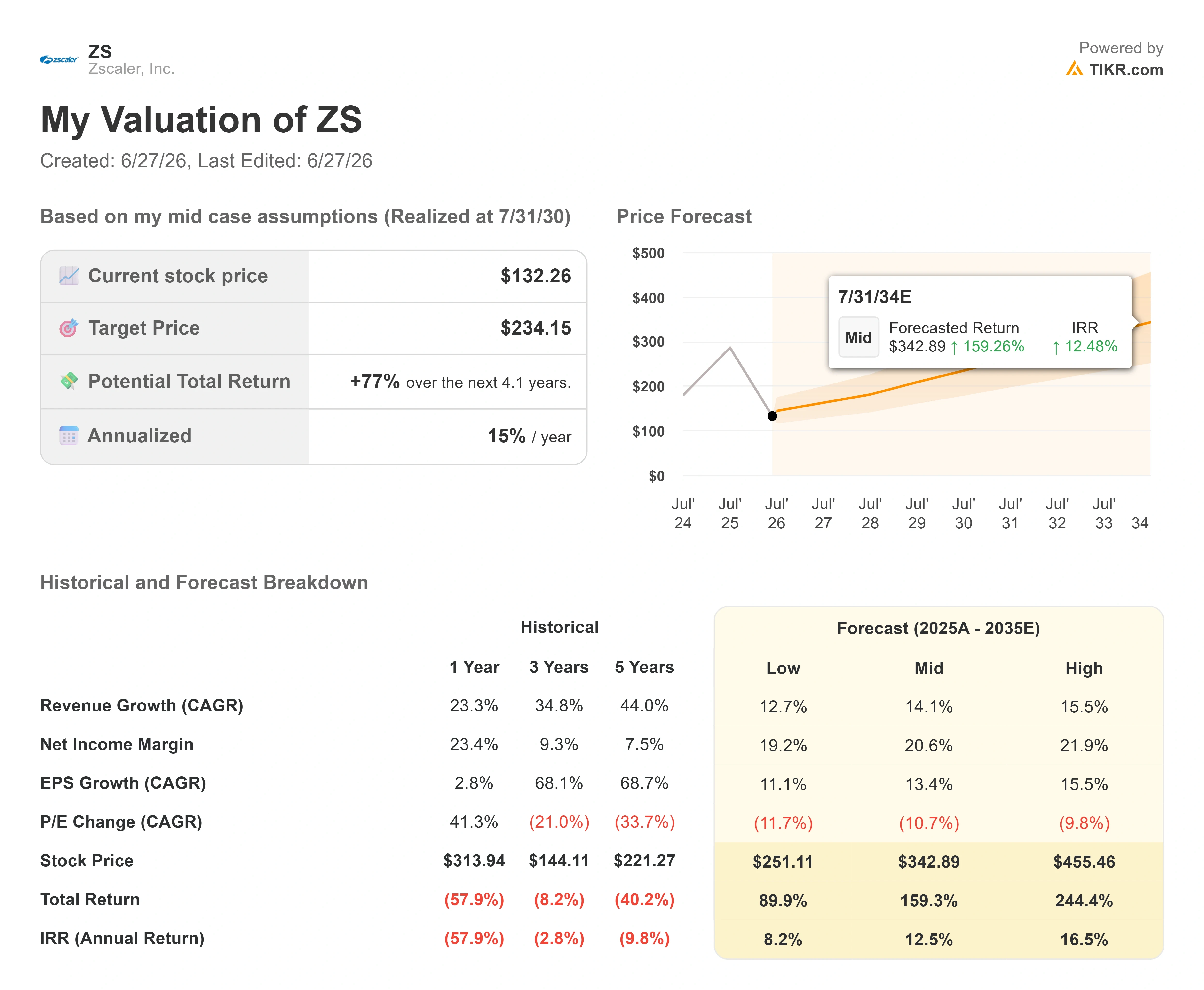 Zscaler Advanced Valuation Model (TIKR)
See analysts’ growth forecasts and price targets for Zscaler stock (It’s free!) >>>
Using TIKR’s mid-case scenario, the model values Zscaler at around $235 by mid-2030, implying roughly 77% total return from the current price, or about 15% annualized over the next 4.1 years. The mid-case is the right anchor here because it leans on management’s own preliminary guidance rather than a recovery story that requires the AI narrative to fully play out.
The target rests on two revenue drivers. The first is the consumption-based agentic and AI security layer, where AI Protect has already crossed $100 million in trailing-twelve-month bookings, and the Agentic Exchange opens a traffic-priced model. The second is platform expansion inside the installed base, where Zero Trust Everywhere adoption surpassed 500 enterprises, and data security annual recurring revenue crossed $500 million, growing over 30%. The margin driver is operating leverage: non-GAAP operating margin hit an all-time high of 23% in Q3, and the model’s roughly 14% revenue CAGR and around 21% net income margin extrapolate existing leverage rather than assuming aggressive expansion. The primary risk is that fiscal 2027 growth settles in the mid-teens and AI security bookings stay invisible in reported results, leaving the multiple stuck.
The upside is straightforward: if agentic security demand converts the way the conference suggested, the stock re-rates from the bottom of its own historical range toward the Street’s roughly $193 mean target and beyond. The downside is equally clear: another guidance reset or visible competitive pressure from Palo Alto Networks and Cloudflare keeps the stock in the penalty box regardless of the long-term story.
Conclusion
The next real test is the fiscal Q4 report expected in early September, and the metric that matters is net new ARR. Management’s preliminary framework implies a step down in organic net new ARR growth, so the question is whether the agentic and AI security momentum on display at Zenith Live starts showing up in that line. Good looks like net new ARR holding or beating the cautious guide, while AI Protect bookings keep climbing past the $100 million mark. Bad looks like another in-line-to-soft guide that confirms the deceleration is structural rather than a prudent reset around the sales transition. Zenith Live made the long-term case as well as management could have. September is when the numbers either back it up or they don’t.
See what stocks billionaire investors are buying so you can follow the smart money with TIKR.
Should You Invest in Zscaler?
The only way to really know is to look at the numbers yourself. TIKR gives you free access to the same institutional-quality financial data that professional analysts use to answer exactly that question.
Pull up Zscaler, and you’ll see years of historical financials, what Wall Street analysts expect for revenue and earnings in the quarters ahead, how valuation multiples have moved over time, and whether price targets are trending up or down.
You can build a free watchlist to track Zscaler alongside every other stock on your radar. No credit card required. Just the data you need to decide for yourself.
Analyze Zscaler on TIKR Free →
Looking for New Opportunities?
- See what stocks billionaire investors are buying so you can follow the smart money.
- Analyze stocks in as little as 5 minutes with TIKR’s all-in-one, easy-to-use platform.
- The more rocks you overturn… the more opportunities you’ll uncover. Search 100K+ global stocks, global top investor holdings, and more with TIKR.
Disclaimer:
Please note that the articles on TIKR are not intended to serve as investment or financial advice from TIKR or our content team, nor are they recommendations to buy or sell any stocks. We create our content based on TIKR Terminal’s investment data and analysts’ estimates. Our analysis might not include recent company news or important updates. TIKR has no position in any stocks mentioned. Thank you for reading, and happy investing!
You May Also Like

George Conway and Mehdi Hasan deliver searing indictment of 'dumb' Trump’s presidency

BitMine Just 500K ETH Away From 5% Supply Goal

Exhibits at Trump’s State Fair documented by reporter: ‘Basically just put up some chairs’

