

HIVE AI Infrastructure Matches H100 Performance With Older GPUs
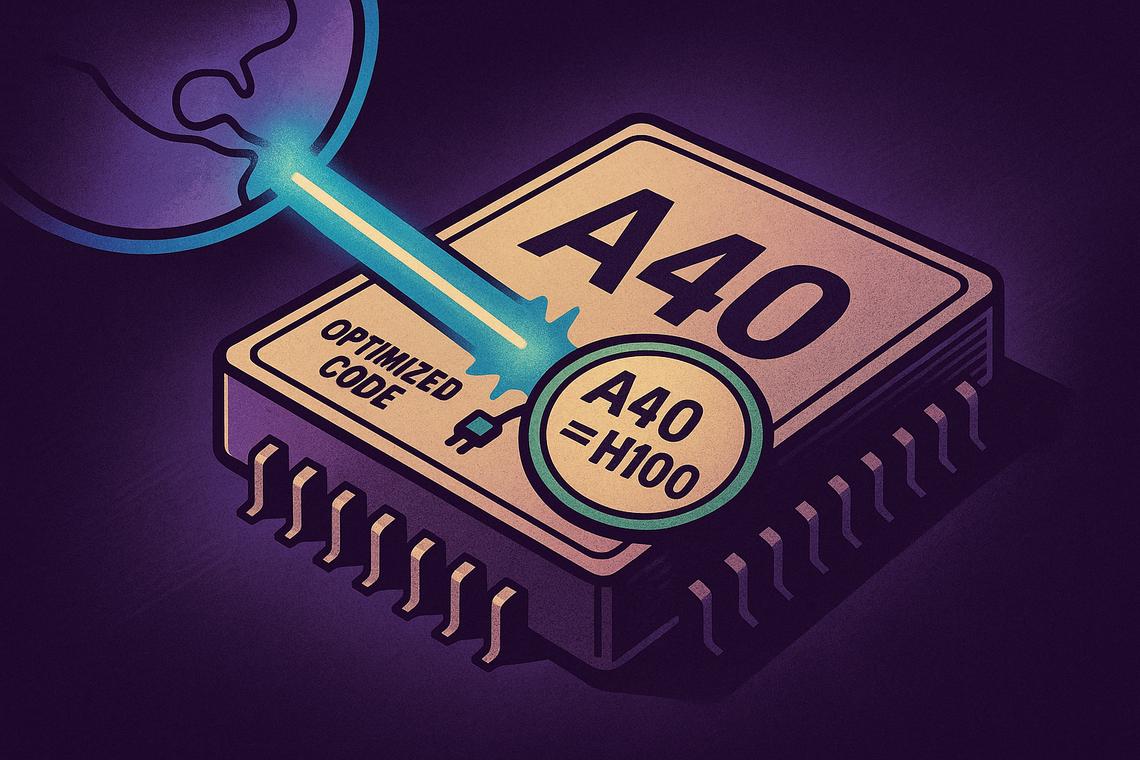
A collaboration between HIVE Digital Technologies and Columbia University has produced something the AI computing world rarely sees from an emerging market: hard proof. Researchers at Columbia’s Department of Industrial Engineering and Operations Research ran iterative AI training workloads on HIVE’s GPU cluster in Asunción, Paraguay — more than 5,000 miles away from their New York City lab — and the results were good enough to submit to NeurIPS, one of the most competitive AI research conferences on the planet.
Key takeaways
- HIVE’s A40 GPUs in Paraguay matched the performance of newer-generation H100 GPUs after code optimizations by Columbia researchers.
- The research was submitted to NeurIPS, a leading annual machine learning conference held each December, alongside ICLR and ICML as one of the three most impactful AI research venues globally.
- Columbia researchers successfully ran intercontinental AI training runs remotely over 5,000 miles from New York City to Asunción.
- HIVE’s 100 MW substation in Yguazú, Paraguay is expected to be energized by September 2026, with a new Tier-III data center starting construction in Fall 2026 and ready for service in H2 2027.
- The research focused on the Muon optimizer and advanced neural network pretraining techniques relevant to future large language model development.
HIVE and Columbia University Validate AI GPU Infrastructure in Paraguay
The core finding is straightforward but significant: geography no longer has to limit where serious AI research gets done. Over a two-month period, Columbia researchers optimized their training code specifically for HIVE’s A40 GPU nodes in Asunción. When they measured throughput, latency, and token-per-second performance against H100 benchmarks — the current industry-standard reference GPU — the results aligned after normalizing for each hardware platform’s raw performance characteristics.
That is not a minor footnote. H100 GPUs represent Nvidia’s flagship data center silicon, and closing that performance gap using older A40 hardware through software-level optimization speaks directly to HIVE’s argument that smart engineering can extract significant value from its existing infrastructure.
Intercontinental AI Training from New York to Asunción
What makes this collaboration technically interesting is the intercontinental dimension. Running AI training jobs remotely is not unusual within a single data center or campus network. Doing it reliably across more than 5,000 miles, with iterative training runs that depend on low-latency feedback loops, is a different challenge entirely. The Columbia team pulled it off, establishing a concrete performance baseline for HIVE’s Asunción GPU cluster that the company can now use as a reference point for future commercial AI workloads.
Performance Parity of HIVE’s A40 and Newer H100 GPUs
The performance parity result carries weight beyond this single study. It suggests that clients evaluating HIVE’s Paraguay infrastructure for AI workloads — particularly those pretraining large language models at scales up to 1.4 billion parameters, as tested in this research — should not automatically assume a hardware generation gap means a capability gap. The Columbia team also ran serving throughput and latency tests on a 1.4B parameter model and conducted standard benchmarks using LLaMA models, building a broader performance picture of the cluster.
Cutting-Edge Research on Neural Network Pretraining and Optimization
The academic substance of this project goes beyond infrastructure validation. The Columbia team’s research sits at the intersection of optimization theory and practical large-scale AI training, a field that has attracted serious attention as LLM pretraining costs continue to balloon.
Focus on Muon Optimizer and Advanced Pretraining Techniques
The study analyzed the Muon optimizer and variants, examining neural network pretraining under conditions of general geometry and large noise. In practical terms, Muon is a matrix-aware optimizer — meaning it accounts for the structure of weight matrices during gradient updates, rather than treating all parameters uniformly as simpler optimizers do. The Columbia researchers designed and analyzed an accelerated algorithm that matched Muon’s performance in both theoretical and practical settings, which is a meaningful contribution to understanding how next-generation pretraining methods behave at scale.
Insights from Columbia University Researchers
An assistant professor in Columbia’s IEOR department described the broader significance: the work advances understanding of matrix-aware optimizers such as Muon and related scale-invariant methods, clarifying their theoretical foundations and evaluating them in real neural network training environments. The research highlights their potential relevance for future LLM pretraining — precisely the workloads that will define AI infrastructure demand over the next several years.
Submitting this work to NeurIPS — which, alongside ICLR and ICML, is considered one of the three primary high-impact venues in machine learning globally — signals that the research quality is being put to a serious peer-review test, not just circulated as a marketing proof of concept.
Strategic AI Infrastructure Development in Paraguay
The Columbia collaboration is timed deliberately. HIVE is in the middle of a substantial infrastructure build-out in Paraguay that transforms this research milestone into a commercial foundation rather than a standalone academic exercise.
100 MW Substation and Tier-III Data Center Construction
In Yguazú, Paraguay, HIVE has a 100 megawatt substation under construction with civil works already complete. The company is planning commissioning this summer, with the substation expected to be energized by September 2026. Construction on a new Tier-III data center at the same site is scheduled to begin in Fall 2026.
Projected Commissioning and Operational Timelines
The Tier-III data center carries a ready-for-service date in H2 2027, giving HIVE a clear runway to convert the performance benchmarks established in this research into a fully operational HPC and AI computing facility. The token-per-second, latency, and bandwidth data collected during the Columbia study now serve as the technical baseline for that facility’s design and commercial positioning.
The strategic logic is worth examining closely. Paraguay sits on an energy surplus built around hydroelectric generation — clean, consistent, and relatively inexpensive. HIVE, which was founded in 2017 as one of the first publicly listed companies to mine digital assets using green energy, has been operating data centers in Canada, Sweden, and Paraguay with an explicit focus on environmental sustainability. Bringing AI workloads to that same infrastructure base is a natural extension of the business model, and the Columbia research now provides the kind of third-party performance validation that enterprise clients typically require before committing compute budgets.
Leadership Perspectives on Innovation and Global AI Strategy
Executive Chairman Frank Holmes on Distributed AI Infrastructure
Executive Chairman Frank Holmes framed the result in terms of what it disproves: “It shows that high-performance computing does not need to be limited by geography.” Holmes pointed to Paraguay’s combination of power capacity, strategic location, and now a verified proof point as the foundation for the company’s vision of connecting the country directly to the global AI economy. “HIVE is proud to help bring that future online,” he added.
CEO Aydin Kilic on Research Validation and Future Vision
President and CEO Aydin Kilic zeroed in on what the A40-to-H100 parity result means for HIVE’s broader investment thesis: “Great engineering can unlock significant value.” Kilic noted that the company’s history of hardware innovation — including building the BuzzMiner in collaboration with Intel Corporation and becoming one of Sweden’s largest demand-response participants, helping balance the national electrical grid — reflects a consistent pattern of extracting operational efficiency through technical ingenuity rather than simply deploying the newest available hardware.
That framing matters for investors and potential cloud clients alike. If HIVE can close performance gaps through code optimization rather than capital expenditure on the latest GPU generation, the unit economics of its Paraguay infrastructure look considerably more attractive — particularly as demand for cost-efficient AI compute continues to outpace supply of premium H100 capacity globally.
FAQ
What was the main achievement of HIVE’s research collaboration with Columbia University?
The collaboration demonstrated intercontinental AI training, with Columbia researchers in New York City successfully running AI workloads on HIVE’s GPU cluster in Asunción, Paraguay, over 5,000 miles away. The key technical finding was that HIVE’s A40 GPUs matched the performance of newer H100 GPUs after code optimizations developed by the Columbia team.
Where and when will HIVE’s new AI data center and substation in Paraguay come online?
The 100 MW substation in Yguazú, Paraguay is expected to be commissioned in summer 2026 and energized by September 2026. Construction on a new Tier-III data center at the same site is scheduled to begin in Fall 2026, with a ready-for-service date in the second half of 2027.
What advanced AI research was conducted using HIVE’s infrastructure?
Researchers from Columbia University’s Department of Industrial Engineering and Operations Research studied neural network pretraining using optimization theory under conditions of general geometry and large noise. The work focused on the Muon optimizer and related matrix-aware methods, evaluating pretraining algorithms for large language models up to 1.4 billion parameters on HIVE’s A40 GPU nodes in Asunción.
How does HIVE view Paraguay’s role in the global AI infrastructure landscape?
HIVE leadership views Paraguay as a strategically positioned hub for global AI computing, citing its hydroelectric power capacity, geographic location, and now a verified performance baseline as key advantages. The company’s goal is for Paraguay to participate directly in the global AI economy through distributed, energy-efficient HPC infrastructure.
Article produced with the assistance of artificial intelligence and reviewed by the editorial team.


You May Also Like

Infamous MEV Bot JaredFromSubway Drained For $7.5 Million

Exclusive: Index Ventures, Union Square Ventures back trading app Fomo at $550 million valuation

Thorne reaches $500M in revenue after L Catterton take private



