Author: Ash Compiled by: TechFlow @newmichwill, founder of @CurveFinance, is launching @yieldbasis, a Bitcoin AMM liquidity platform with no impermanent loss. Meanwhile, @yearnfi founder and DeFi god @AndreCronjeTech is building @flyingtulip_, a unified AMM+CLOB exchange. Two different attempts to solve the same problem: how to make on-chain liquidity truly effective: Yield Basis ($YB): A Curve-native AMM that eliminates impermanent loss for BTC liquidity providers by maintaining a constant 2x leveraged BTC-crvUSD liquidity pool (LP value remains 1:1 with BTC while earning transaction fees). Users can mint ybBTC (yield-generating BTC). Flying Tulip ($FT): An on-chain unified exchange (including spot, lending, perpetual contracts, options, and structured returns), based on a volatility-aware hybrid AMM+CLOB architecture, combined with a slippage-aware lending mechanism, and ftUSD (a delta-neutral USD equivalent) as the core incentive. Yield Basis Traditional AMMs allow BTC liquidity providers to sell when prices rise or buy when prices fall (√p exposure, DeepChao Note: market risk exposure measured in square roots of prices), resulting in impermanent losses that often exceed the fees earned from providing liquidity. The specific mechanism of Yield Basis will be explained in detail later, but the core is: users deposit BTC into the platform, and the protocol borrows an equal amount of crvUSD, forming a 50/50 BTC-crvUSD Curve liquidity pool, which operates with 2x compound leverage. A re-leveraged AMM and virtual pool maintains a debt approximately equal to 50% of the liquidity pool value; arbitrageurs profit by maintaining leverage constant. This allows the value of the liquidity pool to change linearly with BTC while earning transaction fees. Liquidity providers hold ybBTC, a yield-generating BTC receipt token that automatically compounds BTC-denominated transaction fees. The platform also provides governance tokens $YB, which can be locked as veYB and used for voting (for example, selecting liquidity pool reward distribution). Yield Basis is primarily aimed at BTC holders who want to unlock productive BTC in a protocol that solves the impermanent loss problem and earn fees. Flying Tulip Traditional decentralized exchanges (DEXs) often have static user experiences and risk profiles. Flying Tulip aims to bring centralized exchange (CEX)-level tools to the blockchain by adjusting AMM curves based on volatility and adjusting loan-to-value (LTV) ratios based on actual execution/slippage. Its AMM adjusts the curvature based on the measured volatility (EWMA) - that is, it tends to be flat (close to the constant sum) in the case of small volatility to compress slippage and impermanent loss; it has more multiplicative characteristics in the case of large volatility to avoid liquidity depletion. ftUSD tokenized delta-neutral liquidity pool positions are generated and used for incentive mechanisms and liquidity programs. The platform token $FT may be used for revenue buybacks, incentives, and liquidity programs. Flying Tulip is a DeFi super app: an exchange that supports spot trading, lending, perpetual contracts, and options. Execution quality relies on accurate volatility/impact signals and robust risk control in stressed environments. Outlook of the two projects Yield Basis aims to become a platform for BTC liquidity, while Flying Tulip aims to become a platform for all on-chain native trading. In an era dominated by perpetual contract decentralized exchanges (Perp DEXs), Flying Tulip's launch seems opportune. Frankly, if it can achieve best execution, Flying Tulip could even divert future BTC traffic to a pool similar to YB. If Yield Basis succeeds, ybBTC could become Bitcoin's "stETH" primitive: BTC exposure + liquidity provider (LP) trading fees, without impermanent loss. Flying Tulip has the potential to launch its integrated stack, providing users with centralized exchange (CEX)-level tools, attempting to become a "one-stop shop for all DeFi." While cautiously optimistic about both projects, it's important to note that these projects, led by OG founders and top-tier teams, remain untested, and their founders must also consider the development of other protocols, such as Curve and Sonic. The above image was compiled by TechFlow as follows: Author: Ash Compiled by: TechFlow @newmichwill, founder of @CurveFinance, is launching @yieldbasis, a Bitcoin AMM liquidity platform with no impermanent loss. Meanwhile, @yearnfi founder and DeFi god @AndreCronjeTech is building @flyingtulip_, a unified AMM+CLOB exchange. Two different attempts to solve the same problem: how to make on-chain liquidity truly effective: Yield Basis ($YB): A Curve-native AMM that eliminates impermanent loss for BTC liquidity providers by maintaining a constant 2x leveraged BTC-crvUSD liquidity pool (LP value remains 1:1 with BTC while earning transaction fees). Users can mint ybBTC (yield-generating BTC). Flying Tulip ($FT): An on-chain unified exchange (including spot, lending, perpetual contracts, options, and structured returns), based on a volatility-aware hybrid AMM+CLOB architecture, combined with a slippage-aware lending mechanism, and ftUSD (a delta-neutral USD equivalent) as the core incentive. Yield Basis Traditional AMMs allow BTC liquidity providers to sell when prices rise or buy when prices fall (√p exposure, DeepChao Note: market risk exposure measured in square roots of prices), resulting in impermanent losses that often exceed the fees earned from providing liquidity. The specific mechanism of Yield Basis will be explained in detail later, but the core is: users deposit BTC into the platform, and the protocol borrows an equal amount of crvUSD, forming a 50/50 BTC-crvUSD Curve liquidity pool, which operates with 2x compound leverage. A re-leveraged AMM and virtual pool maintains a debt approximately equal to 50% of the liquidity pool value; arbitrageurs profit by maintaining leverage constant. This allows the value of the liquidity pool to change linearly with BTC while earning transaction fees. Liquidity providers hold ybBTC, a yield-generating BTC receipt token that automatically compounds BTC-denominated transaction fees. The platform also provides governance tokens $YB, which can be locked as veYB and used for voting (for example, selecting liquidity pool reward distribution). Yield Basis is primarily aimed at BTC holders who want to unlock productive BTC in a protocol that solves the impermanent loss problem and earn fees. Flying Tulip Traditional decentralized exchanges (DEXs) often have static user experiences and risk profiles. Flying Tulip aims to bring centralized exchange (CEX)-level tools to the blockchain by adjusting AMM curves based on volatility and adjusting loan-to-value (LTV) ratios based on actual execution/slippage. Its AMM adjusts the curvature based on the measured volatility (EWMA) - that is, it tends to be flat (close to the constant sum) in the case of small volatility to compress slippage and impermanent loss; it has more multiplicative characteristics in the case of large volatility to avoid liquidity depletion. ftUSD tokenized delta-neutral liquidity pool positions are generated and used for incentive mechanisms and liquidity programs. The platform token $FT may be used for revenue buybacks, incentives, and liquidity programs. Flying Tulip is a DeFi super app: an exchange that supports spot trading, lending, perpetual contracts, and options. Execution quality relies on accurate volatility/impact signals and robust risk control in stressed environments. Outlook of the two projects Yield Basis aims to become a platform for BTC liquidity, while Flying Tulip aims to become a platform for all on-chain native trading. In an era dominated by perpetual contract decentralized exchanges (Perp DEXs), Flying Tulip's launch seems opportune. Frankly, if it can achieve best execution, Flying Tulip could even divert future BTC traffic to a pool similar to YB. If Yield Basis succeeds, ybBTC could become Bitcoin's "stETH" primitive: BTC exposure + liquidity provider (LP) trading fees, without impermanent loss. Flying Tulip has the potential to launch its integrated stack, providing users with centralized exchange (CEX)-level tools, attempting to become a "one-stop shop for all DeFi." While cautiously optimistic about both projects, it's important to note that these projects, led by OG founders and top-tier teams, remain untested, and their founders must also consider the development of other protocols, such as Curve and Sonic. The above image was compiled by TechFlow as follows:

New projects from DeFi veterans: Curve founder creates BTC pool, AC plans to build a full-fledged exchange

2025/09/30 08:00
4 min read

Author: Ash

Compiled by: TechFlow

@newmichwill, founder of @CurveFinance, is launching @yieldbasis, a Bitcoin AMM liquidity platform with no impermanent loss.

Meanwhile, @yearnfi founder and DeFi god @AndreCronjeTech is building @flyingtulip_, a unified AMM+CLOB exchange.

Two different attempts to solve the same problem: how to make on-chain liquidity truly effective:

  • Yield Basis ($YB): A Curve-native AMM that eliminates impermanent loss for BTC liquidity providers by maintaining a constant 2x leveraged BTC-crvUSD liquidity pool (LP value remains 1:1 with BTC while earning transaction fees). Users can mint ybBTC (yield-generating BTC).
  • Flying Tulip ($FT): An on-chain unified exchange (including spot, lending, perpetual contracts, options, and structured returns), based on a volatility-aware hybrid AMM+CLOB architecture, combined with a slippage-aware lending mechanism, and ftUSD (a delta-neutral USD equivalent) as the core incentive.

Yield Basis

  • Traditional AMMs allow BTC liquidity providers to sell when prices rise or buy when prices fall (√p exposure, DeepChao Note: market risk exposure measured in square roots of prices), resulting in impermanent losses that often exceed the fees earned from providing liquidity.
  • The specific mechanism of Yield Basis will be explained in detail later, but the core is: users deposit BTC into the platform, and the protocol borrows an equal amount of crvUSD, forming a 50/50 BTC-crvUSD Curve liquidity pool, which operates with 2x compound leverage.
  • A re-leveraged AMM and virtual pool maintains a debt approximately equal to 50% of the liquidity pool value; arbitrageurs profit by maintaining leverage constant.
  • This allows the value of the liquidity pool to change linearly with BTC while earning transaction fees.
  • Liquidity providers hold ybBTC, a yield-generating BTC receipt token that automatically compounds BTC-denominated transaction fees.
  • The platform also provides governance tokens $YB, which can be locked as veYB and used for voting (for example, selecting liquidity pool reward distribution).
  • Yield Basis is primarily aimed at BTC holders who want to unlock productive BTC in a protocol that solves the impermanent loss problem and earn fees.

Flying Tulip

  • Traditional decentralized exchanges (DEXs) often have static user experiences and risk profiles. Flying Tulip aims to bring centralized exchange (CEX)-level tools to the blockchain by adjusting AMM curves based on volatility and adjusting loan-to-value (LTV) ratios based on actual execution/slippage.
  • Its AMM adjusts the curvature based on the measured volatility (EWMA) - that is, it tends to be flat (close to the constant sum) in the case of small volatility to compress slippage and impermanent loss; it has more multiplicative characteristics in the case of large volatility to avoid liquidity depletion.
  • ftUSD tokenized delta-neutral liquidity pool positions are generated and used for incentive mechanisms and liquidity programs.
  • The platform token $FT may be used for revenue buybacks, incentives, and liquidity programs.
  • Flying Tulip is a DeFi super app: an exchange that supports spot trading, lending, perpetual contracts, and options.
  • Execution quality relies on accurate volatility/impact signals and robust risk control in stressed environments.

Outlook of the two projects

Yield Basis aims to become a platform for BTC liquidity, while Flying Tulip aims to become a platform for all on-chain native trading. In an era dominated by perpetual contract decentralized exchanges (Perp DEXs), Flying Tulip's launch seems opportune. Frankly, if it can achieve best execution, Flying Tulip could even divert future BTC traffic to a pool similar to YB. If Yield Basis succeeds, ybBTC could become Bitcoin's "stETH" primitive: BTC exposure + liquidity provider (LP) trading fees, without impermanent loss. Flying Tulip has the potential to launch its integrated stack, providing users with centralized exchange (CEX)-level tools, attempting to become a "one-stop shop for all DeFi." While cautiously optimistic about both projects, it's important to note that these projects, led by OG founders and top-tier teams, remain untested, and their founders must also consider the development of other protocols, such as Curve and Sonic.
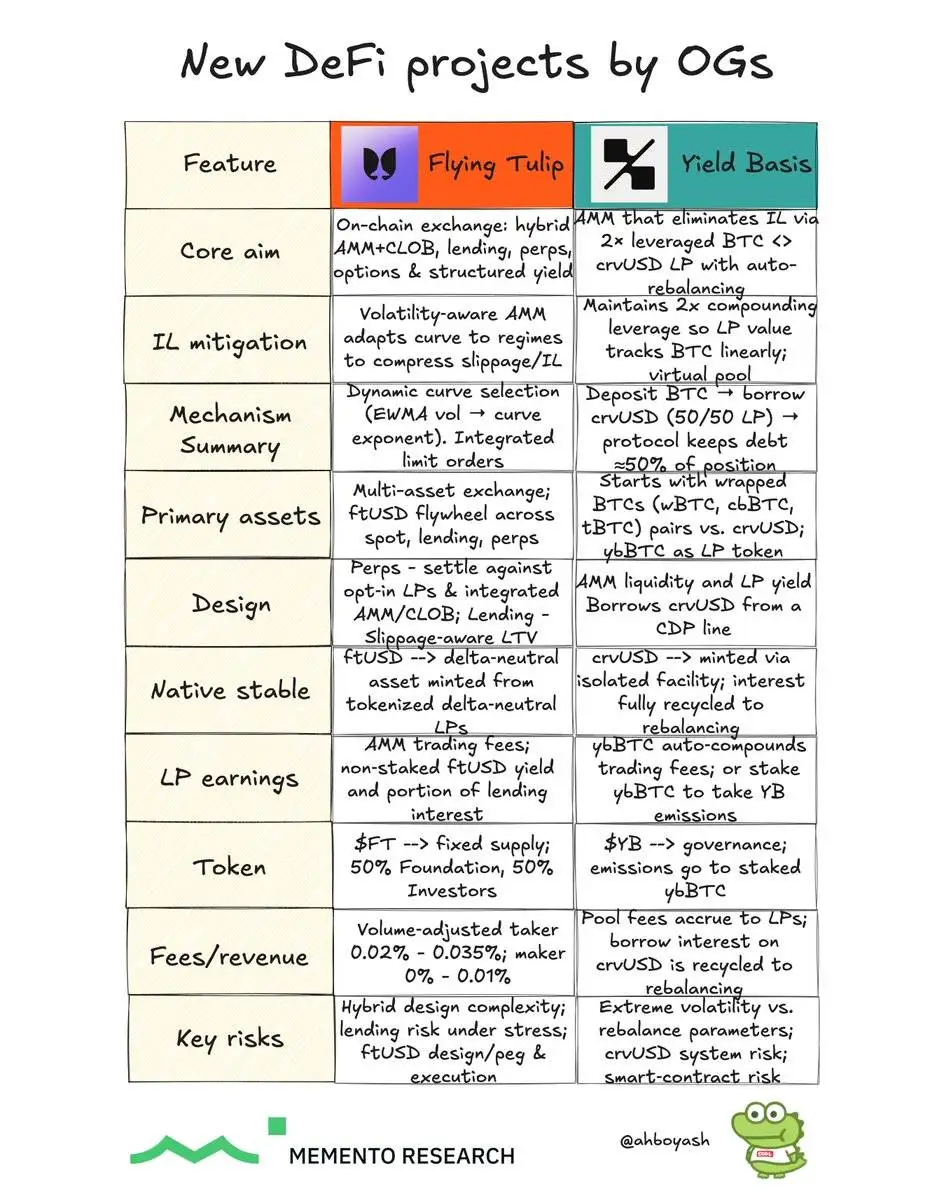
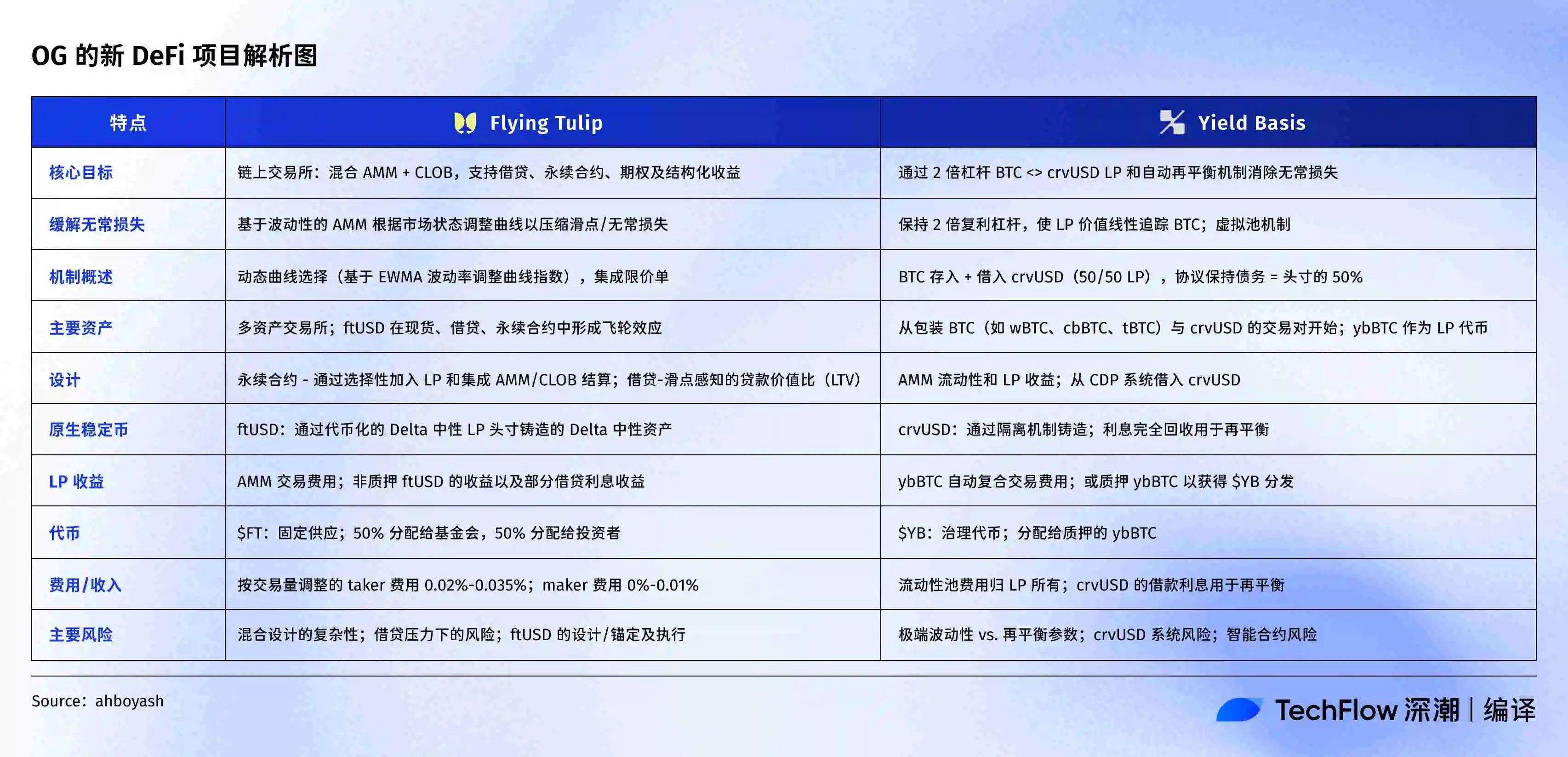
The above image was compiled by TechFlow as follows:
Market Opportunity
DeFi Logo
DeFi Price(DEFI)
$0.000311
$0.000311$0.000311
-4.60%
USD
DeFi (DEFI) Live Price Chart
Disclaimer: The articles reposted on this site are sourced from public platforms and are provided for informational purposes only. They do not necessarily reflect the views of MEXC. All rights remain with the original authors. If you believe any content infringes on third-party rights, please contact service@support.mexc.com for removal. MEXC makes no guarantees regarding the accuracy, completeness, or timeliness of the content and is not responsible for any actions taken based on the information provided. The content does not constitute financial, legal, or other professional advice, nor should it be considered a recommendation or endorsement by MEXC.

You May Also Like

XAU/USD picks up, nears $4,900 in risk-off markets

XAU/USD picks up, nears $4,900 in risk-off markets

The post XAU/USD picks up, nears $4,900 in risk-off markets  appeared on BitcoinEthereumNews.com. Gold (XAU/USD) is trimming some losses on Friday, trading near
Share
BitcoinEthereumNews2026/02/06 20:32
Sonic Holders Accumulate Millions as Price Tests Key Levels

Sonic Holders Accumulate Millions as Price Tests Key Levels

The post Sonic Holders Accumulate Millions as Price Tests Key Levels appeared on BitcoinEthereumNews.com. Top 25 wallets added 12.22M SONIC, led by SonicLabs treasury accumulation. Accumulation may link to governance vote, RWA tokenization, or liquidity pool plans. Analyst Van de Poppe says Sonic has strong support and big upside potenti Sonic (S) is trading around $0.29 at the time of writing, down slightly on the day. Despite the pullback, activity from large holders has turned heads in the market. Top Holders Add 12 Million SONIC In the past 24 hours, the top 25 Sonic wallets accumulated 12.22 million tokens. This amount is more than 51 times the daily average, according to on-chain data. The buying was led by the SonicLabs treasury, hinting that most of the wallets involved are connected to the project itself. 🚨 Breaking: in the past 24 hours, the top 25 Sonic holders added +12.22M tokens – This is 51x the daily average – The surge is led by @SonicLabs treasury– the 25 wallets are all likely owned by Sonic So what is likely the reason? 🤔 – the team are positioning themselves for… pic.twitter.com/5WrQKibeGA — Intel Scout (@IntelScout) September 17, 2025 There are speculations that the move could be linked to upcoming developments. These include preparation for an institutional governance vote, progress in real-world asset (RWA) initiatives such as FinChain’s $328 million tokenization project, and possible allocation of SONIC to support RWA trading and liquidity pools. Related: Analyst Singles Out XRP to Rival Bitcoin. Not in Price Though Sonic Hasn’t Seen An ‘Uptrend’ Yet Analyst Michaël van de Poppe said the Sonic ecosystem is one worth keeping an eye on. He explained that the project is holding on to strong support levels, which shows that its price has a solid foundation. According to him, the potential for upside remains big, even though Sonic has not yet entered a clear uptrend.…
Share
BitcoinEthereumNews2025/09/18 05:22
The 1inch team's investment fund withdrew 20 million 1INCH tokens, worth $1.86 million, from Binance.

The 1inch team's investment fund withdrew 20 million 1INCH tokens, worth $1.86 million, from Binance.

PANews reported on February 6 that, according to on-chain analyst Yu Jin, the 1inch team's investment fund withdrew 20 million 1INCH (US$1.86 million) from Binance
Share
PANews2026/02/06 19:58