

Samsung Stock Drops 9% — And the Strike Hasn’t Even Started Yet
TLDR
- Samsung Electronics stock fell roughly 9% on the Korea Stock Exchange on Friday after its largest union refused to call off a planned 18-day strike set to begin May 21.
- Government-mediated wage talks collapsed this week when both sides failed to agree on bonus structures and pay caps.
- Workers are demanding the removal of bonus caps and a profit-sharing scheme tied to operating earnings, citing a gap with rival SK Hynix’s recently agreed terms.
- Samsung executives traveled to the Pyeongtaek campus to meet the union leader, with the company apologizing publicly for the disruption.
- JPMorgan estimates a strike could hit Samsung’s operating profit by 21T to 31T won ($14B–$20.8B), with sales losses of around 4.5T won.
On Friday, Samsung Electronics stock fell around 9% on the Korea Stock Exchange, trading at 273,500 won as of early morning Seoul time. The drop came after the National Samsung Electronics Union confirmed it would push ahead with an 18-day strike starting May 21, despite the company’s offer to resume unconditional pay talks.
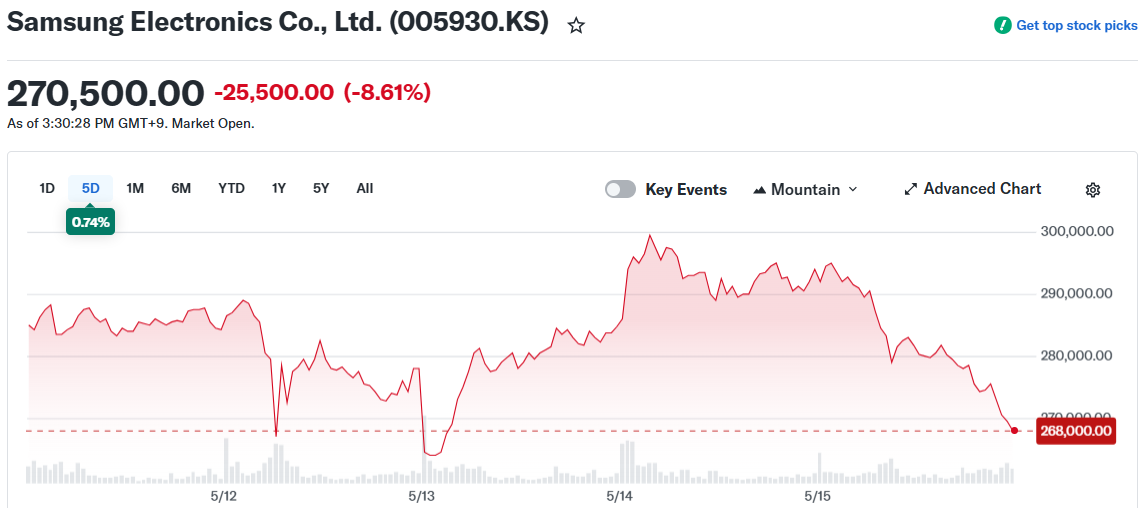 Samsung Electronics Co., Ltd. (005930.KS)
The union said it was open to fresh negotiations — but only after June 7. That means the strike window stands.
Samsung lost as much as 99.07 trillion won ($66.18 billion) in market value on Wednesday alone after wage talks broke down. Friday’s session extended those losses.
The dispute has been building for months. Workers held rallies at a factory complex south of Seoul in April, pushing for better compensation. Their core demands: an end to bonus caps and a profit-sharing scheme tied to Samsung’s operating earnings.
A major source of frustration is the pay gap with rival chipmaker SK Hynix. SK Hynix recently agreed to more generous bonus terms with its own workforce, and Samsung employees say the difference is hard to ignore.
Government-mediated talks between Samsung and the union fell apart earlier this week. The two sides could not agree on how bonuses should be calculated or capped.
South Korea’s government has been watching closely. The prime minister and industry minister both urged both sides to keep talking, warning that a strike could damage exports, financial markets, and broader economic growth.
The presidential Blue House also weighed in Friday, saying it hoped the strike could still be avoided. Officials noted that the conditions for invoking emergency mediation powers had not yet been reached.
Samsung moved quickly after the union’s announcement. Company executives traveled to the Pyeongtaek campus to meet directly with the union leader. Samsung also issued a public apology for the disruption caused by the dispute, pledging to negotiate with an open attitude.
What a Strike Could Cost
JPMorgan put some numbers on the potential damage. The bank estimated the production impact could be larger than previously expected, due to broader worker participation than earlier modeled.
JPMorgan put the hit to Samsung’s operating profit at 21 trillion to 31 trillion won ($14.08 billion to $20.79 billion). Sales losses could reach around 4.5 trillion won.
Those are significant figures for a company already navigating a tough chip market cycle.
What Happens Next
The union has kept the door open — talks after June 7 remain on the table. But with the strike set to begin May 21, the window for resolution before production disruption is narrow.
Samsung’s executives were heading to Pyeongtaek as of Friday morning, and the company has not yet responded publicly to whether a new meeting date has been confirmed.
The post Samsung Stock Drops 9% — And the Strike Hasn’t Even Started Yet appeared first on CoinCentral.


You May Also Like

XRP Whales Hold Steady as 68.5% of Supply Concentrated in Large Wallets

Trump Stock Moves Draw Attention After Iran War Market Dip




